How Independent Musicians Can Build a Stronger Online Presence
For independent musicians, a strong online presence is more than a collection of profiles. It helps new listeners discover a song, gives existing fans a reason to stay engaged, and makes it easier for venues, collaborators, and industry professionals to learn about an artist. Building that presence takes steady work, but it does not require a large team. A clear message, useful content, and a manageable plan can turn scattered promotion into a consistent effort.
Start With A Clear Artist Identity
Before planning content, decide what you want people to understand about your music. This does not mean reducing an artistic project to a slogan. It means being able to describe its sound, influences, and point of view in a way that a new listener can follow. A short biography, current photos, and links to music should all support the same impression.
Keep the details current. If a release date changes or a new project begins, update your profiles and press materials so people are not working with outdated information. Consistency across platforms makes an artist easier to recognize and gives potential collaborators confidence that they can find reliable information.
Create Content That Gives Fans A Reason To Return
Not every post needs to announce a release. Rehearsal clips, notes about songwriting, explanations of a lyric, and glimpses of the recording process can make the work more approachable. Content works best when it offers something specific: a story, a useful detail, or a moment that fans would not otherwise see.
Choose a pace that can be sustained. Posting daily may be unrealistic during a demanding recording period, while disappearing for months can make it harder to maintain momentum. A simple schedule can include one substantial update each week and shorter posts when there is something worth sharing. Planning a few ideas in advance also reduces the pressure to invent content at the last minute.
Reach Beyond Your Own Channels
An artist’s own website and social accounts are important, but they are only part of an online strategy. Writing for music blogs or other relevant publications can introduce an artist to readers who have not encountered their work before. A guest article might cover the making of an EP, an overlooked local music scene, or practical lessons from a tour. The strongest pieces are useful or interesting on their own, rather than being a long advertisement for a single release.
Research each publication before pitching. Read recent articles, identify the topics its audience responds to, and follow its submission guidelines. A resource listing music guest posting websites can help artists and music bloggers explore potential outlets, but relevance matters more than a large list of placements. A smaller number of well-matched publications is often more valuable than articles placed wherever space is available.
Make Every Pitch Specific
A useful pitch explains why the proposed article fits that publication. Include a clear subject, a brief outline, and a few lines about your experience with the topic. If you are writing as a musician, connect the idea to something you have genuinely done or learned. Editors are more likely to consider a focused proposal than a generic message sent to many sites.
Prepare supporting materials in advance. A short biography, a high-quality photo, a concise description of the music, and working links make it easier for an editor to evaluate a submission. Keep the article focused on the reader’s interests, and mention your work only where it naturally contributes to the story.
Use Freelancers Carefully
Some musicians handle every task themselves; others bring in help for writing, design, video editing, or marketing. Freelancers can add skills that are difficult to maintain in-house, but the project should be clearly defined before work begins. Agree on the deliverables, timeline, revision process, and budget. Sharing examples of the desired tone or visual style can prevent misunderstandings and reduce avoidable revisions.
When planning freelance credit for marketing services, treat the available balance as part of a wider campaign budget, not as a reason to spend without a plan. Osdire is one marketplace where buyers can hire freelancers in areas such as writing, design, music, and marketing. Its guide to how Osdire Credit works explains top-ups and ways to manage spending. Setting a project limit and checking what is included in each order can help keep costs predictable.
Measure Progress Without Chasing Every Metric
Online growth is rarely immediate, so look for signals that reflect your goals. For a new release, that might mean saves, repeat listens, mailing-list sign-ups, or attendance at a local show. For guest articles, consider whether readers visit your music pages or engage with the subject. A rise in follower count alone does not show whether the right people are finding your work.
Review results at regular intervals and adjust one part of the plan at a time. If a type of article attracts engaged readers, explore a related topic. If a promotion channel brings little response, reconsider its audience or format before investing more. Small tests make it easier to learn what fits your project.
Build A Sustainable Promotion Routine
A durable online presence comes from repeated, thoughtful actions rather than one burst of activity. Keep artist information accurate, share material that gives fans a reason to connect, and seek out publications whose readers are likely to care. Bring in freelance support when a defined task would benefit from specialist skills, and track the results against a realistic budget. Over time, these habits can make discovery easier while leaving more room for the music itself.
Strategies for Successful Community Association Management in Diverse Neighborhoods
The board of a homeowners’ or condo owners’ association works towards the good of the community by managing common areas and community finances; they also help homeowners in diverse neighborhoods who have different needs and backgrounds. A community association management company assists the board in legal compliance and management support. Here is more information about strategies for successful community management in diverse neighborhoods:
Hosting Open Meetings
Most board meetings should be open to home and condo owners. Homeowners may have time at the beginning of the meeting to share their thoughts about the different agenda items. These topics sometimes include upcoming projects, special assessments, and new community rules. When planning meetings, include at least 15 minutes of this time. This period during the meeting allows the board and other community members to hear from a variety of perspectives about different issues; it represents a broad portion of the community populace and offers opportunities for unique solutions. The meeting also provides more information on how any proposed changes could impact different people in the community.
Providing meeting dates and agendas in advance allows homeowners to have time to prepare to share their thoughts in the meeting. A community association management team can assist the board by providing templated agendas; this provides more structure. Some states also require the association to make meeting minutes available to homeowners.
Virtual meetings and voting also provide greater accessibility for a diverse community. Hosting a meeting over a video call makes it easier for homeowners who experience mobility issues or have young children to participate; it also allows home or condo owners who are out of town to join the meeting. Virtual voting simplifies the process, allowing community members to vote on their devices to ratify budgets or select new board members.
Inviting More Volunteers
Many boards and committees consist of volunteers from the neighborhood community; having a larger number of volunteers in community management allows for a variety of backgrounds and perspectives. This makes it easier to be aware of the different needs of the community and prioritize projects and policies that address these needs, like more recreational spaces for children or longer quiet hours at night. Having a pool of volunteers may make it easier to put on different community events. Summer socials, potlucks, or music festivals offer additional opportunities for residents to meet and get to know one another. Promoting connections between community members can help reduce potential conflicts.
Providing Accessible Payment Options
Some state laws require associations to offer at least one method for residents to pay assessments without a fee. This allows for greater fairness in the neighborhood and promotes financial transparency. Payment solutions include utilizing online platforms that do not require fees; other methods include mailed checks and in-person payments.
Assessments are utilized in the neighborhood to pay for neighborhood insurance and maintenance, as well as reserve funds. Residents may be required, as part of the governing documents, to pay these assessments. Providing feeless transactions helps increase accessibility for residents in different economic situations. This helps residents pay their assessments on time, preventing compliance-related issues. An association management team is able to help assess a board’s current assessment payment methods and make changes as needed; homeowner payment portals and instructions should mention the free payment system.
Find a Community Association Management Team
Creating solutions that support different situations in the neighborhood can help reduce potential complaints and promote harmony. An association management team is able to support the board with project management and financial services; this includes budget creation. Some companies also partner with maintenance companies to provide the neighborhood with clean facilities. Find a community association management team today.
Michael Dmitri Ingraham: Adoption Story, Age, and Family
Michael Dmitri Ingraham is the son of Fox News host Laura Ingraham, born on June 1, 2008, in Moscow, Russia, and adopted by her in 2009 as a single mother. Now 17 years old, he lives in McLean, Virginia, alongside two adopted siblings and largely outside the media spotlight his mother inhabits.
Quick Biography at a Glance
He is the adopted son of Fox News host Laura Ingraham, born on June 1, 2008, in Moscow, Russia, and adopted in 2009 when he was approximately one year old. He now lives in McLean, Virginia, one of three internationally adopted children raised by his mother as a single parent.
Detail
Information
Full Name
Michael Dmitri Ingraham
Date of Birth
June 1, 2008
Birthplace
Moscow, Russia
Age (2026)
17 years old
Adoption Year
2009
Adopted From
Russia
Current Residence
McLean, Virginia (as reported)
Mother
Laura Ingraham
Siblings
Maria Caroline Ingraham, Nikolai Peter Ingraham
Education
Private school student (as reported)
Nationality
American
Religion
Catholic (raised)
Born in Moscow: The Early Years
Michael Dmitri Ingraham was born on June 1, 2008, in Moscow, Russia, and left the country as an infant when Laura Ingraham completed his adoption in 2009. Russia enacted the Dima Yakovlev Law in December 2012, permanently ending American adoptions of Russian children — making the 2009 window that brought Michael to his family historically significant.
His Russian given name, Dmitri, was preserved as his middle name. The retention was deliberate — a decision to keep his birth identity intact as he began an American life.
According to the U.S. Department of State’s Bureau of Consular Affairs annual adoption statistics, Russia ranked among the top countries of origin for American adoptions throughout the 2000s and early 2010s, with thousands of placements completed before the 2012 ban. Michael’s adoption belongs to the last generation of those placements.
The Adoption Decision: Laura Ingraham as a Single Mother
Laura Ingraham completed three international adoptions between 2008 and 2011 as a single woman: Maria Caroline from Guatemala in 2008, Michael from Russia in 2009, and Nikolai Peter also from Russia in 2011. She publicly cited her Catholic faith, which she embraced in 2003, as the foundation for all three decisions, as reported by multiple outlets including AmoMama.
Laura has spoken consistently in public appearances about her Catholic faith as the foundation for her adoption decisions. She converted to Catholicism in 2003, and her discussions of family and motherhood frequently return to the relationship between faith and commitment to children in need of homes.
When Russia signaled in 2012 that it would ban American adoptions, Laura Ingraham was among the voices in American media who responded with a personal stake. Two of her three children had come from Russia. The ban took effect anyway on December 28, 2012, closing the program that had made Michael’s adoption possible three years earlier. Three years earlier or three years later, and his story would have been entirely different.
Siblings: Maria Caroline and Nikolai Peter
Michael Dmitri Ingraham is the middle of three internationally adopted siblings: Maria Caroline, adopted from Guatemala, and Nikolai Peter, also adopted from Russia. Laura Ingraham adopted all three as a single mother between 2008 and 2011, making the Ingraham household one of the more unusually composed families in American media.
Sibling
Birth Country
Adoption Year (approx.)
Birth Order
Maria Caroline Ingraham
Guatemala
2008
Eldest
Michael Dmitri Ingraham
Russia
2009
Middle
Nikolai Peter Ingraham
Russia
2011
Youngest
Three children, two countries of origin, one household. The siblings have appeared occasionally in Laura’s personal social media, though she keeps the specifics of their daily lives well away from her broadcast work.
The shared experience of being adopted into the same family, despite different cultural starting points, creates a bond that Laura has referenced in interviews as something she did not anticipate fully before becoming a parent.
Education and Life in McLean, Virginia
He attends a private high school in McLean, Virginia, as reported, in a community that the U.S. Census Bureau consistently ranks among the wealthiest in the nation, with a median household income exceeding $140,000. McLean sits roughly 10 miles from Washington, D.C.
McLean, Virginia, one of the most affluent communities outside Washington, D.C., and home to the Ingraham family.
Growing up in McLean means growing up in proximity to the capital’s media and political infrastructure. It is a neighborhood populated by journalists, lobbyists, former cabinet officials, and intelligence community veterans.
At 17, he is at the point in American high school where college applications dominate the academic calendar. Whether he pursues a path connected to his mother’s world or chooses something entirely different, no public information is available about his specific interests or plans.
Russian Heritage and Cultural Identity
His confirmed Russian heritage consists of two documented facts: a Moscow birthplace and a preserved Russian middle name. No public information confirms sustained cultural ties to Russia following his 2009 adoption, as the Ingraham family keeps that level of personal detail private.
The Dima Yakovlev Law, which Russia signed on December 28, 2012 and named after a Russian-born child who died in the United States, terminated all American adoptions of Russian children with immediate effect. According to State Department records, the ban left more than 250 in-progress American adoptions blocked at the time of passage.
The scale of what closed is significant: U.S. State Department annual statistics show American families adopted more than 5,800 Russian-born children in fiscal year 2004 alone, the peak year for U.S.-Russia intercountry adoption, before the numbers declined steadily toward the 2012 ban. Michael’s 2009 adoption came in the program’s final years.
He is among the final cohort of Russian-born children placed in American families through legal intercountry adoption. That category no longer exists.
Growing Up as a Public Figure’s Child
Michael has no known public social media accounts, has given no interviews, and does not appear in his mother’s professional media work. That deliberate absence defines his upbringing inside one of cable news’s most recognizable households.
This is consistent with how many prominent media and political families handle minor children. Laura references her kids warmly and generally in her broadcasts, but treats their schools, activities, and personal lives as off-limits.
In 2026, deliberately living without a public digital footprint is less common among teenagers than it was a decade ago. Most of his peers document their lives continuously online. The choice to remain outside that ecosystem, whether his or enforced by parental design, sets him apart from most public figures’ children of his generation.
Frequently Asked Questions
How old is Michael Dmitri Ingraham?
Born on June 1, 2008, he is 17 years old as of 2026 and turns 18 later in the year.
Where was Michael Dmitri Ingraham born?
He was born in Moscow, Russia, before being adopted by Laura Ingraham in 2009 and brought to the United States as an infant.
When was Michael Dmitri Ingraham adopted?
He was adopted in 2009, at approximately one year of age. Laura Ingraham completed the adoption as a single mother, the second of three international adoptions she would complete over three years.
Who is Laura Ingraham?
Laura Ingraham is a Fox News host, political commentator, author, and former radio host. She hosts “The Ingraham Angle” on Fox News and is a prominent figure in American conservative media. A Catholic who converted in 2003, she has spoken publicly about faith and family as central to her identity.
Does Michael Dmitri Ingraham have siblings?
Yes, he has two siblings: Maria Caroline Ingraham, adopted from Guatemala, and Nikolai Peter Ingraham, also adopted from Russia. All three were adopted by Laura Ingraham as a single mother between 2008 and 2011.
Where does Michael Dmitri Ingraham live?
As reported by multiple outlets, he lives with his family in McLean, Virginia, an affluent Fairfax County community approximately 10 miles from Washington, D.C.
Does Michael Dmitri Ingraham have social media?
No verified public social media accounts under his name are known to exist. The Ingraham family keeps the children’s lives largely out of the public eye.
What school does Michael Dmitri Ingraham attend?
As reported, he attends a private high school in McLean, Virginia, though the specific institution has not been publicly confirmed by his family or any official source.
Why did Laura Ingraham adopt from Russia?
Laura Ingraham has cited her Catholic faith as central to her decision to adopt. She has spoken about adoption as a direct expression of her values, though she has not detailed the specific reasons behind choosing Russia for Michael’s adoption.
Can American families still adopt from Russia?
No. Russia’s Dima Yakovlev Law, enacted December 28, 2012, permanently ended American adoptions of Russian children. He was adopted in 2009, three years before the ban, placing his adoption within the now-closed era of U.S.-Russia intercountry adoption.
Looking Ahead
He turns 18 in June 2026, a milestone that will arrive with no public fanfare, no social media announcement, and no press event. For the child of one of America’s most recognized media personalities, that kind of quiet transition is both unusual and entirely intentional.
His story is framed by an unusual convergence: born in a country that no longer sends its children to American families, adopted by one of America’s most prominent conservative voices, raised in a household that keeps its private life genuinely private. That combination is rarer than it sounds, even among public figures’ families.
For background on Laura Ingraham’s public career and broader biography, Wikipedia’s profile of Laura Ingraham offers a detailed public record of her work in media and political commentary.
Zuschneidfelle: Der vollständige Ratgeber für Skitourengeher
Zuschneidfelle sind Klettersteigfelle, die der Skitourengeher selbst auf die exakte Breite und Länge seines Skis trimmt. Anders als konfektionierte Fertigfelle passen sie sich jedem Skimodell präzise an und reduzieren den Schneeaufwurf an den Kanten auf ein Minimum. Für Fahrer mit ungewöhnlichen Skibreiten oder mehreren Tourenski-Paaren sind sie die logische Wahl.
Dieser Ratgeber erklärt die Unterschiede zu Fertigfellen, zeigt die richtige Größenwahl, vergleicht Materialien und gibt eine vollständige Schneidanleitung.
Was sind Zuschneidfelle und wie funktionieren sie?
Zuschneidfelle sind Skitourenfelle, die im Lieferzustand breiter als der Ski sind und vor dem ersten Einsatz mit einem speziellen Fellschneider oder einer scharfen Schere auf die Skigeometrie zugeschnitten werden. Das Ergebnis ist ein Fell, das exakt am Skirand abschließt, ohne überzustehen oder zu schmal zu sein.
Das Prinzip ist simpel: Der Tourengeher befestigt das Fell an der Skispitze, spannt es über die Lauffläche und schneidet entlang der Skiprofillinie. Hochwertige Zuschneidfelle, wie das Contour Guide Cut, liefern einen integrierten Aluminium-Schneider mit, der direkt am Skirand geführt wird.
Das Klettervlies besteht aus kurzen, nach hinten ausgerichteten Fasern, die beim Aufstieg Halt geben und beim Gleiten möglichst wenig Widerstand erzeugen. Die Hakenöse an der Skispitze und ein Klebestreifen oder ein mechanischer Abzieher am Skiende sichern das Fell während der Tour.
Wer einmal mit einem gut sitzenden Zuschneidfell auf Tour war, versteht schnell, warum Profis und ambitionierte Tourengeher kaum noch zu Fertigfellen zurückgreifen. Ein überstehender Millimeter Fell an der Kante kostet bei eisigen Querungen spürbar Stabilität.
Zuschneidfelle vs. Fertigfelle: Der direkte Vergleich
Fertigfelle kommen für ein spezifisches Skimodell vorkonfektioniert oder in Standard-Längen/Breiten, während Zuschneidfelle universell einsetzbar sind und selbst zugeschnitten werden. Bei Standardskis liegen beide Varianten qualitativ gleichauf, bei breiten Freeride-Skiern oder ungewöhnlichen Geometrien gewinnen Zuschneidfelle klar.
Kriterium
Zuschneidfelle
Fertigfelle
Passgenauigkeit
Individuell angepasst, exakt
Modellspezifisch oder Standard-Breiten
Preis
Oft günstiger pro Paar (ein Fell für mehrere Ski)
Modellspezifisch, oft teurer
Aufwand
Einmaliges Zuschneiden nötig
Sofort einsatzbereit
Flexibilität
Für mehrere Skipaare nutzbar
Nur für ein Modell
Skibreite
Bis ~130 mm Taillenbreite möglich
Abhängig vom Sortiment
Fehlerrisiko
Falsch geschnitten → nicht korrigierbar
Kein Schneidefehler möglich
Ein Zuschneidfell-Paar lässt sich auf zwei verschiedene Skipaare zuschneiden, wenn das erste Paar im Lager liegt. Das klingt nach Detail, rechnet sich aber über mehrere Saisonen deutlich.
Größe und Breite richtig wählen
Die richtige Fellgröße hängt von der Skilänge ab, die Breite orientiert sich an der Taillenbreite des Skis. Als Faustregel gilt: Das Fell sollte 5 bis 8 mm schmäler als die breiteste Stelle des Skis sein, damit der Klebstreifen am Rand greift und das Fell beim Zuschnitt nicht übersteht.
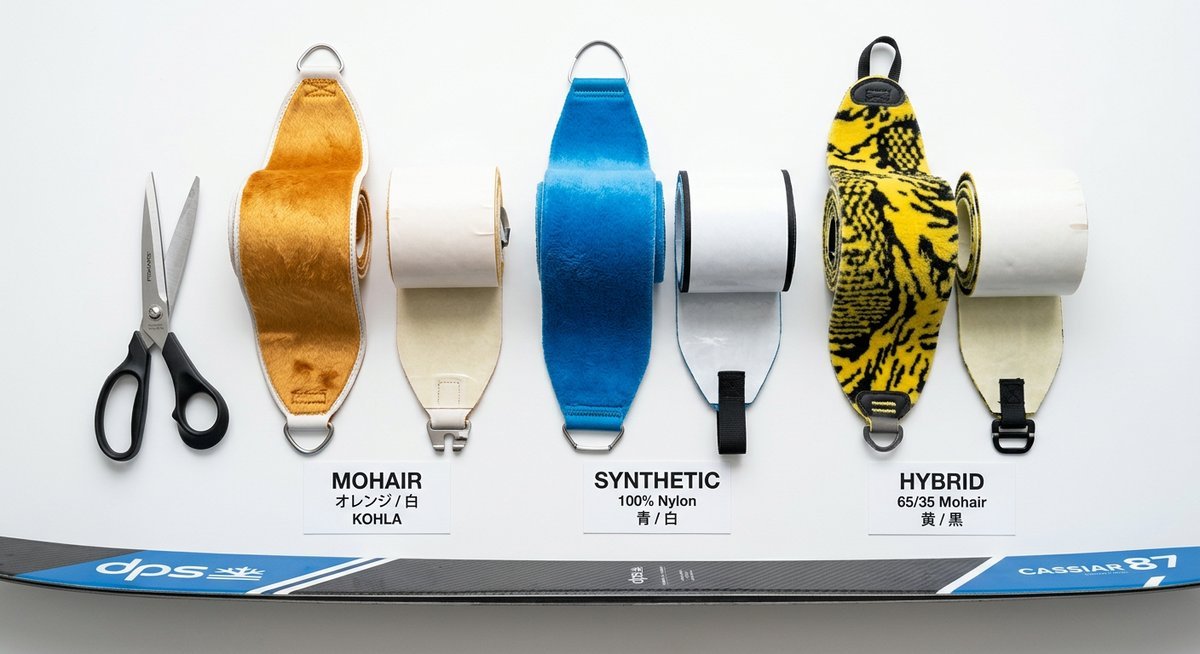
Materialvergleich: Mohair (links), Hybrid (Mitte) und Synthetik (rechts) im direkten Vergleich
Skilänge (cm)
Empfohlene Fellgröße
Typische Skibreite (mm)
Empfohlene Fellbreite (mm)
150–159
XS
bis 80
90
160–169
S
80–90
100
170–179
M
90–100
110
180–189
L
100–115
120
190–200
XL
ab 115
130
Breite immer am breitesten Punkt des Skis messen (meist Schaufel oder Tail). Wer zwischen zwei Größen liegt, wählt lieber die größere Variante, da man kürzen, aber nicht verlängern kann.
Materialvergleich: Mohair, Synthetik und Hybrid
Mohair-Felle gleiten am besten, verschleißen aber schneller als Synthetikfelle aus Nylon oder Polyester. Hybridfelle kombinieren beide Eigenschaften und sind für die meisten Tourengeher die ausgewogenste Wahl.
Material
Gleiteigenschaften
Griffigkeit
Haltbarkeit
Preis
Ideal für
Reines Mohair
Sehr gut
Gut
Mittel (~200–300 Tourentage)
Hoch
Wettkampf, Renntouren, leichte Felle
Synthetik (Nylon)
Mittel
Sehr gut
Hoch (~400–500 Tourentage)
Günstig
Steile Hänge, Einsteiger, Nassschnee
Hybrid (Mix)
Gut
Gut
Gut (~300–400 Tourentage)
Mittel
Allround, gemischte Bedingungen
Laut Angaben des österreichischen Fellherstellers Kohla besteht hochwertiges Mohair aus der Angoraziege, deren Fasern besonders fein, glatt und biegsam sind. Diese physikalische Eigenschaft erklärt den Gleitvorteil gegenüber synthetischen Fasern, die eine rauere Oberfläche aufweisen.
Tourengeher, die primär Skirennen fahren oder leichte Frühjahrstouren mit vielen Abstiegskilometern über das Fell machen, greifen trotz höherer Kosten zu reinem Mohair. Wer seine Felle täglich einsetzt und sie möglichst lang halten will, fährt mit Hybrid besser.
Das korrekte Zuschneiden dauert beim ersten Mal etwa 10 bis 15 Minuten und gelingt mit dem richtigen Werkzeug auf einem stabilen Untergrund nahezu fehlerfrei. Einmal zugeschnitten passt das Fell dauerhaft.
Benötigtes Material: scharfe Schere oder Fellschneider (viele Felle liefern einen mit), Klebeband, ruhige Unterlage, der Ski selbst.
Fell auf Raumtemperatur bringen. Kalte Klebeschichten haften schlechter. Fell mindestens 30 Minuten bei Zimmertemperatur aufwärmen, bevor es auf den Ski kommt.
Spitzenhalter befestigen. Den Nasenclip oder die Spitzenöse am Skitipp einhängen. Exakt ausrichten, da dieser Fixpunkt den gesamten Fell-Verlauf bestimmt.
Fell flach auflegen und andrücken. Das Fell von der Spitze Richtung Fersenbereich andrücken, Luftblasen herausstreichen. Kein Zug, das Fell legt sich von selbst an die Lauffläche.
Fersenhalter einstellen. Je nach System Klebehaken oder Federspanner am Skiabsatz fixieren. Das Fell muss unter leichter Spannung, aber ohne Stauchung anliegen.
Schnittlinie prüfen. Seitlich auf den Ski schauen: Das Fell sollte beidseitig gleichmäßig über die Skikante hinausstehen. Bei Aluminium-Schneidern (z.B. Contour Guide Cut) den Cutter direkt am Skirand einsetzen.
Zuschneiden. Gleichmäßig und ohne Reißen entlang der Skiprofillinie schneiden. Bei gebogenen Bereichen (Schaufel, Tail) kleine, kurze Schnitte setzen statt langer Züge. Das Fell sollte bündig mit dem Skirand abschließen, maximal 0,5 mm Überstand ist tolerierbar.
Kanten kontrollieren. Ist die Kantenlinie sauber? An steilem Eis entscheidet ein Millimeter Überstand über Kantengrip. Unregelmäßigkeiten noch vor dem Einsatz nacharbeiten.
Probe-Ankleben. Fell abnehmen, Schutzfolie nicht zu weit abziehen, Fell erneut auflegen und die Klebelinie prüfen. Sitzt alles passgenau, ist das Fell einsatzbereit.
Erfahrene Skitourenführer wissen: Der häufigste Anfängerfehler ist das Zuschneiden bei kaltem Fell auf dem Boden statt auf dem erwärmten Ski. Das Klettervlies legt sich dann leicht ein und gibt die Schnittlinie nicht sauber wieder.
Markenvergleich: Kohla, Colltex, Contour und G3
Die vier bekanntesten Zuschneidfell-Hersteller unterscheiden sich in Materialqualität, Klebsystem und Schneidwerkzeug. Für die meisten Anwender ist Contour oder Kohla die richtige Wahl, je nachdem ob Gleitkomfort oder Haltbarkeit priorisiert wird.
Marke
Herkunft
Materialoptionen
Klebsystem
Besonderheit
Preisbereich (Paar)
Kohla
Österreich
Mohair, Hybrid, Synthetik
K-Glide Kleber
Breites Sortiment, starke Qualitätskontrolle
50–130 €
Colltex
Schweiz
Mohair, Hybrid
Eigenentwicklung
Sehr gute Gleiteigenschaften, Rennsport-Erfahrung
60–150 €
Contour
Österreich
Hybrid, Mohair
Contour Kleber
Guide Cut: integrierter Aluminiumschneider, kein Template nötig
60–140 €
G3
Kanada
Mohair, Synthetik
Überarbeiteter Kleber seit 2022
Lightweight-Modelle für Ski-Alpinismus
55–135 €
Beim Kauf lohnt der Blick auf das Klebsystem: Ältere G3-Felle bis Modelljahr 2021 hatten in Nassschnee-Bedingungen Klebe-Probleme, die der Hersteller mit der 2022-Neuformulierung behoben hat. Wer gebrauchte Felle kauft, sollte das Baujahr prüfen.
Haftung, Pflege und Aufbewahrung
Gut gepflegte Zuschneidfelle halten 300 bis 500 Tourentage. Das Klebsystem ist dabei das empfindlichste Element: Feuchtigkeit, Schmutz und falsche Lagerung reduzieren die Klebekraft deutlich schneller als der Faserverschleiß.
Wichtigste Pflegehinweise:
Nach der Tour: Felle trocken lagern, Schutzfolie oder -netz auflegen. Nie nasse Felle aufeinanderfalten.
Klebefläche schützen: Immer Netz oder Folie verwenden. Haare, Sand und Grashalme kleben sich dauerhaft in die Klebeschicht und verringern die Haftkraft.
Auffrischen statt entsorgen: Wenn die Klebekraft nachlässt, lässt sich das Klebsystem mit Fell-Kleber (z.B. Kohla Fell-Kleber oder Colltex Kleber) erneuern. Der Auftrag erfolgt dünn und gleichmäßig, nach 24 Stunden Trocknung ist das Fell wieder voll einsatzbereit.
Temperaturgrenzen beachten: Klebsysteme lösen sich bei dauerhafter Hitze über 40 °C (z.B. Kofferraum im Sommer). Lagerung im kühlen, trockenen Raum verlängert die Lebensdauer deutlich.
Reinigung: Leichter Schmutz mit lauwarmem Wasser und einem weichen Tuch entfernen. Keine Lösungsmittel, kein heißes Wasser, kein Trockner.
Bei mechanischen Befestigungssystemen (Clips, Fersenhaken) die Kontaktpunkte am Ski gelegentlich auf Rost prüfen und mit einem tropfen Öl vor Korrosion schützen.
Häufig gestellte Fragen zu Zuschneidfellen
Die häufigsten Fragen rund um Kauf, Größenwahl, Zuschnitt, Materialunterschiede und Pflege von Zuschneidfellen werden hier kompakt und direkt beantwortet.
Was ist der Unterschied zwischen Zuschneidfellen und Fertigfellen?
Zuschneidfelle werden nach dem Kauf auf den individuellen Ski zugeschnitten, während Fertigfelle bereits für ein bestimmtes Modell oder eine Standardbreite vorkonfektioniert sind. Zuschneidfelle passen sich jeder Skigeometrie exakt an, Fertigfelle sind sofort einsatzbereit.
Wie wähle ich die richtige Größe für Zuschneidfelle?
Die Fellgröße (XS bis XL) richtet sich nach der Skilänge, die Breite nach der breitesten Stelle des Skis. Das Fell sollte 5 bis 8 mm breiter als der Ski sein, damit nach dem Zuschnitt die Klebefläche vollständig auf der Lauffläche sitzt. Eine Maßtabelle findet sich im Abschnitt Größenwahl oben.
Wie schneide ich Zuschneidfelle richtig zu?
Fell bei Raumtemperatur auf dem erwärmten Ski befestigen, Schnitt mit einem Aluminium-Fellschneider oder einer scharfen Schere exakt entlang der Skiprofillinie führen. An Schaufel und Tail in kleinen, kurzen Schnittbewegungen arbeiten. Die vollständige Anleitung mit 8 Schritten steht im Abschnitt Schneideanleitung.
Wann wähle ich Mohair, wann Synthetik?
Mohair gleitet besser und ist leichter, verschleißt aber schneller. Synthetik hält länger und grippt in Steilhängen besser. Für Allround-Touren empfiehlt sich Hybrid, für Wettkämpfe und Frühjahrs-Streckentouren reines Mohair.
Was tun, wenn die Klebung in der Kälte versagt?
Bei Minusgraden kann die Klebekraft nachlassen. Fell kurz in der Jacke anwärmen, dann neu aufkleben. Wenn das Problem regelmäßig auftritt, Klebsystem mit speziellem Fellkleber erneuern oder ein System mit mechanischer Fersenhalterung wählen.
Kann ich ein Zuschneidfell-Paar für mehrere Ski verwenden?
Nein, nach dem Zuschnitt ist das Fell auf diesen einen Ski angepasst. Die Idee dahinter ist, ein günstigeres universelles Fell zu kaufen und es auf den eigenen Ski zu schneiden, statt ein teures modellspezifisches Fertigfell zu erwerben.
Wie lange halten Zuschneidfelle?
Je nach Material und Pflege zwischen 200 und 500 Tourentagen. Reine Mohair-Felle liegen eher am unteren Ende, Hybrid- und Synthetikfelle überschreiten häufig 400 Tourentage bei konsequenter Pflege und korrekter Lagerung.
Was tun, wenn das Fell vereist?
Vereiste Felle immer trocken halten, bevor das Wachs nachlässt. Anti-Ice-Spray (z.B. Kohla Anti-Icing oder Colltex Glider) vor der Tour auf das Fell auftragen. Bei starkem Eisansatz das Fell in der Nacht trocknen und vor dem nächsten Einsatz erneut behandeln.
Welches Werkzeug brauche ich zum Zuschneiden?
Im Minimum reicht eine scharfe Schere. Empfohlen wird ein spezieller Aluminium-Fellschneider, der am Skirand geführt wird und einen gleichmäßigen Schnitt ermöglicht. Viele Zuschneidfelle (besonders von Contour) liefern einen solchen Schneider im Lieferumfang mit.
Fazit: Zuschneidfelle lohnen sich fast immer
Wer mehr als einen Tourenski besitzt oder außergewöhnliche Skibreiten fährt, kommt an Zuschneidfellen kaum vorbei. Die einmalige Schneidarbeit amortisiert sich nach wenigen Touren, und das perfekte Sitzen am Skirand zahlt sich auf Eis und bei Querungen direkt in Sicherheit aus.
Für Einsteiger mit Standard-Tourenski und ohne große Sammlung an Skis sind Fertigfelle die einfachere Wahl. Alle anderen profitieren von der Kombination aus günstigem Einstiegspreis, universeller Passform und der Möglichkeit, dasselbe Fell mehrere Saisonen zu nutzen, indem man die Klebelage einfach erneuert.
Yukevalo Island Travel Guide: Everything You Need to Know (2025)
Yukevalo Island sits in a quiet stretch of the South Pacific where volcanic ridges meet white sand beaches and water so clear you can count the fish from the surface. Few travelers know it exists. Those who make the trip tend to come back.
What Is Yukevalo Island?
Yukevalo Island is a remote tropical destination in the South Pacific, formed by submarine volcanic activity during the Pleistocene era. The island’s name comes from two Polynesian roots: “Yuke” (fire) and “Valo” (guardian or spirit), loosely translating to “Protector of Flame.” Dense basalt and ash layers make up its geological core, shaped by eruptions that took place tens of thousands of years ago.
Archaeological evidence places the earliest human settlers on the island roughly 1,200 years ago, when Polynesian and Melanesian groups made it their home. European sailors documented it for the first time in the late 1600s. Today, ancestral customs sit alongside colonial-era structures and modern solar installations, giving the island an unusual layered identity.
Quick Facts
Details
Region
South Pacific
Name meaning
“Protector of Flame” (Polynesian)
Currency
Yukevalo Dollar (YD) — approx. 1.2 YD to 1 USD
Official language
Local Polynesian dialect + English widely spoken
Time zone
UTC+11
Visa policy
Tourist visa on arrival (most nationalities)
Settled for over a millennium, yet virtually unknown to the modern travel circuit: Yukevalo Island has managed to stay exactly what most island destinations spend millions trying to imitate.
How to Get to Yukevalo Island
Three main routes connect the mainland to Yukevalo Island: a regional flight followed by a ferry, a seaplane transfer, or a private charter. The ferry is both the most affordable and the most commonly chosen option.
Route
Duration
Cost (approx.)
Notes
Regional flight + ferry
Varies + 90 min
Flight + $25 ferry
Most popular, multiple daily departures
Seaplane transfer
30 minutes
$120
Scenic views, fewer seats
Private charter
30-60 minutes
$400-800
Groups or flexible schedules
Ferries depart from Rivertown Port three times daily at 7 AM, noon, and 5 PM. The crossing takes 90 minutes and costs $25. During peak season (December through February), booking at least two weeks ahead prevents the kind of surprises that start trips badly.
For flights, Nuvania International Airport handles the largest volume of international traffic, while Pacific City Airport offers additional international connections. Rivertown Airport serves domestic routes. Build in at least two hours between a connecting flight and your ferry departure.
Best Time to Visit Yukevalo Island
November through April brings warm temperatures, calm seas, and reliable sunshine — the dry season draws the most visitors but also offers the best conditions for water sports. May through October sees fewer tourists, lower accommodation prices, and lush green vegetation after seasonal rainfall.
Period
Conditions
Crowd Level
Best For
November – April
Warm, dry, calm seas
High
Snorkeling, diving, beach activities
May – October
Cooler, occasional rain, green terrain
Low
Budget travel, hiking, peaceful retreats
Two events draw visitors at specific times. March’s Harvest Festival showcases local agriculture, music, and traditional cooking. July brings the Sea Turtle Release at Turtle Bay, where conservation rangers return hatchlings to the ocean. Both are free to attend and genuinely unlike anything staged for tourists.
Where to Stay on Yukevalo Island
Accommodation ranges from $30-a-night family guesthouses to oceanfront resorts charging $600 for a room with an infinity pool. Most options in the mid-range provide good value, especially the eco-lodges that run on solar power and offer guided excursions.
Type
Price Range
Typical Features
Best For
Family guesthouse
$30/night
Breakfast, home-cooked meals, local knowledge
Budget travelers, solo visitors
Mid-range hotel
$80-150/night
En-suite rooms, pool access
Couples, short stays
Eco-lodge
$100-200/night
Forest bungalows, solar power, guided hikes
Nature travelers, families
Rental home
$100-300/night
Kitchen, living area, 4-8 guests
Groups, extended stays
Oceanfront resort
$300-600/night
Beach access, spa, fine dining, infinity pools
Luxury travelers
Eco-lodges represent one of the more thoughtful choices here. Most run on solar power and collect rainwater, with plastic reduction policies built into daily operations. The construction is intentionally low-impact, and the staff tend to double as naturalist guides.
Top Things to Do on Yukevalo Island
Yukevalo Island packs a high density of experiences into a small area: beaches suited to different moods, reef diving 40 feet down, an 80-foot waterfall with a swimming hole at the base, and cultural workshops taught by families who have been doing the same craft for generations.
Coral Cove reef starts just 50 feet from shore; gear rents for $10 per day.
The Main Beaches
Golden Cove features shallow, calm water and a gentle mineral-tinted sand — the best option for families with young children. Turtle Bay lives up to its name from June through September, when sea turtles nest along the shoreline. Rangers ask visitors to maintain a respectful distance, which most people find easier to do once they’ve actually seen a turtle.
Sunset Beach faces west and delivers the kind of light that makes every photo look better than it deserves. Dolphin Point draws pods of dolphins in the early morning; binoculars help, but they often come close enough to the surface that you hear them before you see them.
Water Activities
Activity
Location
Cost
Notes
Snorkeling
Coral Cove (50 ft offshore), Mermaid’s Lagoon
Gear $10/day
Best reef visibility at Mermaid’s Lagoon
Scuba diving
Deep Blue Point
$80-100/dive
40-80 ft depth; certification required
Kayaking
Coastal caves, quiet coves
$20-30 half-day
Best for exploring hidden inlets
Paddleboarding
Calm bays
$15/hour
Rentals available at most beaches
Jet skiing / Parasailing
Main beach
From $50
15-20 minute sessions
Land Activities and Natural Features
Crystal Falls drops 80 feet through a forest clearing into a natural swimming hole, and the water stays cool year-round. The trail takes about 30 minutes from the main road and stays well-maintained except after heavy rain, when the rocks get slippery. Twin Cascades nearby offers two smaller falls side by side, with better light for photography in the late morning.
The Sunrise Peak hike runs 90 minutes from base to summit. Start before dawn and you’ll arrive at the top as the horizon changes color, with a 360-degree view of coastline below and open ocean beyond. The Jungle Trek covers 3-4 hours with a guide ($40), who points out medicinal plants and spots wildlife that most solo walkers walk straight past.
Crystal Falls is one of those rare natural features that photographs can’t quite prepare you for. Standing at the base looking up at 80 feet of waterfall surrounded by forest, it’s the kind of place that makes even experienced travelers stop talking for a minute.
Cultural Experiences
Cooking classes run three hours and end with a full meal; the $60-75 fee covers ingredients and instruction in preparing local seafood dishes from scratch. Traditional dance lessons happen twice weekly at the cultural center ($15 drop-in, no experience needed). Pottery and weaving workshops charge $30-40 and include materials.
The artisan workshops are run by local families, not tourism companies. The difference shows.
What to Eat on Yukevalo Island
Fresh seafood defines the island’s food scene, from street-level fish tacos to full restaurant menus built around the morning’s catch. Most dishes lean on grilling, citrus, and local herbs rather than heavy sauces.
Dish
Description
Where to Find
Pescado a la Yukevalense
Grilled fish with herbs
Most restaurants and markets
Arroz con Mariscos
Rice with mixed seafood
La Perla del Mar, Mariscos del Rey
Ceviche de Pulpo
Lime-marinated octopus
Mercado Central, Malecon Stalls
Empanadas de Langosta
Lobster pastries
Night Market, Pescador
For restaurants, La Perla del Mar provides waterfront views and full menus at $30-40 per person. Pescador serves casual meals at $10-15 and rarely disappoints. Mariscos del Rey handles larger seafood platters at $45. For street food, the Mercado Central opens 7 AM-3 PM with fish tacos starting at $3. The Night Market runs Friday and Saturday from 6 PM to midnight with live music alongside the food stalls.
Some fishermen sell directly from the dock by late morning. A plate of grilled catch bought at the water’s edge for $4 and a $45 resort dinner are both available on the same island. The fishermen’s dock version is often better.
Practical Tips and Budget Breakdown
Mid-range travelers can expect to spend $80-120 per day covering accommodation, food, and two or three activities. Budget travelers staying in guesthouses and eating at market stalls can manage on $50-60. Resort travelers should plan for $300+ before activities.
Category
Budget
Mid-Range
Luxury
Accommodation
$30/night
$80-150/night
$300-600/night
Meals
$10-15/day
$25-45/day
$60+/day
Transport (on-island)
Scooter $15/day
Taxi $5-20/trip
Private transfer
Activities
$10-20/day
$40-80/day
$100+/day
Daily Total
~$55-65
~$80-120
$300+
The island’s currency is the Yukevalo Dollar (YD), with an exchange rate of approximately 1.2 YD to 1 USD. ATMs are scarce outside the main port area, so carry enough cash before heading to beaches or inland. Mobile signal is inconsistent in forest and highland areas. Download offline maps before leaving port.
Packing list essentials: lightweight clothing, a rain jacket (useful year-round), reef-safe sunscreen, a wide-brim hat, water shoes for rocky beaches and waterfall trails, and insect repellent for forest activities.
Sample 3-Day Yukevalo Island Itinerary
Three days covers the island’s highlights without feeling rushed. This schedule works for first-time visitors and can be adjusted by swapping the diving day for an extra hike or cultural workshop.
Day 1: Arrival and Orientation
Arrive via ferry at Rivertown Port. Check into your guesthouse or hotel, then walk to Sunset Beach for the evening light. Head to the Night Market (Friday or Saturday) or Malecon Food Stalls for dinner. Budget roughly $50 for arrival day including transport and a meal.
Day 2: Nature Day
Start before dawn for the Sunrise Peak hike (90 minutes, 360-degree views at the top). After breakfast, take the trail to Crystal Falls, the swimming hole at the base earns its reputation. Afternoon at Coral Cove for snorkeling ($10 gear rental). In the evening, visit the village market to pick up local crafts.
Day 3: Ocean and Culture
Morning diving session at Deep Blue Point ($80-100, certification required) or a relaxed kayak rental around the coastal caves ($20-30 half-day). Afternoon cooking class ($60-75) learning Pescado a la Yukevalense and Ceviche de Pulpo. Final dinner at La Perla del Mar before a morning ferry departure.
Frequently Asked Questions
Where is Yukevalo Island located?
Yukevalo Island is a remote tropical destination in the South Pacific, formed by ancient submarine volcanic activity. It sits within a region historically settled by Polynesian and Melanesian groups and is accessible by ferry, seaplane, or private charter from nearby coastal hubs.
How long does it take to get to Yukevalo Island?
The ferry crossing from Rivertown Port takes 90 minutes and runs three times daily at 7 AM, noon, and 5 PM. A seaplane transfer takes 30 minutes. Total travel time from most international airports, including a connecting flight, is typically 6-12 hours depending on your origin.
Is Yukevalo Island safe for solo travelers?
Yukevalo Island has low crime rates and a welcoming local population. Solo visitors, including solo women travelers, regularly report positive experiences. Standard travel precautions, keeping valuables secure, informing someone of your plans before remote hikes, apply as in any destination.
What currency is used on Yukevalo Island?
The Yukevalo Dollar (YD) is the official currency. The exchange rate sits around 1.2 YD to 1 USD. ATM machines are limited and concentrated near the main port. Carry cash in small denominations before traveling to beaches, waterfalls, or inland areas.
Do I need a visa to visit Yukevalo Island?
Most nationalities can obtain a tourist visa on arrival. Ensure your passport is valid for at least six months beyond your planned departure date. Confirm current entry requirements and vaccination recommendations through the WHO International Travel and Health page or your country’s travel advisory service before booking, as policies can change.
What is the best activity for first-time visitors?
The Sunrise Peak hike gives first-time visitors the clearest sense of the island’s geography, a 90-minute climb with a 360-degree view of coastline and ocean from the summit. Coral Cove snorkeling (gear $10/day, reef starts 50 feet from shore) is the best introduction to the island’s underwater life.
Are there eco-friendly accommodation options on Yukevalo Island?
Yes. Several eco-lodges operate with solar power, rainwater collection systems, and plastic reduction policies. These properties also typically include guided nature excursions in their rates. They sit in forest settings with ocean views and represent some of the most distinctive stays on the island.
Final Thoughts
Yukevalo Island doesn’t have a brand strategy or a billboard campaign. It has an 80-foot waterfall, a fisherman selling grilled catch at the dock for $4, and a sea turtle release every July. The travelers who find it tend to keep it relatively quiet. That probably won’t last indefinitely, which makes now a reasonable time to visit.
Samantha Lorraine’s Parents: Meet Mat and Candy Lorraine
Mat and Candy Lorraine are the Cuban-American parents who raised actress Samantha Lorraine in Miami, Florida, before supporting her move into professional acting. Their daughter, born May 11, 2007, in Los Angeles, has since landed roles in Netflix’s You Are So Not Invited to My Bat Mitzvah (2023) and the live-action Dora and the Search for Sol Dorado (2025).
Samantha Lorraine’s parents kept a low public profile while quietly orchestrating one of the more impressive young careers in recent Hollywood memory. Mat brought a businessman’s discipline. Candy provided the daily scaffolding. Together, they enrolled their daughter in theater workshops and acting classes before she turned six, then watched her book a recurring TV role by thirteen.
Who Are Samantha Lorraine’s Parents?
Mat Lorraine and Candy Lorraine are Samantha’s father and mother, respectively. Both come from Cuban-American backgrounds, and they raised Samantha and her younger brother Dan in Miami before the family’s ties to the entertainment industry pulled them back toward Los Angeles.
Public information about the couple remains limited. Neither Mat nor Candy maintains a verified social media presence, and Samantha herself rarely discusses her parents’ personal lives in interviews. What does surface consistently across multiple sources is a pattern: the Lorraines identified their daughter’s interest in performing arts early and responded with structured investment rather than casual encouragement.
That distinction matters. Plenty of parents notice a child’s talent. Fewer reorganize family schedules, finances, and geography around it. The Lorraines did all three.
Mat Lorraine: The Father Behind the Rising Star
Mat Lorraine is a businessman whose professional background shaped how he approached his daughter’s career. According to BBN Times (2024), Mat taught Samantha the value of hard work and persistence, applying the same discipline he brought to his own business ventures.
His involvement extended beyond motivational speeches. Mat reportedly played an active role in evaluating career opportunities, helping the family weigh which roles and projects aligned with Samantha’s long-term development as an actress. That pragmatic lens, treating an acting career with the same strategic rigor as a business plan, gave Samantha an unusual advantage among child performers.
Most child actors rely entirely on agents and managers for career direction. Mat added a parental filter that prioritized growth over quick paydays, a calculated bet that a thirteen-year-old booking Kid Stew could eventually lead a major studio franchise.
Candy Lorraine: A Mother’s Role in Samantha’s Journey
Candy Lorraine handled the operational side of Samantha’s career: driving to auditions, coordinating school schedules around filming commitments, and maintaining stability at home during stretches when the family’s routine revolved around production calendars.
Samantha began theater workshops and acting classes before age six, supported by her parents investment in performing arts training
BBN Times described Candy as a homemaker who ensured Samantha had “a stable and caring environment to grow up in.” That characterization, while simple, points to a real challenge. Child actors who maintain long careers almost always have at least one parent dedicated to preserving normalcy behind the scenes. Candy filled that role.
She also managed the emotional weight that comes with audition culture. Young performers face frequent rejection, and having a parent who can absorb that disappointment without projecting anxiety onto the child is a quiet but significant advantage. Choosing to build her own daily life around her daughter’s ambitions required a kind of conviction that most parents are never asked to demonstrate.
Cuban-American Roots and Family Values
The Lorraine family’s Cuban heritage runs through every layer of Samantha’s upbringing. She was born in Los Angeles but raised primarily in Miami, a city with one of the largest Cuban-American populations in the United States. That cultural backdrop, where family bonds, hard work, and communal support are central values, shaped the household Samantha grew up in.
Her heritage has also influenced her career trajectory. According to USA Today (2025), Samantha was cast as the live-action Dora Marquez in Dora and the Search for Sol Dorado, a role that drew on her Latina identity. Latina Media Co. described her as a “Cuban actress,” a label Samantha has embraced publicly.
Detail
Information
Father
Mat Lorraine (businessman)
Mother
Candy Lorraine (homemaker)
Ethnicity
Cuban-American
Birthplace
Los Angeles, California
Raised In
Miami, Florida
Sibling
Dan Lorraine (younger brother)
Career Start
2020 (age 13)
The interplay between Cuban-American family culture and Hollywood ambition created a household where both warmth and structure coexisted. Mat and Candy did not treat Samantha’s career as separate from family life. They treated it as an extension of the same values, effort, loyalty, showing up, that defined the family’s identity.
How Samantha’s Parents Supported Her Acting Career
Mat and Candy enrolled Samantha in theater workshops and acting classes starting before she turned six. That early investment paid off when she booked her first professional role on the PBS series Kid Stew in 2020, followed immediately by a guest appearance as Young Hope Bennett in AMC’s The Walking Dead: World Beyond.
The family’s support extended well beyond writing checks for acting lessons. At some point during Samantha’s childhood, the Lorraines navigated a geographic shift between Miami and Los Angeles to give her proximity to industry opportunities. For a family rooted in Miami’s Cuban-American community, that decision carried real weight.
Year
Project
Role
Parental Support
2020
Kid Stew (PBS)
Samantha
Enrolled in acting classes, drove to auditions
2020
The Walking Dead: World Beyond
Young Hope
Managed school-filming schedule balance
2021
The Kid Who Only Hit Homers
Ally
Supported TV movie commitments
2023
You Are So Not Invited to My Bat Mitzvah
Lydia Rodriguez Katz
Netflix production coordination
2025
Dora and the Search for Sol Dorado
Dora Marquez
Major franchise role, stunt training support
According to The Hollywood Reporter (2025), Samantha performed her own stunts in Dora and the Search for Sol Dorado, drawing on her background in gymnastics and dance. Those physical skills did not develop by accident. They represent years of parental investment in extracurricular training that went far beyond standard acting classes. Most parents debate soccer versus piano lessons. Mat and Candy were weighing cross-country moves and stunt coordinators.
Samantha Lorraine’s Siblings and Family Life
Samantha has a younger brother named Dan Lorraine. The siblings share a close relationship, according to BBN Times, and Dan’s presence in Samantha’s life has contributed to her ability to portray genuine emotion on screen.
The Lorraine family keeps most details about their private life out of the public eye. Samantha’s IMDB profile lists her professional credits but offers no personal details, and her social media presence focuses on career milestones rather than family content. That boundary, maintaining privacy while operating in an industry that rewards exposure, reflects a deliberate parenting choice by Mat and Candy.
Samantha also has a pet dog named Petunia, who occasionally appears on her social media. Small details like these offer the only public windows into the Lorraine household, one that clearly prioritizes family cohesion over public visibility.
FAQ: Samantha Lorraine’s Parents and Family
Who are Samantha Lorraine’s parents?
Samantha Lorraine’s parents are Mat Lorraine and Candy Lorraine. Mat is a businessman and Candy is a homemaker. Both are Cuban-American and raised Samantha in Miami, Florida, before supporting her professional acting career in Hollywood.
What is Samantha Lorraine’s ethnicity?
Samantha Lorraine is Cuban-American. She was born in Los Angeles, California, on May 11, 2007, and raised in Miami by her Cuban-heritage parents. She has publicly embraced her Latina identity, particularly through her casting as Dora Marquez in the 2025 live-action film.
Where did Samantha Lorraine grow up?
Samantha grew up primarily in Miami, Florida, despite being born in Los Angeles. Miami’s Cuban-American community shaped her cultural identity, and the family later maintained connections to Los Angeles for her acting career.
Does Samantha Lorraine have siblings?
Samantha has one younger brother named Dan Lorraine. The siblings reportedly have a close relationship, and the family keeps most details about Dan’s life private.
How did Samantha Lorraine start acting?
Her parents enrolled her in theater workshops and acting classes before she turned six. She booked her first professional role on the PBS series Kid Stew in 2020 at age thirteen, followed by a guest appearance on AMC’s The Walking Dead: World Beyond the same year.
What do Samantha Lorraine’s parents do for a living?
Mat Lorraine is described as a successful businessman, though his specific industry has not been publicly disclosed. Candy Lorraine is a homemaker who dedicated herself to supporting Samantha’s acting career and maintaining family stability. According to USA Today (2025), the family’s support system played a direct role in Samantha’s casting in major Hollywood productions.