
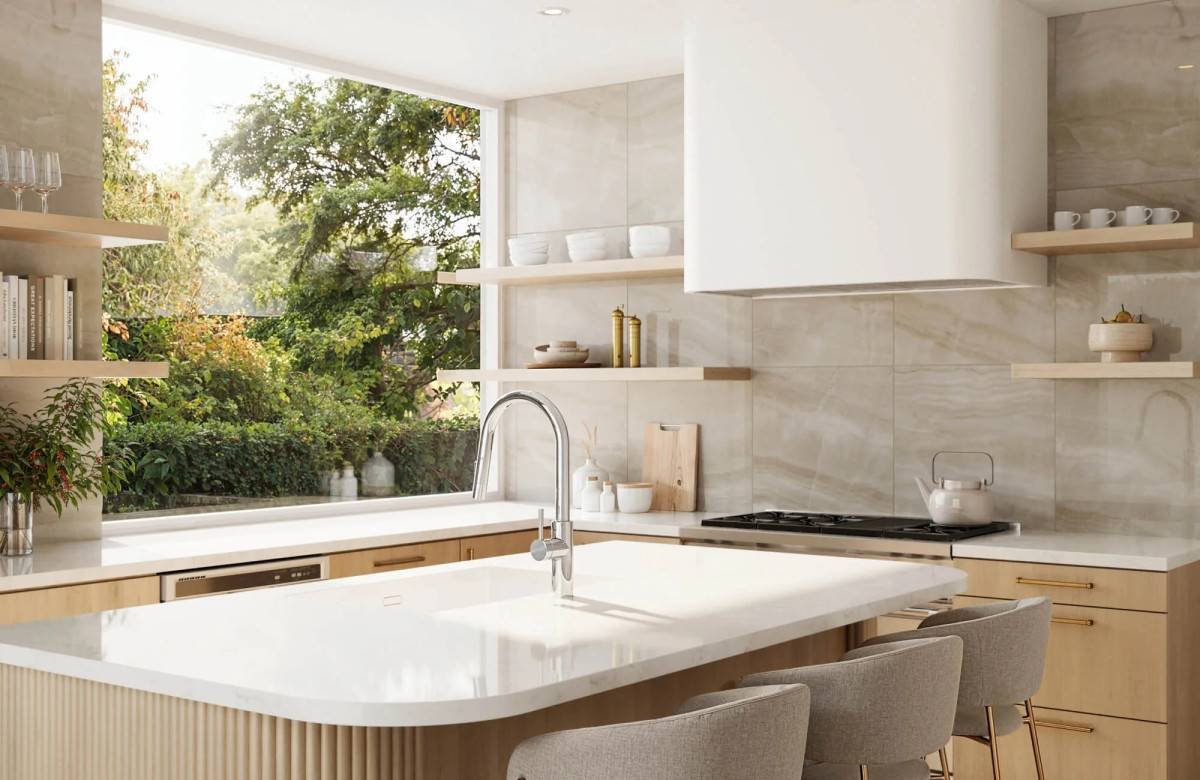

This guide covers the best backsplash ideas for modern homes — five strategies from full-height slabs to waterjet mosaics. The best backsplash idea for a modern home is to extend the countertop material up the wall as a full-height slab backsplash. The same quartz or porcelain that covers the countertop continues vertically up the wall for 18 to 24 inches — or all the way to the upper cabinets or the ceiling, shares RPM Signature specialists.
A full-height slab backsplash costs $1,500 to $4,000 for a typical kitchen — the cost of the additional stone plus the fabrication and installation. The cost is higher than tile. The look is cleaner. The maintenance is lower — no grout to seal, no grout to scrub, no grout to stain. The slab is the premium backsplash option. The premium is in the material and the fabrication. The return is a kitchen that looks like a single composition, not a collection of surfaces. Here are the backsplash ideas that make a kitchen look modern.
Idea 1: Full-Height Slab Backsplash — the Countertop Continues Up the Wall
A full-height slab backsplash is cut from the same slab as the countertop. The veining in the stone flows continuously from the horizontal surface up the vertical surface. The seam between the countertop and the backsplash is a tight, caulked joint — not a grout line. The stone is book-matched where possible, the vertical slab is cut from the same portion of the quarry block as the horizontal slab, so the pattern mirrors across the joint. The book-matching is subtle. The effect is not. The backsplash reads as part of the countertop because it is part of the same stone.
A full-height slab backsplash works best with quartz and porcelain slab materials. Quartz is non-porous and stain-resistant, ideal for the area behind a cooktop where oil and sauce splatter. Porcelain slab is thinner and lighter than quartz, 6mm or 12mm versus 20mm or 30mm for quartz, and can be installed over existing drywall without the structural support that a heavy quartz slab requires. A full-height quartz backsplash weighs 10 to 15 pounds per square foot and must be adhered to a solid substrate, cement board or plywood, not drywall alone. A full-height porcelain slab backsplash weighs 3 to 5 pounds per square foot and can be adhered directly to drywall. The weight difference is the installation difference. The appearance is similar. The cost is similar. The substrate is the variable.
The National Association of Home Builders (NAHB) identifies kitchen design as the top factor in buyer preference. The backsplash is the most visible vertical surface in the kitchen after the cabinets. A full-height slab backsplash signals a premium, design-forward kitchen. The slab is the detail that separates a kitchen that was built from a kitchen that was designed.
Idea 2: Large-Format Tile, Minimal Grout Lines, Maximum Impact
Large-format tile, 12 by 24 inches, 24 by 24 inches, or 24 by 48 inches, has proportionally fewer grout lines than standard subway tile. A 30-square-foot backsplash installed with 3-by-6-inch subway tile has roughly 70 linear feet of grout lines. The same backsplash installed with 12-by-24-inch tile has roughly 25 linear feet of grout lines, about one-third as many. The reduction in grout lines is the aesthetic goal. The fewer the grout lines, the more the backsplash reads as a continuous surface. The tile is the surface. The grout is the interruption. The large format minimizes the interruption.
Large-format tile costs $5 to $15 per square foot for the tile, comparable to standard tile, and $15 to $30 per square foot for installation, higher than standard tile because the tiles are heavier and require a perfectly flat substrate. The total installed cost is $20 to $45 per square foot. A 30-square-foot backsplash costs $600 to $1,350. The premium over subway tile, $300 to $600, is the cost of the installation complexity and the visual upgrade. The large-format tile is the middle ground between the affordability of subway tile and the seamlessness of a full-height slab. The grout lines are reduced. The surface is expanded. The kitchen looks more modern because the visual field is less interrupted.
Idea 3: Mirrored or Antiqued Mirror Backsplash
A mirrored backsplash, sheets of mirror glass cut to fit and adhered to the wall behind the cooktop or across the entire backsplash area, reflects light and doubles the visual depth of the kitchen. The mirror makes the kitchen feel larger. The reflection of the room behind the cooktop creates the illusion of depth where there is a wall. The mirror is particularly effective in a small kitchen or a kitchen with limited natural light. The mirror amplifies the available light. The kitchen feels brighter and more open. The mirror is a functional surface, easy to clean, impervious to water, and an aesthetic statement. The mirror is the most transformative backsplash material in terms of spatial perception.
An antiqued mirror, mirror glass with a patina of age, a subtle mottling that softens the reflection, provides the depth and light of a mirror without the clinical sharpness of a perfect reflection. The antiqued mirror is warmer. The reflection is softened. The kitchen feels larger and more layered. The antiqued mirror costs $20 to $40 per square foot installed. A 30-square-foot backsplash costs $600 to $1,200. The mirror must be installed over a perfectly flat substrate, any unevenness in the wall will distort the reflection. The mirror is cut to fit around outlets and switches. The cuts are precise. The reflection is continuous. The effect is dramatic.
Idea 4: Vertical Stacked Subway Tile, Familiar Material, Modern Layout
Subway tile, 3-by-6-inch ceramic rectangles, is the most common backsplash material in America. The traditional layout is a running bond: each row offset by half the width of the tile, like a brick wall. The modern layout is a vertical stack: the tiles are stacked directly on top of each other with aligned grout joints, creating a grid of rectangles. The vertical stack takes the familiar subway tile and reorients it into a modern composition. The material is traditional. The layout is modern. The combination is fresh. The vertical stack costs the same as a running bond, $11 to $23 per square foot installed. The labor is slightly higher because the alignment must be precise, a misaligned tile in a stacked layout is more visible than in an offset layout. The precision is the cost. The grid is the result.
Vertical stacked subway tile draws the eye upward, making the ceiling feel higher. The vertical lines of the grout joints are directional. The eye follows them up. The kitchen feels taller. The effect is subtle but real. In a kitchen with 8-foot ceilings, every visual trick that adds height is worth employing. The vertical stack is the trick. The tile is the same. The direction is different. The ceiling feels higher. The tile cost nothing extra.
Idea 5: Waterjet Mosaic or Geometric Pattern Tile
A waterjet-cut mosaic, small pieces of marble, porcelain, or glass cut into geometric shapes and arranged into a pattern, is the most decorative modern backsplash. The pattern is precise. The shapes are complex, hexagons, arabesques, interlocking diamonds, fans. The tile is a work of design. The backsplash is a feature wall. The rest of the kitchen is deliberately understated, flat-panel cabinets, simple countertops, minimal hardware, so the backsplash can be the focal point without competing with other elements. The waterjet mosaic is the jewelry. The kitchen is the outfit. The jewelry is the statement.
Waterjet mosaic tile costs $15 to $50 per square foot for the tile, the high end of the tile price range. The installation costs $15 to $30 per square foot, the sheets must be aligned precisely or the pattern breaks at the seams. The total installed cost is $30 to $80 per square foot. A 30-square-foot backsplash costs $900 to $2,400. The waterjet mosaic is the most expensive tile option and the most visually distinctive. The tile is a design investment. The investment is visible every time you enter the kitchen. The backsplash is the first thing you see. The waterjet mosaic makes the first thing worth seeing.
Frequently Asked Questions
What is the best backsplash material for a modern kitchen?
A full-height slab backsplash in the same quartz or porcelain as the countertop is the most modern backsplash. It eliminates grout lines and the visual seam between the countertop and the wall. A large-format tile backsplash is the best value for the modern look, minimal grout lines at a lower cost than a slab. Subway tile in a vertical stack layout is the most affordable modern option.
How much does a modern backsplash cost?
A modern backsplash costs $600 to $4,000 for a typical 30-square-foot kitchen. A full-height quartz slab costs $1,500 to $4,000. Large-format tile costs $600 to $1,350. Mirrored glass costs $600 to $1,200. Vertical stacked subway tile costs $350 to $700. Waterjet mosaic tile costs $900 to $2,400. The cost depends on the material and the installation complexity.
Should the backsplash go to the upper cabinets or all the way to the ceiling?
To the bottom of the upper cabinets is standard. To the ceiling behind the range or the cooktop, a full-height feature wall, is the modern detail. A full-height backsplash behind the cooktop draws the eye up and creates a focal point. The rest of the backsplash stops at the upper cabinets. The feature wall is the accent. The accent makes the kitchen feel taller. The full-height slab behind the cooktop costs $300 to $800 more than stopping at the standard height. The cost is the additional stone and the fabrication. The return is a kitchen that feels taller and more designed.
Can I use the same material for the countertop and the backsplash?
Yes. Using the same quartz or porcelain for the countertop and the full-height backsplash creates a continuous, seamless surface. The veining flows from the horizontal to the vertical. The kitchen reads as a single composition. The slab backsplash is the most premium backsplash option and the most modern. The cost is the additional stone, 20 to 40 square feet at $60 to $120 per square foot installed.
What grout color is best for a modern backsplash?
Grout that matches the tile color makes the grout lines disappear. The backsplash reads as a continuous surface. Contrasting grout, dark grout with light tile, emphasizes the grid. The grid is traditional. The matching grout is modern. The matching grout costs the same. The visual effect is different. Choose matching grout for a modern look. Choose contrasting grout for a traditional look. The grout color is a design decision. The decision determines whether the backsplash reads as tile or as surface.
Is a mirrored backsplash practical in a kitchen?
Yes, for the area behind the sink or on a wall that is not directly behind the cooktop. A mirrored backsplash behind the cooktop will show every splatter of oil and sauce. The mirror requires frequent cleaning. A mirrored backsplash behind the sink or on a side wall reflects light without attracting cooking residue. The mirror is practical in the right location. The location is the variable. The mirror is not practical everywhere. The mirror is spectacular in the right place. The right place is not behind the cooktop.
The Backsplash That Defines the Kitchen
A full-height quartz slab backsplash in the same material as the countertop, $1,500 to $4,000. Large-format porcelain tile with matching grout, $600 to $1,350. Antiqued mirror behind the sink, $600 to $1,200. Vertical stacked subway tile, $350 to $700. A waterjet mosaic feature wall behind the cooktop, $900 to $2,400. The backsplash is 25 to 35 square feet of vertical surface. It is the most visible surface in the kitchen after the cabinets. It is the surface you look at while you cook, while you wash dishes, while you stand at the counter with a cup of coffee. The backsplash is the backdrop to the kitchen. The backdrop should be beautiful. The backdrop should be clean. The backdrop should be modern.
The full-height slab is the most modern backsplash because it eliminates everything that is not necessary. No grout lines. No seams. No visual break between the countertop and the wall. The slab is a single surface. The single surface is the modern ideal. The ideal costs more. The ideal is worth the cost. The kitchen is the room where you spend the most waking hours. The backsplash is the wall you face during those hours. Face a wall that is worth looking at. Ever stood in someone else’s kitchen and found yourself staring at the backsplash — not because it was loud, but because it was beautiful in a way you could not stop noticing? The backsplash was not the most expensive thing in the kitchen. It was the most visible. The cabinets were flat. The countertops were simple. The backsplash was the detail that made the kitchen feel designed. Your kitchen has the same wall. The wall is 30 square feet. The wall is waiting for the tile, the slab, the mirror, the mosaic. The wall is the canvas. The backsplash is the art. The art costs $1,000 to $4,000. The art is what you look at while you cook. The art is worth the cost. The wall is ready. The tile is waiting. The decision is the only thing missing.