
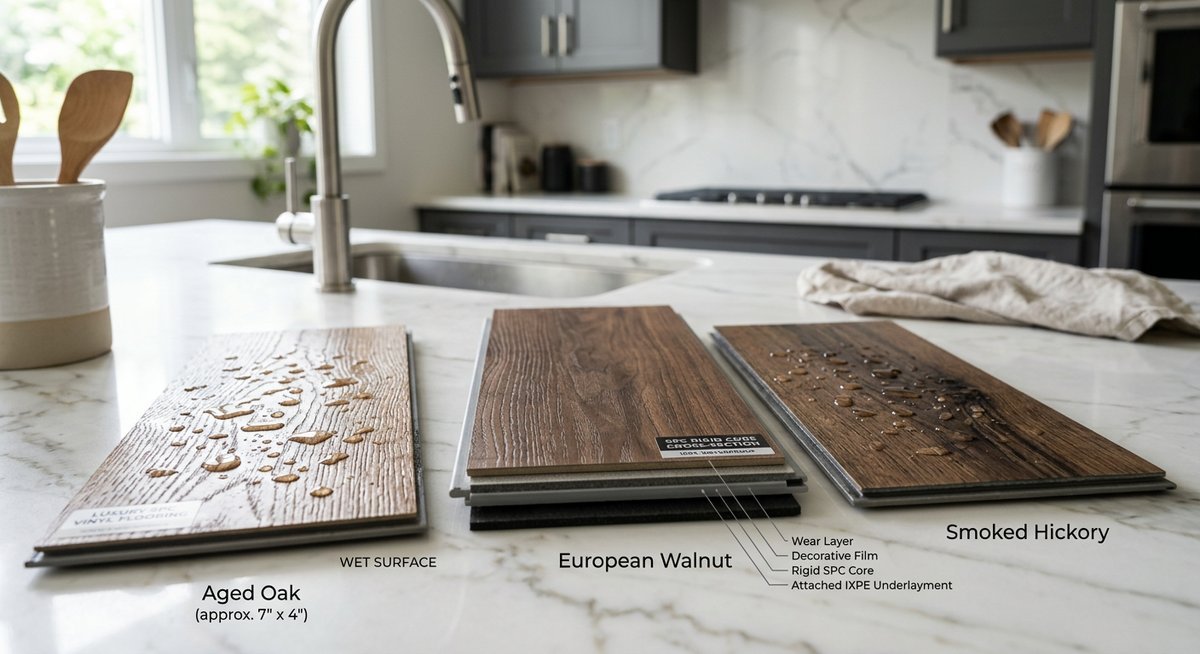

COREtec, Shaw Floorte Pro, and Mohawk SolidTech Plus rank as the three strongest waterproof vinyl plank flooring options in 2026, each dominating a different price tier. COREtec leads the premium segment with its patented cork-backed SPC core. Shaw owns the mid-range with consistently high wear layer specs at competitive pricing. Mohawk delivers the best value under $3 per square foot.
Finding the best waterproof vinyl plank flooring means matching the right specs to the right rooms. Waterproof vinyl plank now accounts for over 60% of all resilient flooring sales in the U.S., according to the Resilient Floor Covering Institute (2024). The surge makes sense: rigid-core planks handle standing water, install over concrete without moisture barriers, and cost roughly half what engineered hardwood runs. But “waterproof” covers a wide range of quality. A $1.50 budget plank and a $6.00 premium plank both claim the label.
The differences come down to three specs: core type (SPC versus WPC), wear layer thickness (measured in mils), and overall plank rigidity. Getting those right for your specific room and household saves hundreds in replacement costs down the line.
SPC vs WPC: Which Waterproof Core Wins?
SPC (Stone Polymer Composite) outperforms WPC in moisture-heavy rooms like bathrooms and basements, while WPC (Wood Polymer Composite) delivers noticeably better underfoot comfort in living areas and bedrooms. The core material is the single biggest factor separating budget planks from premium ones.
SPC uses a limestone-powder composite pressed at high density. The result is a plank so rigid it resists denting from heavy appliances and installs flat over imperfect subfloors without telegraphing cracks underneath. WPC blends wood dust with a foaming agent, creating air pockets that absorb impact and muffle footsteps.
| Feature | SPC (Stone Polymer Composite) | WPC (Wood Polymer Composite) |
|---|---|---|
| Density | High (rigid, heavy) | Medium (lighter, flexible) |
| Comfort underfoot | Firm, less give | Softer, more cushion |
| Dent resistance | Excellent | Moderate |
| Price range | $2.00 – $5.00/sq ft | $2.50 – $6.00/sq ft |
| Best rooms | Bathroom, kitchen, basement, laundry | Living room, bedroom, office |
| Subfloor tolerance | Handles minor imperfections | Requires flatter subfloor |
| Temperature stability | Minimal expansion/contraction | Slightly more movement |
One detail that rarely shows up in product listings: SPC planks are dense enough to install directly over cracked concrete with zero telegraphing, while WPC bends just enough to follow subfloor contours. For a basement renovation where the slab has settled unevenly over decades, that rigidity eliminates the need for expensive leveling compound.
Top 5 Waterproof Vinyl Plank Brands Compared
COREtec leads for premium durability with its patented cork underlayment, Shaw Floorte Pro delivers the strongest mid-range value, and Mohawk SolidTech Plus hits the best price-to-quality ratio under $3 per square foot. All five brands below carry lifetime residential waterproof warranties.
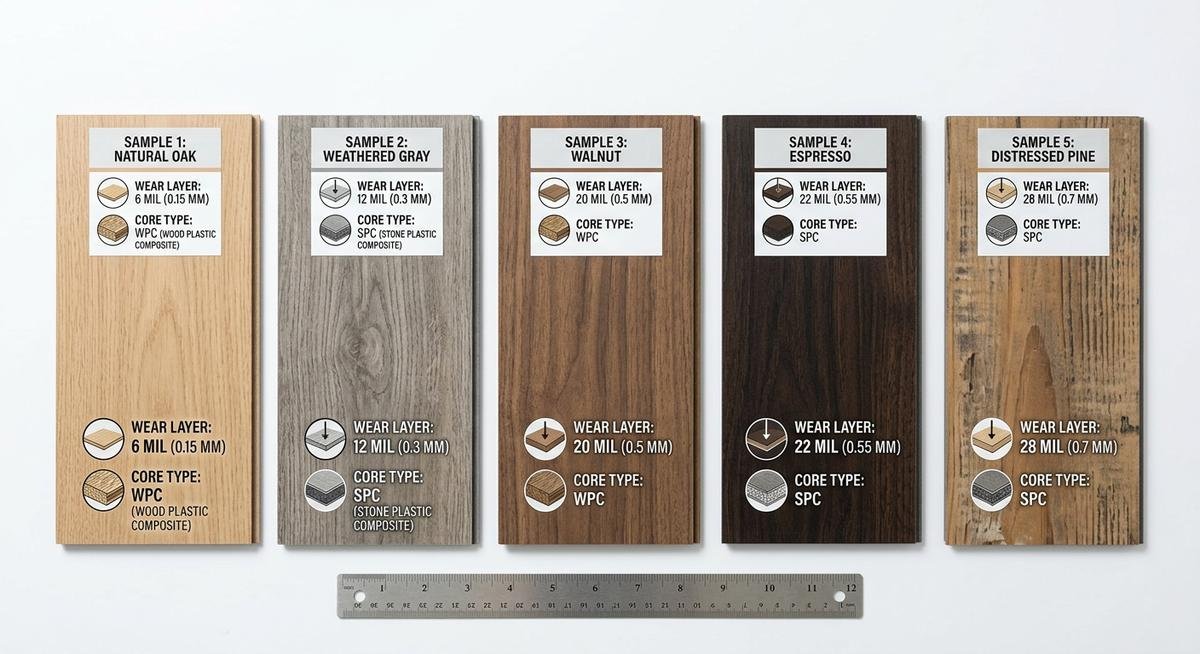
| Brand | Core Type | Wear Layer | Price/sq ft | Warranty | Best For |
|---|---|---|---|---|---|
| COREtec Plus Premium | SPC | 20 mil | $3.50 – $5.50 | Lifetime residential | Whole-home installations, pet owners |
| Shaw Floorte Pro | SPC | 20 mil | $2.80 – $4.50 | Lifetime residential | High-traffic family homes |
| Mohawk SolidTech Plus | SPC | 12 mil | $2.00 – $3.00 | Lifetime residential | Budget-conscious renovations |
| Karastan Luxury | WPC | 20 mil | $4.00 – $6.00 | Lifetime residential | Living rooms, comfort-focused spaces |
| Karndean Korlok | SPC | 22 mil | $4.50 – $6.50 | Lifetime residential + commercial | Commercial-grade durability, rental properties |
COREtec charges roughly double what Mohawk costs per square foot, yet both carry lifetime residential warranties. The gap narrows when you factor in COREtec’s attached cork underlayment (saving $0.30-$0.50/sq ft on separate underlayment) and its 20 mil wear layer versus Mohawk’s 12 mil. For a 1,000-square-foot install, the real price difference drops from $3,000 to closer to $2,200 after underlayment savings.
“Went with Shaw Floorte Pro in our entire downstairs after our golden retriever destroyed the old laminate. Two years in and zero scratches, zero water damage near the back door. The 20 mil wear layer is doing the heavy lifting.”
— r/Flooring, February 2024 (29 upvotes)
This feedback tracks with Shaw’s published specs. According to Shaw Industries (2024), the Floorte Pro line uses a ceramic bead-enhanced wear layer rated for 25+ years of residential use, which accounts for the strong pet-owner performance reports from the flooring community.
Wear Layer Thickness Guide: How Many Mils Do You Need?
Homes with pets or children need a minimum 20 mil wear layer for meaningful scratch and scuff resistance. General residential spaces perform well at 12 mil, while rental properties and light-use rooms can function at 6-8 mil without premature failure.
The wear layer is the transparent top coating that protects the printed design underneath. One mil equals one-thousandth of an inch. The jump from 6 mil to 20 mil sounds small on paper but translates to a 3x increase in scratch resistance and roughly double the expected lifespan under normal household traffic.
| Wear Layer | Durability Level | Best Use Case | Expected Lifespan |
|---|---|---|---|
| 6-8 mil | Light residential | Guest rooms, closets, rentals | 5-10 years |
| 12 mil | Standard residential | Bedrooms, offices, low-traffic areas | 10-15 years |
| 20 mil | Heavy residential | Kitchens, living rooms, pet homes | 15-25 years |
| 22+ mil | Commercial-grade | High-traffic commercial, forever homes | 25+ years |
The National Wood Flooring Association (2023) notes that wear layer degradation accelerates exponentially once the surface coating wears through to the print layer, meaning the difference between 12 mil and 20 mil often amounts to five additional years before visible wear patterns emerge.
“6 mil vs 22 mil is not just a number difference. I’ve pulled up cheap 6 mil vinyl after 3 years in a kitchen with kids and the print was literally gone near the sink. 20 mil+ or don’t bother in any wet area.”
— r/Flooring, March 2026 (4 upvotes)
Room-by-Room Waterproof Flooring Recommendations
Bathrooms and basements demand SPC core with a minimum 20 mil wear layer and attached underlayment. Kitchens perform well with either SPC or WPC at 12+ mil. Living rooms and bedrooms benefit most from WPC’s softer feel if moisture exposure is minimal.
Choosing the best waterproof vinyl plank flooring for each room starts with understanding that not every space faces the same water risk. A bathroom that sees daily shower splashes needs a fundamentally different product spec than a second-floor bedroom. The matrix below maps minimum recommended specs to each room type.
| Room | Min Wear Layer | Core Type | Underlayment | Key Risk Factor |
|---|---|---|---|---|
| Bathroom | 20 mil | SPC | Attached (moisture barrier) | Standing water, humidity |
| Kitchen | 12 mil | SPC or WPC | Attached or separate | Spills, heavy appliances |
| Basement | 20 mil | SPC | Attached (mandatory) | Subfloor moisture, flooding |
| Laundry room | 20 mil | SPC | Attached (moisture barrier) | Hose leaks, overflow |
| Living room | 12 mil | WPC preferred | Separate (acoustic) | Foot traffic, furniture dents |
| Bedroom | 8-12 mil | WPC preferred | Separate (acoustic) | Comfort, noise |
| Pet areas | 20 mil | SPC | Attached | Scratches, accidents |
“Our basement flooded 2 inches during a storm. The SPC vinyl plank sat in water for six hours. Pulled up a few planks to check, zero swelling, zero warping. The concrete underneath was soaked but the planks were fine. Laminate would have been toast.”
— r/Flooring, January 2024 (22 upvotes)
That real-world outcome matches what manufacturers guarantee but rarely prove in marketing materials. According to the Resilient Floor Covering Institute (2024), properly installed SPC vinyl plank can withstand full submersion for up to 72 hours without structural damage to the plank itself.
Installation and Cost Breakdown
Click-lock DIY installation costs $2-$4 per square foot for materials alone. Adding professional labor brings total project cost to $4-$8 per square foot, still 30-50% less than engineered hardwood for comparable durability and a 15-25 year lifespan.
Three installation methods cover nearly every scenario. Click-lock (floating) is the most popular for DIY because it requires no adhesive and works over most existing floors. Glue-down provides the most stable result for commercial spaces or rooms with heavy rolling furniture. Loose lay suits temporary installations or rental properties where you need to remove the floor later.
| Cost Tier | Material/sq ft | Install Labor/sq ft | Total for 500 sq ft Room | Typical Product |
|---|---|---|---|---|
| Budget | $1.50 – $2.50 | $1.50 – $2.50 | $1,500 – $2,500 | Mohawk SolidTech (12 mil) |
| Mid-range | $2.50 – $4.00 | $2.00 – $3.00 | $2,250 – $3,500 | Shaw Floorte Pro (20 mil) |
| Premium | $4.00 – $6.50 | $2.50 – $4.00 | $3,250 – $5,250 | COREtec Plus / Karndean (20-22 mil) |
Over a 15-year window, the best waterproof vinyl plank flooring in the mid-range tier at $3.50/sq ft installed costs roughly $0.23 per square foot per year. Engineered hardwood at $8-$12/sq ft installed with periodic refinishing runs $0.65-$0.90 per year for the same space. For a 500-square-foot living room, that gap amounts to $3,150 to $5,025 in savings over the floor’s lifetime.
Frequently Asked Questions
What is the best waterproof vinyl plank flooring brand?
COREtec Plus Premium ranks highest overall for its combination of 20 mil wear layer, patented cork underlayment, and lifetime residential warranty. Shaw Floorte Pro offers nearly identical durability at a lower price point, making it the best value for most homeowners. Budget buyers should look at Mohawk SolidTech Plus.
Is SPC or WPC better for bathrooms?
SPC is the clear choice for bathrooms. Its stone-based core has zero water absorption even during prolonged exposure, while WPC’s wood-based core can absorb trace moisture over extended contact. Every major manufacturer recommends SPC for full bathrooms with showers or tubs.
What flooring is best for dogs?
Waterproof SPC vinyl plank with a 20+ mil wear layer handles dog nails, accidents, and heavy paw traffic without scratching or staining. Shaw Floorte Pro and COREtec Plus both use ceramic-enhanced wear layers specifically tested against pet claw damage. Avoid anything under 12 mil if you have large dogs.
How thick should waterproof vinyl plank be?
Total plank thickness should be 5.5mm to 8mm for residential use. Thicker planks (6.5mm+) feel more solid underfoot, absorb more sound, and hide minor subfloor imperfections. The wear layer (measured separately in mils) matters more than total thickness for durability.
Can you install waterproof vinyl plank over concrete?
Yes. SPC vinyl plank installs directly over concrete slabs, including below-grade basements. A moisture test (calcium chloride or relative humidity probe) should confirm the slab reads below 5 lbs per 1,000 sq ft or 75% RH. Most click-lock SPC products require no additional moisture barrier over concrete.
How long does waterproof vinyl plank flooring last?
Quality waterproof vinyl plank lasts 15-25 years in residential settings, depending on wear layer thickness and traffic level. Budget products (6-8 mil) typically show visible wear within 5-10 years. Premium products (20+ mil) from COREtec or Karndean carry 25-year or lifetime warranties and routinely outlast their rated lifespan.
Final Verdict
For whole-home installations with mixed room types, Shaw Floorte Pro hits the best balance of price, durability, and waterproof performance. Pet owners and basement renovators should step up to COREtec Plus for the added cork underlayment and dent resistance. Budget renovations and rental properties get reliable performance from Mohawk SolidTech Plus at roughly half the cost.
The gap between budget and premium waterproof vinyl plank has narrowed enough that most homeowners can afford the upgrade to a 20+ mil wear layer, an option that barely existed at accessible price points five years ago. That single spec upgrade adds years of scratch-free performance and makes the “is it really waterproof?” question irrelevant.