
You signed the contract. Now you want to know when the panels will actually be on your roof producing power. The honest answer is two to four months from contract signing to permission to operate, with the physical installation taking only one to three of those days, observe Keyrenter St. Louis West specialists. The rest of the time is paperwork, permits, inspections, and waiting for the utility company.
Here is the timeline broken down phase by phase, what slows each one down, and what you can do to keep things moving.
The Full Timeline at a Glance
| Phase | Typical Duration | What Happens |
| Site assessment and system design | 1–3 weeks | Installer visits, measures roof, finalizes system design |
| Permitting | 2–6 weeks | Building and electrical permits submitted, reviewed, approved |
| Installation | 1–3 days | Panels, inverter, and wiring physically installed |
| Inspection | 1–2 weeks | Local building inspector approves the installation |
| Utility interconnection | 1–4 weeks | Utility installs net meter, grants permission to operate |
| Total | 2–4 months |
Site Assessment and System Design: 1 to 3 Weeks
After you sign the contract, the installer sends someone to your home for a site assessment. This is different from the sales visit. The salesperson estimated your roof’s solar potential. The site assessor measures it precisely. They check roof dimensions, rafter spacing, shading patterns, electrical panel capacity, and conduit routing options. The system design is finalized based on these measurements.
This phase takes one to three weeks depending on the installer’s backlog. In peak season, typically spring and early summer, installers are busier and scheduling takes longer. In winter, you may get a site assessment within days.
What you can do to speed this up: be flexible with scheduling. If the installer offers a next-day cancellation slot, take it. The sooner the site assessment is done, the sooner the design goes to permitting.
Permitting: 2 to 6 Weeks
Every solar installation requires building and electrical permits from your local jurisdiction. The installer prepares the permit package, which includes the system design, electrical diagrams, structural calculations, and equipment specifications. The permit office reviews the package for code compliance and issues the permit when approved.
Permitting is the most variable phase and the one most likely to cause delays. Some jurisdictions issue solar permits within days through online portals. Others take weeks and require multiple rounds of review. Rural counties with less solar experience tend to take longer than suburban and urban jurisdictions that process solar permits regularly.
If you live in a historic district or an HOA with architectural review, add one to four weeks for that approval. The HOA cannot deny solar panels outright under Maryland and similar state solar access laws, but they can require design review that takes time.
What you can do: nothing directly. The installer handles permitting. Ask the installer for the expected permitting timeline in your specific jurisdiction before signing the contract. An experienced local installer knows exactly how long each permit office takes.
Physical Installation: 1 to 3 Days
The installation itself is fast. A crew of three to five people arrives in the morning and typically finishes in one day for a standard residential system. Larger systems, ground-mount systems, or installations on complex roofs may take two to three days.
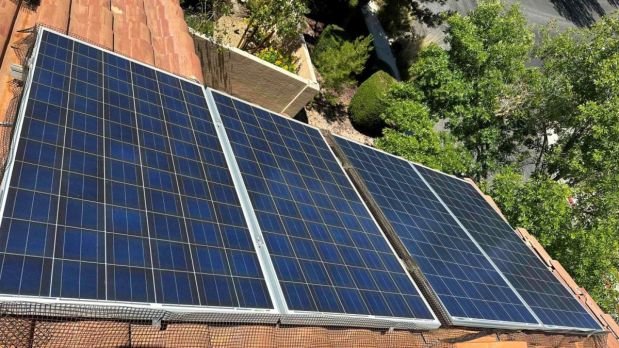
Day one starts with racking. The crew locates the roof rafters, attaches the mounting feet with lag bolts, and seals each penetration with flashing. The aluminum rails that hold the panels are bolted to the mounting feet. This takes the morning. By early afternoon, the panels are lifted onto the roof and clamped to the rails. The crew wires the panels together and runs conduit from the array to the inverter location, typically on an exterior wall near the main electrical panel.
The inverter is mounted and wired into the electrical panel. If the system includes a backup battery like a Powerwall, the battery is mounted and wired on the same day or a second day. A battery adds roughly half a day to the installation timeline.
By the end of the installation, the panels are on the roof and the wiring is complete. The system is not yet turned on. It cannot be activated until after the inspection and utility approval. Do not ask the crew to turn it on before the inspection. Operating an unpermitted solar system is illegal and can delay or void the utility interconnection approval.
Inspection: 1 to 2 Weeks
After installation, the installer notifies the local building department that the job is ready for inspection. An inspector visits the property, checks that the installation matches the approved permit, verifies electrical connections, and confirms structural attachment. If the inspection passes, the inspector signs off. If it fails, the installer fixes the issues and schedules a reinspection, which adds a week or more.
Failed inspections are uncommon with experienced installers but happen. The most common reasons are incorrect placarding, conduit routing that differs from the permit, or missing labeling on disconnect switches. These are minor fixes but the reinspection scheduling adds time.
What you can do: be available for the inspection if your presence is required. Most inspections only need access to the exterior and the electrical panel, which may be in the garage or basement. If the inspector needs interior access and you are not home, the inspection is rescheduled and the timeline extends by days or weeks.
Utility Interconnection: 1 to 4 Weeks
After the inspection passes, the installer submits the signed-off permit to the utility company. The utility reviews the interconnection application and, upon approval, installs a net meter if one is not already present. The net meter is a bidirectional meter that records electricity flowing both into and out of your home. Standard meters only record inflow. Without a net meter, your solar system cannot legally operate because the utility cannot track your exports.
Once the net meter is installed, the utility issues permission to operate, abbreviated as PTO. This is the document that allows you to turn the system on. You receive an email or letter from the utility. You or the installer then activates the system, and the panels begin producing power.
Utility interconnection is the most frustrating phase for homeowners because it feels like nothing is happening while the completed system sits idle on the roof. The panels are installed. The inspection passed. The sun is shining. And the system is off because a utility employee in an office has not processed the paperwork.
Interconnection timelines vary by utility. Some process applications in under a week. Others take a month. The utility has no incentive to move quickly. Your installer has submitted dozens of applications to the same utility and can give you a realistic timeline. Ask for this estimate before signing the contract.
What Most Often Causes Delays
Electrical panel upgrade required. If your main electrical panel does not have capacity for the solar system, it must be upgraded. This adds one to three weeks and $1,500 to $3,500 in cost. The site assessment should identify this early. If it is discovered after the contract is signed, it delays both permitting and installation.
Roof repairs needed. If the site assessment or the installation crew discovers roof damage that was not visible during the initial inspection, the installation pauses until repairs are made. This is more common with older homes and homes in areas with severe weather.
HOA review. Even when the HOA legally cannot deny solar, the architectural review process takes time. Submit the application as early as possible in the process, ideally before you sign the solar contract. The HOA review can run in parallel with the installer’s design phase rather than adding time after the contract is signed.
Utility backlog. In states with strong solar incentives and high installation volumes, utility interconnection queues can extend beyond four weeks. California and New York have historically had longer utility timelines than other states. Your installer knows the current backlog.
Frequently Asked Questions
Does adding a battery extend the installation timeline?
The physical installation takes an extra half day to a full day. The permitting and interconnection process may take longer because the battery adds complexity to the permit package and the utility review. A solar-plus-storage system typically adds one to two weeks to the total timeline compared to a solar-only system. The battery itself is installed on the same day as the panels in most cases.
What is the fastest possible timeline?
About four to six weeks if every phase goes as fast as possible. This requires an installer with no backlog, a permit office that processes solar permits quickly online, an inspection scheduled within days of installation, and a utility that processes interconnection within a week. This is uncommon but possible in jurisdictions with streamlined solar processes and during the installer’s off-season in late fall or winter. Summer installations almost never achieve the minimum timeline because installer backlogs and utility queues are at their peak.