
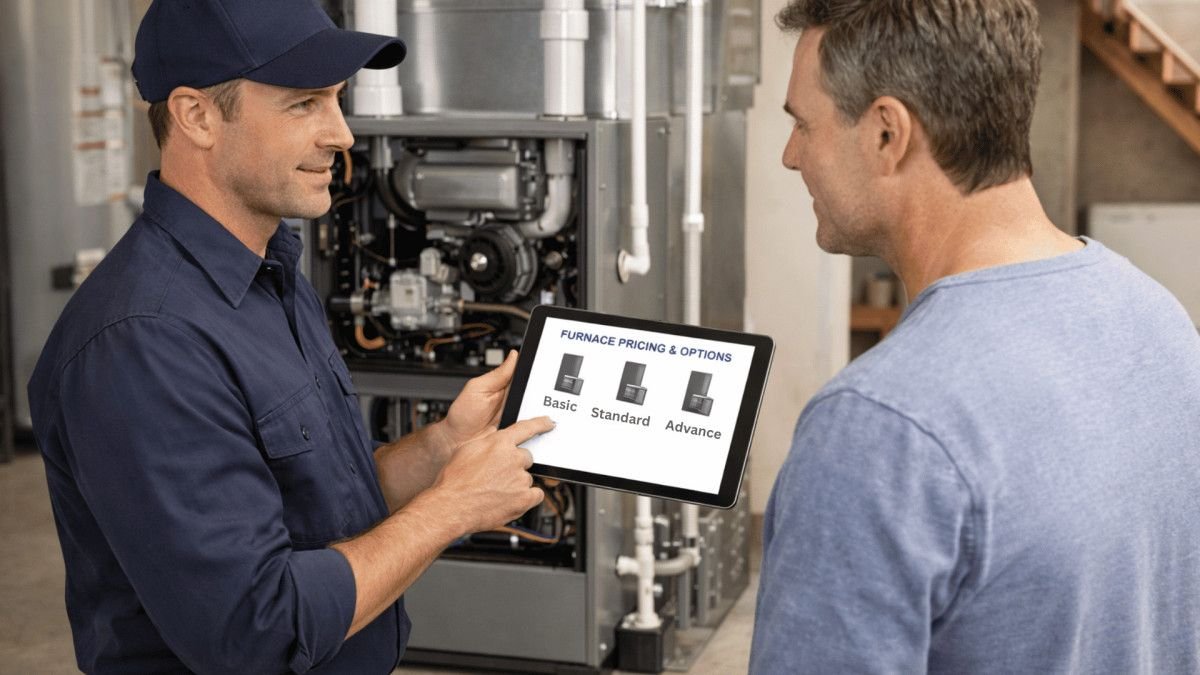

A new furnace costs between $2,500 and $14,000 installed in 2026, with the sweet spot for most single-family homes landing between $4,500 and $7,500. That range is wide enough to be useless without context. The final bill depends on four things: the type of furnace you buy, the efficiency rating, the complexity of your existing ductwork, and where you live.
A single-stage 80% AFUE gas furnace in a 1,500 sq ft ranch with accessible ductwork in a low-cost market might run $2,800 installed — and it will heat the house. A modulating 98.5% AFUE condensing furnace with a variable-speed blower and a communicating thermostat, installed in a 3,000 sq ft two-story in Boston with an old chimney that needs a liner, can push past $12,000. Both numbers are for a furnace that turns on when you turn up the thermostat. What separates them is efficiency, comfort, and how many winters you plan to stay in the house.
Furnace Cost by Type: Single-Stage, Two-Stage, and Modulating
The biggest price variable is the furnace type. Single-stage furnaces fire at full capacity every time they run. Two-stage furnaces can run at a low-fire setting (roughly 65-70% of maximum) for milder days and only step up to full fire when the outdoor temperature dips. Modulating furnaces adjust their output continuously in small increments, typically from 25% to 100% of capacity.
| Furnace Type | Equipment Cost | Installed Total | Best For
|
| Single-stage, 80% AFUE | $1,200-$1,800 | $2,500-$3,800 | Budget replacement, mild climates, rental properties |
| Single-stage, 92-95% AFUE | $1,800-$2,500 | $3,200-$5,000 | Moderate climates, first-time homebuyers |
| Two-stage, 80% AFUE | $1,600-$2,200 | $3,200-$4,500 | Multi-story homes, better comfort on a budget |
| Two-stage, 95-96% AFUE | $2,500-$3,500 | $4,500-$6,500 | Cold climates, 10+ year homes |
| Modulating, 96-98.5% AFUE | $3,200-$5,000 | $5,500-$8,500 | Cold climates, high comfort, forever homes |
| Modulating + communicating thermostat | $3,500-$5,500 | $6,500-$14,000 | Premium whole-system upgrade |
These prices assume a straightforward replacement: the new furnace goes where the old one was, the gas line and flue are compatible, and the ductwork does not need major modification. When any of those assumptions break, the installation labor and materials jump — sometimes doubling the total.
Furnace Cost by Fuel Type: Gas, Electric, Oil, and Propane
The fuel type determines both the equipment cost and the annual operating cost. Natural gas is the most common and usually the cheapest to operate. Electric furnaces cost less to buy and install but significantly more to run in most U.S. markets. Oil and propane furnaces fall in between — higher equipment costs than gas, and fuel prices that fluctuate more dramatically.
| Fuel Type | Equipment Cost | Installed Total | Annual Fuel Cost (2,000 sq ft, avg) | Lifespan
|
| Natural Gas | $1,200-$5,000 | $2,500-$8,500 | $600-$1,100 | 18-22 years |
| Electric | $600-$1,800 | $1,500-$3,200 | $1,200-$2,500 | 20-25 years |
| Oil | $2,000-$4,000 | $4,000-$7,500 | $1,400-$2,800 | 15-20 years |
| Propane | $1,800-$4,500 | $3,500-$7,000 | $1,500-$3,000 | 18-22 years |
Electric furnaces have the lowest upfront cost because they do not require a gas line, a flue, or a heat exchanger. The downside is operational: electricity costs two to four times more per BTU than natural gas in most states. In the Northeast and Midwest, running an electric furnace for a full heating season can cost $1,000 to $1,500 more than natural gas.
Oil furnaces require a storage tank (typically in the basement or buried in the yard) and an annual cleaning of the burner assembly. The tank alone adds $500 to $1,500 to the installation if it needs replacement. Oil prices swing with global crude markets, making annual heating costs hard to predict.
What Is Actually Included in an Installed Furnace Price?
When a contractor quotes $5,500 for a furnace replacement, that number needs to be unpacked. A good quote itemizes the equipment, labor, and any modifications to the gas line, flue, electrical, or ductwork. A bare quote with no breakdown conceals assumptions — and those assumptions become expensive change orders after the work starts.
A typical furnace replacement quote in 2026 includes:
- Equipment: The furnace unit itself plus any required accessories (filter cabinet, condensate pump for high-efficiency models, thermostat if included)
- Labor: 6 to 12 hours for a two-person crew depending on complexity; $800 to $2,000 for typical labor
- Permits: $100 to $300 depending on local jurisdiction
- Old furnace removal and disposal: $50 to $150
- Basic sheet metal transitions: $150 to $400 to connect the new furnace to existing ductwork
- Gas line connection: $100 to $300 if the existing shutoff and flex line are reusable
- Flue or venting modifications: $200 to $800 if the new furnace requires different venting (PVC for condensing vs. metal B-vent for 80% AFUE)
- Electrical: $100 to $300 for a dedicated circuit or thermostat wiring update
- Startup and combustion test: Included in most quality installation packages; verify it is listed
When to expect additional costs beyond the base quote:
• Chimney liner for a new 80% furnace going into an old unlined chimney: $800-$1,500
• Running PVC vent pipes through a finished wall for a condensing furnace: $500-$1,200
• Upgrading the gas line from ½-inch to ¾-inch for a larger furnace: $400-$900
• Adding a return air duct to balance airflow: $300-$700
• Asbestos abatement on old duct wrap: $1,500-$3,000
Furnace Cost by Brand: Major Manufacturers Compared
Brand name drives roughly 15% to 25% of the equipment cost for an equivalent furnace type and AFUE rating. The premium brands charge more for the same efficiency because of dealer certification requirements, longer parts warranties, and perceived reliability. Whether the premium is worth it depends on how long you plan to stay in the house and how much you value the warranty.
| Brand | Price Tier | 80% AFUE Installed | 95%+ AFUE Installed | Warranty (HX / Parts)
|
| Goodman | Budget | $2,500-$3,500 | $3,800-$5,500 | Limited lifetime / 10 yr |
| Rheem / Ruud | Mid-range | $2,800-$3,800 | $4,200-$6,500 | Limited lifetime / 10 yr |
| Bryant | Mid-range | $3,000-$4,200 | $4,500-$7,000 | Limited lifetime / 10 yr |
| Trane / American Standard | Premium | $3,200-$4,500 | $5,000-$7,500 | Limited lifetime / 10 yr |
| Carrier | Premium | $3,300-$4,800 | $5,200-$8,500 | Limited lifetime / 10 yr |
The warranty matters more than the brand name. A Goodman furnace with a 10-year parts warranty installed by a competent independent contractor will almost certainly outlast a Carrier installed by the lowest-bidder dealer who rushes the sheet metal work. The installation quality is the primary determinant of furnace longevity — not the badge on the cabinet.
How Location Affects Furnace Installation Costs
The same furnace costs different amounts in different parts of the country. Labor rates, permit costs, and market competition drive the variation. A modulating 96% furnace that costs $7,500 installed in Dallas might cost $10,000 in San Francisco or $5,800 in Birmingham.
| Region | Typical Installed Range (Mid-Range Gas) | Cost Driver
|
| Southeast (GA, AL, SC) | $3,500-$5,500 | Low labor rates, high contractor competition |
| Midwest (OH, IN, MI) | $4,000-$6,500 | Moderate labor, high demand volume |
| Northeast (NY, MA, CT) | $5,000-$8,500 | High labor, strict codes, chimney liner common |
| West Coast (CA, WA, OR) | $5,500-$9,500 | Highest labor, seismic code requirements |
| Mountain West (CO, UT) | $4,500-$7,000 | Altitude adjustment on equipment, moderate labor |
| South Central (TX, OK) | $3,500-$5,500 | Low labor, but high-efficiency less common |
In the Northeast, chimney liner requirements add $800 to $1,500 to a typical furnace replacement. In California, seismic strapping and Title 24 energy compliance add $400 to $800. These regional add-ons are not optional — they are code mandates — and they account for much of the price difference between markets.
Tax Credits and Rebates That Reduce Your Furnace Cost in 2026
The Inflation Reduction Act (IRA) provides federal tax credits for high-efficiency furnace installations through December 31, 2032. The credit is 30% of the project cost up to a maximum of $600 per year for furnaces with an AFUE of 97% or higher. It is non-refundable, meaning it offsets your tax liability but does not generate a refund.
State and utility rebates layer on top of the federal credit. The amounts vary significantly:
- Massachusetts (Mass Save): Up to $1,250 for a 97%+ AFUE gas furnace replacement
- New York (NYSERDA): Up to $750 for ENERGY STAR certified furnaces
- Colorado (XCel Energy): Up to $500 for high-efficiency furnace installations
- California (various utilities): $200-$500 depending on the specific program
- Pacific Northwest (Energy Trust of Oregon, PSE): $300-$800 depending on efficiency tier
Manufacturers also offer seasonal rebates. Carrier, Trane, and Lennox typically run $200 to $500 instant rebates on premium furnaces in spring and fall — the slow seasons for HVAC contractors. The best time to buy a furnace, purely on price, is late September or early April, when demand is lowest and contractors are actively filling their schedules.
Renting vs. Buying a Furnace: Is a Payment Plan Worth It?
Some HVAC companies offer furnace rental or lease-to-own programs where you pay a monthly fee (typically $60 to $150) instead of an upfront lump sum. The program bundles the equipment, installation, repairs, and annual maintenance into one monthly payment for a contract term of 7 to 15 years.
The total cost over the contract term is almost always higher than buying outright — often 50% to 100% more. For a $5,500 furnace on a 10-year plan at $100 per month, you pay $12,000 over the life of the contract. The only scenario where this makes financial sense is when you literally cannot access any other form of financing and your current furnace has failed in January.
If you need to finance, a home equity line of credit (HELOC), a personal loan from a credit union, or a 0% APR promotional credit card for 18-24 months are all better options than a contractor-arranged rental agreement. The furnace rental business model is profitable specifically because the math favors the rental company, not the homeowner.
Hidden and Additional Costs to Watch For
Beyond the furnace itself, several add-ons can push the final bill well past the initial quote. These are not scam charges — they are legitimate work that the original quote assumed was not needed — but they should be discussed before the crew arrives, not discovered on a change order halfway through the job.
Ductwork modifications: If the new furnace has a different physical footprint than the old one, the installer needs to fabricate a sheet metal transition (plenum) between the furnace cabinet and the existing duct. A basic transition is $150 to $400 and is included in most quotes. A full plenum rebuild or the addition of a return air drop adds $500 to $1,200.
Gas line upgrade: A larger furnace may need a larger gas line. Running a new ¾-inch or 1-inch black iron pipe from the meter to the furnace costs $400 to $900 depending on distance and access.
Electrical work: A variable-speed blower motor draws more amps than a single-speed motor in some configurations. If the existing circuit is maxed out, an electrician needs to pull a new dedicated circuit: $300 to $600.
Condensate drain: High-efficiency condensing furnaces produce acidic water that must be drained to a floor drain, a condensate pump, or outside. If no drain is nearby, installing a condensate pump and running vinyl tubing to the nearest drain costs $150 to $400.
Asbestos abatement: Homes built before the 1980s may have asbestos tape on old duct joints. If the installation disturbs that material, abatement is legally required and costs $1,500 to $3,000. A reputable contractor checks for this during the estimate visit and includes it in the quote.
FAQ: Furnace Cost Questions, Answered
When is the cheapest time of year to buy a furnace?
Early fall (September to early October) and early spring (March to April). Demand is lowest during these shoulder seasons, and manufacturers run seasonal rebates. Avoid buying in December through February unless your furnace has failed — contractors are at peak demand and rarely discount.
Can I install a furnace myself to save money?
Not in any jurisdiction that requires a mechanical permit. Furnace installation involves gas piping, combustion venting, and electrical connections — all of which require licensed trade work by code. A DIY furnace installation voids the manufacturer’s warranty, violates your homeowners insurance policy if a fire or CO leak occurs, and is illegal in most municipalities. The only safe DIY work is the prep: clearing the work area, replacing the air filter cabinet, and painting the surrounding walls before the contractor arrives.
What are the best furnace financing options in 2026?
A HELOC (currently 7-9% APR), a credit union personal loan (8-12%), or a 0% intro APR credit card with an 18-24 month term are the best options. Contractor-arranged financing through GreenSky or Service Finance typically carries 12-18% APR for borrowers with good credit, and 20-28% for fair credit. Those rates make a $6,000 furnace cost $9,000 to $12,000 over a five-year term.
At what point should I replace my furnace instead of repairing it?
If the repair costs more than 50% of a new furnace and the unit is over 15 years old, replace it. A $1,500 heat exchanger replacement on a 16-year-old 80% AFUE furnace is money that would be better spent toward a new high-efficiency unit. The exception: a $400 blower motor replacement on an otherwise healthy 12-year-old furnace is a repair worth making.
What furnace should a landlord buy for a rental property?
A single-stage 80% AFUE Goodman or Rheem furnace. It costs $2,500 to $3,500 installed, it has simple controls that tenants cannot break, and every HVAC technician in the country knows how to repair it. High-efficiency condensing furnaces in rental properties create two problems: tenants ignore the condensate drain until it clogs and floods the utility room, and the repair costs eat into the operating margin.
How many quotes should I get before buying a furnace?
Three. One from a large HVAC company with a 24/7 service department, one from a mid-size independent contractor, and one from a Costco or Home Depot partner program. The large company will be the most expensive but will have the fastest emergency response if something goes wrong during the first heating season. The independent will usually have the best price. The big-box partner program will sit in the middle on price and throw in an extended labor warranty.
Should I replace my thermostat when I replace the furnace?
If your current thermostat uses mercury switches or is more than 15 years old, yes. A basic digital thermostat costs $30 to $60 and takes 15 minutes to install. For a modulating or two-stage furnace, the thermostat must match the furnace’s control protocol. A standard Nest or ecobee will only operate a modulating furnace as a two-stage unit — the full modulation range is only available with the manufacturer’s proprietary communicating thermostat, which adds $400 to $800 to the installed price.
The Bottom Line on Furnace Costs
For most homeowners replacing a furnace in 2026, the budget should land between $4,500 and $7,500 for a quality two-stage or modulating gas furnace with a 95%+ AFUE rating, professionally installed with permits. The range below that buys a furnace that will heat the house but cost more every month to run. The range above that buys comfort features that matter most in cold climates and forever homes.
Get three quotes. Ask each contractor to itemize the equipment, labor, permits, and any ductwork or venting modifications. If a quote is $1,500 lower than the other two, the difference is almost certainly in the scope of work — the low bidder is skipping something, and that something will surface as a change order or as shortened equipment life.