
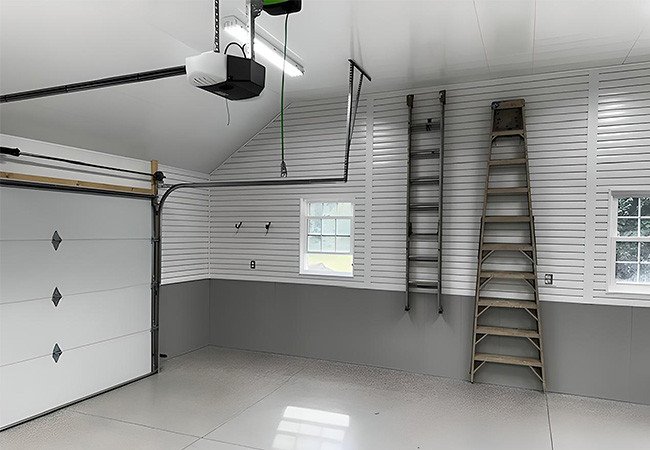

A two-car garage has roughly 800 to 1,000 square feet of wall area and 400 square feet of ceiling area. The walls are open studs or, in an older garage, possibly covered with pegboard, OSB, or nothing at all. Drywalling the garage turns it from a utilitarian shell into a finished room that is brighter, cleaner, and easier to heat. The cost depends on the size of the garage, whether the ceiling is included, the drywall thickness, and whether the taping and finishing is included in the job. A basic hang-only job costs half as much as a fully taped and painted finish. The difference is whether the garage looks like a construction site with drywall or a finished room, explains Mark Thomas Management experts.
According to wikiHow’s home finishing guide, which has been viewed over 500,000 times, drywall is the phase that transforms a framed space into a room with finished walls and ceilings. The principles are the same for a garage. This guide provides real costs for drywalling a standard two-car garage.
Cost by Scope for a Two-Car Garage (20×20×10)
| Scope | DIY Materials | Professional (Labor + Materials) |
| Walls only, hang only (no tape) | $400-700 | $1,000-1,800 |
| Walls only, hang + tape + texture | $600-1,000 | $1,800-3,500 |
| Walls + ceiling, hang + tape + texture | $1,000-1,700 | $3,000-5,500 |
| Walls + ceiling, hang + tape + smooth finish (Level 4) | $1,200-2,000 | $4,000-7,000 |
Cost Per Sheet and Per Square Foot
| Item | DIY Cost | Professional Cost |
| 4×8 sheet of 1/2-inch standard drywall | $15-20 | $35-50 (hung + taped) |
| 4×8 sheet of 5/8-inch fire-rated drywall | $18-25 | $40-60 (hung + taped) |
| Per square foot (walls, hang + tape) | $0.60-1.00 | $1.50-3.00 |
| Per square foot (ceiling, hang + tape) | $0.80-1.20 | $2.00-3.50 |
Materials Breakdown for a Two-Car Garage (Walls + Ceiling)
| Material | Quantity | Cost |
| 1/2-inch drywall sheets (walls, 800 sq ft) | 25 sheets | $375-500 |
| 5/8-inch drywall sheets (ceiling, 400 sq ft) | 13 sheets | $235-325 |
| Joint compound (3 buckets) | 3 × 4.5 gal | $45-75 |
| Drywall tape (paper or mesh) | 2-3 rolls | $15-25 |
| Drywall screws (5 lbs) | 1 box | $30-40 |
| Corner bead | 8-10 sticks | $30-50 |
| Total materials | $730-1,015 |
What Moves the Drywall Cost
- Ceiling inclusion. Adding the ceiling roughly doubles the square footage and adds the physical difficulty of overhead work. Ceiling drywall requires a lift rental or a second person. The lift costs $30 to $40 per day.
- Finish level. A Level 3 finish, which is tape and one coat of compound, is adequate for a garage that will be painted but where seams do not need to be invisible. A Level 4 finish, tape and three coats, is required for smooth-painted walls where seams must not show. The third coat adds roughly $0.30 to $0.50 per square foot in labor and materials.
- Drywall thickness. 5/8-inch drywall is required by code for the ceiling if there is living space above the garage, for fire separation between the garage and the house. If the garage has no living space above, 1/2-inch is acceptable for the ceiling. 5/8-inch drywall weighs 70 pounds per sheet versus 55 pounds for 1/2-inch. The weight difference makes overhead installation significantly harder.
- Wall condition. Per wikiHow’s wall finishing guide, co-authored by Ryaan Tuttle, proper drywall installation requires a flat, stable framing surface. If the garage has open studs, the drywall can be hung directly. If the garage has existing wall covering that must be removed, add $200 to $500 for demolition and disposal.
DIY vs. Professional: Time and Savings
Drywall is one of the most DIY-accessible trades. Hanging drywall requires a drill, a drywall T-square, a utility knife, and the physical ability to lift 55 to 70-pound sheets. Taping and mudding requires a technique that develops over the first few walls. A homeowner can hang drywall in a two-car garage in one to two weekends working alone. The taping and finishing take an additional two to three weekends because each coat of compound must dry before the next is applied.
The DIY savings on a fully drywalled two-car garage are $1,800 to $4,500 compared to professional installation. The savings come entirely from labor. The material cost is the same whether a homeowner or a contractor buys the drywall. A drywall lift rental for $30 per day makes the ceiling work possible for one person and is the best rental value in the entire project.
Moisture-Resistant Drywall: When You Need It in a Garage
Standard drywall absorbs moisture from the air. In an unconditioned garage, humidity swings from damp summer mornings to dry winter afternoons. Over years, standard drywall can develop mold on the back side where it contacts the studs, and the paper facing can peel in areas exposed to water splashes. Moisture-resistant drywall, green board or purple board, has a treated core and facing that resists moisture absorption. It costs $2 to $4 more per sheet than standard drywall. For a two-car garage using 38 sheets, the premium is $76 to $152.
Moisture-resistant drywall is recommended for the bottom 4 feet of garage walls, where snow melt from vehicles, rain splash from the open garage door, and floor-level humidity are concentrated. It is not required by code for garages in most jurisdictions, but it is a practical upgrade that costs less than $150 and prevents the bottom of the walls from degrading. For a garage that will be heated and used as a workshop or gym, use moisture-resistant drywall on all walls. For a garage that is purely for parking and storage, standard drywall is sufficient.
Drywall Finish Levels Explained for Garages
Drywall finishing is graded from Level 0 to Level 5. For a garage, three levels are relevant:
- Level 2 (tape only). Joint tape embedded in compound with no finish coats. The tape is visible. The seams are visible. This is the minimum for a garage where appearance does not matter and the drywall is primarily for fire separation. Materials cost roughly $150 less than a Level 4 finish because no additional compound or sanding is required.
- Level 4 (tape + 3 coats). The standard for painted walls. Tape embedded, three coats of compound applied and sanded smooth. Seams are not visible under flat or matte paint. This is the standard for a garage that will be used as a workshop, gym, or living space. Most professional quotes assume Level 4.
- Level 5 (skim coat). A thin skim coat of compound applied over the entire surface, not just the seams. Required for high-gloss or semi-gloss paint where every surface imperfection is visible under the sheen. Adds $0.50 to $1.00 per square foot. Rarely used in garages unless the garage is being converted to living space with a high-end finish.
The cost difference between Level 2 and Level 4 is roughly $0.30 to $0.50 per square foot in labor, or $350 to $600 for a two-car garage. For a workshop or gym where the walls will be painted and the garage will be used regularly, Level 4 is worth the additional cost. For a utility garage that exists only for parking, Level 2 is acceptable.
Frequently Asked Questions
Do I need fire-rated drywall in a garage?
Building code requires 5/8-inch Type X fire-rated drywall on the ceiling of an attached garage if there is living space above. It is also required on the wall shared between the garage and the house. The fire-rated drywall provides a one-hour fire separation between the garage and the living space. For a detached garage or a garage with no living space above, standard 1/2-inch drywall is acceptable. Check local code. The inspector will flag non-fire-rated drywall on a shared wall or ceiling.
Should I paint garage drywall or leave it unpainted?
Unpainted drywall absorbs moisture from the air and from any splashes or spills. Over time, unpainted drywall in a garage develops water stains, mold spots, and a general dinginess that cannot be cleaned. Paint the drywall with at least a coat of PVA primer and one coat of paint. The paint cost for a two-car garage is $80 to $150 in materials. The unpainted drywall looks acceptable for about a year. The painted drywall looks acceptable for a decade.
The Garage That Looks Finished
Drywalling a garage costs $730 to $1,015 in materials for DIY, or $1,800 to $5,500 for professional installation depending on whether the ceiling is included. The drywall transforms the garage from exposed studs to smooth walls. The paint that follows is optional but recommended. A drywalled and painted garage is brighter, easier to clean, and feels like a room rather than a shell. The drywall is the skin. Everything before it is bones. The material cost is the same whether a homeowner or a contractor buys the sheets. The labor is the difference. A homeowner who hangs and finishes the drywall themselves saves $1,800 to $4,500. A homeowner who hangs the drywall and hires a taper to finish saves roughly half that amount and gets a professional-quality finish on the seams. Either approach turns exposed studs into walls. The garage becomes a room.