
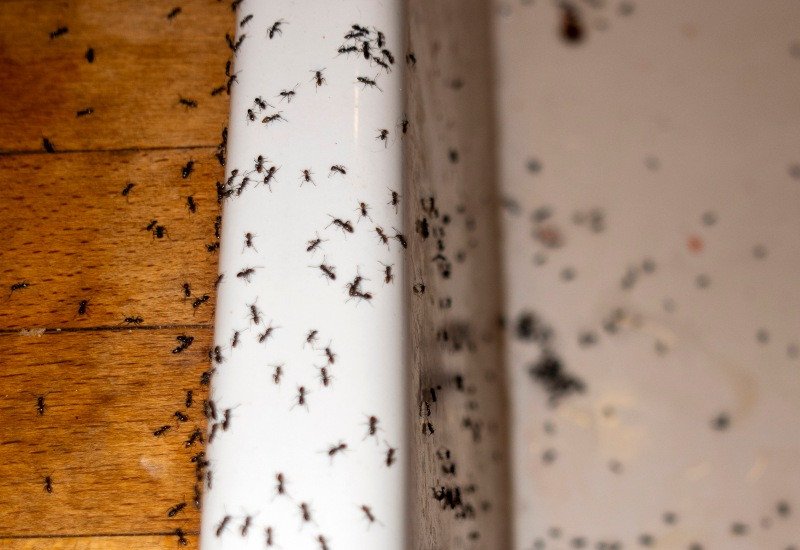

They are tiny, jet black, and moving in a thin line from the baseboard to the cat food bowl, reports TE Johnson & Sons in Greensboro. They look like moving specks of pepper. These are little black ants, and unlike the slightly larger dark brown sugar ants, they almost always nest outdoors and enter through foundation cracks.
Little black ants, Monomorium minimum, are one of the smallest ant species that invade kitchens. They are about one sixteenth of an inch long, shiny black, and form distinct trails. The colony is outside under a rock, in a crack in the driveway, in the mulch, or in the soil next to the foundation. The ants you see in the kitchen are foraging workers. Kill them without addressing the outdoor nest and new workers replace them within days. Here is how to find the nest outside and stop them at the source.
Little Black Ants vs. Other Tiny Kitchen Ants
Proper identification saves you from using the wrong bait. Little black ants are jet black and shiny with a two-segmented waist. They are smaller than odorous house ants, which are dark brown and smell like rotten coconut when crushed. They are larger than pharaoh ants, which are pale yellow and translucent. They move in distinct single-file trails rather than the scattered foraging pattern of larger ants.
Little black ants prefer sweets in spring and summer, then switch to protein and grease in late summer and fall. If you put out sugar bait and they ignore it, they are in a protein-feeding phase. Put out a dab of peanut butter or cat food next to the sugar bait. Whichever the ants swarm is what the colony currently wants.
Find the Outdoor Nest by Following the Trail
Little black ants nest outdoors. The nest is usually within 30 feet of the kitchen. Finding it is the fastest path to elimination because you can treat the colony directly rather than waiting for bait to travel through the foraging chain.
Follow the ant trail from the kitchen backward. Watch where the line of ants enters the kitchen. Is it through a crack in the baseboard? Under the door? Through the gap around a pipe under the sink? Go to the other side of that entry point and find where the ants emerge outside. For baseboard entry, go to the exterior wall on the other side. For pipe entry, check where the pipe exits the foundation. For door entry, check the door threshold from outside.
Once outside, follow the trail across the ground. Little black ant trails on soil, concrete, and mulch are visible as a moving line of black specks. The trail will lead to a small opening in the soil, a crack in the driveway, under a rock, in mulch, or along the foundation edge. The nest entrance is a small hole surrounded by fine soil particles. You may see ants carrying bits of food into the hole.
Nests are easiest to find in the morning and late afternoon when ants are most active. If you lose the trail, place a dab of jelly or honey at the point where ants enter the house from outside. Wait 30 minutes. A new trail will form directly from the nest to the food. Follow it.
Treat the Outdoor Nest Directly
Once you have located the nest, you can eliminate the entire colony in one treatment. This is faster and more effective than weeks of indoor baiting.
Pour a pot of boiling water slowly into the nest entrance. The water penetrates the soil and kills ants on contact through heat. This works for nests in soil and lawn. It does not work for nests in driveway cracks or under slabs, where the water drains away before reaching the colony. Boiling water kills grass and plants it contacts. Use it on nests in bare soil or lawn edges away from desirable plants.
For nests in cracks, under rocks, or in locations where boiling water is impractical, apply food-grade diatomaceous earth directly into and around the nest entrance. Use a bulb duster to puff the powder into the opening. Ants walking through the treated entrance carry the powder into the nest on their bodies. The colony dies over several days as the powder spreads through the galleries.
For large nests or nests in difficult locations, use a boric acid bait station placed directly at the nest entrance. Mix one cup of warm water, two tablespoons of sugar, and half a teaspoon of boric acid. Soak a cotton ball in the solution and place it immediately next to the nest opening. The foraging ants will carry the bait directly into the colony. Skip the long trail into your kitchen entirely. The colony feeds on poison at its own front door.
Indoor Baiting When You Cannot Find the Nest
If the nest is under the foundation slab, in a neighbor’s yard, or in a location you cannot find, bait indoors using the same approach as for sugar ants. Place sugar-based bait on the active trail inside the kitchen. The ants carry the bait back to the outdoor nest over several days. This takes longer than direct nest treatment but works for the same reason. The queen eats the bait and the colony collapses.
Use Terro Liquid Ant Bait or a homemade borax and sugar water solution. Little black ants respond well to borax baits. Do not spray insecticide on the trail while baiting. The spray kills foragers and the colony sends replacements. The bait kills the queen and the colony stops producing replacements. These are fundamentally different outcomes. One suppresses for a few days. The other eliminates permanently.
Seal Entry Points After the Nest Is Dead
Wait until you have seen zero ant activity for three days. Then seal the entry point the ants were using. Common little black ant entry points include cracks in the foundation where the concrete meets the sill plate, gaps around plumbing and utility penetrations where pipes enter the house, gaps under exterior doors without sweeps, cracks in window frames and failed caulking around windows, and gaps where siding meets the foundation.
Use silicone caulk for cracks and gaps. Use expanding foam for larger openings around pipes. Install door sweeps on exterior doors. These are one-time fixes that prevent ants from finding new entry points next season. The outdoor colony may still exist in the yard. You are not eliminating all ants from your property. You are blocking their route into your kitchen.
Prevention: Keep the Next Colony Out
Little black ants are outdoor insects. They enter homes because something inside is worth eating and something outside leads them to your door.
Keep the foundation perimeter dry and clear. Remove mulch, leaves, and organic debris from the first three feet around the foundation. Replace with gravel if possible. This creates a dry zone that ants avoid. Trim vegetation that touches the house. Ants use plant stems and branches as bridges from the soil to the siding and windows.
Store firewood, lumber, and landscape materials away from the house. A stack of firewood against the foundation is home to multiple ant colonies and provides a highway directly to your siding. Move it at least 20 feet away and elevate it on a rack.
Inspect the foundation perimeter each spring for new cracks and ant activity before the foraging season begins. A five-minute walk around the house in April with a tube of caulk prevents a summer of ants in the kitchen.
Frequently Asked Questions
Are little black ants the same as sugar ants?
No. Little black ants are a distinct species, Monomorium minimum, that is jet black and nests almost exclusively outdoors. Sugar ants is a common name that usually refers to odorous house ants, which are dark brown, smell like rotten coconut when crushed, and often nest indoors in wall voids. The treatment approach is different. Sugar ants require indoor baiting because the colony may be inside the walls. Little black ants require outdoor nest location and treatment because the colony is outside. If you use the wrong approach, you spend weeks baiting indoors for an outdoor problem or searching your yard for an indoor nest.
Why are the ants ignoring my bait?
Three possible reasons. The bait is the wrong food type. If the ants are in a protein-feeding phase, they ignore sugar bait. Put out peanut butter or cat food next to the bait. If they swarm the protein, switch to a protein bait. The bait has too much borax. If ants die within hours on the bait, the concentration is too high. Dilute it. The bait is not on the trail. Ants follow chemical trails precisely. If the bait is six inches from the trail, they may never find it. Place bait directly on the active trail.
I kill them and they keep coming back. What am I doing wrong?
You are killing workers, not the queen. Ant spray, soapy water, and squishing kill the ants you see. The queen, protected in the outdoor nest, continues laying eggs. Every ant you kill is replaced within days. The solution is not to kill more ants more efficiently. It is to find the nest and kill the queen. Follow the trail outside. Treat the nest. The ants in the kitchen disappear because the factory that produces them has shut down.