
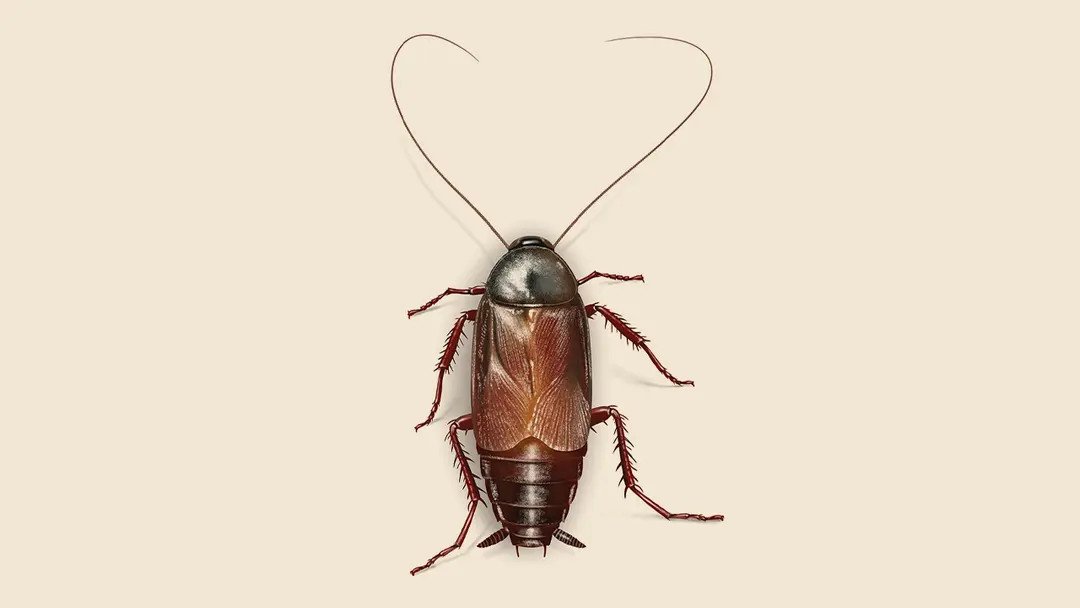

You found a large, shiny black roach in the basement. It was slow, almost sluggish. It did not scatter when you turned on the light. This is not a German roach. It is an oriental roach, and it lives outside, not inside your walls.
Oriental roaches, often called water bugs, are outdoor insects that enter homes in search of moisture and decaying organic matter, point out KRS Charlottesville specialists. They do not breed indoors at the rate German roaches do. They prefer cool, damp environments and are most active in spring and fall. Getting rid of them means fixing what attracts them to your foundation and sealing how they get inside. Here is how to do it.
How to Identify an Oriental Roach
Oriental roaches are dark brown to glossy black, about one inch long. Males have short wings that cover about three quarters of the body but cannot fly. Females have tiny wing stubs and look more oval. Neither sex can climb smooth vertical surfaces, which is a key difference from German and American roaches. If you find them in a sink or bathtub, they fell in and cannot climb out.
They move slowly compared to other roaches and do not scatter rapidly when exposed to light. They emit a strong musty odor that is more pronounced than the smell of German roaches. They are most common in the northeastern and midwestern United States, the Pacific Northwest, and the United Kingdom. In the South, they compete with the larger American roach and are less dominant.
Oriental roaches are frequently misidentified as water bugs, a name that also refers to giant water bugs in the family Belostomatidae, which are aquatic predators that bite. Oriental roaches do not bite. They are cockroaches, not true water bugs. The name confusion matters because treatment for one is irrelevant to the other.
Where Oriental Roaches Live and Why They Enter Your Home
Oriental roaches live outdoors in cool, damp, dark locations. They are found under leaf litter, in mulch beds, under stones and landscape timbers, in woodpiles, in sewer and storm drain systems, in crawl spaces with moisture problems, and in basements with high humidity or standing water.
They enter homes at ground level. Unlike German roaches that travel through wall voids to upper floors, oriental roaches are poor climbers and almost always enter through foundation-level openings. The most common entry points are gaps under exterior doors without sweeps, foundation cracks, openings around plumbing and utility penetrations at ground level, gaps where siding meets the foundation, floor drains and basement drains, and crawl space vents without screens.
They are especially active after heavy rain. Heavy rain floods their outdoor harborage in mulch, leaf litter, and soil, driving them toward higher ground. Your basement, crawl space, and ground-floor rooms are the higher ground. A spike in oriental roach sightings immediately after a rainstorm is a classic pattern and indicates an outdoor population nearby, not an indoor infestation.
Step One: Eliminate Moisture, Their Primary Attractant
Oriental roaches need moisture to survive. They dehydrate faster than other roach species and cannot live in dry environments. Reducing moisture around and under your home is the single most effective control measure. Without moisture, they leave or die.
Fix all plumbing leaks. A slow drip from a basement laundry sink or a sweating cold water pipe provides enough moisture for a oriental roach population. Check basement and crawl space pipes, water heater connections, and washing machine hoses. Even minor condensation on pipes in summer can sustain roaches. Insulate cold water pipes with foam pipe insulation to prevent condensation.
Reduce basement and crawl space humidity. Run a dehumidifier in the basement and set it to maintain humidity below 50 percent. In crawl spaces, install a vapor barrier. A 6-mil polyethylene sheet covering the crawl space floor prevents ground moisture from evaporating into the space. Seal crawl space vents if local building code allows, or install vent covers that reduce airflow while maintaining some ventilation.
Clean gutters and extend downspouts. Clogged gutters overflow against the foundation. Downspouts that discharge at the foundation corner saturate the soil next to the basement wall. Clean gutters each fall and extend downspouts at least six feet from the foundation. Grade soil away from the foundation so rainwater flows outward, not toward the basement wall.
Remove organic debris from the foundation perimeter. Rake leaves away from the house. Pull mulch back from direct contact with the foundation wall. Replace organic mulch within the first three feet of the foundation with stone or gravel. This creates a dry zone that oriental roaches are reluctant to cross and eliminates the moist decaying organic matter they feed on.
Step Two: Treat Outdoor Harborage Sites
Outdoor baiting and perimeter treatment target the oriental roach population before it reaches the foundation. This is the proactive approach. Treat the source, not just the symptom.
Apply granular insecticide bait around the foundation perimeter in a band three to six feet wide. Products containing hydramethylnon, fipronil, or indoxacarb are effective. Water the granules lightly to activate them. Oriental roaches foraging in the treated zone encounter the bait and die before entering. A 10-pound bag covers approximately 2,000 linear feet of perimeter and costs $15 to $25.
Treat mulch beds, woodpiles, and other harborage sites directly. Apply a liquid insecticide labeled for outdoor cockroach control to the underside of the woodpile, into thick mulch, and around landscape timbers and stone borders. Focus on the damp, dark lower layers where oriental roaches rest during the day. Use a handheld pump sprayer for precision. A concentrated insecticide to mix in a pump sprayer costs $10 to $20 and covers 2,000 to 4,000 square feet.
Treat floor drains and basement drains. Oriental roaches travel through sewer and drain lines. Pour a half cup of a drain insecticide or foam cleaner labeled for roach control into each basement floor drain, laundry drain, and infrequently used sink or shower drain. The product coats the inside of the drain pipe and kills roaches traveling through it. Do this monthly during the active season from spring through fall.
Step Three: Seal Entry Points at Ground Level
Oriental roaches enter at ground level. This makes sealing simpler and more effective than for German roaches, which can enter through upper-floor gaps and wall voids.
Install door sweeps on all exterior doors, especially basement and garage doors. The gap under an exterior door is the single most common oriental roach entry point. A sweep with a rubber fin that contacts the threshold along its entire length costs $8 to $15 per door and installs in 10 minutes with a screwdriver.
Seal foundation cracks with hydraulic cement or polyurethane caulk. Hairline cracks in poured concrete foundations widen over time. A crack wide enough to insert a dime is wide enough for an oriental roach. Inspect the foundation perimeter inside and out, including the joint where the foundation meets the sill plate. Seal every crack and gap.
Seal around plumbing and utility penetrations where pipes, conduits, and cables enter the basement or crawl space. Use silicone caulk for small gaps and copper mesh packed into the opening before caulking for larger gaps. The openings around sewer cleanouts, main water line entry, and sump pump discharge pipes are frequently unsealed from the original construction.
Screen crawl space vents with quarter-inch galvanized hardware cloth. Plastic and fiberglass vent screens degrade in sunlight and tear easily. Galvanized metal screen secured with screws and washers lasts for years. Check vent screens each spring and replace any that are damaged.
If Oriental Roaches Are Already Inside
Indoor treatment for oriental roaches is simpler than for German roaches because they do not establish deep indoor harborage sites. They enter, forage for food and moisture, and leave or die.
Apply gel bait along baseboards in basements, laundry rooms, and ground-floor bathrooms. Oriental roaches prefer starch-based baits over sugar-based baits. A protein and starch gel bait like Advion Evolution or Maxforce Complete is more attractive to them than the sugar-heavy baits designed for German roaches. Place dots in corners, along baseboards, and near moisture sources like sinks and floor drains.
Apply diatomaceous earth or boric acid dust along basement and ground-floor baseboards, under appliances, and in the back of cabinets. The dust is especially effective for oriental roaches because they are heavy-bodied and drag more of their underside across treated surfaces than lighter German roaches. A thin layer is all that is needed. Visible piles are avoided.
Use sticky traps to monitor activity. Place traps along basement walls, near floor drains, and under the basement stairs. Check them weekly. The traps tell you whether the outdoor treatment and sealing are working. Trap counts should decline weekly. If they do not decline after three weeks, outdoor harborage is still active and producing roaches faster than indoor measures can intercept them.
Long-Term Prevention
Oriental roaches are a seasonal problem driven by outdoor conditions. Long-term prevention means maintaining the changes you made this season so you do not repeat the process next year.
Maintain the dry zone around the foundation year-round. Keep the first three feet of the foundation perimeter free of mulch, leaves, and organic debris. Inspect the foundation for new cracks each spring and seal them.
Treat the foundation perimeter with granular bait each spring before oriental roach activity peaks. A single spring application in April or May, depending on your region, suppresses the population before it builds to summer levels. Reapply in September for fall activity.
Keep gutters clean and downspouts extended. This is a one-time investment in proper drainage that prevents the saturated foundation soil that attracts oriental roaches. If your gutters constantly clog from nearby trees, install gutter guards.
If you have a chronic oriental roach problem that persists despite all of the above, the source is likely a municipal sewer or storm drain system near your property. There is no DIY solution for sewer-sourced roaches beyond sealing every drain, installing backflow preventers on floor drains, and accepting that some level of outdoor oriental roach activity is normal in neighborhoods with older sewer infrastructure.
Frequently Asked Questions
Is oriental roach treatment different from German roach treatment?
Completely different. German roach treatment focuses on indoor gel baiting, insect growth regulators, and treating wall voids and appliance cavities where the colony lives. Oriental roach treatment focuses on outdoor habitat modification, moisture reduction, perimeter baiting, and sealing ground-level entry points. Using a German roach protocol for oriental roaches applies indoor chemicals to a problem whose source is outside. It costs money and solves nothing.
Are oriental roaches the same as water bugs?
Oriental roaches are commonly called water bugs because they prefer damp environments, but they are true cockroaches. True water bugs in the family Belostomatidae are aquatic insects that live in ponds and streams and can deliver a painful bite. Oriental roaches do not bite. The name overlap causes confusion, but the insect you are dealing with in your basement is a cockroach, not a water bug.
Can oriental roaches climb walls?
No. Unlike German and American roaches, oriental roaches cannot climb smooth vertical surfaces. This is why they are found in basements, ground floors, sinks, and bathtubs. If you find roaches on upper floors, on walls, or in upper kitchen cabinets, you are dealing with a different species. The inability to climb also means sealing ground-level entry points is unusually effective for oriental roaches. Once you block the foundation-level openings, they cannot find alternative routes higher up the structure.
Do oriental roaches die off in winter?
Outdoor activity drops significantly in winter. Oriental roaches overwinter as nymphs in protected outdoor sites like deep mulch, woodpiles, and sewer systems. Indoor activity may increase in fall as roaches move toward the warmth of basements and crawl spaces, then decrease in winter as outdoor movement stops. You may see a spike in October and November, followed by relative quiet from December through March, then a resurgence in April as outdoor activity resumes.