
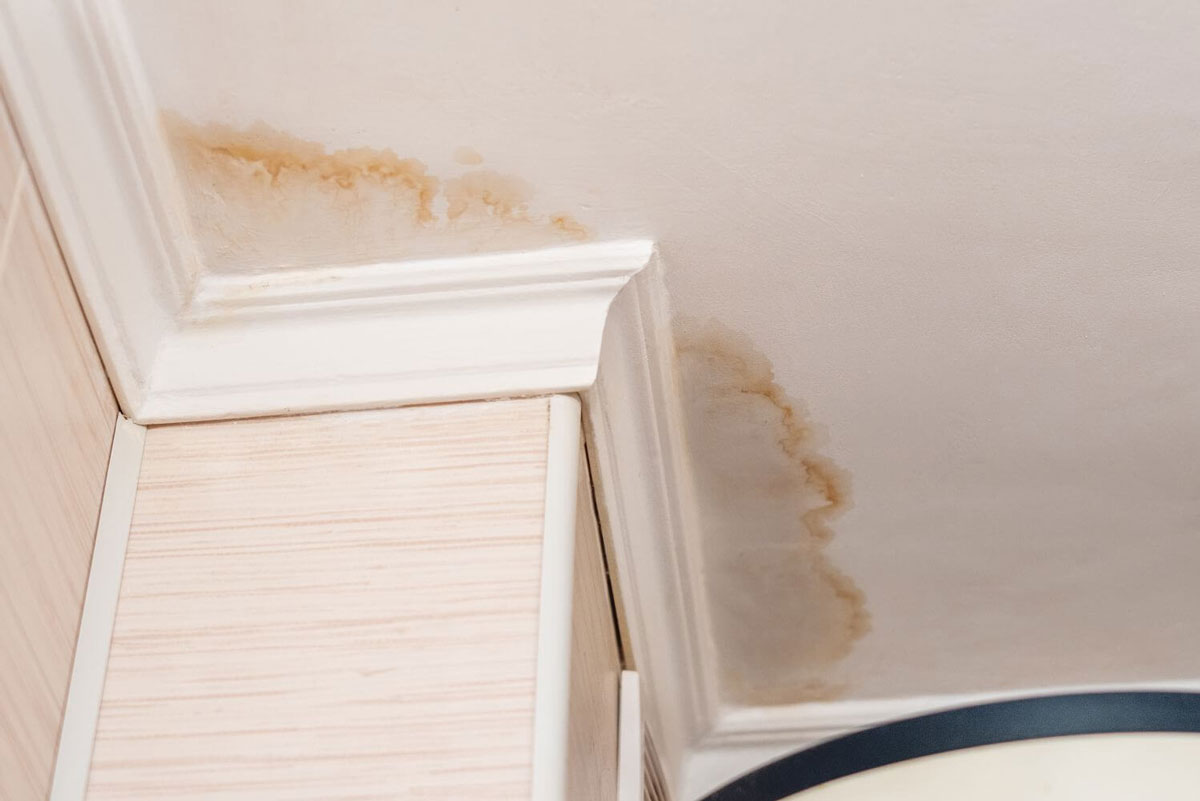

Most interior water damage starts overhead, long before a drip shows up. A roof rarely fails all at once. It loses a little protection each season, and the water that gets past it travels along rafters and insulation before it reaches a place you can see. By the time a ceiling stains, the problem has often been active for months.
This guide covers the early signs at the roofline, what to check each season, and how to tell when a leak is a repair job and when the roof has simply reached the end of its life.
How a roof leak becomes interior damage
Water takes the path of least resistance. It enters at a weak point, such as a lifted shingle or a dried-out seal around a vent pipe, runs down the underlayment or the underside of the decking, and soaks into whatever it meets first. That is usually attic insulation, which holds moisture instead of draining it.
From there it can spread sideways along a rafter and drop onto a ceiling several feet from the actual entry point. This is why the stain on your bedroom ceiling is a poor guide to where the roof is failing. Start your search uphill and toward the ridge from the stain, not directly above it.
Repair or replace: reading what the roof is telling you
A single leak does not mean the roof is finished. A cracked vent boot, a failed patch of flashing or a few blown-off shingles are ordinary repairs, and a good roofer can fix them in a day. The question is whether the leak is an isolated failure or one symptom of a roof that is wearing out everywhere.
Signs that point toward replacement:
- Age. Check the install date or the roofer’s paperwork. A roof near the end of its rated life is a poor candidate for repeated patching.
- Curling, cupping or buckling. Shingles that lift at the edges or bow in the middle have lost their bond and their waterproofing.
- Heavy granule loss. Bald patches, or a gutter full of grit, mean the surface protection is gone.
- Leaks in more than one place. A second and third leak after you fixed the first usually means the whole surface is failing.
- Soft or sagging decking. If the wood under the shingles is rotted, patching on top only hides the damage.
- Daylight in the attic. Light coming through the boards means the roof has holes, not just worn shingles.
A useful rule: if repairs are starting to cost a large share of what a new roof would, and the roof is in the last third of its expected life, put the money toward replacement. Patch money spent on a roof that is about to fail is money you will not get back, and the interior water damage it allows can cost more than the roof work itself.
Budgeting for a new roof
Replacement is one of the largest maintenance bills a house produces, and the total varies widely by where you live. Labor rates, roof pitch, local building codes, hurricane and hail requirements, and the material your area favors all move the price. If you are starting to plan, looking at roof replacement cost by state gives you a realistic range for your area before you start collecting quotes.
When you do get quotes, ask each contractor to price the same scope. That means tear-off versus overlay, the underlayment type, new flashing and vent collars, and any decking repairs. Get at least three, and confirm the license and insurance of whoever you hire.
Early signs you can spot from the ground and from inside
Stained or sagging ceilings
A faint yellow or brown ring on drywall is the classic sign. Rings that darken and grow after rain point to an active leak. A stain with crisp, dry edges that never changes is probably old damage from a leak that was already fixed. Press gently on a stained area. If the drywall feels soft or bulges, it is holding water and needs attention soon.
Moisture in the attic
Go up with a flashlight on a dry day. Look for dark streaks on the underside of the roof decking, damp or compressed insulation, rusted nail tips, and any musty smell. Frost on the nails in winter usually means warm, humid air is escaping from the living space and condensing on cold wood. That is a ventilation and air-sealing problem rather than a hole in the roof, but it rots decking just as effectively.
Failing flashing
Flashing is the thin metal that seals the joints where the roof meets something else: chimneys, skylights, vent pipes, dormers and walls. It is the most common source of leaks on roofs that otherwise look fine. Check for gaps, rust, lifted edges and dried sealant. Rubber collars around plumbing vents crack from sun exposure long before the shingles around them wear out.
Clogged gutters
When gutters fill with leaves and shingle grit, water backs up under the lowest row of shingles and soaks the fascia and roof edge. Look for overflow stains on the siding below the gutter, plants growing out of the trough, and gutters pulling away from the house.
Ice dams
In cold climates, heat escaping through the attic melts snow on the upper roof. The meltwater runs down, refreezes at the cold eaves and builds a ridge of ice. Water then pools behind that ridge and gets pushed up under the shingles. Icicles along the eaves, especially thick ones in only some spots, are a hint that heat is leaking from your attic. The lasting fix is more insulation and better air sealing at the attic floor, not chipping the ice off.
A seasonal checklist
Spring
- Scan the roof with binoculars for missing, curled or cracked shingles after winter.
- Check the attic for damp insulation or new stains on the decking.
- Clean the gutters and confirm the downspouts discharge several feet from the foundation.
Summer
- Look at the rubber collars and sealant around vents and skylights for cracks.
- Trim branches that touch the roof. They scrape off granules and drop debris.
- Check attic ventilation. A very hot, stuffy attic cooks shingles from below.
Fall
- Clear gutters again once the leaves are down.
- Inspect flashing at chimneys and walls before the wet season.
- Walk the perimeter of the house and look for granules collecting at downspout outlets, a sign of aging shingles.
Winter
- Watch for icicles and ice at the eaves, and note which spots they favor.
- Look at ceilings after a thaw for new spots.
- After heavy snow or wind, check the ground for shingle pieces.
What to do when you find a leak
- Move belongings away and put a bucket under any drip. Poke a small hole in a bulging ceiling to drain it controllably, rather than letting it collapse.
- Photograph the damage with dates before you touch anything.
- In the attic, follow the wet insulation back toward the ridge to find the entry point.
- Cover the spot with a tarp from a safe position, or have a roofer do it. Do not work on a wet or steep roof alone.
- Dry the area quickly. Wet drywall and insulation can grow mold within a couple of days, so run fans and a dehumidifier and remove anything that will not dry.
A few minutes with a flashlight each season catches the quiet failures at the roofline, and catching them early is the difference between a vent boot and a ceiling.