
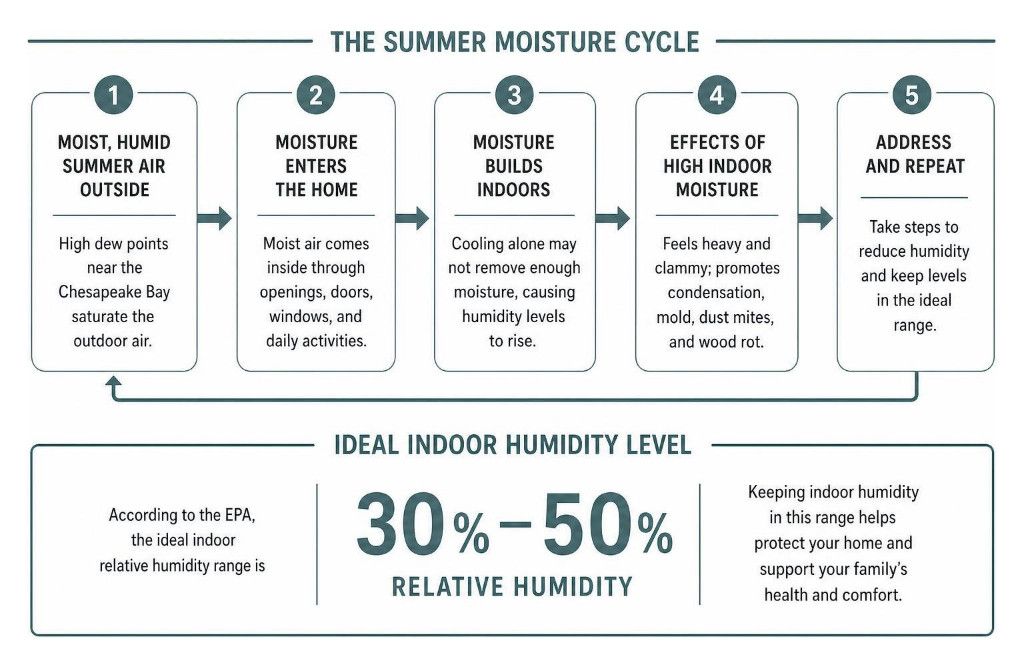

Living in the Baltimore area offers many perks, but our proximity to the Chesapeake Bay brings a significant challenge: high dew points. When the summer sun hits our region, the air becomes saturated with moisture. This creates a “heavy” feeling that often lingers indoors, even when your air conditioner is running.
According to the Environmental Protection Agency (EPA), the ideal indoor relative humidity range is between 30% and 50%. While some homeowners find comfort at slightly higher levels, anything consistently above 60% creates a breeding ground for biological contaminants. In our climate, maintaining this 30–50% range is essential for more than just comfort; it is a critical step in preserving your home’s structural integrity and your family’s respiratory health. When moisture levels remain too high, you aren’t just dealing with “sticky” air—you are inviting dust mites, mold spores, and potential wood rot into your living space.
Signs Your Home Exceeds Healthy Moisture Thresholds
Your home will often give you subtle—and sometimes not-so-subtle—warnings when it is struggling with excess humidity. One of the most common indicators is condensation on windows, especially in the early morning. If you notice peeling paint, wallpaper that seems to be bubbling, or a persistent musty odor in basements or closets, these are red flags that your indoor environment is too damp. If you feel “clammy” despite your thermostat being set to a reasonable temperature, your cooling system is likely failing to extract enough moisture from the air.
Core Challenges in Managing Summer Humidity Near the Chesapeake
Baltimore homes face a unique “stack effect” and infiltration problem. Because our outdoor air is so saturated with water vapor, any air leak—whether through a drafty window, a gap in your siding, or an unsealed crawl space—acts as a doorway for humidity to enter. Once that moisture is inside, it settles into cooler areas like basements, where it condenses on surfaces. Because the basement is naturally cooler than the upper floors, it often becomes a “moisture sink,” trapping damp air that eventually migrates upward through the rest of the house.
5 Proven Methods for Managing Summer Humidity in Baltimore Homes
Managing moisture requires a multi-layered approach. You cannot rely on a single device to solve the problem; instead, you need a strategy that balances airflow, filtration, and moisture extraction.
Method 1: Optimizing Air Conditioning Performance for Moisture Removal
Your central air conditioner is a natural dehumidifier. As warm air passes over the cold evaporator coil, water vapor condenses into liquid and drains away. However, if your system isn’t maintained, this process stalls. Ensure your air filters are changed regularly, as a clogged filter restricts airflow and prevents the coil from reaching the temperature necessary to pull moisture out of the air.
Furthermore, avoid the “ON” setting on your thermostat fan. When the fan runs constantly, it blows air over a wet evaporator coil after the cooling cycle ends, re-evaporating that moisture and pushing it right back into your home. Keep your fan set to “AUTO.” For those looking for deeper insights, this resource on managing summer humidity offers a breakdown of how your HVAC settings directly impact indoor moisture levels.
Method 2: Installing Targeted or Whole-House Dehumidification Systems
Sometimes, even a perfectly tuned AC system isn’t enough to handle the intensity of a Maryland summer. If your humidity levels remain high, you may need a dedicated dehumidifier. For large homes, a whole-house unit integrated into your ductwork is the gold standard. It works independently of your AC, meaning it can remove moisture without over-cooling your home.
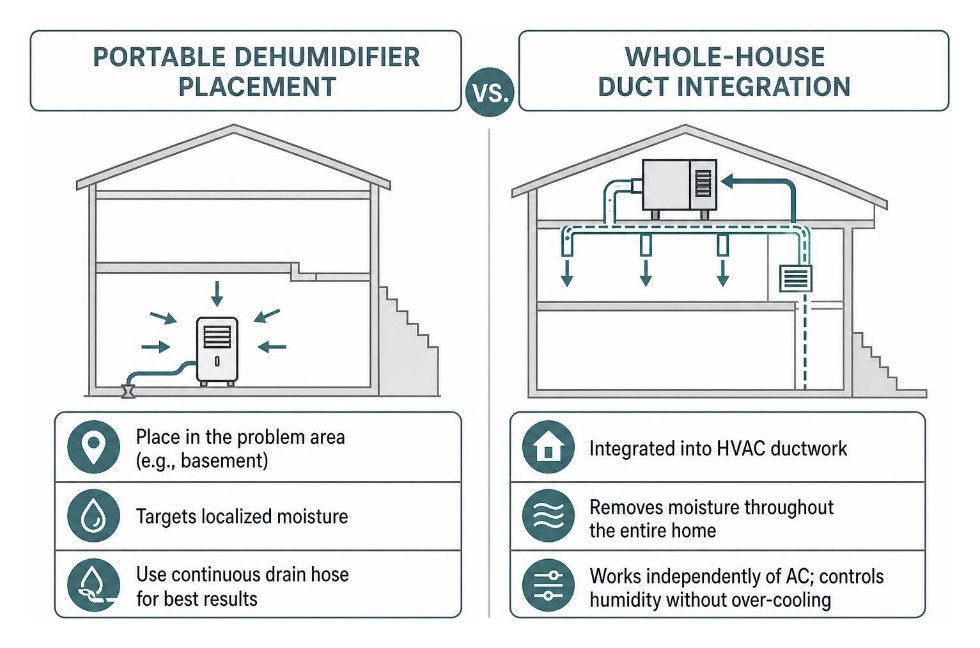
When choosing a unit, capacity is key. A 30-pint unit is generally sufficient for a small 500-square-foot space, while a 70-pint unit is necessary for areas up to 2,500 square feet. If you are dealing with a damp basement, a high-capacity portable unit with a continuous drain hose can make a world of difference.
Method 3: Improving Ventilation Protocols and Managing Summer Humidity Indoors
Ventilation is a double-edged sword. While you need fresh air, bringing in hot, humid Maryland air during the peak of the day only makes your moisture problems worse. Run your kitchen and bathroom exhaust fans whenever you are cooking or showering, but use timer switches to ensure they don’t run longer than necessary. If you have a fresh-air intake damper connected to your HVAC system, consider having a professional inspect it; in some cases, closing or limiting this intake during the hottest, most humid weeks of July and August can significantly reduce the moisture load on your home.
Method 4: Sealing Building Envelope Leaks and Encapsulating Crawl Spaces
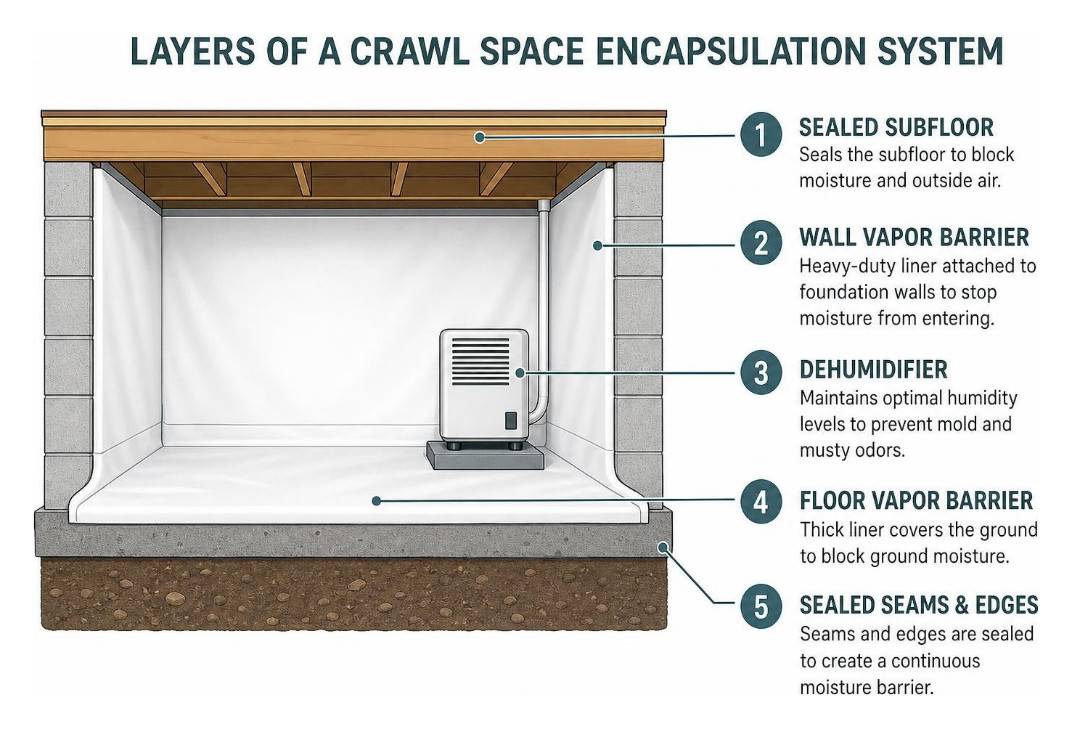
You can run a dehumidifier 24/7, but if your home is “leaky,” you are essentially trying to dry out the entire neighborhood. Focus on sealing gaps around windows, doors, and utility penetrations. If you have a crawl space, ensure it is properly encapsulated with a high-quality vapor barrier. This prevents ground moisture from rising into your home, which is one of the most common, yet overlooked, sources of summer humidity in older Baltimore rowhomes and suburban houses alike.
Method 5: Upgrading to Smart Thermostats and Digital Hygrometer Monitoring
You can’t manage what you don’t measure. A simple digital hygrometer—often costing less than $20—is an essential tool. Place one in your basement, one on the main floor, and one in an upstairs bedroom. If you want to take it a step further, modern smart thermostats can monitor humidity levels and, in some cases, communicate with your HVAC system to prioritize moisture removal over temperature control.
When to Consult a Professional HVAC Contractor
There are times when DIY efforts reach their limit. If you notice your AC is “short-cycling”—turning on and off rapidly—it may be oversized for your home. An oversized unit cools the air too quickly, meaning it doesn’t run long enough to effectively strip the moisture out of the air. A professional contractor can perform a load calculation to determine if your system is properly sized.
Addressing AC Sizing Issues and Persistent Airflow Imbalances
If your home has “hot spots” or rooms that feel consistently damp while others feel dry, you likely have an airflow imbalance. This can be caused by leaky, poorly insulated ductwork. When cold air travels through ducts located in hot, humid attics or crawl spaces, the temperature difference causes condensation to form on the outside of the ducts. This not only wastes energy but also creates a hidden source of moisture that can lead to mold growth inside your walls or ceilings.
Remedying Ductwork Condensation and Hidden Mold
If your ducts are “sweating,” it is a sign that they need better insulation or sealing. A professional HVAC technician can test your duct static pressure and apply professional-grade mastic or insulation to ensure your system is delivering conditioned air efficiently without losing its “cool” to the surrounding environment.
Frequently Asked Questions About Managing Indoor Summer Moisture
What is the ideal indoor humidity level for Baltimore homes during summer?
You should aim for 35% to 50% relative humidity. Staying within this range ensures your home is comfortable and discourages the growth of mold and dust mites.
Why does my AC run constantly without lowering indoor humidity?
This is often caused by a dirty evaporator coil, low refrigerant levels, or the “fan on” setting being active. If your coils are coated in dust, they cannot effectively condense moisture. If the system is low on refrigerant, it won’t get cold enough to perform its dehumidification duties.
Is a portable dehumidifier enough for a Baltimore basement or crawl space?
For a localized area like a basement, a high-quality portable unit can be very effective. However, if you are experiencing widespread moisture issues throughout the entire house, a whole-house solution is almost always more efficient and provides better long-term protection for your property.
Conclusion
Managing humidity in the Baltimore area is a year-round commitment, but it becomes particularly vital during our humid summers. By monitoring your levels, sealing your home’s envelope, and ensuring your HVAC system is optimized for moisture removal, you can transform your living space into a dry, comfortable sanctuary. If you find that your home is still struggling despite your best efforts, don’t hesitate to reach out to a professional. A small investment in expert maintenance today can save you from significant repair costs and health issues down the road.