
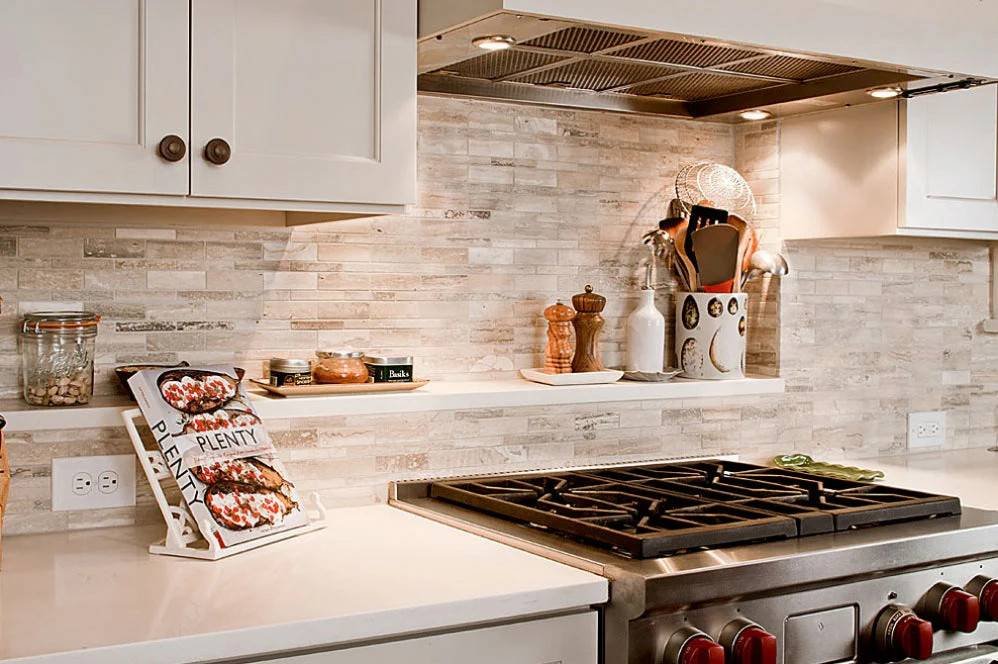

According to elitepropertymanagementsd.com, a kitchen backsplash covers 25 to 35 square feet on average. At $30 per square foot for designer tile and professional installation, the total is $750 to $1,050. At $2 per square foot for subway tile and a DIY weekend, the total is $50 to $175. The backsplash is the smallest surface in the kitchen — roughly 5% of the total square footage — and the one where a budget material installed correctly looks identical to a premium material to anyone who does not touch it. The difference between a $2 tile and a $30 tile is invisible from 3 feet away. It is visible only in the weight, the edge consistency, and the way the tile cuts under a saw — details the installer notices and the homeowner never sees again.
The budget backsplash strategy is not to find the cheapest version of the expensive tile you wanted. It is to choose a material whose inherent cost is low regardless of quality level — subway tile, peel-and-stick, beadboard — and install it with the same precision you would apply to expensive tile. A perfectly installed $2 subway tile backsplash looks custom. A poorly installed $30 handmade tile backsplash looks like a mistake. The material sets the ceiling. The installation sets the floor. The seven options below are ordered from lowest cost to highest, with the installation method and the durability expectation spelled out for each.
Peel-and-Stick Tile, $5 to $15 per Square Foot, Installed in an Afternoon
Peel-and-stick backsplash tiles are vinyl or gel-based tiles with an adhesive backing. They install without grout, without a wet saw, and without any skill beyond measuring and cutting straight lines with a utility knife. A standard 30-square-foot backsplash area costs $150 to $450 in materials and installs in an afternoon. The tiles adhere to a clean, smooth, dry surface, existing drywall, existing tile, or painted wallboard. The surface must be clean and free of grease. A kitchen wall above the stove that has accumulated cooking oil over years will reject the adhesive. Clean it with a degreaser, rinse it, and let it dry completely before starting.
The print quality on modern peel-and-stick tiles is dramatically better than the yellowed vinyl of the 1970s. Current products convincingly mimic subway tile, marble, encaustic cement tile patterns, and geometric designs. From 3 feet away, the illusion holds. From 6 inches away, the lack of grout depth and the visible seams between tiles are apparent. Peel-and-stick is a 2-to-5-year solution. The edges will lift in high-humidity areas, directly behind the sink, directly behind the stove, and the color may fade over time from cooking heat and UV exposure. It is the right choice for a rental kitchen, a budget flip, or a temporary solution while saving for real tile. It is not a 20-year backsplash.
Subway Tile, $2 to $5 per Square Foot, Timeless and DIY-Friendly
White 3-by-6-inch ceramic subway tile is the cheapest real tile backsplash material available. Individual tiles cost as little as $0.15 each, or roughly $2 per square foot. The grout, thinset mortar, trowel, spacers, tile cutter, and grout float add $50 to $100 in tools and supplies. The total material cost for a 30-square-foot backsplash is $110 to $250. The installation takes a weekend for a first-time tiler. Subway tile cuts with a snap cutter, a $25 tool that scores and snaps the tile, no wet saw required. The edges are self-spacing with built-in lugs that create a consistent 1/16-inch grout joint.
The pattern options for subway tile extend beyond the classic running bond (brick pattern). Stacked vertically, subway tile reads as modern and elongates the wall visually. Set in a herringbone pattern, it adds texture and movement but requires significantly more cutting and produces more waste. The running bond is the standard for a reason: it is the easiest to install, produces the least waste, and looks intentional in every kitchen from traditional to modern. The grout color changes the look entirely. White grout on white tile is clean and seamless. Dark gray or black grout on white tile creates a graphic, industrial look that highlights the grid pattern. Light gray grout is the safe middle ground that hides stains better than white and looks softer than black.
Beadboard, $1 to $3 per Square Foot, Cottage Charm Without Tile
Beadboard is not tile. It is a wood paneling product with vertical grooves milled into the surface, sold in 4-by-8-foot sheets at any home center. A single sheet covers 32 square feet, enough for most backsplashes, and costs $25 to $40. Cut to size with a circular saw or jigsaw, painted with a semi-gloss kitchen-and-bath paint, and nailed to the wall with finish nails, beadboard creates a cottage or farmhouse backsplash that costs under $100 total. The semi-gloss paint is essential, flat paint absorbs cooking grease and cannot be cleaned. Semi-gloss wipes clean with a damp cloth.
The limitation of beadboard is moisture. It is wood, and wood expands and contracts with humidity. The area directly behind the sink, where water splashes and sits on the horizontal edge of the countertop, must be sealed with a bead of silicone caulk along the bottom edge where the beadboard meets the countertop. Without the caulk, water wicks into the bottom edge, swells the wood, and eventually rots the panel from the bottom up. Beadboard is the right choice for a kitchen where the design language is cottage, farmhouse, or coastal and the budget is the absolute minimum. It is the wrong choice for a modern, minimalist, or industrial kitchen.
Painted Glass or Mirror Backsplash, $5 to $10 per Square Foot, Sleek and Modern
A single sheet of tempered glass, cut to size by a glass shop and painted on the back side with any paint color, creates a seamless, grout-free backsplash that reflects light and makes a small kitchen feel larger. The glass costs $150 to $300 for a 30-square-foot area, cut and tempered. The paint, applied to the back of the glass so the glossy front surface protects it from splashes, costs $10 to $30. The glass installs with mirror adhesive applied in vertical beads to the wall. There are no grout lines to clean, no seams for water to penetrate, and no surface easier to wipe down after cooking.
The limitation is the wall surface behind the glass. It must be perfectly flat. Any bump, drywall seam, or uneven patch will show through the glass as a distorted reflection. The wall must be skim-coated smooth or covered with 1/4-inch drywall before the glass is installed. The glass must be tempered, standard annealed glass will shatter from the heat of the stove. The edges must be polished, raw cut edges are sharp and dangerous. A glass backsplash is the most modern, easiest-to-clean option on this list. It is also the least forgiving of a poorly prepared wall. Per ENERGY STAR, pairing energy-efficient under-cabinet LED lighting with a reflective glass backsplash amplifies task lighting by 30% to 50%, reducing the need for overhead lights during food preparation.
Mosaic Tile Sheets, $3 to $8 per Square Foot, Maximum Impact per Dollar
Mosaic tile sheets, small tiles mounted on a mesh backing, cost $3 to $8 per square foot and install exactly like larger tile, with one advantage: the mesh backing eliminates the need to space individual tiles. The sheet sets the spacing. Mosaic sheets in hexagon, penny-round, arabesque, or picket shapes add visual complexity that a plain subway tile does not, for roughly the same material cost. The installation labor is slightly higher than subway tile because mosaics require more cuts around outlets and corners, and the sheets must be aligned carefully so the seams between sheets are invisible.
The budget play with mosaic tile is to use it as an accent, a single row of mosaic behind the stove or sink, with the surrounding area in plain subway tile. The mosaic row costs $30 to $80 in materials and reads as a custom design detail. The same mosaic covering the entire backsplash reads as busy and costs no more in materials but looks like the homeowner did not know when to stop. Less mosaic in the right place looks more expensive than more mosaic everywhere.
Shiplap, $2 to $4 per Square Foot, Farmhouse Texture on a Budget
Shiplap is horizontal wood boards with a gap, typically 1/8 inch, between each board, creating a shadow line that adds texture and visual width to the wall. Shiplap boards cost $2 to $4 per square foot and install with a nail gun over the existing drywall. The boards are painted with semi-gloss kitchen-and-bath paint before installation so the edges of the gap are painted, painting after installation leaves unpainted wood in the gap that will absorb moisture. The total cost for a 30-square-foot backsplash in shiplap is $60 to $120 in materials plus $20 to $40 in paint.
Shiplap shares beadboard’s vulnerability to moisture. The gap between boards is a trap for cooking grease splatter, and the horizontal orientation means water that drips down the wall runs along the board edge and into the gap. A clear silicone bead in the gap before painting reduces moisture penetration but eliminates the shadow line that is the visual point of shiplap. Shiplap is the right choice for a farmhouse or coastal kitchen. It is the wrong choice behind a stove or sink where grease and water exposure are constant. Use it on a side wall away from the cooking zone.
Painted Wall with a Splash Guard, Under $50, the Absolute Minimum
A painted wall behind the stove, protected by a stainless steel or tempered glass splash guard that covers the 30-inch width of the range, is the cheapest functional backsplash option available. The splash guard costs $30 to $80. The paint costs $20 to $40. The total is under $100. The splash guard protects the wall directly behind the burners. The adjacent areas, to the sides of the stove, behind the sink, are painted with a semi-gloss kitchen-and-bath paint that wipes clean. This is not a design statement. It is a functional stopgap that looks intentional if the rest of the kitchen is finished and the painted wall reads as a design choice rather than an unfinished project. It works in rental kitchens where the landlord prohibits permanent modifications. The splash guard removes without damaging the wall when the lease ends.
| Option | Cost/sq ft | 30 sq ft Total | DIY Difficulty | Lifespan |
| Peel-and-Stick | $5–$15 | $150–$450 | Very Easy | 2–5 years |
| Subway Tile | $2–$5 | $110–$250 | Easy–Moderate | 20+ years |
| Beadboard | $1–$3 | $30–$90 | Easy | 10–15 years |
| Painted Glass | $5–$10 | $150–$300 | Easy | 20+ years |
| Mosaic Tile Sheets | $3–$8 | $140–$290 | Moderate | 20+ years |
| Shiplap | $2–$4 | $60–$120 | Easy | 10–15 years |
| Painted Wall + Splash Guard | – | $50–$100 | Very Easy | 5–10 years |
Frequently Asked Questions
Is peel-and-stick backsplash worth it, or should I save for real tile?
Peel-and-stick is worth it as a 2-to-5-year solution. It transforms the appearance of an ugly or unfinished backsplash immediately for $150 to $450. It will not last 10 years. The edges will lift in high-humidity areas, and the color may fade from stove heat. If the alternative is a bare drywall backsplash that you cannot afford to tile for another year, peel-and-stick is the right answer today. If the alternative is financing the difference between $200 in peel-and-stick and $500 in subway tile, save the extra $300 and install real tile. The subway tile will still look good when the peel-and-stick would have been replaced twice.
Can I install a tile backsplash myself, or should I hire a pro?
Subway tile is the most DIY-friendly real tile backsplash. A first-time tiler can complete a 30-square-foot subway tile backsplash in a weekend with $50 to $100 in tools and no prior experience. The key skills are patience with leveling the first row and willingness to pull off a tile that is crooked and reset it. Tile installation is not talent-dependent. It is patience-dependent. Mosaic sheets, glass tile, and complex patterns benefit from professional installation, the cutting is harder, the alignment is less forgiving, and the materials are more expensive to replace if the first attempt fails. Professional backsplash installation costs $8 to $15 per square foot for labor, or $240 to $450 for a 30-square-foot area.