
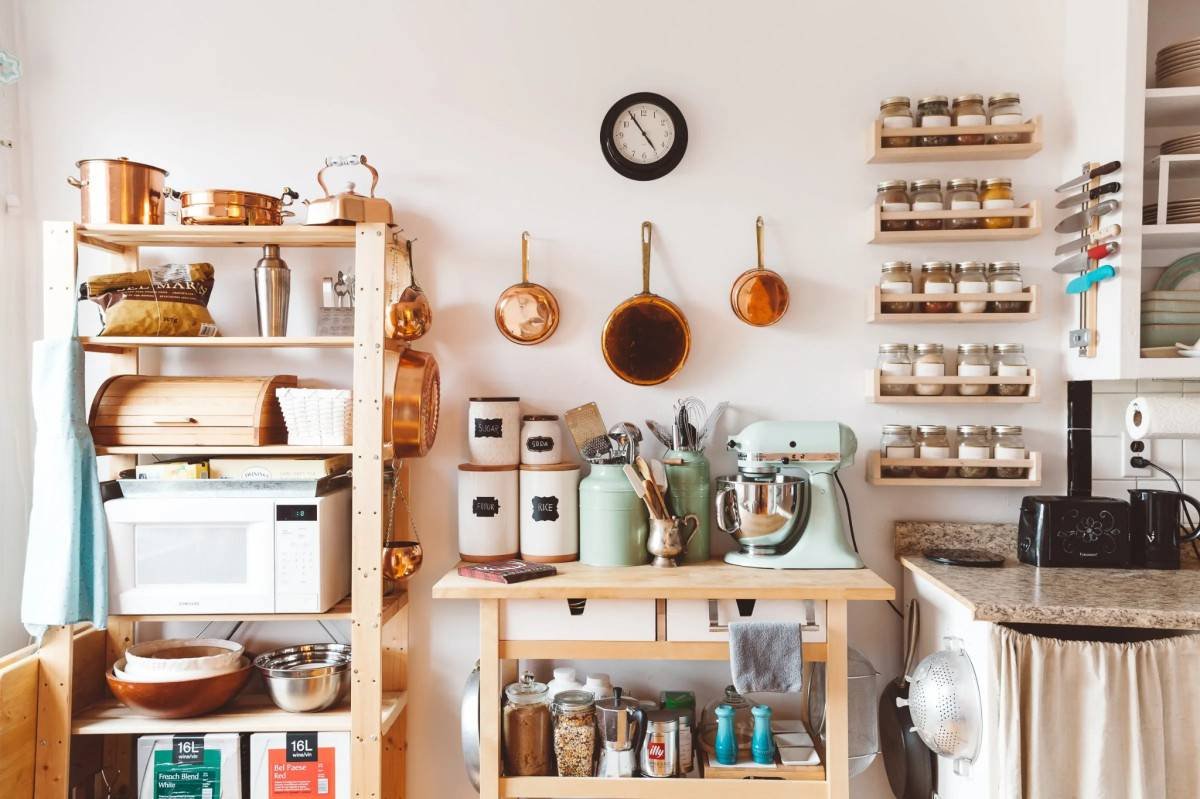

This guide covers budget-friendly kitchen storage options — from roll-out trays to tiered risers. The most budget-friendly kitchen storage upgrade is a set of roll-out trays that slide into an existing base cabinet — the kind with a wire or wood frame on ball-bearing slides that screw to the cabinet floor and pull out to reveal every pot, pan, and lid that was previously lost in the dark back corner. The roll-out trays cost $30 to $80 each for a standard 20- to 24-inch-deep base cabinet. A kitchen with 12 base cabinets can be fully upgraded for $360 to $960. The trays double the accessible storage volume of each cabinet — from roughly 50% accessible to 95% accessible — without adding a single square foot of new cabinetry. The trays are the most impactful storage upgrade per dollar spent. The trays do not add storage space. The trays make the existing storage space usable. The usable space is the space you can reach without kneeling on the floor and reaching into the dark. The reachable space is the space you use. The unreachable space is the space you avoid. The roll-out trays convert avoided space into used space. The conversion costs $50 per cabinet. The conversion is worth it every time you open a base cabinet and the pots come to you.
Kitchen storage is the most common complaint in a kitchen of any age. The cabinets are full. The countertops are cluttered. The pantry is a disaster. The fix is not more cabinets — more cabinets cost $8,000 to $18,000. The fix is better use of the cabinets you already have. The better use is organization products — roll-out trays, shelf risers, over-the-door racks, cabinet door organizers, tiered pull-out shelves, and drawer dividers. The products cost $10 to $100 each. A fully organized kitchen costs $300 to $1,500 in total. The organized kitchen feels larger because the storage is efficient. The efficient storage holds more in the same space. The same space is the cabinets you already own. The cabinets you already own are free. The organization products are the investment. Here are the products, in order of impact per dollar.
Budget Kitchen Storage Options, Ranked by Impact
| Product | Cost Per Unit | What It Solves | Installation |
| Roll-out trays for base cabinets | $30 – $80 | Pots and pans lost at back of cabinet | Screw to cabinet floor, 15 min per cabinet |
| Tiered shelf riser for upper cabinets | $15 – $30 | Plates, bowls, and mugs stacked inefficiently | Set in place, no installation |
| Cabinet door-mounted organizer rack | $10 – $25 | Lids, cutting boards, plastic wrap boxes | Hook over door or screw to door interior |
| Spice drawer insert (tiered) | $15 – $40 | Spices in a jumble, cannot find the cumin | Set in drawer, measure drawer first |
| Over-the-sink dish drying rack | $30 – $60 | Dish rack taking up counter space | Set across sink, no installation |
| Magnetic knife strip (wall-mounted) | $15 – $30 | Knife block on counter consuming workspace | Screw to wall, 10 minutes |
| Can rack organizer (first-in, first-out) | $20 – $40 | Cans buried at back of pantry shelf | Set on shelf, no installation |
| Stackable drawer dividers (adjustable) | $10 – $25 per set | Utensil drawer chaos | Set in drawer, measure drawer first |
Roll-Out Trays, the Single Best Investment
A roll-out tray in a base cabinet converts a two-shelf, dark-hole storage system into a two-drawer system where every item is visible and reachable, highlight Keyrenter West Seattle specialists. The tray extends on ball-bearing slides rated for 75 to 100 pounds, heavy enough for a stack of cast-iron pans or a full set of dinner plates. The tray stops at full extension, no tipping, no falling out of the cabinet. The tray slides back into the cabinet with a push. The tray is the drawer that should have been in the cabinet when it was built. The tray is the retrofit that makes the cabinet work like it should have worked from the beginning.
Roll-out trays are available in wire, $30 to $50, or wood, $50 to $80. Wire trays are lighter, less expensive, and allow air circulation, good for produce, bread, and pantry items. Wood trays are heavier, more expensive, and provide a solid surface, good for pots and pans, small appliances, and plates. The wire tray is the budget choice. The wood tray is the premium choice. Both work. Both pull out. Both bring the contents to you. The difference is the material and the cost. The function is the same. The function is the pull-out. The pull-out is the accessibility. The accessibility is the reason the $50 tray is worth $500 in perceived cabinet value. The perceived value is the user experience. The user experience is the smooth glide of the tray extending fully from the cabinet. The smooth glide is the daily satisfaction. The daily satisfaction is the return on the $50.
The National Association of Home Builders (NAHB) identifies kitchen storage as one of the top buyer priorities in new homes and remodels. An organized kitchen with pull-out shelving, tiered storage, and drawer organizers signals an efficient, well-maintained home. The organization products cost $300 to $1,500. The perceived value to a buyer exceeds the cost. The buyer opens a base cabinet, sees a roll-out tray, and thinks “this kitchen was designed for how people actually cook.” The thought is the value. The thought costs $50 per tray. The thought is worth multiples of the cost.
Pantry and Cabinet Organization, Tiered and Vertical Solutions
Tiered shelf risers, $15 to $30 each, turn a single shelf into two tiers of storage. Plates go on the bottom. Bowls go on the top. The bowls are visible above the plates. No stacking. No reaching. No unstacking a tower of salad plates to get to the dinner plates underneath. The riser is a wire or plastic frame that sits on the existing shelf. The riser requires no installation. The riser doubles the usable surface area of the shelf. The riser is the cheapest storage upgrade with zero installation. The riser costs $20. The riser reclaims a shelf that was stacked three items deep. The three items deep required unstacking to reach anything. The unstacking is the frustration. The riser eliminates the frustration. The elimination is the value. The value is $20.
Cabinet door-mounted organizers, $10 to $25, mount to the inside of the cabinet door and hold lids, cutting boards, pot holders, plastic wrap boxes, or cleaning supplies. The inside of the door is dead space. The organizer fills the dead space. The dead space is 2 to 3 inches deep. The organizer is 2 to 3 inches deep. The organizer is sized to fit without interfering with the shelves when the door is closed. The organizer is the most efficient use of the most overlooked space in a kitchen cabinet. The space is the door interior. The door interior is free. The organizer costs $15. The organizer holds the lids that had no home. The lids that had no home were piled in a jumble on the bottom shelf. The jumble is gone. The lids are organized. The organization costs $15.
Countertop Decluttering, Taking Storage Off the Work Surface
The most budget-friendly way to reclaim counter space is to move things off the counter and onto the wall or into the cabinet. A magnetic knife strip mounted to the wall, $15 to $30, eliminates the knife block. The knife block occupies roughly 6 by 8 inches of counter space, 48 square inches. The magnetic strip occupies zero counter space. The knives are on the wall. The knives are visible. The knives are accessible. The knife block is in a cabinet or the trash. The counter is clear. The 48 square inches of cleared counter space is the return on the $20 strip. The counter space is the most valuable real estate in the kitchen. The $20 strip reclaims the 48 square inches. The 48 square inches is a plate, a cutting board, or a prep zone. The prep zone is the workspace. The workspace is the function. The function is the reason the kitchen exists. The $20 strip buys 48 square inches of function. The function is the return.
An over-the-sink dish drying rack, $30 to $60, eliminates the dish rack from the counter. The rack spans the sink. The dishes drip into the sink. The counter is clear. The rack is the bridge between the sink and the cabinet. The bridge holds dishes while they dry. The bridge is removed and stored when not in use. The bridge is temporary. The cleared counter is permanent. The cleared counter is the workspace. The workspace is the prep area. The prep area is where the cooking happens. The cooking happens in the cleared space. The cleared space was the dish rack. The dish rack is now over the sink. The $40 bridge bought the counter space. The counter space is the return.
Frequently Asked Questions
What is the cheapest way to add storage to a kitchen?
Roll-out trays inside existing base cabinets are the best value at $30 to $80 per cabinet. Tiered shelf risers are the cheapest at $15 to $30 each, zero installation, doubles shelf space. Cabinet door-mounted organizers reclaim the dead space on the inside of doors for $10 to $25 each. A fully organized kitchen costs $300 to $1,500 total.
Can I add roll-out shelves to my existing cabinets without replacing them?
Yes, aftermarket roll-out trays screw to the cabinet floor and slide on ball-bearing rails. The trays are available in standard widths, 12, 15, 18, 21, and 24 inches, to fit most stock and semi-custom cabinets. Installation takes 15 minutes per tray with a drill and a screwdriver. Measure the interior width of the cabinet before ordering. The tray must be 1 to 2 inches narrower than the cabinet opening to clear the hinges and the door.
How do I organize a small kitchen without a pantry?
Convert a base cabinet or an upper cabinet into a pantry using roll-out trays for the base and tiered shelf risers for the upper. Use cabinet door-mounted racks for spices and small jars. Install a magnetic knife strip to free counter space. Use stackable drawer dividers to organize utensils and gadgets. A single upper cabinet organized with risers can hold the equivalent of a small pantry. The risers are the key. The risers cost $60 for four cabinets. The risers are the pantry.
How much do custom pull-out shelves cost compared to aftermarket trays?
Aftermarket roll-out trays cost $30 to $80 each and are installed by the homeowner in 15 minutes. Custom pull-out shelves built by a cabinetmaker or a closet company cost $150 to $400 each and are professionally installed. The aftermarket trays are the budget option. The custom shelves are the premium option. Both pull out. The difference is the fit, custom shelves are built to the exact width of the cabinet, with no side gaps, and the slide quality. The aftermarket trays are the 80% solution at 20% of the cost.
What is the best budget way to organize a corner kitchen cabinet?
A lazy Susan, a rotating circular shelf, costs $30 to $60 and makes the contents of a corner cabinet accessible without reaching into the dark triangle of wasted space. The lazy Susan sits on the existing shelf and rotates. The items on the back half rotate to the front. The front is accessible. The back was inaccessible. The lazy Susan makes the back accessible. The lazy Susan is the $40 solution to the corner cabinet problem. The problem is the reaching. The solution is the rotation. The rotation brings the item to you.
Should I buy kitchen storage products online or at a home improvement store?
Online retailers offer a wider selection of specialized sizes, particularly for narrow cabinets and corner cabinets, and user reviews that identify which products fit which cabinet brands. Home improvement stores offer the advantage of measuring in person and returning immediately if the product does not fit. The strategy: measure every cabinet, order one of each product type online to test fit, then order the remaining quantities once the fit is confirmed. The test order is the insurance against buying 12 trays that do not fit. The test order costs one week of patience. The patience saves the return of 11 wrong-sized trays.
The Storage You Already Own
Roll-out trays in every base cabinet, $360 to $960 for 12 cabinets. Tiered shelf risers in every upper cabinet, $90 to $180 for 6 cabinets. Cabinet door organizers for lids, cutting boards, and cleaning supplies, $30 to $75 for 3 doors. A magnetic knife strip on the wall, $20. An over-the-sink dish rack, $40. The total is $500 to $1,300 for a fully organized kitchen. The kitchen has the same number of cabinets it had before. The kitchen holds 30% to 50% more, because every cabinet is now fully accessible. The accessibility is the capacity. The capacity is the storage. The storage is the organization. The organization is the products. The products are the budget. The budget is $500 to $1,300. The budget is the cost of the products. The products are the storage. The storage was already there, inside the cabinets, in the back corners, behind the items you use every day. The products brought the back corners to the front. The back corners are now accessible. The accessible storage is the storage you use. The used storage is the value. The value is the kitchen that holds more without adding cabinets. The cabinets are the same. The storage is increased. The increase is the products. The products are the investment. The investment returns storage. The storage returns a kitchen that works. The kitchen that works is the kitchen where you can find the cumin. The cumin is in the tiered spice drawer insert. The insert cost $20. The cumin is found. The search is over. The value is $20. Ever opened a kitchen cabinet, reached for a pot at the back, and knocked over a tower of lids that had been leaning against the cabinet wall since the day they were moved in — and thought “I need to organize this cabinet”? The thought was correct. The organization took 15 minutes and a $45 roll-out tray. The tray was screwed to the cabinet floor. The pots went on the tray. The lids went in a door-mounted rack. The lids no longer lean. The pots slide out. The cabinet is organized. The $45 was the cost. The organized cabinet is the return. The return is daily — the drawer that opens smoothly and shows every pot. And for the items that have no cabinet to go back to — the duplicate appliances, the seasonal equipment, the things that were moved out to make this system work — storage units Whitby offer an affordable offsite option so the kitchen stays organized permanently rather than just until the next influx.
