
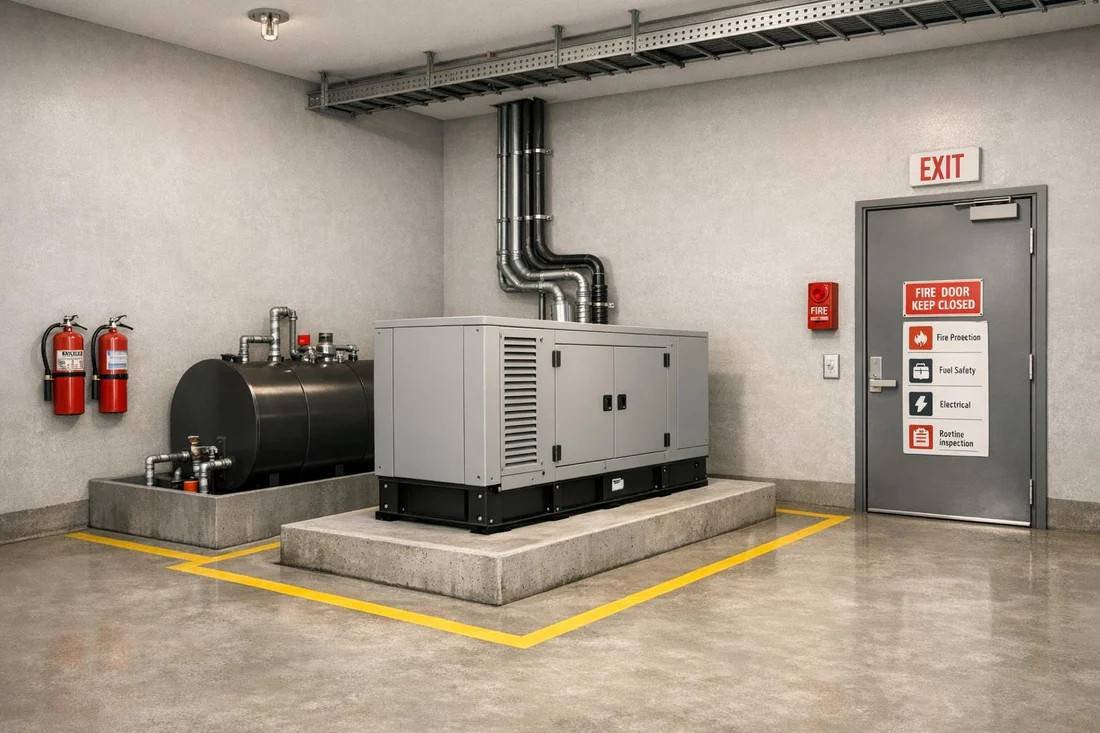

A permanently installed standby generator is not an appliance. It is a power plant on a concrete pad in your backyard, and the National Electrical Code treats it accordingly. The installation is governed by at least five separate code articles — NEC 700 (Emergency Systems), 701 (Legally Required Standby), 702 (Optional Standby), NFPA 37 (Stationary Engines), and Chapter 4 of the International Fuel Gas Code for natural gas and propane connections — plus local building code amendments that vary by city, county, and state, notes Chubbuck Property Management Company. Missing any one of these requirements means a failed inspection, a denied permit, or, in the worst case, carbon monoxide entering the house through a window the installer placed the generator too close to.
Generator installations fail inspection more often than they pass on the first attempt. The most common reasons: the generator is too close to a window or door, the transfer switch is undersized or missing entirely, the gas line was not permitted separately, or the electrical disconnect is not within sight of the generator. Each of these is a code requirement that exists because someone died, a house burned down, or a utility lineman was electrocuted by backfeed from an improperly connected generator. The code is a memorial to past disasters. The requirements below are the ones that apply to every residential standby generator installation in the United States, regardless of jurisdiction.
Placement and Clearance — The 5-Foot Rule and What It Protects
The most fundamental generator placement rule in the NEC and NFPA 37 is the 5-foot clearance from any opening in the building. The generator exhaust must be at least 5 feet from any window, door, vent, crawlspace opening, or fresh-air intake. This is a carbon monoxide safety requirement. Generator exhaust contains carbon monoxide at concentrations that can be lethal within minutes in an enclosed space. A generator placed 4 feet from a bedroom window can fill that bedroom with CO while the occupants sleep. Five feet is the minimum. Some jurisdictions require greater distances for specific window types or for generators above a certain kilowatt rating.
The second placement rule is 18 inches of clearance from the back and sides of the generator to any combustible wall or obstruction. This is a cooling and fire safety requirement. Generators produce significant heat during operation — the engine and alternator need airflow to dissipate it. Placing a generator tight against a vinyl-sided wall will melt the siding within an hour of continuous operation. The 18-inch clearance applies to the generator housing, not the exhaust outlet, which has its own clearance requirements based on the manufacturer’s specifications. The manufacturer’s installation manual is legally part of the code — NEC 110.3(B) requires that equipment be installed according to the manufacturer’s instructions, and the inspector will check the manual against the installation.
Additional placement requirements that vary by jurisdiction include elevation above the floodplain (common in coastal areas under FEMA and Florida Building Code requirements), wind resistance ratings for hurricane zones, and property-line setbacks enforced by local zoning rather than electrical code. The generator pad must be a level concrete surface or a prefabricated composite pad rated for the generator’s weight plus vibration. A generator placed on dirt will sink, tilt, and eventually damage the fuel line connection.
Transfer Switch, The Non-Negotiable Requirement
Every permanently installed generator connected to a building’s electrical system must have a transfer switch. NEC 702.5 makes this explicit. The transfer switch serves one purpose: it physically isolates the generator from the utility grid so that generator power cannot backfeed onto the utility lines and electrocute a lineman working to restore power. A generator connected to the house wiring without a transfer switch, for example, by backfeeding through a dryer outlet with a homemade cord, is illegal, dangerous, and the most common cause of generator-related utility worker fatalities.
There are two types of transfer switches: automatic and manual. An automatic transfer switch (ATS) senses the loss of utility power and switches to generator power within seconds, then switches back when utility power is restored. A manual transfer switch requires a person to physically throw the switch after starting the generator. The choice between automatic and manual determines how the generator is sized relative to the load.
The sizing rules are in NEC 702.4(B). For a manual transfer switch, the generator must be sized to handle the full connected load that the homeowner chooses to run during an outage. The homeowner manually selects which circuits to energize by switching individual breakers, so the generator only needs to be large enough for the circuits that are switched on simultaneously. For an automatic transfer switch, the sizing rules differ depending on whether a load management system is installed. Without load management, the generator must be sized to handle the entire connected load, every circuit that could run simultaneously, because the ATS transfers all connected circuits at once with no human intervention to shed load. With a load management system that automatically sheds non-essential loads when the generator approaches capacity, the generator can be sized to a lower rating because the management system prevents overload.
The transfer switch must be rated for the application. A service-entrance-rated transfer switch includes a main breaker and serves as the first disconnect between the utility and the building. A non-service-entrance transfer switch installs between the main panel and a subpanel and requires the main breaker to remain upstream. The difference determines whether the transfer switch is installed at the meter or at a subpanel location inside the house.
Electrical Requirements, Disconnect, Grounding, and Conductor Sizing
The generator must have a disconnect switch within sight of the generator and no more than 50 feet away, per NEC 445.18. This allows emergency responders and utility workers to shut down the generator without entering the building. The disconnect must be clearly labeled as the generator disconnect.
Generator grounding and bonding follow NEC 250. A separately derived system, where the generator’s neutral is not connected to the building’s neutral, requires its own grounding electrode (a ground rod driven near the generator). A non-separately derived system, where the generator neutral is bonded to the building neutral at the transfer switch, uses the building’s existing grounding electrode system. The distinction matters because an incorrectly bonded neutral creates a ground-fault current path that can energize the generator frame, creating a shock hazard. The manufacturer’s installation manual and the transfer switch wiring diagram specify which configuration is correct for that specific generator model.
Conductors between the generator and the transfer switch must be sized for the generator’s rated output at 125% of the full-load current, per NEC 445.13 for generators with overcurrent protection. If the generator does not have integral overcurrent protection, the conductors must be sized to 115% of the generator rating and protected by a breaker at the generator or at the first point of connection. For a 22-kilowatt generator on a 240-volt single-phase system, the full-load current is roughly 92 amps, and the conductors must be rated for at least 115 amps. The actual wire gauge depends on the conductor material (copper or aluminum), the insulation temperature rating, and the distance between the generator and the transfer switch, voltage drop over a long run may require upsizing the conductors beyond the minimum ampacity requirement.
Per the EPA, building code compliance for permanently installed equipment, including generators, is not just a legal requirement but a critical safety measure, as improper installations of combustion equipment are a leading cause of residential carbon monoxide incidents annually.
Fuel Gas Requirements, A Separate Permit and a Separate Inspection
A generator powered by natural gas or propane requires a fuel gas permit in addition to the electrical permit. The gas line is governed by the International Fuel Gas Code (IFGC) Chapter 4 or the equivalent state fuel gas code. The gas pipe must be sized to deliver the generator’s full-load BTU rating at the required inlet pressure, accounting for the pressure drop across the entire pipe run from the meter or tank to the generator. Undersized gas piping is the most common reason a generator fails to start under load, the engine cranks, fires, and then stalls because it cannot draw enough fuel to maintain the electrical output.
The gas line requires a dedicated shutoff valve within 6 feet of the generator and outside the generator housing, per IFGC 409.5. The valve must be accessible without entering the generator enclosure. Flexible gas connectors listed for outdoor use and rated for the generator’s vibration are required between the rigid gas pipe and the generator connection point. A rigid pipe connection will crack from vibration within the first year of operation.
The gas piping must be pressure-tested before connection to the generator, and the test must be witnessed by the inspector. The test pressure and duration are specified by the local fuel gas code, typically 15 PSI for 15 minutes for residential installations. The gas permit is separate from the electrical permit, and both must be closed before the generator installation is considered complete.
| Code Section | Requirement | Consequence If Missed |
| NFPA 37 / NEC 445 | 5 ft from openings, 18 in from walls | CO risk, failed inspection |
| NEC 702.5 | Transfer switch required | Backfeed hazard, illegal |
| NEC 702.4(B) | Generator sizing per transfer type | Overload, generator shutdown |
| NEC 445.18 | Disconnect within sight, ≤50 ft | Emergency responder risk |
| NEC 250 | Grounding and bonding per system type | Shock hazard, fault current risk |
| NEC 445.13 | Conductors at 115-125% of rated current | Overheated wires, fire risk |
| IFGC 409.5 | Gas shutoff within 6 ft of generator | Failed gas inspection |
| NEC 110.3(B) | Per manufacturer instructions | Failed inspection, voided warranty |
Permit and Inspection, The Sequence That Gets It Approved
A generator installation requires at minimum an electrical permit and, for gas-powered generators, a fuel gas permit. Some jurisdictions also require a building permit for the concrete pad, especially if the generator is large enough to be considered a permanent structure. The permit application must include a site plan showing the generator location with measurements to all nearby openings, property lines, and structures; an electrical riser diagram showing the meter, panel, transfer switch, disconnect, and generator with conductor sizes and conduit types; a load calculation per NEC Article 220 demonstrating that the generator is sized appropriately for the connected load; and the generator and transfer switch manufacturer specification sheets.
The inspection sequence typically involves a footing inspection for the concrete pad (if required), a rough-in inspection for the electrical conduit and gas piping before they are covered, and a final inspection after the generator is installed and operational. The final inspection confirms placement clearances, proper transfer switch operation, grounding and bonding, gas leak testing, and the required signage, a placard at the service entrance identifying the location and type of on-site generator, per NEC 702.7. The placard tells firefighters and utility workers that a generator is present before they cut into walls or touch wires they assume are de-energized.
Frequently Asked Questions
Do I need a permit to install a portable generator with a manual transfer switch?
Yes. The generator itself is portable and does not require a permit, but the transfer switch installation and the electrical inlet box it connects to are permanent modifications to the building’s electrical system and require an electrical permit. The transfer switch is hardwired into the panel, and the inlet box is a permanently installed exterior receptacle. Both are covered by NEC requirements for permanently installed equipment. The permit covers the transfer switch and inlet, not the portable generator that plugs into them.
How far does a generator need to be from the house?
The minimum is 5 feet from any window, door, or ventilation opening per NFPA 37 and NEC requirements. This is a carbon monoxide safety minimum. The manufacturer’s installation manual may specify a greater distance for specific models. Local building codes may impose additional setbacks, some jurisdictions require 10 feet, especially for generators above 20 kilowatts. The generator must also be at least 18 inches from any combustible wall surface and positioned so that prevailing winds do not direct exhaust toward occupied areas of the house or neighboring properties.
Can I connect a generator to my house without a transfer switch?
No. Connecting a generator directly to house wiring without a transfer switch, by any method, including backfeeding through an outlet, is a violation of NEC 702.5 and is illegal in every U.S. jurisdiction. The transfer switch is the mechanism that prevents generator power from flowing back onto the utility grid, where it can electrocute utility workers restoring power. A generator interlock kit installed on the main panel is an acceptable alternative to a separate transfer switch in many jurisdictions, it mechanically prevents the main breaker and the generator breaker from being on simultaneously, but the interlock must be listed for the specific panel model and installed according to the manufacturer’s instructions.
How much does it cost to install a generator to code?
The generator hardware for a whole-house standby unit ranges from $4,000 to $8,000 for a 20 to 26-kilowatt air-cooled unit. The automatic transfer switch adds $600 to $1,200. Installation, concrete pad, electrical conduit and wiring, gas line, permits, runs $3,000 to $6,000. The total installed cost for a code-compliant 22-kilowatt standby generator is $8,000 to $15,000 depending on the distance from the gas meter, the distance from the electrical panel, the complexity of the transfer switch integration, and local permit and inspection fees. Portable generator installations with a manual transfer switch and inlet box cost $500 to $1,500 for the electrical work plus the cost of the generator itself.