

A concrete waterproofing sealer is either a water repellent or a true waterproofer, and the label rarely admits which. Repellents like silane and siloxane shed rain from driveways and patios; only cementitious and crystalline products stand up to water pushing through a basement wall.
That one distinction sorts the whole shelf. Buy by the problem in front of you: falling water on a horizontal slab is a repellent job, water under pressure from soil is a waterproofer job, and a product marketed for one will quietly fail at the other.
Sealer vs Waterproofer: The Difference That Matters
A sealer keeps liquid water from soaking into the surface while letting the slab breathe; a waterproofer resists hydrostatic pressure, the constant push of water in saturated soil against buried concrete. The chemistry is different, the failure modes are different, and the words get used interchangeably by everyone selling both.
The test is which side of the water you are on. A patio gets rained on, and the water leaves; any quality penetrating sealer wins there. A basement wall holds back wet earth around the clock, and a surface repellent on its inside face does close to nothing; that wall needs a cementitious coating or crystalline treatment that bonds into the concrete, and past a point, exterior drainage instead of chemistry.
The Four Types, Sorted
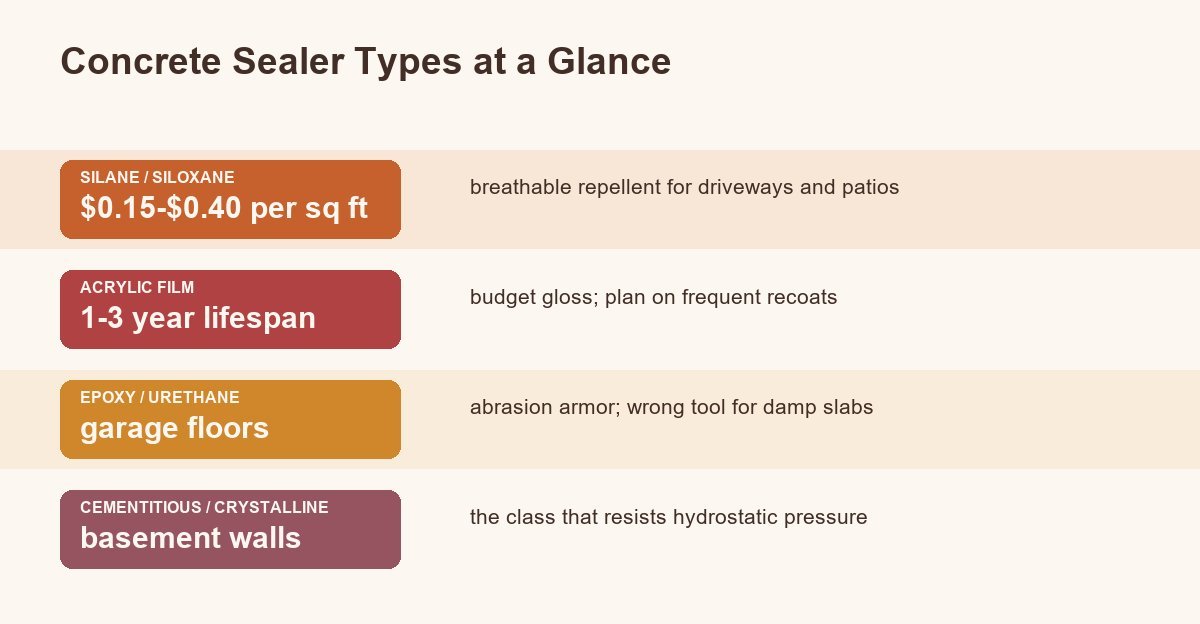
| Type | Where it belongs | Lifespan | What it will not do |
|---|---|---|---|
| Silane/siloxane (penetrating) | Driveways, patios, walkways, exposed aggregate | 7–10 years | No gloss, no film; will not bridge cracks |
| Acrylic (film) | Decorative and colored concrete needing sheen | 1–3 years | Wears fast under tires; recoat cycle never ends |
| Epoxy/polyurethane (film) | Garage and shop floors | 5–10 years | Traps moisture in damp slabs; peels without prep |
| Cementitious/crystalline (waterproofer) | Basement and retaining walls, tanks, below grade | 10+ years | No cosmetic finish; will not fix active leaks at cracks |
Veteran applicators land on the same conclusion from the field side. Exterior restoration contractor Scott Paul, who has tested sealers for three decades at Concrete Sealer Review, puts it flatly: no single product wins every situation, and type-to-surface matching decides the outcome before brand ever enters it. The failure gallery behind that rule is specific: solvent acrylics blushing white over damp slabs, epoxy lifting off exterior aprons in sheets, repellents disappearing into old porous concrete that wanted double the coverage rate. Type first, brand second.
Match the Product to the Surface
Outdoor flatwork in freeze-thaw country wants a penetrating silane/siloxane: it repels the water that would otherwise freeze inside the pores and spall the surface, without changing the look or making the slab slick. Garage floors take epoxy or urethane for abrasion, with the caveat that a slab reading damp underneath will push any film coating off. Basements get the waterproofer class on interior walls, and Ghostshield’s guidance matches the industry default: below-grade water problems get solved on the wet side or with drainage when coatings alone keep losing.
Application has a weather window.
The 50°F-to-85°F range on clean, fully dry concrete comes up in every professional spec sheet for a reason: sealer applied to a damp or hot slab flashes, blotches, or fails adhesion, and the redo costs more than the first coat.
What No Sealer Fixes: Cracks and Joints
Every season, homeowners point at cracked concrete and reach for a jug of sealer, and the most-upvoted version of that reflex reads like this:
“This is the concrete outside my garage foundation. Do I need to seal these cracks in prep for winter weather? If so, what is the best way?”
– r/HomeMaintenance, October 2025 (110 upvotes)
The tradespeople in the replies never say sealer, because pourable sealers have no ability to span a moving gap. Cracks and joints get a flexible polyurethane caulk, and the specific recommendation repeats across threads:
“I wouldn’t use self leveling material here because the Concrete isn’t level. I would use a sika flex 1a. The color “stone” would match this well. Once the materials tooled out, sprinkle some play sand on it and lightly rub it. Let cure for 24 hrs”
– r/HomeMaintenance, October 2025 (28 upvotes)
The working order for any slab: caulk the cracks and joints first, let them cure, then seal the field. Sealing over open cracks waterproofs everything except the paths water was using in the first place. The $8 tube is the cheapest step in the whole project and the one that decides whether the $50 gallon accomplishes anything. And a basement wall leaking at a crack under pressure is past both products; that is injection or drainage territory.
What It Costs to Do a Slab
Penetrating sealers cover about 150 to 300 square feet per gallon depending on how porous the surface is, and quality silane/siloxane products retail around $30 to $60 per gallon. A 500-square-foot driveway lands near $60 to $200 in material for the recommended two wet-on-wet coats, an afternoon with a pump sprayer, and a 7-to-10-year interval before it needs thinking about again.
The pattern to avoid is the cheap-acrylic treadmill: a $20 jug that looks glossy for a season, wears through in tire paths by year two, and needs stripping before anything better goes on. Across a decade the bargain product gets bought five times, and the stripping labor between coats costs more per square foot than the quality sealer would have. Where the slab shows from the street, buy once.
Concrete Waterproofing Sealer FAQ
What is the best waterproof sealant for concrete?
Silane/siloxane penetrating sealer is the best waterproofing product for outdoor slabs, and cementitious or crystalline coatings are the best for walls holding back soil. For cracks and joints, the best product is not a sealer at all but a polyurethane caulk like Sikaflex.
Can you seal concrete to be fully waterproof?
Against rain and surface water, yes; a penetrating sealer makes a slab shed water for years. Against sustained hydrostatic pressure, surface sealers cannot; that calls for crystalline or cementitious waterproofing bonded into the concrete, and for serious pressure, exterior drainage.
What works on basement walls?
Interior basement walls take a cementitious waterproof coating or crystalline treatment, applied to bare, clean masonry after any active leaks are addressed. Surface prep is most of the job: coatings brushed over old paint or efflorescence peel within seasons, which is where most basement-sealer disappointment comes from. Wire-brush to bare block, treat the white mineral bloom, then coat.
How often does concrete need resealing?
Penetrating silane/siloxane lasts about 7 to 10 years, film-forming acrylics 1 to 3, and epoxy floors 5 to 10 depending on traffic. The sprinkle test gives the reapply signal: water that soaks in and darkens the slab instead of beading means the sealer is done.