
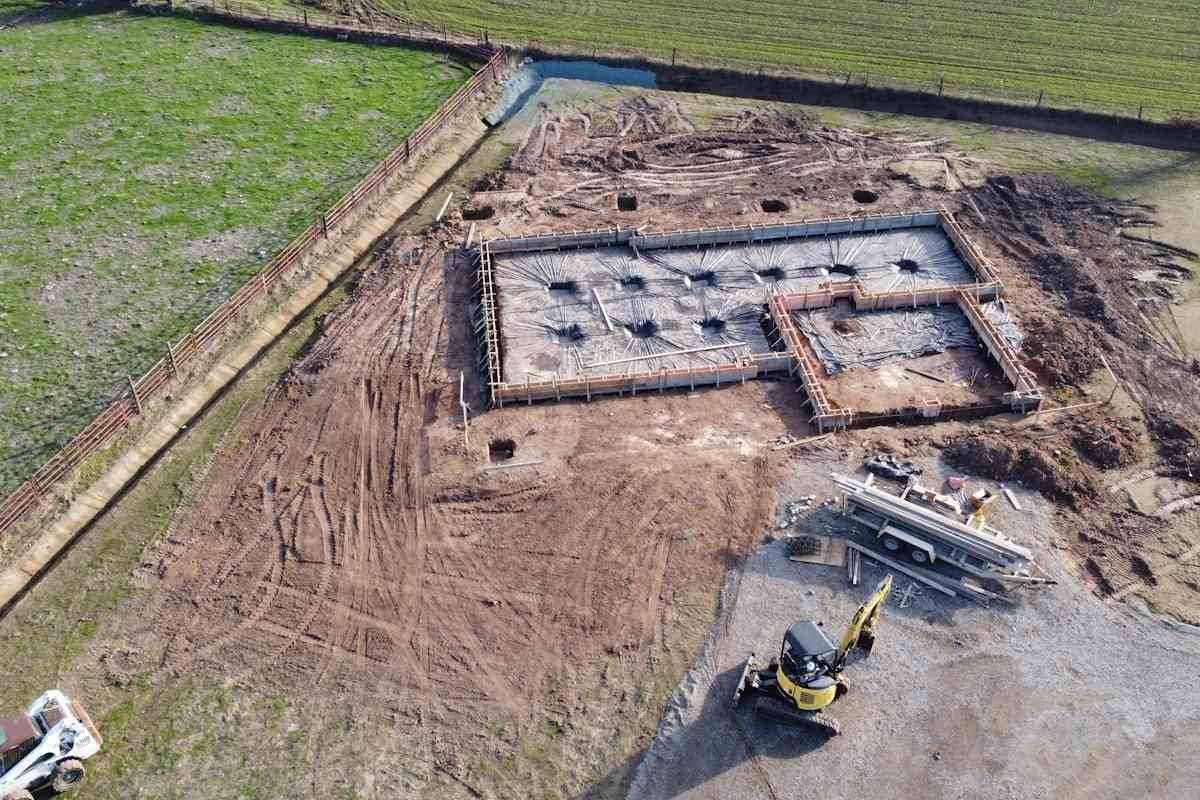

A french drain collects water and moves it by gravity; a sump pump ejects water that gravity cannot take anywhere. They solve different halves of the same problem, which is why wet basements so often end up with both.
The two systems get framed as rivals by contractors who happen to sell one of them. The useful framing is a single site question: from the spot where water gathers, can a pipe slope continuously downhill to daylight, a storm drain, or a dry well? If yes, gravity does the work for decades without a moving part. If no, electricity has to lift the water out, and that is pump territory.
What Each System Does
A french drain is a gravel trench with perforated pipe at the bottom, wrapped in filter fabric. Water in saturated soil enters through the perforations and follows the pipe’s slope away. Outdoors it intercepts surface and subsurface water before the foundation; indoors, run under the basement slab edge, it collects what rises against the footing.
A sump pump sits in a pit at the low point. Groundwater seeps or drains into the pit, a float switch trips, and the pump pushes the water up and out through a discharge line. It moves impressive volumes, and it needs power, a working switch, and a maintained impeller every time a storm arrives.
The combination is not a compromise; it is how basement waterproofing is normally engineered. An interior perimeter drain does the collecting, the pit does the concentrating, and the pump does the lifting. Asking drain-or-pump for a chronically wet basement is like asking gutters or downspouts.
Cost: Why Published Numbers Disagree
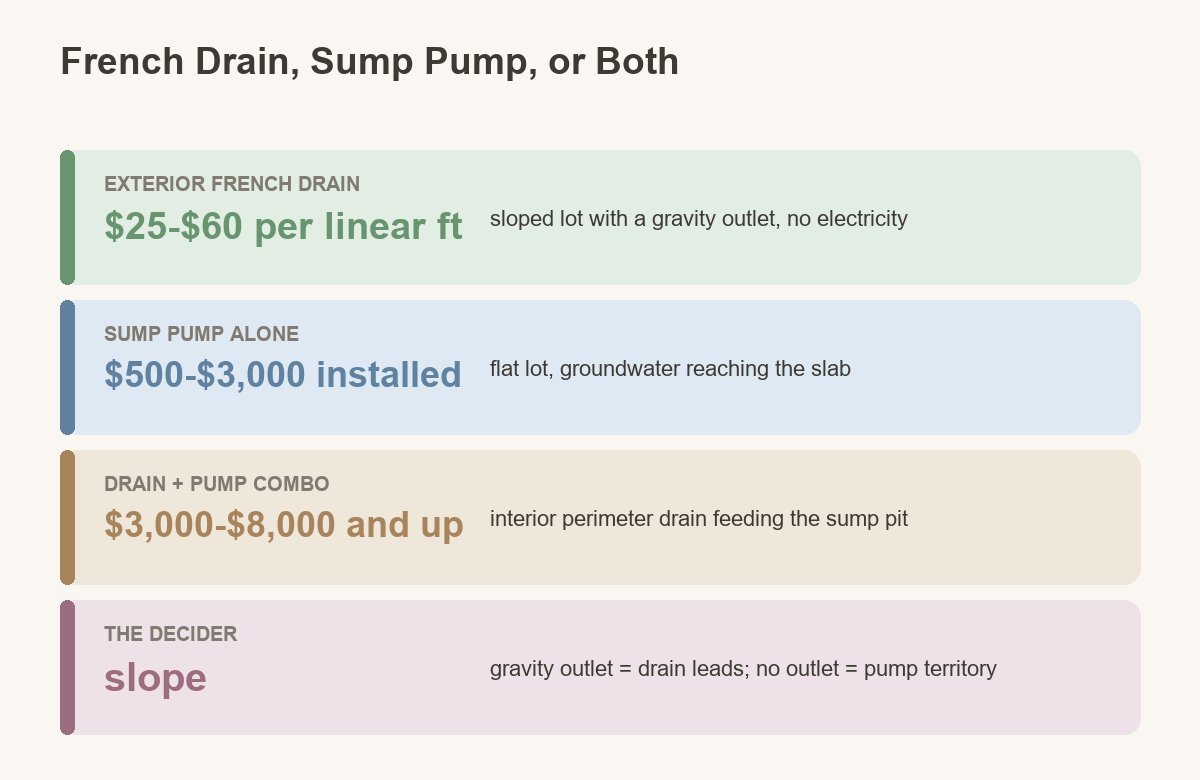
Cost guides quote wildly different figures for the same words because “french drain” names three different projects. Per The Basement Guide’s breakdown, an exterior yard drain prices around $25 to $60 per linear foot, an interior perimeter system $60 to $120 per foot with concrete cutting included, and a basic sump pump install lands between $1,200 and $3,000, with the unit itself as little as $200. A shallow gravel trench dug through a lawn shares nothing but a name with jackhammering a slab edge.
Budget three ways: a 100-foot exterior drain on a sloped lot commonly totals $2,500 to $6,000; a sump pump alone, $500 to $3,000 depending on who installs it; a full interior drain-plus-pump system, $3,000 to $8,000 and beyond for large perimeters. Add the operating difference: the drain consumes nothing, while the pump adds electricity, a battery backup if outages matter, and a replacement unit on a schedule.
Match the Configuration to the Water
- Soggy yard, sloped lot: exterior french drain alone. Surface and subsurface water gets intercepted uphill of the house and gravity carries it to daylight. No pit, no power, no monthly thought. This is the configuration owners rave about when it fits.
- Water at the slab, flat lot: sump pump, possibly alone. With nowhere downhill to send water, collection without ejection is a bathtub. A pit and pump handle groundwater rising under the floor; short interior drain runs feed it if seepage enters along more than one wall.
- Perimeter seepage in a basement: the combo. Interior drain to collect, pump to discharge. One system without the other either collects water it cannot remove or removes only the water lucky enough to reach the pit.
The outcome when the right configuration meets the right problem is the point of the spend:
“French drain for us after two floods through a window (damn window wells). We had major flooding in our area in 2023, which was the second window flood. Got the drain installed after. Even worse flood in 2024 and we stayed dry. Huge fan of the French drain. Finally got insurance back this year too 🙌.”
– r/basement, June 2026 (6 upvotes)
Lifespan and the Ways Each One Fails
A fabric-wrapped drain built with washed stone is a 30-year installation; skip the filter fabric and silt can choke it inside a decade, which is where the “french drains only last 10 years” claims come from. Its other failure mode is more basic, and drainage veterans warn about it constantly:
“A French drain needs to be fairly deep (200-300mm) to have grass grow over it and has to drain away somehow-somewhere otherwise it just becomes a soak/dry-well (not much better than what you’ve got.) A surface drain, grated drain, even just a sump that water runs into is probably better. I’d get a landscaper/plumber to work it out tho. If you cross connect it with roof drainage or don’t get the fall right, it can make things worse/be a waste of effort.”
– r/GardeningAustralia, May 2026 (11 upvotes)
A drain with no discharge point is an underground bathtub wearing a french accent. Before any trench gets dug, the destination has to exist, and it has to be legal: routing runoff onto a neighbor or into a sanitary sewer can require permits, and you stay responsible for water that leaves your lot and causes damage downstream.
Sump pumps fail on a schedule. FEMA’s maintenance guidance is to check the pump yearly and replace any unit past 10 years old, and the common failures arrive sooner: a stuck float switch, a clogged intake, or a power outage during the exact storm that filled the pit. The pump’s lifetime cost is the unit, its successor, the electricity between them, and ideally a battery backup for the outage case.
Where the Water Goes: Four Legal Destinations
Every configuration ends at a discharge point, and picking it belongs at the start of planning, not the end. Daylighting to a downhill slope is the cheapest and most reliable outlet when grade allows. A dry well works on flat lots with sandy soil but fails in clay, where it fills and stays full. Municipal storm drain connections are the cleanest urban option where the city permits them. The curb, via a pop-up emitter, is the common default for pump discharge lines.
Two destinations invite trouble: the sanitary sewer, which many municipalities prohibit for groundwater, and the neighbor’s lot line, which courts take a dim view of when their yard turns to marsh. A ten-minute call to the local building department about discharge rules is the cheapest part of the entire project.
French Drain vs Sump Pump FAQ
What are the disadvantages of a french drain?
A french drain needs a downhill discharge point, serious excavation through anything in its path, and a silt-filtering design to avoid clogging over the years. It also handles only the water that reaches its gravel; a rising water table under a flat slab defeats it without a pump.
Will a sump pump work without a french drain?
Yes, when groundwater naturally converges on the pit, which happens in many flat-lot basements where the pit sits at the true low point. Seepage entering along multiple walls needs collection piping to reach the pit, and that piping is the interior drain half of the combo.
What does a 100-foot french drain cost?
An exterior 100-foot run commonly totals $2,500 to $6,000 at the $25-to-$60-per-linear-foot rates in published cost breakdowns, landing higher with deep trenches, poor access, or hardscape in the way. The same length as an interior perimeter system costs roughly double or more because of concrete work.
What works better than a french drain?
For roof-driven water, gutters, extended downspouts, and regrading beat any trench and cost far less; for flowing surface water, a channel or catch-basin drain outperforms buried gravel. A french drain earns its place specifically for subsurface water moving through soil, and nothing cheaper substitutes there.