
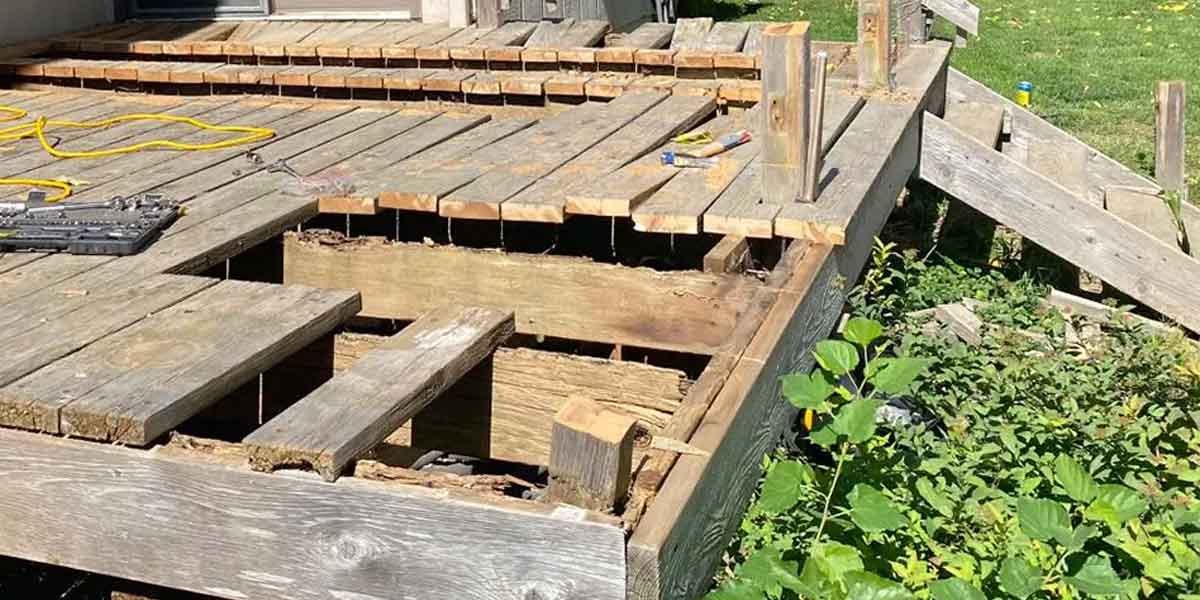

The average deck repair cost lands between $500 and $3,000, with a typical bill near $1,500.
That band is wide because two decks thirty feet apart can need different work at different prices. A warped board and a handful of popped nails belong to the low end. Rot in a joist, a post base, or the ledger that ties the deck to the house belongs to the high end, and it changes the deck repair cost from a few hundred dollars into a structural question.
The surface is rarely what decides the price. Water is.
What Deck Repair Costs by the Square Foot
Homeowners pay $10 to $55 per sq ft for deck repairs, and the decking material sets the floor of that range. Wood spans $10 to $55, composite and fiberglass $15 to $40, vinyl $10 to $30, and metal $10 to $40, according to Fixr’s national deck repair cost database.
Within the wood category, the species does most of the work. Pressure-treated pine is the cheap end at $10 to $30 per sq ft. Cedar and mahogany sit at the top, both at $25 to $55 per sq ft, because the boards cost more and crews handle them more carefully to avoid splitting.
| Deck material | Repair cost per sq ft |
|---|---|
| Pressure-treated pine | $10 to $30 |
| Redwood | $12 to $35 |
| Ipe | $15 to $45 |
| Cedar | $25 to $55 |
| Mahogany | $25 to $55 |
| Composite | $15 to $40 |
| Fiberglass | $15 to $40 |
| Vinyl | $10 to $30 |
| Aluminum | $15 to $40 |
| Steel | $10 to $35 |
A per-sq-ft figure only works when the whole surface is coming up. Swap three boards and no contractor prices the job that way, because the trip, the setup, and the matching of the new boards to the faded ones cost more than the lumber. Treat the square foot number as a budgeting shortcut for full resurfacing, not as a quote for a patch.
Where the per-sq-ft number comes from
Contractors build that figure from the board price plus the labor hours the boards consume. Pressure-treated pine sells in the $3 to $6 per sq ft range as raw material, cedar $4 to $8, and composite decking from brands like Trex $5 to $14, based on the material table published by Decks.com. Skilled deck labor then runs $50 to $100 an hour on top, which is why a $6 board can show up as $20 per sq ft in a finished quote.
Repair cost by deck size
Scale changes the bill in a straight line for surface work. On board replacement pricing at $12 to $20 per sq ft installed, a 10×10 deck comes to $1,200 to $2,000, a 12×16 deck to $2,300 to $3,800, and a 14×20 deck to $3,400 to $5,600, with railing and stairs priced separately.
Structural problems break that line. A single footing replacement costs $300 to $400 whether the deck is 100 sq ft or 400 sq ft, so a small deck with frame damage is the one most often torn out and rebuilt.
What Each Deck Problem Costs to Fix
Missing fasteners run $100 to $200, a hole or crack $150 to $500, mold and mildew $200 to $600, rotted sections $300 to $5,000, termite damage $500 to $10,000, wobbly stairs $200 to $2,000, and a sagging deck $750 to $10,000.
Those bands come from the same national cost data, sorted by symptom instead of by material, and the sort is useful because most homeowners arrive with a symptom rather than a diagnosis.
Repair-priced work
- Replacing nails $100 to $200. Simple in isolation, more expensive if the fasteners pulled loose because the wood around them swelled.
- Screws backing out $100 to $200. Usually poor fastener choice or boards moving more than the framing allows.
- Patching a hole or crack $150 to $500. Epoxy or filler, then sanding to blend the repair into the surrounding boards.
- Power washing $150 to $500. Removes dirt, stains, and mildew film, and it is the cheapest way to find out whether the grey you see is surface weathering or the beginning of rot.
- Repairing deck boards $10 to $35 per sq ft. Patching, sanding, and filling on the boards that stay.
- Flashing repair $15 to $30 per linear ft. The metal strip that keeps water out of the joint between deck and house. It fails rarely, and when it does, the damage underneath is usually worse than the flashing itself.
- Railing repair $25 to $100 per linear ft. Pricing tracks the railing material and how easily a crew can reach the damaged section.
- Stair repair $15 to $50 per step. Loose treads and rot at the stringers both land here.
- Joist repair $100 to $300 per joist. A sistered joist bolted alongside the damaged one is the standard fix; badly rotted members get cut out and replaced.
Replacement-priced work
Parts damaged past repair get replaced, and the per-piece prices climb fast. Deck boards run $15 to $55 per sq ft installed. Steps go $30 to $60 each. Railing replacement lands at $50 to $250 per linear ft, with glass and cable systems at the top of that range. Joists cost $150 to $350 each, posts $200 to $400 each, and a single concrete footing $300 to $400.
Posts and footings are the expensive ones to ignore. They hold the load, they sit closest to the soil, and replacing a footing means excavation next to an existing structure.
Refurbishing, resurfacing, and sealing
Refurbishing a tired deck with sanding, cleaning, and stain runs $1,000 to $3,000. Full resurfacing, where damaged boards, railing sections, and steps are replaced before the finish goes down, runs $1,500 to $3,500. Sealing or staining a deck on its own costs $550 to $850, and that is the one line item a careful homeowner can move to their own weekend.
Repair or Replace: Where the Line Sits
A sound frame makes repair the cheaper call. Board replacement on a 350 sq ft deck runs $12 to $20 per sq ft installed, and a full replacement with composite boards and railing on the same footprint typically costs $20,000 to $40,000.
Hynes Construction published those 2026 numbers for a Pennsylvania market and split the middle tier that most cost pages skip. Surface boards alone sit at $4,200 to $7,000 on that 350 sq ft deck. Boards plus partial structural work, meaning a few sistered joists or an upgraded ledger connection, add $2,000 to $6,000 to the same job. A complete rebuild with a pressure-treated frame and composite surface reaches $20,000 to $40,000, or $12,000 to $22,000 in all wood.
Deck repairs stop being the economical answer when rot has reached the members that carry weight. The frame decides it. Boards, railing, and stairs are surface work at surface prices, and a deck with a dry, solid frame can be re-boarded for roughly a fifth of what a rebuild costs. The same arithmetic shows up on roofs, where the repair-or-replace call turns on the structure hidden under the shingles rather than on the surface a homeowner can see.
Fixr’s own rule of thumb is blunter: when a repair estimate approaches the price of a new deck, price the new deck. Their comparison for a 300 sq ft deck puts repair at $500 to $3,000 against replacement at $6,000 to $18,600, so the grey zone opens when structural work pushes a repair bill past roughly a third of replacement cost.
Why Two Quotes for the Same Deck Can Differ Threefold
Labor, access, and disposal drive most of the spread, not the price of boards. Deck repair labor runs $50 to $100 an hour, a call-out fee lands at $50 to $75, and urgent same-day work for something like a broken joist adds $50 to $150.
Disposal is the line homeowners never see coming. Boards that come off the deck have to leave the property, and hauling them away can cost up to $500 depending on the contractor’s policy. Tearing out the whole structure, including demolition and legal disposal, runs $500 to $1,000 before a single new board is delivered, and a large lumber delivery typically starts at $50.
Access moves the number in both directions. A raised deck with open space underneath gives a crew room to work on joists and posts from below, which shortens the job. A deck built tight to the ground forces work from above, and a deck boxed in by landscaping, a hot tub, or a screen enclosure pushes it higher again.
Licensing and warranty coverage sit inside the price as well. Structural work is a permit-and-inspection job in many jurisdictions, so the contractor who carries liability insurance and puts a workmanship warranty in writing will quote higher than the one who does not, and that gap is worth the money on anything load-bearing.
Why does the same deck get two honest prices three times apart? One quote prices boards, the other prices boards plus the joists the crew found soft. Ask which structural members each estimate includes, and the gap usually closes on its own.
What a $25 to $200 inspection buys
A professional deck inspection runs $25 for a quick visual pass to $200 for a detailed assessment of framing, fasteners, and connections. Contractors generally want to look at the deck before quoting, and the call-out fee is often credited against the final bill if you hire them.
Older decks deserve the closer version. Any deck past ten years should have its joist system examined, since framing wears out of sight below the boards.
Check Before You Pay for Anything
A screwdriver pushed into the wood tells you more than any visual inspection. If the tip sinks in, that member is soft, and soft wood in a load-bearing location makes the job structural.
Both the Fixr cost guide and the Hynes inspection write-up describe the same probe, which is a good sign that it holds up in practice. Hynes puts the test at the post bases, the ledger, and the joist ends. Those three locations carry the deck’s weight and collect the water that gets past the boards, so they fail before anything else does.
The south-facing boards go first. They take the hose bib drip and the downspout splash every storm, and by the third summer the end grain has gone grey and spongy while the rest of the surface still looks presentable.
What a probe does not settle is whether the visible rot is the whole story. Rot spreads along the grain inside a member, and a joist that looks solid from one side can be hollow eight inches in. That is the practical reason a $25 to $200 inspection beats a free estimate built from the driveway.
Where DIY stops
Fastener work, board swaps, and a weekend of sealing are reasonable homeowner projects. Anything involving joists, posts, the ledger, or footings is not, and neither is a railing that has started to move, because guardrails protect people from a fall and the connections have to meet the building code.
Does Homeowners Insurance Cover a Deck Repair?
Homeowners insurance usually covers a deck only when a listed peril caused the damage. Wind, hail, and a falling limb can qualify; rot, insects, and deferred maintenance do not.
A deck is treated as an “other structures” item on the standard HO-3 policy form, which typically caps that coverage near 10 percent of the dwelling limit, and the deductible applies first. Storm damage that a homeowner has documented with photos right after the event is the case most likely to clear a claim. Gradual sagging is the case most likely to be denied, because the adjuster will trace it to water exposure or age rather than to a single covered event.
Permits follow the size of the work. Minor to moderate deck repairs generally do not require one, while structural changes, added height, and anything that alters the footprint usually do. Local rules vary enough that the municipality is the only reliable source, and permits on a deck project typically add $200 to $500 where they apply.
When to Book the Work
Deck repairs are cheapest from late summer through fall and between November and March. Prices peak at the end of winter and the start of spring, when everyone who looked at a deck in February books at once.
The seasonal gap is real but modest, and it only pays if the deck is safe to leave alone. A soft post base or a ledger that has pulled away from the house is a fall risk, and waiting for a discount on work that keeps people off a raised deck is the wrong trade. Book the structural repair now and the cosmetic work in the off-season.
Deck Repair Cost FAQ
What is the average cost to repair a deck?
The average deck repair cost is about $1,500, and most jobs land between $500 and $3,000. Replacing missing fasteners can cost as little as $150, while extensive termite damage on a hardwood deck can reach $10,000.
What is the typical deck repair cost per square foot?
Deck repairs run $10 to $55 per sq ft, and the decking material narrows that band: pressure-treated pine sits at $10 to $30, while cedar and mahogany reach $55. The figure fits full resurfacing better than a two-board patch.
Are deck repairs covered by homeowners insurance?
Homeowners insurance covers a deck repair when a listed peril caused the damage, and wind, hail, and falling debris are the usual candidates. Rot, termites, and wear from skipped maintenance fall outside the covered perils on a standard HO-3 policy.
How much does a 14×20 deck cost to build?
A 14×20 deck is 280 sq ft, and building a new one runs roughly $30 to $60 per sq ft installed in most markets, or about $8,400 to $16,800. Repairing the same deck usually costs far less unless the frame has failed.
How do I repair a wooden deck myself?
Fastener and board swaps are realistic DIY work, and structural repair is not. Replacing a cracked board or reseating popped screws needs a driver, matching fasteners, and an hour. Anything soft at a post base, a joist end, or the ledger belongs to a licensed contractor.
Is it cheaper to repair or replace a deck?
Repair is cheaper whenever the frame survives a probe test, and it stops being cheaper the moment rot reaches joists, posts, or the ledger. Partial structural work adds $2,000 to $6,000 to a board replacement before any new boards go down.
The inspection is the number that decides everything downstream. Spend the $25 to $200 first, and the two estimates stop looking equally plausible.
