
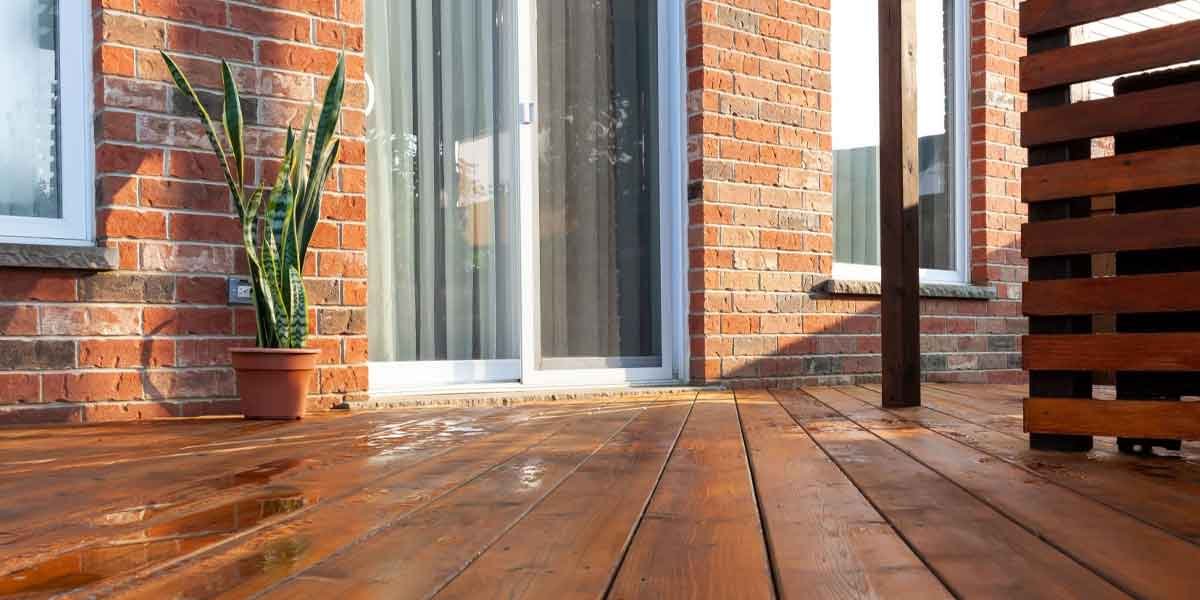

Deck waterproofing paint belongs on railings, not on deck boards. Boards need a finish that soaks into the wood and lets the wood dry from the inside; paint sits on the surface and holds water against it until the film lifts.
The U.S. Forest Service’s deck finishing guidance is blunt about that order of preference. Film-forming finishes such as paint and solid-color stain “are prone to trap moisture and fail by peeling,” and penetrating finishes are what the Forest Products Laboratory recommends for a walking surface. Railings are the documented exception, because water runs off them and nothing walks on them.
Wood on a deck does not need to be sealed against all water. It needs to dry. Everything that decides whether a coating lasts five years or two follows from which of those two jobs the product is actually doing.
Do You Need Deck Waterproofing Paint at All?
Decay needs wood that stays wet for months. Fungi establish only when moisture content sits above the fiber saturation point, roughly 26 to 29 percent in most lumber species, at temperatures between 50°F and 95°F.
Home Innovation Research Labs, the research group that grew out of the NAHB Research Center, ran a five-year field study of wood moisture and settled on 20 percent moisture content as the threshold that prevents decay from propagating. Wood that peaked at 15 percent stayed sound. Sheathing held at 35 percent sat on the wrong side of that line: the panels had to be opened up, and the moisture inside had already ruined the instruments monitoring them.
Deck boards spend most of their life cycling through that range. Rain soaks the top face, the gaps between boards drain, and sun and wind dry the rest. A coating changes how fast water beads at the surface, which buys time during a storm. It cannot change how fast the board dries afterward, and boards that stay wet are the ones that rot.
Mold gives a second, lower ceiling to work with. ASHRAE Standard 160 sets its mold-prevention criterion at a 30-day average surface relative humidity of 80 percent, which Home Innovation translates to 16 percent moisture content in solid wood, 14 percent in plywood, and 13 percent in OSB. A shaded board behind a planter can sit above that line for weeks without anyone noticing, since the surface looks dry while the core is not.
Any board that is soft underfoot, spongy at a fastener, or dark around a knot is past the point where coatings help, and no product on a shelf reverses it. And any board in permanent contact with soil or splash will stay wet no matter what goes on top, which is why pressure-treated lumber still fails first at the bottom of a stair stringer and along the rim joist.
Pressure-treated stock and naturally durable species such as western redcedar and redwood resist decay on their own, and the Forest Products Laboratory still calls for a finish on them, because the finish is what limits checking, raised grain, and mildew on the exposed face. Some producers ship 5/4 radial-edged decking with a water repellent built into the preservative treatment, and those boards need less help from the surface than a plain brown-treat board does. Cut ends made during construction are the one place treatment does not reach, and they are worth brushing with a water-repellent preservative while the saw is still out, since end grain takes up water faster than any face on the board.
Why Film-Forming Deck Paint Peels
A film-forming coating holds water against the wood. Boards swell and shrink through every wet and dry cycle, a film that cannot stretch with them cracks at the edges and lifts, and the wood underneath stays damp the whole time.
Moisture is only half of the problem. The same guidance notes that film-forming finishes take “excessive wear, especially in high-traffic areas.” A deck board moves more than a siding board and takes more abrasion than a railing, so paint on a walking surface fights both chemistry and feet.
The result is a predictable sequence. The film fails first at the traffic lane between the stairs and the door, where abrasion thins it; water gets under the lifted edge; the wet wood swells and pries the sheet back a little further with every storm. By the time the peeling is obvious across a full board, the damage underneath is usually older than the coating.
Boards, Railings, and Stairs Take Different Finishes
Three finish families show up on decks, and what separates them is how they sit on the wood. A water-repellent preservative is a penetrating finish with a mildewcide stirred in, and that mildewcide is the only thing separating it from a plain water repellent. A semitransparent stain is the same idea loaded with coarse pigment, which is why it will not blister or peel even when water reaches the board. Paint and solid-color stain form the third family: a continuous layer that sits on top of the wood instead of soaking into it.
| Surface | Finish that holds up | What goes wrong with the wrong product |
|---|---|---|
| Deck boards (walking surface) | Water-repellent preservative or semitransparent oil-based stain, reapplied as it wears | Film-forming paint traps moisture, thins at traffic lanes, then peels in sheets |
| Railings, posts, and pickets | Exterior paint or solid-color stain, including film-forming products | Low risk: the surface sheds water and takes no foot traffic |
| Stair treads | Penetrating stain plus a traction additive | A smooth film turns slick in the rain, and the fall risk outlasts the cosmetic gain |
| Stair stringers and risers | Paint, with the cut ends treated | Untreated end grain wicks water upward into the assembly |
| Concrete patio or pool apron | Elastomeric or epoxy deck coating with texture | A wood finish chalks, blisters, and wears off at the edges |
Boards and railings are two different products on one structure.
The wording on railings is worth keeping in view. They “can be designed to avoid trapping moisture,” which gives more freedom in choosing a finish, and paints and solid-color stains “may perform quite well on the railings.” A homeowner who wants a color change on the railing and a serviceable deck underfoot can have both, on different products.
Wood grain matters at the finish line too. A board that was mill-finished with a water repellent, or coated with a water-repellent preservative last season, will not absorb a semitransparent stain evenly, and pigmented finish laid over a partly sealed board shows lap marks where one pass overlaps the next. New or freshly treated decking needs two to three months of weather before it takes finish properly. Stretching that wait toward a full year invites the checking that ends most deck lives.
Penetrating products have their own cost: they are maintenance, not a project. A water-repellent preservative runs about a year on exposed deck surfaces, and a semitransparent stain lasts longer because its pigment shields both the wood and the mildewcide from ultraviolet light. Neither one blisters or peels, which is the trade being made: more frequent recoats in exchange for not scraping.
Reclaiming a painted deck is slower than finishing a bare one. A new coat needs a continuous surface to bond to, so every lifted edge has to come off before the next application goes down, and the loose fiber that was already tenting under the old film comes away with it.
Rooftop and Over-Living-Space Decks
A walkable deck that shelters a room below is a roof assembly. It needs a reinforced membrane with a fabric layer bonded under the wear coat, and no paint product covers that requirement.
GAF’s HydroStop line shows the shape of the assembly: a base coat, an embedded fabric layer, then a textured or smooth traffic coat over the top, sold as a warranted walkable surface. The fabric is what lets the system bridge small cracks and handle standing water that a paint film cannot, and the textured top coat is what keeps the surface usable when it is wet.
Almost none of that transfers to a ground-level wood deck that drains and dries on its own. The two situations share a word and very little else.
Where the substrate under the finish is plywood rather than boards, the waterproof layer is carrying the building, and a product meant for a walking surface is the wrong layer to trust with that. Plywood also sits lower in the moisture budget than solid wood does: the same mold-prevention criterion works out to 14 percent moisture content for plywood and 13 percent for OSB, against 16 percent for a solid board.
Concrete takes a third approach again, since the water usually arrives from the soil underneath, and waterproofing a concrete slab is a problem of vapor and drainage rather than a problem of rain.
Where a deck sits over living space and the substrate is sound concrete, a coating system can be the right answer. Over wood, the sequence runs the other way: strip back to bare boards, test moisture, and expect the membrane to be replaced on the schedule the manufacturer prints.
The Numbers That Decide Whether the Coating Survives
Deck coating data sheets converge on the same limits: wood moisture content below 15 percent, surface and air temperatures between 50°F and 90°F, two coats, and a full cure measured in days.
Moisture, Temperature, and Drying Time
A solvent-based deck and siding stain from Richard’s Paint states the moisture limit the way most manufacturers do: “Wood moisture content should be below 15%.” A pin-type meter pressed into three or four boards takes a minute and answers the only question that matters before the first coat goes on.
Temperature carries the same weight. The BEHR Advanced DeckOver label sets application between 50°F and 90°F, warns against humidity above 80 percent, requires 24 rain-free hours on either side, and puts full cure at 72 hours. Waterborne coatings need warmth to knit into a continuous film, and the 50°F floor on a label is where that stops being reliable: an October job that looked fine can turn chalky by spring.
Cleaning belongs on the same timeline, and household bleach does the work when the dilution is right:
- Dilute the bleach with three parts water and add a little detergent.
- Never add a detergent that contains ammonia, because the two react to release a toxic gas.
- Rinse the bleach off, then give the deck at least two warm, windy days to dry before finish goes back down.
Coverage, Cost, and Wet Traction
Coverage claims deserve arithmetic rather than trust. The Richard’s Paint data sheet lists 150 to 400 square feet per gallon, with a wet film of 3.5 mils drying to 1.2 mils at 300 square feet per gallon. The spread is real: it reflects how much a given board absorbs, and a weathered deck sits at the thirsty end of it.
A 12 by 16 foot deck holds 192 square feet of walking surface, and the first coat on dry wood always drinks more than the second. Budget two gallons for a deck that size with weathered boards, then expect the second coat to cover close to twice the area per gallon that the first one did. Application method moves the number again: brush and roller push product into open grain, while spray puts more of it in the air, and most manufacturers specify two coats rather than one thick pass.
Wet traction rarely appears on the front of the can. The ANSI/NFSI B101.1 test method places a wet static coefficient of friction of 0.60 or above in the high-traction range and anything under 0.40 in the minimal-traction range, and neither ADA nor OSHA sets a mandatory minimum for deck surfaces. A gloss enamel that slides underfoot after rain is still a compliant surface, and the only person testing it is the one walking down the stairs.
Recoating signals read differently on each type of finish. When water stops beading on a penetrating product and starts soaking in, and the color has gone silver in the traffic lanes, the finish is spent and the boards are dry enough to take another coat the same week. Waiting for visible peeling on a film coating means the wood has already spent a season wet.
One more measurement matters on houses built before 1978, where old coatings can contain lead. Stripping, sanding, or power washing that paint falls under the EPA’s renovation rule and its containment requirements, and the work is worth handing to a certified firm rather than risking a yard full of contaminated dust.
Deck Waterproofing Paint FAQ
What kind of paint do you use on an outdoor deck?
Deck boards do best with a penetrating water-repellent preservative or a semitransparent oil-based stain. Paint and solid-color stains belong on railings, posts, and stringers, where water runs off and nothing walks on the surface.
What are the drawbacks of using waterproof paint?
Deck waterproofing paint holds water against the wood, so the board stays damp under an intact film and peels once the film fails. A full-coverage film also hides rot until it becomes structural and has to be stripped completely before the next coat.
Do I need to seal my deck after painting?
A painted deck does not need a sealer on top. The film already blocks water at the surface, and a second layer adds thickness that cracks sooner while trapping any moisture that reaches the wood from below.
How can I waterproof my existing deck?
Fix drainage and ventilation first, confirm the boards measure below 15 percent moisture content, then apply a penetrating finish in two coats. A deck that sits over a living space needs a fabric-reinforced membrane system instead of a finish.