
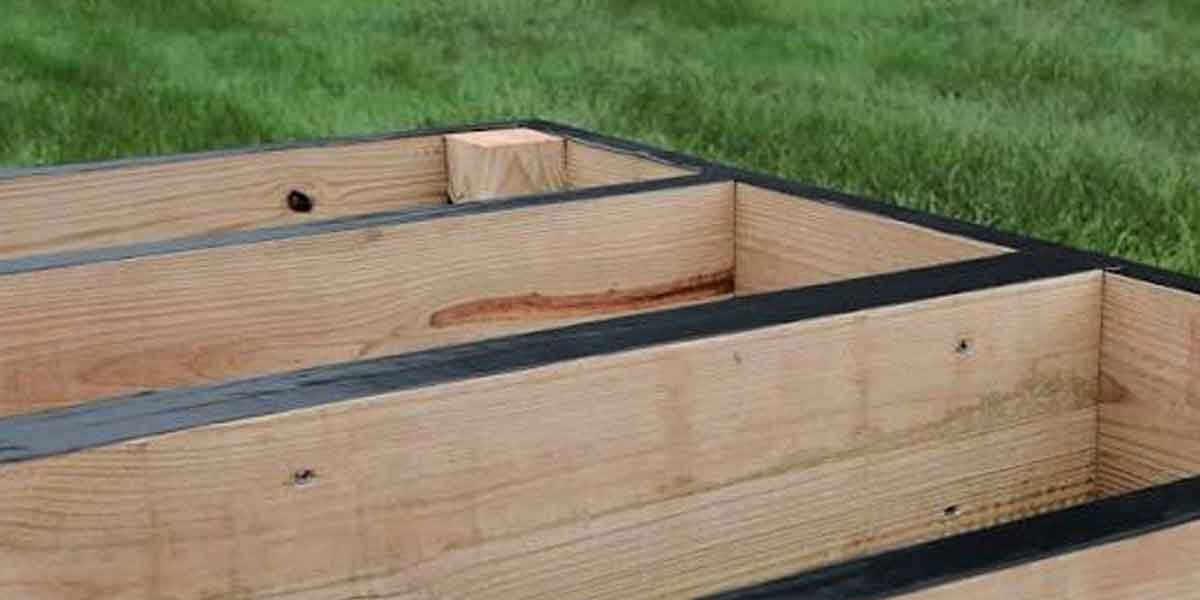

Deck flashing tape is a self-adhering butyl or asphalt membrane that caps the top faces of joists, beams, rim boards, and the ledger so rain and snowmelt run off the frame instead of soaking into it. Retailers and builders use two names for the same product: flashing tape and joist tape.
The name promises more than the roll delivers. Metal flashing at the ledger carries water away from the joint where a deck meets the wall. Tape carries water off the lumber underneath the deck boards. Both jobs matter, and only one of them is required by code.
What the Roll Actually Covers
A roll of deck flashing tape covers the top of every joist, the top of the beam and the rim joists, the ledger board, the base of each post, and the stringers of any stair. Cut ends get covered as well, because a field cut opens wood the factory treatment never reached.
That list follows the water. Wind-driven rain arrives at the frame through the gaps between deck boards, and the top face is both the first thing it touches and the last place it can dry.
Coverage is sized by width. A 1-5/8 inch roll caps the top face of a single joist; the 3-1/8 inch roll wraps the top and folds over both shoulders, and it fits double joists.
Where the Code Stops and the Tape Starts
Approved corrosion-resistant flashing is required at any ledger connection to a wall of wood-frame construction, and joist tape is not required anywhere. The American Wood Council’s prescriptive deck guide puts its flashing provisions at the ledger connection and nowhere else, and never mentions tape.
That guide also fixes the material: corrosion-resistant metal at a nominal thickness of not less than 0.019 inch, or an approved non-metallic equivalent. The detail it draws is continuous flashing with a drip edge, run out past the joist hangers so water clears the framing below.
The other option, continuous flashing notched around every crossing joist, costs a cut at each one and drains worse. The American Wood Council publishes its deck guide as a free download, and many building departments accept it in place of an engineered drawing set.
Aluminium has no business against treated lumber. Copper-based preservatives in the wood corrode aluminium, which is why the details specify copper or stainless steel instead.
Two further code items govern the same joints the roll covers. Lumber touching the ground must be rated for ground contact, every field cut needs an approved preservative brushed on site, and fasteners used with treated wood must be hot-dipped galvanised to ASTM A 153 Class D, stainless steel, silicon bronze, or copper.
None of that is optional, and tape covers for none of it.
A freestanding deck changes half of this. A frame that stands on its own posts and never touches the house has no ledger connection to flash. The joist tops still sit under the boards collecting rain, so the roll keeps its job while the metal detail drops out.
Why Joist Tops Fail Before Anything Else
Joist tops stay wet because the deck board above them traps water in a gap that sees no sun and gets almost no airflow. A damp morning there is normal. Damage comes from water that sits for weeks.
Preservative treatment raises the wood’s resistance to decay and does not make the wood waterproof. Field cuts are the weak point in treated lumber, which is why the code asks for a brush-on preservative at every one of them.
Metal parts fail in the same place the wood does. Joist hangers and screws sit against lumber carrying copper-based preservatives, and those chemicals attack galvanised steel over time.
Capping the top face keeps water off the screw shanks and gives the hardware one less reason to let go.
The damage is invisible from standing height. A joist failing at the top face looks like every other joist until a deck board comes up, and then the screws spin under the driver and the lumber marks with a thumbnail.
Water that reaches framing through a gap and cannot drain away is the pattern behind most hidden structural damage in a house, from the sill plate to the deck rim.
Installing the Roll
Apply deck flashing tape to clean, dry, dust-free lumber, press it down with a hand roller, and keep at least a two-inch overlap end to end. Direct sun exposure has a limit, and one manufacturer sets it at 90 days.
Air temperature sets the floor
Minimum application temperatures differ by product, and the number tracks the adhesive more than the membrane. DeckWise rates its butyl JoistTape for 25 °F or warmer; the Deck Flash Barrier listed at Menards asks for 35 °F or higher.
Cold tape on cold wood is a real failure mode. The membrane looks bonded, then lifts at the edges a week later. Butyl keeps its tack at lower temperatures, and DeckWise says it will take on lumber that is not fully kiln-dried or on a dewy morning, though clean and dry still beats convenient.
Cleaning, cutting, and rolling
Sawdust is the quiet failure here. A joist that was just cut and not blown off holds a layer of dust between adhesive and wood, and that layer is where delamination starts.
Run the tape down the joist, press it with a hand roller, and overlap two inches where one length meets the next. Fold the ends over the edge, since square-cut ends catch on tools and lift. Diagonal snips at the corners let the membrane wrap a post without pleating. If a face refuses to take the adhesive, DeckWise allows staples, nails, or a construction-grade spray adhesive to hold the membrane down.
On posts, start two to three inches above finished grade and overlap the wrap by at least an inch.
The 90-day window
The membrane belongs under cover. DeckWise caps direct sun exposure at 90 days, which turns into a schedule constraint: tape the frame when the decking is close behind it. A frame that sits taped through a full summer has spent its allowance.
Retrofit is the awkward case. Tape goes down before the decking does, so a finished deck has to come apart before the roll can help it. On a deck old enough to need the protection, that means lifting boards to reach the joists, and the labour runs well past the price of the tape.
What to Buy, and What a Deck Spends on Tape
Butyl and asphalt are the two families on the shelf, and a butyl deck flashing tape is the safer default: it oozes less in summer heat, holds at lower temperatures, and flows around screw shanks to seal around them. Width matters more than brand.
| Product family | Cold-weather floor | In summer heat | Common roll |
|---|---|---|---|
| Butyl, rubberised | About 25 °F on DeckWise JoistTape; 35 °F on Deck Flash Barrier | Oozes less, stays tacky | 20 to 22 mil, 1-5/8 in or 3-1/8 in by 50 ft |
| Asphalt or bitumen | Needs warmer wood before it grabs | Softer, can creep | Widely stocked at retail, price-led |
A 50-foot roll of deck flashing tape covers one joist run. A 12-by-16-foot deck framed with joists 16 inches on centre carries thirteen joists at 12 feet, which is 156 linear feet, and the ledger plus both rim joists add another 48. Four to five rolls covers that deck once overlaps and waste are counted. At Menards pricing of $19.98 for a 1-5/8 inch, 50-foot roll, the material lands near $100, which is the same order the trade site decks.com quotes for a typical deck.
The narrow roll protects the face where rain lands. The wide roll also guards the shoulders and tidies the seams at intersections. Neither choice is wrong, and the narrow roll with careful edge coverage costs less.
Availability shapes the choice as much as specs do. DeckWise sells through a dealer network, so local stock usually means a Trex Protect roll, a SPAX joist and beam tape, or the Deck Flash Barrier listed at Menards. Brand is the last variable; width and cold-weather rating decide whether the roll works.
Warranty terms reward a moment’s reading. DeckWise ties its limited warranty to registering the product, and limited cover is not a guarantee of joist life. Trex Protect markets a 25-year warranty on its butyl tape.
Deck Flashing Tape FAQ
Is joist tape required by code?
No. The International Residential Code contains no joist tape provision. Corrosion-resistant flashing is required at the ledger connection, and tape sits outside the code as a good-practice upgrade.
Does flashing tape stick to wood?
Yes, on clean, dry, dust-free lumber. Butyl adhesive holds on wood that is not fully dried and on a dewy morning, but sawdust, dirt, and standing water break the bond and the membrane lifts at the edges.
Does a deck need flashing?
Yes, at the ledger. Approved corrosion-resistant flashing is required wherever a ledger attaches to wood-frame construction, and continuous flashing with a drip edge is the detail the American Wood Council’s deck guide draws in Figure 14.
What is the 3-4-5 rule for a deck?
The 3-4-5 rule is the squaring check. Measure 3 feet along one rim, 4 feet along the adjoining rim, and the diagonal between those marks reads 5 feet when the corner is square. A racked frame pulls tape at the corners, so confirm the geometry before laying membrane.
Tape the joists to make the frame outlast the decking. Flash the ledger because the code requires it and the deck hangs off that connection.
