

French drain fabric means non-woven geotextile, a gray felt-like material that lets water pass straight through while holding silt out of the gravel. One product category does this job; the woven and “landscape” fabrics sold two shelves over are how french drains end up clogged.
The confusion is understandable, because every roll in the aisle calls itself drainage-adjacent. The sorting rule fits in a pocket: if it looks like felt, it filters; if it looks like a woven tarp, it blocks; if it tears like paper after a season in soil, it was weed fabric all along.
Woven vs Non-Woven: Why Only One Belongs in a Drain
Non-woven geotextile is made of tangled polypropylene fibers needle-punched into a mat, so water moves through its whole surface while soil particles stay behind. Woven geotextile is a different tool: tight ribbons designed for strength under driveways and roads, with far less water flow through the weave. Suppliers who sell both put it plainly; Pro Fabric Supply’s drainage line is entirely non-woven, with woven fabric reserved for stabilization jobs.
The third category, thin weed-barrier fabric from the garden section, fails twice: its flow rate drops sharply once fine soil loads it, and the material itself degrades in ground contact. Michigan drainage contractor French Drain Man makes the point bluntly: thin landscape fabrics biodegrade and break down, which is why his crews install double-punched non-woven geotextile and nothing else.
“We’ve been installing lawn drainage systems for over 30 years, primarily to reduce standing water, protect foundations, and move surface water away from homes. Over that time, we’ve found that subsurface French drains using perforated ADS pipe surrounded by washed stone have worked extremely well for our customers. It’s a system we’ve had a lot of confidence in. That said, there are a lot of different approaches in this industry. Some contractors prefer surface inlet (catch basin) drains to col…”
– r/basement, June 2026 (29 upvotes)
Weight: 4 oz Is the Residential Default
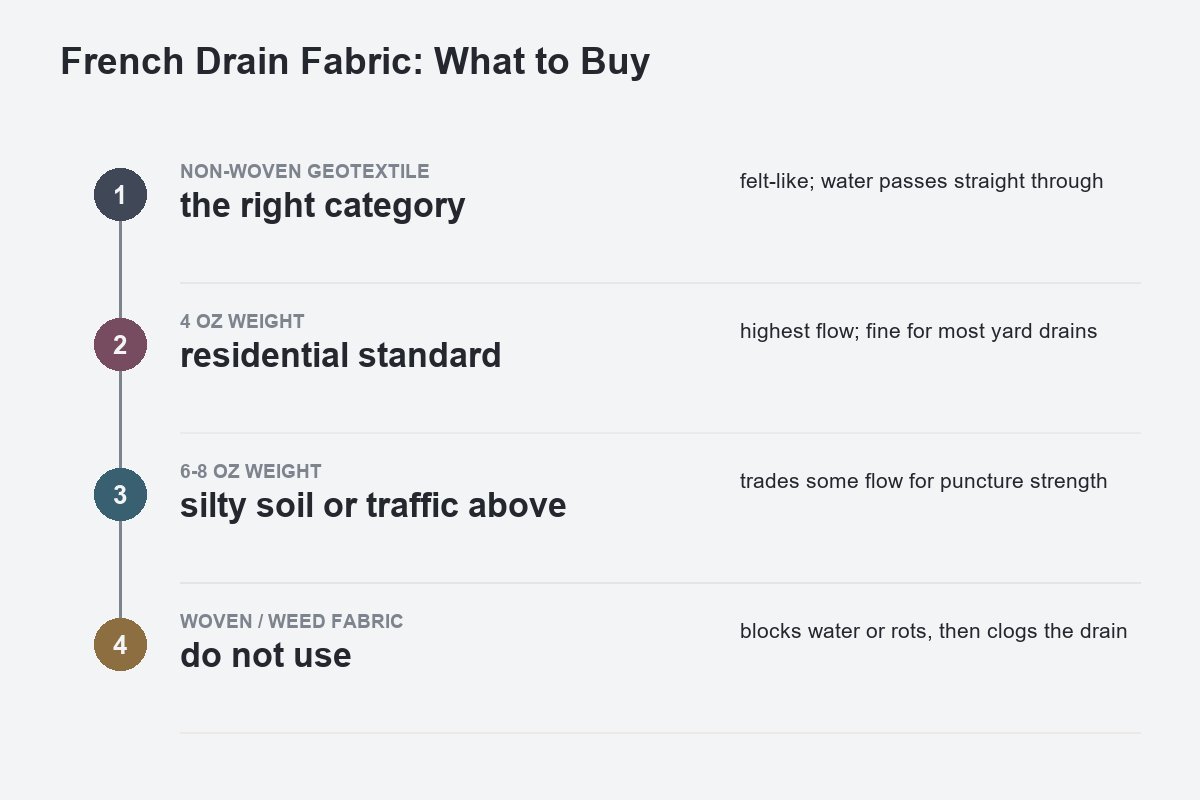
Geotextile is sold by weight per square yard, from 3 oz garden-duty up to 32 oz industrial. For a yard or foundation drain, 4 oz non-woven is the standard: the highest practical flow with enough strength to survive backfilling. Heavier 6 to 8 oz cloth trades some flow for puncture resistance, and earns that trade where the soil is fine silt that will press against the fabric for decades, or where vehicles pass above the trench.
French Drain Man’s crews split the choice by flow: 4 oz where water volume is the priority, 8 oz where flow is low and durability matters more. Either way the fabric is the cheap line item, with listed roll prices working out to roughly $0.10 to $0.45 per square foot depending on weight and roll size.
Is the Fabric Necessary at All?
Yes, in any soil with fines: skip the fabric and silt migrates into the gravel with every rain, filling the voids the drain depends on until water has nowhere to travel. A french drain without a filter is a temporary drain.
The choke is gradual, which is what makes it expensive: year one drains beautifully, year three slows, year six the lawn is spongy again and nobody connects it to a decision made at the supply house. Digging up and re-graveling a clogged run costs close to the original install, and the slow silt-choke is a major source of the claims that french drains only last a decade.
It is the last place in the project to save ten dollars.
The asterisk comes from engineering practice, where a properly graded sand-and-gravel envelope can do the filtering the way agricultural drains have for a century. That method depends on getting particle-size gradation right, which is why residential installers standardized on fabric: a wrapped trench with washed stone is repeatable by any crew, and the failure mode of a botched gradation is invisible until the lawn is soggy again.
The exception where fabric hurts: soils dominated by fine clay can slowly blind any filter surface, fabric included. In heavy clay, the drain wants more gravel surface area and shallower expectations, not a thicker sock.
“Nothing will exactly stop either over time with fine grained soils such as clay and silt. Clogging will eventually occur with both given seepage. Installing sand in conjunction with geofabric will prolong the life. With french drains the water holding capacity is a function of void space. So if you have ample space you could go crazy and install sand between two layers of filter/geofabric and hopefully just have to dig around the sides sequentially and replace the sand layer when the time comes…”
– r/AskEngineers, April 2026 (6 upvotes)
How Much Fabric a Trench Needs
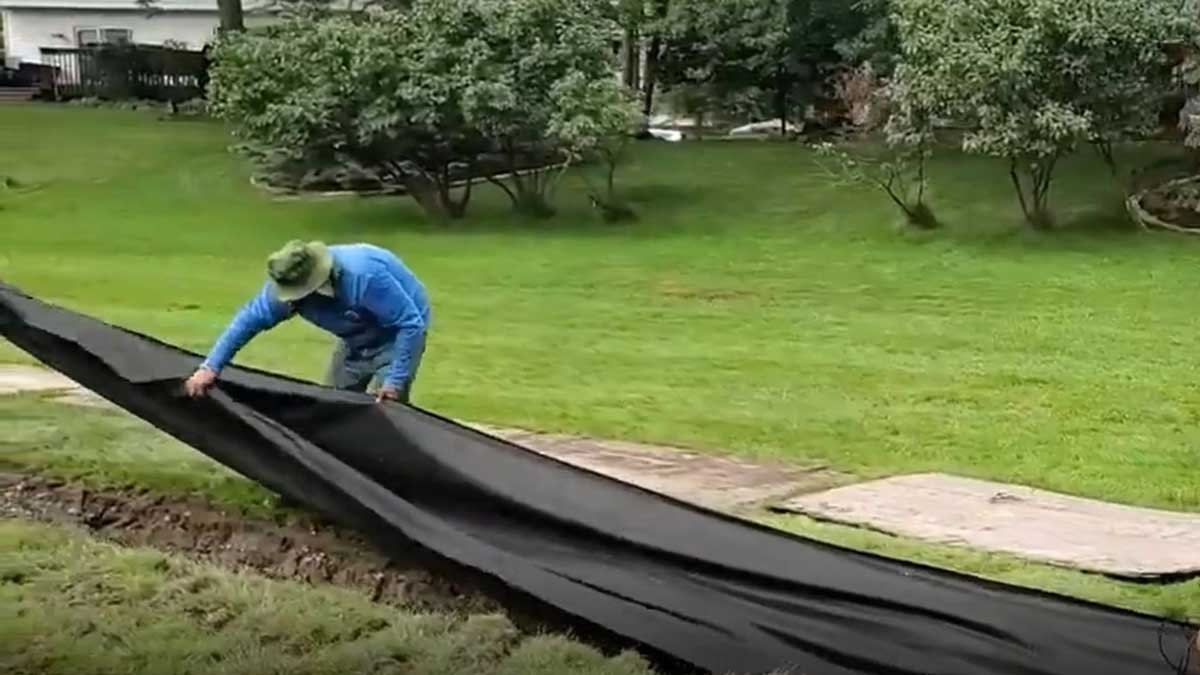
A standard trench 12 inches wide and 18 inches deep needs about 6 feet of fabric width: enough to line the bottom and both walls with a foot of overlap at the top. For a 50-foot drain that is roughly 300 square feet (our french drain calculator figures the gravel side of the same trench), one 6-by-100-foot roll with slack for pinning; a 100-foot drain wants two.
The Burrito Wrap, Step by Step
Wrapping the gravel envelope takes four moves, and the last one is the one crews skip:
- Line the open trench with fabric, walls and bottom, pinning the edges at grade.
- Add a few inches of washed stone, lay the perforated pipe (holes down), then fill washed stone to near grade.
- Fold the fabric flaps over the top of the gravel with a 12-inch overlap, the burrito wrap that keeps topsoil from raining in from above.
- Cap with a couple of inches of soil or decorative stone, and the drain disappears into the yard.
Fabric that stops at the trench walls but never closes over the top leaves the gravel open to the very silt it was meant to exclude.
French Drain Fabric FAQ
What fabric is best for a french drain?
A 4 oz non-woven geotextile is the best fabric for a typical residential french drain, stepping up to 6 or 8 oz in silty soil or under traffic. The label needs the words non-woven and a weight rating; brand matters far less than category.
Will landscape fabric work for a french drain?
No. Thin weed-barrier fabric clogs quickly once soil fines load it and degrades in ground contact, taking the drain down with it. It costs a few dollars less than real geotextile up front and the whole trench’s lifespan later.
Does the fabric go around the pipe or around the gravel?
Around the gravel. The fabric lines the trench and folds over the stone envelope, keeping soil out of the whole system; the perforated pipe inside stays in clean gravel contact. Tight fabric socks on the pipe itself are where silt blinds a drain fastest in fine soils.
How long does french drain fabric last?
Quality non-woven polypropylene is rated for decades buried, and installers who use double-punched 4-to-8 oz cloth describe it as a lifetime component. The lifespan risks are installation tears from sharp backfill and sun exposure before burial, not underground aging.