
Build a Garage: 13 Steps You Should Know
Building a garage is one of the most important tasks for homeowners. When there is no garage in the home, it should be built from scratch. So as waterproofing experts we highly recommend you to follow these 14 steps when building a garage from scratch. This guide help you to build your garage free of water and structural damages prolong.
- Determine the types of the garage
- Deciding the garage size and dimensions
- Choose the location for the garage
- Test the garage ground condition
- Design the garage slab thickness
- Control the garage floor slope and drainage
- Decide the waterproofing system
- Design the garage roof and rainwater controlling
- Seal the garage openings
- Select the garage wall and roof material
- Select a lighting system and ventilation
- Decide the storage and compartments
- Decide the garage flooring
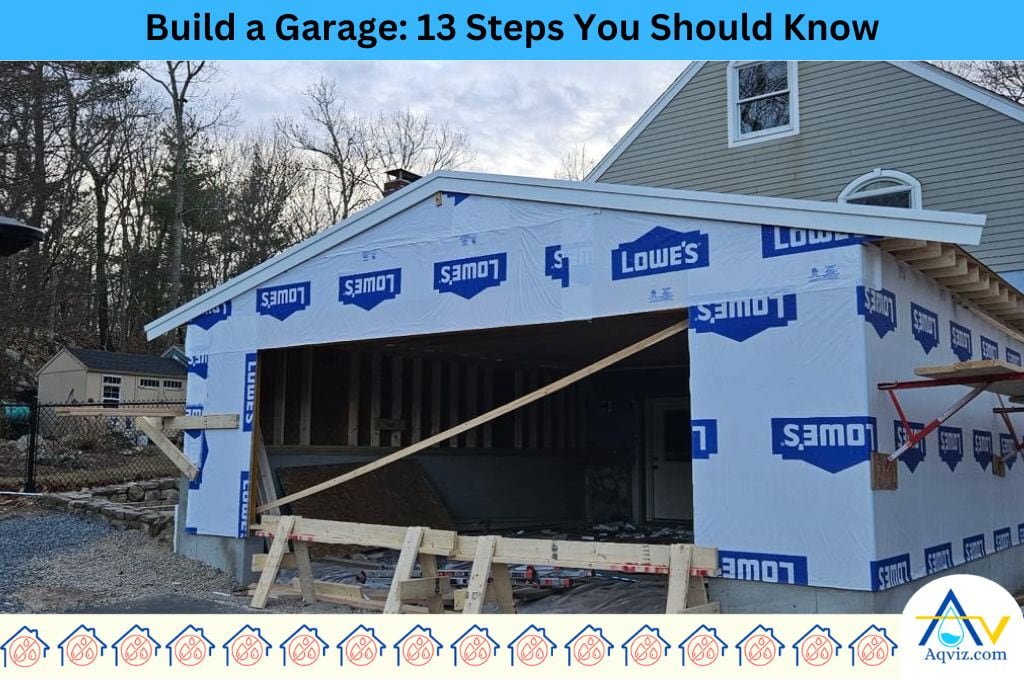
1. Determine the Types of the Garage
First, you should determine the type of garage you need because garages are available in different types and purposes, such as vehicle parking, repair work, storage, or mixed use. The type of garage directly controls the size, slab design, electrical load, ventilation, waterproofing, and finishes.
There are 6 main types of garages used in residential construction.
- Vehicle parking garage: A vehicle parking garage is designed mainly to park vehicles such as cars, SUVs, pickup trucks, or motorcycles. So this type of garage needs weather protection, theft prevention, and controlled access.
- Workshop garage: A workshop garage is built for mechanical work, carpentry, or DIY projects. This garage type needs stronger floor slabs, higher electrical capacity, and proper ventilation. Hence, the workshop garage should have epoxy flooring and wall-mounted power outlets at 1.1 m (42 in) height to avoid water splash damage.
- Storage garage: A storage garage is used to store household items, seasonal tools, bicycles, lawn equipment, or bulk materials. When build this types of garage homeowner shoul focus on moisture control, shelving systems, and pest resistance.
- Multi-purpose garage: A multi-purpose garage combines parking, storage, and light workshop use. This is the most common choice among homeowners.
- Detached garage: A detached garage is built separately from the main house. Homeowners choose this type of garage to reduce noise, fire risk, or structural vibration to the home. In heavy rain regions, you should always focus on ground conditions, access slope, and roof water discharge because detached garages often sit at a lower elevation than the house.
- Attached garage: An attached garage connects directly to the house structure. This type offers convenience and security but needs careful fire separation, vapor barriers, and door sealing. We recommend fire-rated walls and sealed access doors to prevent exhaust fumes and moisture transfer into living areas.
2. Decide the Garage size and Dimensions
Then you should decide on the garage size and dimensions. Garage size and dimensions should be aligned with the type and purpose of the garage. Before build it home owner should decide the internal floor area, door opening size, and vertical clearance to safely park vehicles, open doors, and walk around comfortably.
There are 4 critical dimension factors you should decide before construction.
- Garage overall size: The garage size depends on the number and type of vehicles. For a single car, we recommend a minimum internal size of 3.6 m × 6.0 m (12 ft × 20 ft). For SUVs or pickup trucks, 3.9 m × 6.7 m (13 ft × 22 ft) works better. A double-car garage should be at least 6.0 m × 6.7 m (20 ft × 22 ft). From our experience, adding 600 mm (2 ft) extra width saves daily frustration when opening doors or carrying tools.
- Garage door width and height: The garage door opening controls vehicle access and clearance. A standard single-car door width is 2.4-2.7 m (8-9 ft). Door height should be 2.1 m (7 ft) for sedans, but we strongly recommend 2.4-2.7 m (8-9 ft) if you own an SUV, van, or roof-rack vehicle.
- Vehicle clearance height: Vehicle clearance height is the vertical space from the finished floor level to the lowest obstruction, such as beams, lights, or door tracks. You should maintain a minimum clear height of 2.4 m (8 ft) for standard garages and 2.7-3.0 m (9-10 ft) for workshops or lifted vehicles. This prevents roof scratches and allows overhead storage or lighting installation.
- Side and front clearance: Clearance space allows comfortable movement around the vehicle. We recommend at least 750-900 mm (30-36 in) on each side and 900-1,200 mm (36-48 in) in front of the vehicle.
3. Choose the Location for Garage
Choosing the suitable location for the garage is positioning the garage on your property to allow safe vehicle access, proper slope control, easy entry, and long-term protection from water accumulation and structural stress.
There are 4 main location factors you should evaluate before construction.
- Access paths: First, you should consider the access paths to the garage. Access paths are the driveway routes connecting the road to the garage. You should always choose straight or gently curved access paths with a minimum clear width of 3.0-3.6 m (10-12 ft) for single vehicles.
- Access slope: Second, make sure there is a proper access slope. Access slope controls how vehicles move into the garage and how water flows away. The recommended driveway slope is 5-8%, equal to 50-80 mm per 1.0 m (2–3 in per 10 ft).
- Garage elevation: Third, consider the garage elevation. Garage floor elevation should sit higher than the surrounding ground by at least 150-300 mm (6-12 in). This height difference prevents stormwater, surface runoff, and mud from entering the garage during heavy rain seasons.
- Access door type: Lastly, choose the access door type. Access door type includes vehicle doors and pedestrian doors. Sectional overhead doors work best in a limited space and provide better sealing. Tilt-up doors need more headroom and exterior clearance. We always recommend a separate pedestrian door with a minimum width of 900 mm (36 in) for safe daily access without opening the main garage door.
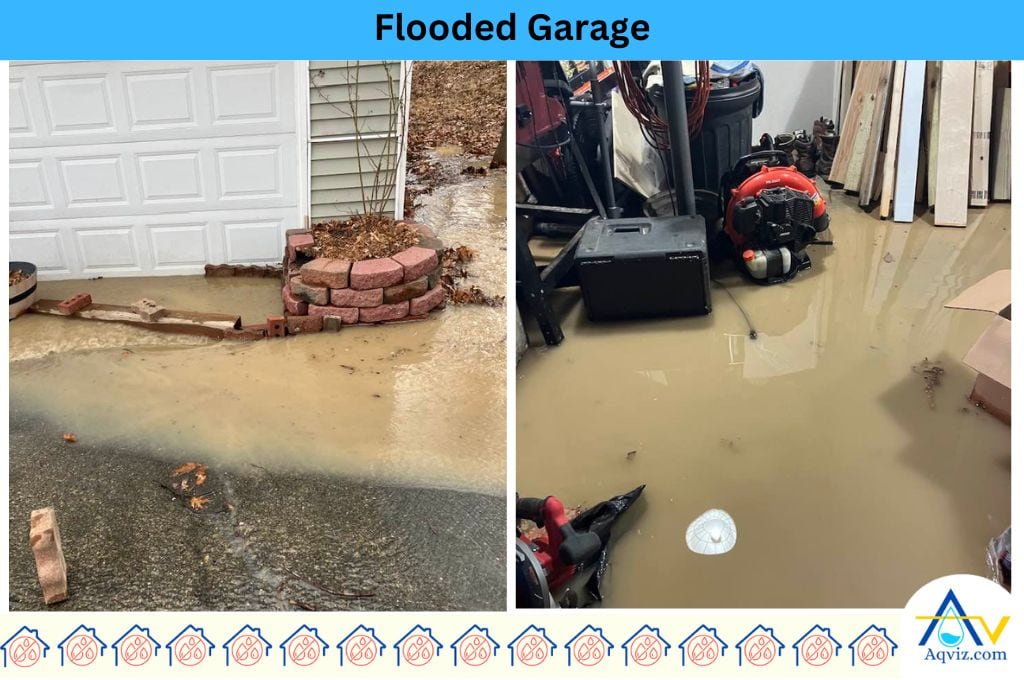
4. Test the Garage Ground Condition
You should test the garage ground condition by evaluating the soil strength, soil type, groundwater level, and seasonal behavior to ensure the garage foundation stays stable, dry, and crack-free throughout its service life.
- Soil condition: Soil condition is the load-bearing capacity of the ground. You should check if the soil can safely support vehicle loads of 2,000-3,000 kg (4,400-6,600 lbs) without excessive settlement.
- Type of soil: Soil type affects drainage and movement of the garage structure. Common residential soil types include sandy soil, clay soil, silt soil, and mixed fill. Sandy soils drain quickly but may need compaction to avoid sinking. Clay soils expand when wet and shrink when dry, which stresses the slab and walls.
- Water table level: The water table is the depth at which groundwater sits below the garage surface. A safe garage foundation requires the water table to stay at least 600-900 mm (24-36 in) below the slab base. High water tables increase hydrostatic pressure and moisture intrusion, resulting in many water damage to the structure.
- Behavior during the rain season: Rain season behavior shows how the garage ground reacts to prolonged moisture. If water stagnates near the garage location, you should redesign the drainage or raise the slab level. Do not ignore this.
5. Design the Garage Slab thickness
Garage slab thickness is the correct concrete thickness, base layers, and reinforcement to safely carry vehicle loads, resist cracking, and perform well under moisture and temperature changes.
- Suitable foundation and slab thickness: Garage slab thickness depends on vehicle weight and usage. For a standard residential garage, we recommend a minimum slab thickness of 100 mm (4 in). For SUVs, pickup trucks, or light workshop use, 125-150 mm (5-6 in) performs better.
- Foundation floor structure: A proper garage floor structure includes compacted subgrade, granular sub-base, vapor barrier, and reinforced concrete. You should install 100-150 mm (4-6 in) of compacted crushed stone below the slab to improve load distribution and drainage. To prevent moisture problems, you should also install a moisture barrier.
- Reinforcement system: Reinforcement controls cracking and improves durability. For the garage reinforcement system, you can use welded wire mesh 6×6-10/10 or rebar Ø10-Ø12 mm (⅜-½ in) spaced at 300 mm (12 in) centers.
- Recommended vehicle load: A properly designed garage slab should support vehicle loads up to 3,000 kg (6,600 lbs) per vehicle. For heavier vehicles or equipment storage, the garage slab should be designed to handle 4,000 kg (8,800 lbs) by increasing thickness and adding reinforcement.
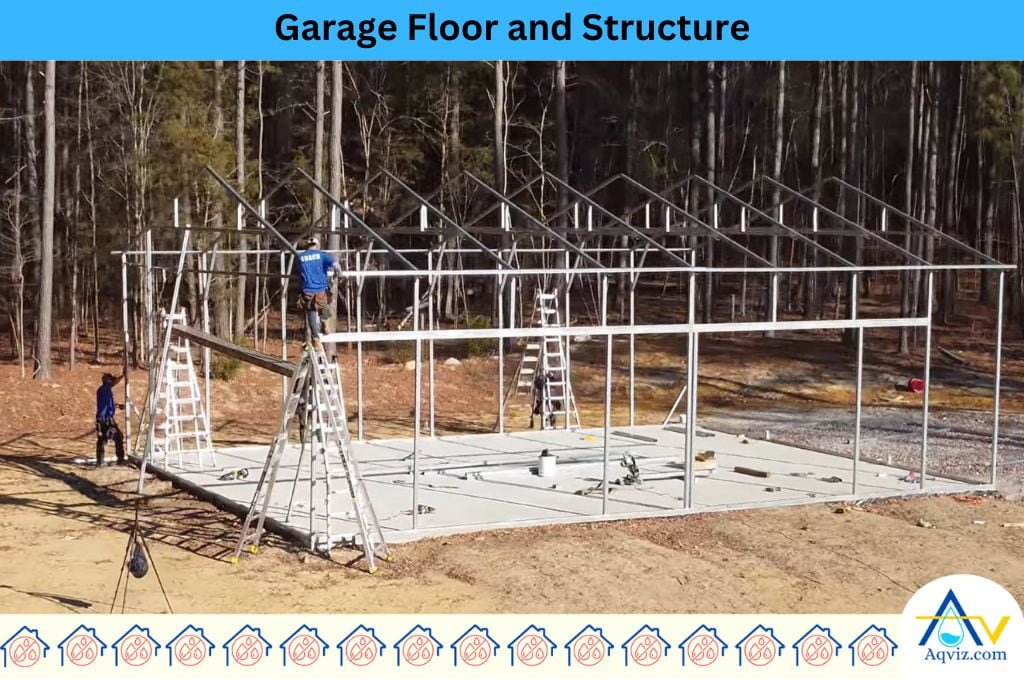
6. Control the Garage Floor Slope and Drainage
Controlling the garage floor slope and drainage helps to properly remove the water, oil, and other liquids away from the structure instead of pooling on the slab.
- Recommended garage floor gradient: The recommended garage floor slope of 1-2%, equal to 10-20 mm per 1.0 m (⅛-¼ in per 1 ft). If it is below 1% cause water ponding, while slopes above 2% make parking uncomfortable and cause rolling tools.
- Garage Slope direction: The garage slope direction should always move water away from walls and toward the garage door or internal drain. In attached garages, you should slope the floor toward a trench drain instead of the house to prevent moisture and fumes from entering living spaces.
- Drainage system inside the garage: Garage drainage systems include trench drains, point drains, and channel drains. Trench drains installed near the garage entrance perform best for wash water and rain intrusion.
- Surface finish and water flow: Surface finish affects drainage performance. Smooth trowel finishes allow faster water movement, while rough finishes trap dirt and oil. We recommend a light broom or epoxy-coated surface to balance slip resistance and water flow.
7. Select the Waterproofing Methods
Waterproofing methods help to prevent water and moisture from leaking into the structure. To waterproof a garage you can use waterproofing membranes, sealants, paints, and equipment which are mentioned below.
- Waterproofing membranes: Waterproofing membranes are used for garage waterproofing to prevent water penetration. Mainly you can use these 4 waterproofing membranes such as polyurethane, EPOXY, acrylic, and cementitious.
- Epoxy sealants: Epoxy sealants are highly effective for sealing garage floors, cracks, and joints against minor to moderate leaks. Epoxy sealants are higher in strength and durability. Epoxy sealants provide a smooth, attractive finish that is resistant to chemicals such as oil and grease and stains.
- Silicone sealants: Silicone sealants are perfect for filling cracks, joints, and gaps in the garage. It helps to protect the garage against minor water leaks. These sealants are flexible, UV-resistant, long-lasting, and offer excellent adhesion to various surfaces.
- Polyurethane sealants: Polyurethane sealants are ideal for sealing cracks, joints, and gaps in the garage, handling moderate leaks effectively. These sealants are highly elastic and durable, providing excellent adhesion to a variety of materials. Their resistance to weathering and UV exposure makes them suitable for both indoor and outdoor applications.
- Concrete sealers: Concrete sealers, such as cementitious waterproofing, can be used for concrete garage floor waterproofing. These sealers are designed for use on garage floors and walls, offering protection against minor to moderate leaks. They penetrate deeply into the concrete, enhancing its durability and resistance to stains and chemicals.
- Waterproof paint: You can use waterproof paint for garage walls, floors, and ceilings to prevent minor leaks. Waterproof paints are easy to apply on the garage surfaces, adds a protective moisture barrier. This paint is particularly useful in preventing surface water damage to the garage floor and is a cost-effective way to keep moisture at bay.
- Weather stripping: Weather stripping can be used to seal the garage doors and windows to prevent water leaks inside.
- Dehumidifiers: Dehumidifires helps to control the condensation in the garage. Humidity will increase the rusting of the metal, and it will be controlled by the dehumidifiers.
Do you know how to waterproof a garage? So you should read this guide. We have included everything there.
8. Design Garage Roof and Rain Water Controling
In this step you should decide the roof type, pitch, and drainage system to protect the garage from water infiltration, reduce maintenance, and direct rainwater safely away from the structure.
- Garage roof type: Common garage roofs include sloped roofs (gable, shed, or hip) and flat roofs. Sloped roofs simplify water drainage and reduce debris accumulation, while flat roofs require high-quality waterproofing and internal drains.
- Desired roof pitch: Roof pitch is the angle of the roof surface that helps rainwater flow off efficiently. For garages, we recommend a minimum pitch of 5-10° (1:12-2:12 slope) for flat-style roofs and 20-30° (4:12-6:12 slope) for sloped roofs.
- Rainwater disposal: Gutters and downspouts collect roof water and direct it safely away from the garage foundation. We recommend connecting downspouts to stormwater drains, rain barrels, or soakaway pits, keeping at least 1.5-2.0 m (5-6 ft) clearance from the foundation.
- Importance of rainwater control: Effective rainwater control prevents water from pooling around the garage, protects the slab and foundation, reduces basement or crawl space flooding, and extends roof life.
9. Seal the Garage Openings
You should seal all the garage openings, including doors, windows, and vents, properly and apply suitable sealants or shields to prevent water, dust, fumes, and pests from entering the garage while allowing proper access, light, and ventilation.
- Garage door sealing: Garage door should be sealed to prevent rainwater entry, dust infiltration, pest access, and cold or hot air leakage. You can use rubber bottom seals, vinyl weatherstrips, and neoprene side seals to close the gaps around the door frame.
- Garage window sealing: Garage window should be sealed to prevent wind-driven rain, condensation, and insect entry. You can use silicone sealant or polyurethane sealant around the window frame and wall junction. We recommend sealing both internal and external sides to avoid hidden moisture penetration that leads to wall dampness and paint peeling.
- Service opening sealing: Service openings include electrical conduits, plumbing sleeves, and ventilation ducts. These openings should be sealed to prevent moisture and pest entry. You can use fire-rated sealant, expanding PU foam, or cementitious filler depending on the gap size.
- Joint and edge shielding: Joints between the slab and walls should be shielded to control water migration. You can use flexible joint sealants or coving systems at floor and wall junctions. In our projects, this detail significantly reduces water seepage and improves the lifespan of epoxy and polyurethane floor coatings.
10. Select the Garage Wall and Roof Material
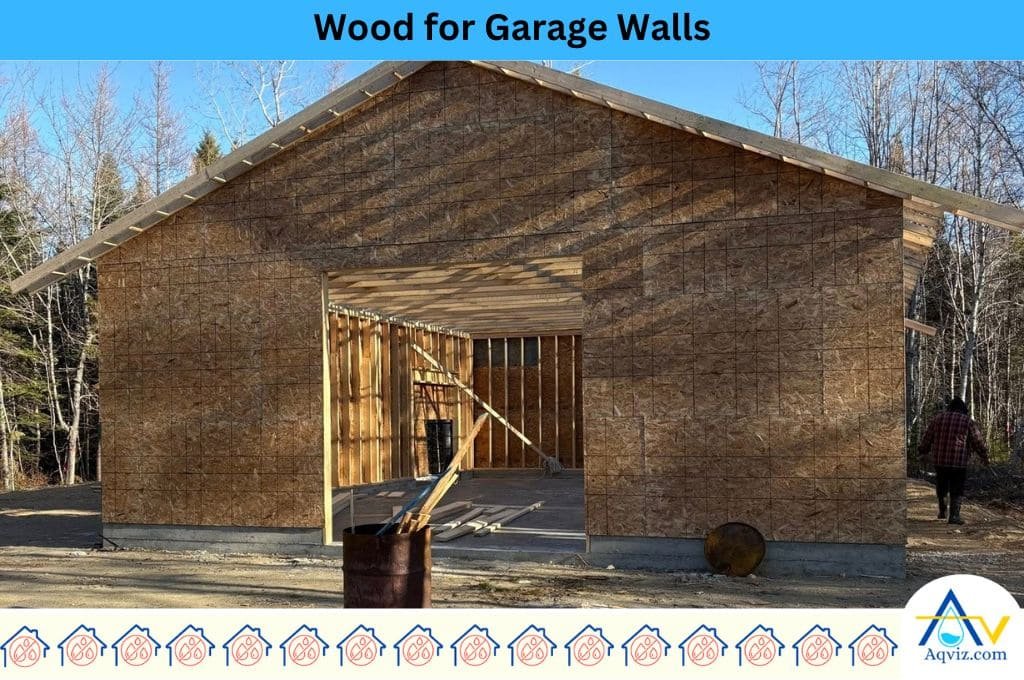
Selecting wall and roof materials are choosing the proper construction materials for the garage walls and roof to ensure durability, weather resistance, thermal performance, and cost-effectiveness.
These are the most used wall and roof materials you can use for garages.
The most used garage wall materials
- PVC panels
- Plywood & OSB panels
- Metal panels
- Fiberglass reinforced plastic (FRP) panels
- Slatwall & pegboard panels
- Drywall
The most used garage roof materials
- Asphalt shingles
- Metal roofing
- Bitumen / felt roofing
- EPDM rubber roofing
- GRP (fiberglass) roofing
- Polycarbonate / plastic sheets
- Clay or concrete tiles
11. Select Lighting System and Ventilation
You should select a proper lighting system to lit up the garage properly and ventilation system to keep the garage free of harmful fumes, moisture, and heat buildup, especially if it’s used for parking, storage, or workshop purposes.
When you select a lighting system and ventialtion system, you should consider below.
- General lighting system for garage: You can use LED ceiling lights at 300-400 lux for standard garages. For workshops, higher brightness of 500-700 lux is highly recommended.
- Special lighting for garage:
- UV lights: Useful for sterilizing surfaces or controlling mold and mildew in humid garages.
- Task lights: Adjustable lights over workbenches or mechanical areas improve precision for DIY or repair projects.
- Motion-sensor lights: Save energy and improve safety during night entry.
- Ventilation system: A proper ventilation system helps to remove car exhaust, chemical fumes, heat, and moisture efficiently. For better garage ventilation, you can use 500-1,000 CFM (cubic feet per minute) for attached garages. More than that, there should be natural ventilation through roof vents or louvered windows for better airflow to the garage to prevent mold and mildews.
12. Decide the Storage and Compartments
Storage and compartments are cabinets, shelves, racks, and lockers in your garage to organize tools, equipment, and materials safely while protecting them from moisture, pests, and accidental damage.
For the storage and compartments you can use these materials such as
- Plywood or MDF boards
- Steel or Aluminum
- Plastic
- Wires
13. Decide the Garage flooring
Garage flooring is the top protective layer applied over the concrete slab to resist wear, chemicals, moisture, and UV exposure. It also improves slip resistance and makes cleaning oil, mud, or water spills easier.
These are the most used 4 types of floorings for the garage
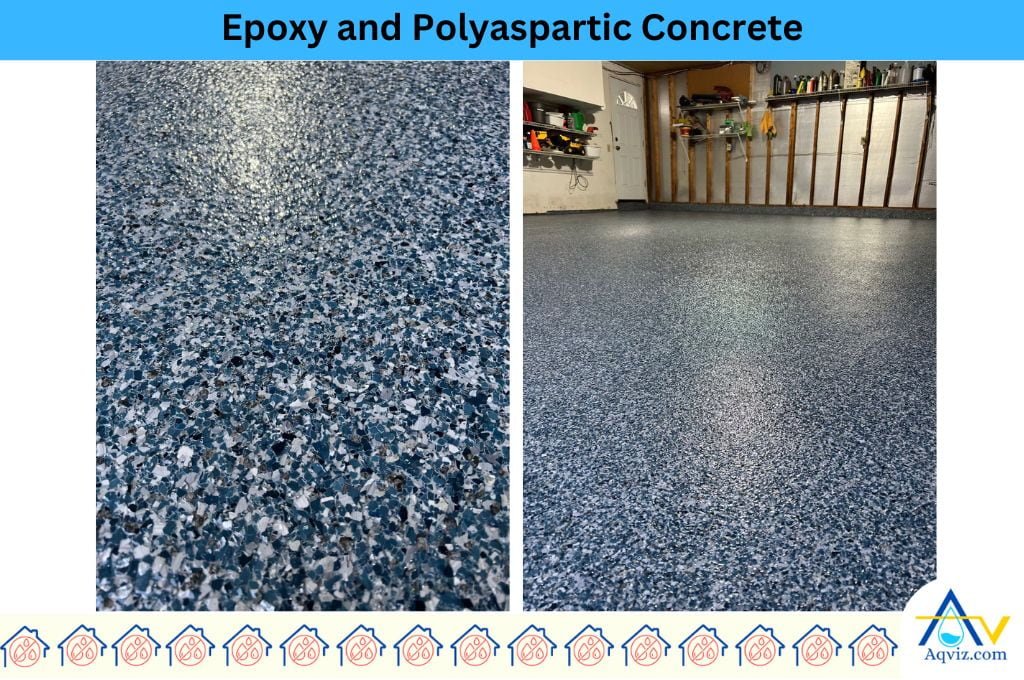
- EPOXY coating: Epoxy coating is highly durable, chemical- and oil-resistant, water-proof, and easy to clean. Hence, it is ideal for vehicle garages and workshops.
- Polyurethane coating: PU coating is flexible, UV-stable, abrasion-resistant; suitable for sun-exposed garages.
- Interlocking PVC tiles / rubber mats: PVC tiles are shock-absorbing, water-resistant, and easy to replace; best for light workshops or tool areas.
- Polished concrete with sealant: Polished concrete is strong, low-maintenance, water-resistant; less slip-resistant, so add anti-slip additives if needed.
Using standard interior tiles, laminate, or paint on garage floors can cause peeling, cracking, water absorption, and slipping. Vehicle tires, oil, and heavy loads quickly damage non-specialized flooring. From experience, homeowners who use regular paint or tiles often face floor damage within 6-12 months, leading to costly repairs.