
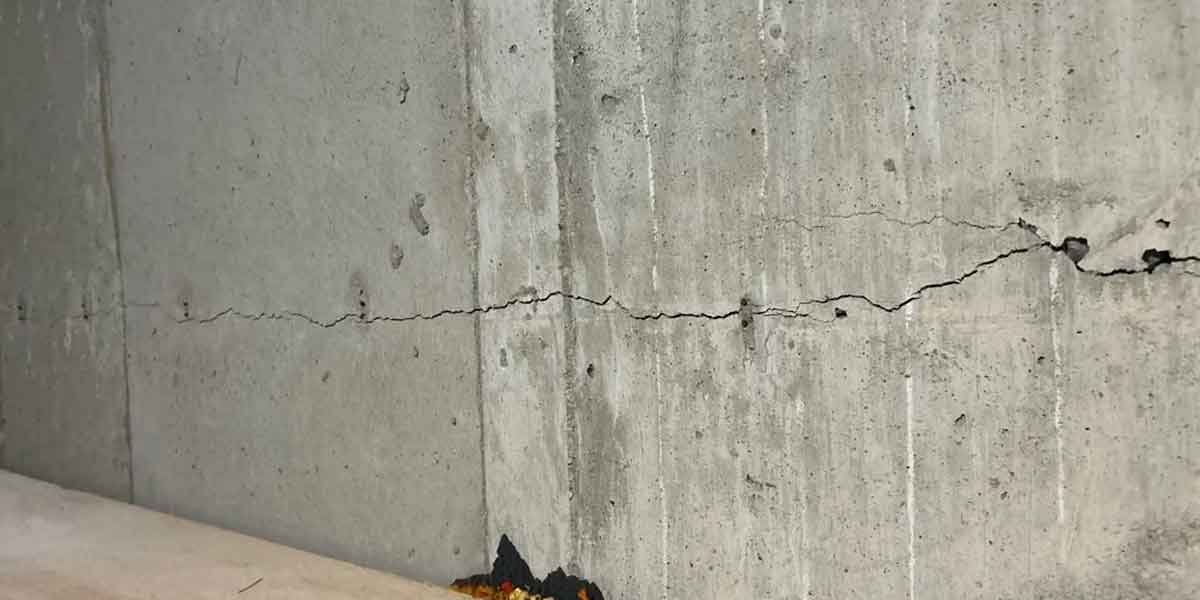

Expect a horizontal foundation crack repair cost of $500 to $1,200 to inject a wall that is still straight, and $4,000 to $12,000 once that wall has bowed inward.
The two figures describe different products. Injection closes a joint and stops seepage. Straps, anchors, and steel give a wall back the strength the crack took out of it. A horizontal foundation crack repair cost estimate that only lists sealing has priced the water and left the structure alone.
Which side of that line you land on comes down to one measurement. Has the wall moved inward, and is it still moving?
What Horizontal Foundation Crack Repair Costs
Typical pricing runs $500 to $1,200 for injection repair on a plumb wall, $4,000 to $12,000 for a carbon fiber strap system, $800 to $1,500 per engineered wall anchor, and $3,500 to $7,000 per wall for steel bracing.
Those unit prices come from the 2026 cost tables published by HomeGuide and Angi, as compiled in Two Brothers Foundation Repair’s cost research, plus Adam Basement’s 2026 crack-repair pricing. They are planning ranges. The low ends assume you can reach the wall from inside without moving shelving, ductwork, or a finished panel.
| Situation | Typical range | Priced per |
|---|---|---|
| Thin horizontal crack, wall straight and dry | $250 to $800 | crack |
| Horizontal crack that weeps or shows white mineral staining | $500 to $1,200 | crack, including prep |
| Wall bowed, carbon fiber straps | $4,000 to $12,000 | wall, roughly 12 straps |
| Wall bowed, engineered wall anchors | $800 to $1,500 each | anchor |
| Steel I-beam or channel bracing | $3,500 to $7,000 | wall |
| Drainage correction (grade, downspouts, exterior drain) | $500 to $5,000 | project |
| Structural engineer’s report | $500 to $3,000 | visit |
One row decides most of the total. The moment a bid moves from the crack to the wall, the unit changes from a seam you pour resin into to a run of wall that needs steel every few feet.
Why Bids Switch From Per Crack to Per Wall
A foundation wall works like a floor standing on edge. Backfill pushes it inward from the outside, which puts the outer face in compression and the inner face in tension, and a horizontal crack opens across the inside face near mid-height, where that bending is largest.
Concrete and block are strong in compression and poor in tension. The American Society of Home Inspectors describes a basement wall as a plate that has to be held at the top by the floor framing and at the bottom by the footing and slab. A horizontal crack is what shows up when the bending demand outruns that capacity.
Crack width matters less than wall movement. A tight horizontal line on a wall that has bowed two inches is a different repair from a wide opening on a wall that is still plumb.
Injection closes the seam. The wall keeps bending under the same load, and the joint usually reopens after the next wet season.
The crack opens where bending peaks
A basement wall spans between the footing and the first floor, and pressure from outside grows with depth. The bending moment peaks somewhere around mid-height, so that is where the tension crack appears, often widest at the middle of the wall’s length and closing toward the corners.
Stair-step cracking in a block wall is the same failure traveling along mortar joints. In poured concrete it reads as a single mostly horizontal line.
Why a slab home does not have this problem
A house on a slab has no wall retaining fill, so there is no lateral pressure to bow a basement wall. Cracks in that slab trace back to shrinkage, settlement, or a footing problem, so quoted slab-crack prices do not transfer to a retaining wall.
Straps, Anchors, and Steel: What Each One Buys
Carbon fiber straps hold a bowed wall where it sits for $300 to $500 each, wall anchors can pull it back for $800 to $1,500 each, and steel bracing at $3,500 to $7,000 per wall takes the load without giving up floor space.
Three systems cover nearly every residential horizontal crack, and the 2026 cost tables price each one differently. Choose by what the wall needs, then price it.
Carbon fiber straps. A carbon fiber strap is a vertical band bonded to the inside face, running from the floor framing above to the footing below. It resists further inward bending and does not push a wall back to plumb, so it suits a wall that has moved a little and stopped. Straps run $300 to $500 each, and a full wall commonly takes around 12, which is where the $4,000 to $12,000 range comes from.
Wall anchors. A wall anchor is an interior plate connected through the wall to an exterior anchor set in stable ground, tightened to hold, and on some walls to draw the wall back over time. At $800 to $1,500 per anchor, a wall needing six of them lands near $5,000 to $9,000 before any drainage work.
Steel I-beam or channel bracing. Steel bracing is a vertical member bearing against the wall from the footing to the joists, at $3,500 to $7,000 per wall. It is the heaviest of the three and it consumes floor space along that wall for good.
A wall that has already bowed past the point a strap can hold needs a system that applies force. A wall that is straight and dry needs neither. The engineer’s report is what separates those cases, and it is also the smallest line item in a five-figure bid.
Reading a Bid Line by Line
Two bids on the same 24 foot wall can differ by a factor of two without either contractor being dishonest, because they are pricing different scopes in different units.
Run the arithmetic on a 24 foot poured wall. Eight carbon fiber straps at $500 each is $4,000 in hardware before labor, surface prep, and patching. Six wall anchors at $800 to $1,500 each is $4,800 to $9,000 before drainage.
Divide either total by the wall’s 24 feet and you have a per-foot figure that the next bid can be measured against. Per-foot pricing is what makes two estimates comparable, and it is the first number to put side by side. That calculation is the part of a horizontal foundation crack repair cost estimate that moves the total most.
Then read the scope. Six items explain most of the spread:
- Unit and count. Ask for the anchor or strap count and the spacing in writing. Count times spacing should cover the full wall, corner to corner.
- Top connection. A strap that stops below the floor framing is holding up half a wall. Confirm the connection to the joists or the first floor system is in the scope.
- Drainage and backfill. Grade, downspout extensions, exterior drain, and any regrading of the backfill. Without them the pressure that opened the crack stays where it was.
- Engineering and permits. Who seals the drawings, and whether the report, the permit fee, and any inspection are inside the number. Permits alone typically run $75 to $150.
- Access and restoration. Patching a finished wall, moving ductwork or a water heater, and reaching the foundation behind a deck are separate lines in most bids.
- Warranty. Read what it covers (the hardware, the wall, or both), who honors it, and whether it transfers if you sell the home.
I ask for the count and the unit price before I ask for the total. A bid that lists the strap or anchor count, the unit price, and the layout on the wall is auditable. A bid that says “fix crack” is not, and asking is free.
Drainage Belongs in the Line Items
Wall design assumes drained backfill. The ICC record of the IRC clause governing precast concrete foundation walls sets lateral earth pressure at 60 pounds per square foot per foot of depth, and the same clause originally assumed the wall would never see hydrostatic pressure from groundwater.
Drainage sits in the bid because of that assumption. Water held against a wall adds load on top of the earth pressure the wall was designed for. The committee that reviewed the clause struck the groundwater line on the argument that precast panels can take that pressure, which leaves older poured and block walls to be judged on their own condition.
Drainage work is also the cheaper half of the job. Grade correction, downspout extensions, and an exterior drain typically run $500 to $5,000, against $4,000 and up for the structural repair.
Order matters. Fix the water source first, then anchor the wall. Anchors installed against saturated backfill spend their service life resisting more load than the wall was designed to carry, and the repair ends up blamed for a drainage problem that never got fixed.
When the Right Answer Is to Wait
A thin horizontal crack on a wall that is straight, dry, and unchanged across a full year of seasons is a monitoring case. A tape measure and a level settle it, and steel can wait until something actually moves.
One dry season of observation separates a wall that has stopped from a wall that is still moving, and the check costs an hour in the basement.
Record it properly. Photograph the crack with a tape measure beside its widest point, write the date on the wall with a pencil, and check the wall’s plumb with a four foot level. Recheck after the wettest month of the year. If nothing has changed, the money stays in your account.
The basement is usually where this gets noticed first, on a Saturday, with a flashlight, because a shelf rocked or a paint line along the wall showed a curve that was not there last spring. The crack itself is often narrow, a sixteenth of an inch, dark with dust along its lower edge.
Waiting stops being reasonable when the crack is damp or carries white mineral staining, when the wall’s plumb has changed since your last check, or when a door above the wall stops closing square.
Questions Owners Ask Before They Pay
How much does horizontal foundation crack repair cost?
A horizontal foundation crack repair cost of $500 to $1,200 covers injection on a wall that is still straight. Once the wall has bowed, straps, anchors, or steel bring the total to $4,000 to $12,000 or more per wall, and drainage work adds $500 to $5,000.
Is a horizontal crack worse than a vertical one?
A vertical crack usually traces shrinkage or settlement and often needs only sealing. A horizontal crack across the inside face at mid-height points to outside pressure bending the wall, which is why it draws structural pricing instead.
Can I inject a horizontal crack and skip the rest?
Injection seals the opening and leaves the wall’s bending capacity where the crack left it. On a wall that has moved, expect the joint to reopen after the next wet season.
Do I need a structural engineer before repairing a horizontal crack?
Bring one in when the wall has visibly moved, when a bid includes anchors whose layout has to be signed, or when two bids disagree by thousands of dollars. Reports run $500 to $3,000, and the inspection visit is usually the cheapest way to settle which repair you actually need.
Does homeowners insurance cover horizontal foundation crack repair?
Claims are decided by cause. Long-term pressure from earth and groundwater is commonly excluded, while a sudden event such as a burst supply line is handled differently, so ask the adjuster which cause the policy names.
What time of year is best for horizontal crack repair?
Late summer into early fall, when the ground is driest and easiest to excavate for anchors or exterior drainage. Concrete and grout cure better in mild temperatures, and a dry season gives you a clean baseline if you decide to monitor the crack first.