
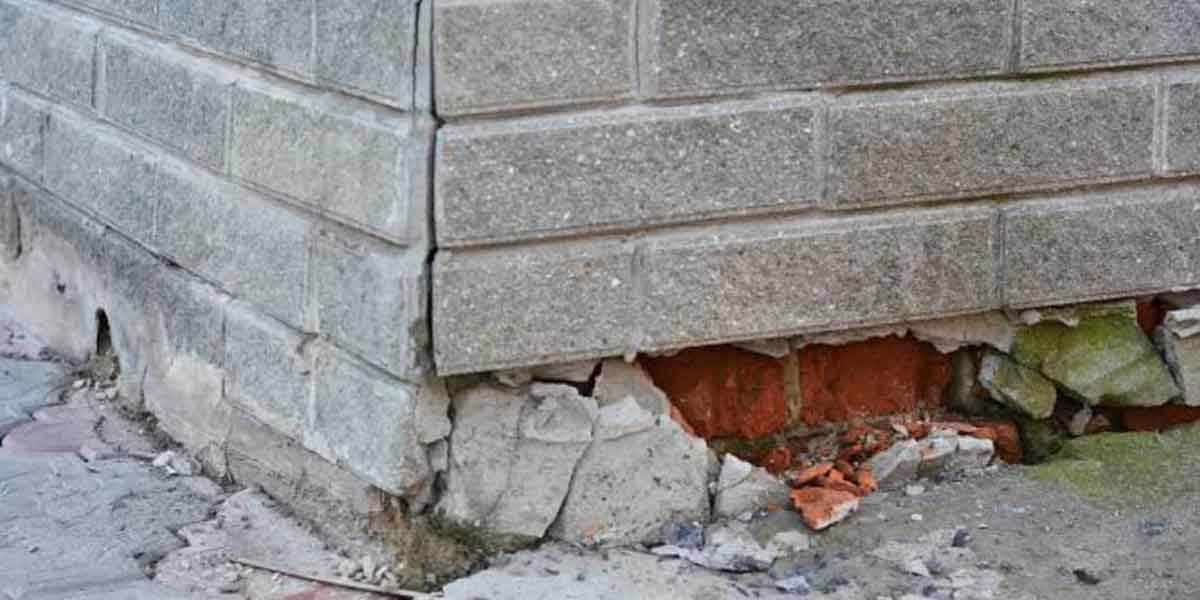

Does homeowners insurance cover foundation issues? Rarely, and almost never because of the crack itself. The HO-3 form most U.S. carriers sell insures the dwelling against direct physical loss from nearly every cause, then takes back the causes that move foundations: earth movement, water below the ground, settling and wear.
The cause decides the claim, not the damage. A photograph of a cracked slab proves that something went wrong. It does not prove which of those causes did it, and that is where the argument usually ends.
Adjusters start with a date. When did you first notice it? Most owners cannot answer, which is why a door that stopped latching last August carries more weight than a folder of close-up shots.
What the Policy Actually Insures
Homeowners insurance pays for sudden damage to the structure from a covered cause. The HO-3 form used by most U.S. insurers covers the dwelling against direct physical loss, subject to a list of exclusions. Foundation damage is judged by the same rule as a roof or a wall, so the cause does the work.
The Insurance Information Institute publishes the coverage table by policy type: HO-2 and HO-3 cover the dwelling against all perils except flood, earthquake, war, nuclear accident, landslide, mudslide and sinkhole. The institute also distributes a sample HO-3 form. Its Coverage A sentence reads, “We insure against risk of direct physical loss to property described in Coverages A and B.” Everything that decides a foundation claim sits after that sentence.
The exclusions open with a rule of their own. Loss caused directly or indirectly by a listed cause is excluded “regardless of any other cause or event contributing concurrently or in any sequence to the loss.” A burst pipe in the same season as a drought does not split the difference.
Earth movement is one of those causes. It does not have to be the only one. The loss falls out whole.
Which Causes Are Covered
Fire, lightning, windstorm, hail, explosion, riot, aircraft, vehicles, smoke, vandalism, theft and volcanic eruption are the perils the standard list names, and the HO-3 applies them to the dwelling. A tree that comes down in a storm and cracks the slab is the cleanest case, because the cause has a date and a weather record behind it.
Two entries on that list bite. Vandalism is excluded once a dwelling has sat vacant for more than 60 consecutive days. The weight of ice and snow will pay for a crushed roof but not for what the same weight does to a footing, a foundation or a wall that supports the building, and the form carves that out in its Coverage A exceptions beside freezing and thawing.
Why Settling and Shrinking Are Excluded
Settling, shrinking, bulging and expansion sit on the HO-3’s list of excluded causes for the dwelling, in the same clause as wear and tear, rust, dry rot, rodents and insects. Water below the surface of the ground is excluded separately.
That second exclusion names the foundation directly. Water that exerts pressure on, seeps through or leaks through a foundation is out, and so is the same water under a driveway, sidewalk or pool. Fire, explosion or theft that follows water damage is still paid, which is the form’s one concession in that section.
Collapse coverage in the same form does not rescue the case either. The HO-3 pays for collapse only when a building or part of one abruptly falls down or caves in, and a standing building is not in a state of collapse even with cracking, bulging, sagging, leaning or settling. Foundations belong to the list of items left out of that coverage unless the damage is a direct result of a building collapse.
Earth movement carries a definition wider than most owners assume: earthquake and the tremors around a volcanic eruption, landslide, mudslide or mudflow, subsidence or sinkhole, and any other sinking, rising or shifting of the earth. Earthquake coverage is sold separately or as an endorsement. The Insurance Information Institute cites researchers’ figure of a one-in-100 annual chance for a catastrophic sinkhole.
Three summers of drought, a mature oak on the property line, gutters that spill at the same corner after every storm. The crack at the garage corner widens in August and closes by February. None of that is a claim on its own, and it is close to the history an adjuster asks for.
Anchor Foundation Repair, a Brazos Valley contractor inspecting foundations for more than 40 years, reports that three or four of its hundreds of annual projects involve any insurance money at all.
The Three Routes That Still Pay
Three routes survive the exclusions. A dated pipe or sewer break can carry a foundation claim, an endorsement can buy the settling language back, and a handful of states require insurers to offer sinkhole coverage. The trigger and the ceiling differ in each case.
A Pipe Break With a Date
Unless the loss is otherwise excluded, the HO-3 pays for damage resulting from an accidental discharge or overflow of water or steam from within a storm drain, or water, steam or sewer pipe. A supply line that fails under the slab and washes out the soil beneath a footing fits that sentence exactly.
The limiting words carry the weight. The discharge has to come from inside one of those systems, and the exclusion in front of the clause still applies. A leak that has been wetting soil for two years is not an accidental discharge. It is the seepage the policy already excludes.
Buying the Coverage Back
A separate endorsement can buy the settling language back. The version quoted by Anchor Foundation Repair pays for settling, cracking, shrinking, bulging or expansion of the foundation, floor slab or footings caused by leakage from a plumbing, heating, air conditioning or fire sprinkler system, plus the cost of tearing out and replacing whatever has to come apart to reach the pipe.
The ceiling is the catch. That quoted endorsement pays no more than 15% of the Coverage A limit or $25,000, whichever is less, for all losses in a policy period. The premium is small by comparison: Brandon Eisenman of W.E. Gibson Insurance puts it at $50 to $100 a year. It exists only if it was added when the policy was written or renewed.
Sinkhole Law in a Few States
Florida and Tennessee require insurers to offer optional sinkhole coverage for an additional premium, according to the Insurance Information Institute, which notes that the coverage is written state by state as either an endorsement or a stand-alone policy. Florida goes further and mandates catastrophic ground cover collapse coverage inside every standard homeowners policy.
Florida Statute 627.706 defines that collapse as geological activity satisfying four tests: the abrupt collapse of the ground cover, a depression visible to the naked eye, structural damage to the covered building including the foundation, and the structure condemned and ordered vacated. All four, not three. The same statute deletes the case most owners bring, since damage consisting merely of the settling or cracking of a foundation, structure or building does not count as a catastrophic ground cover collapse. Sinkhole coverage bought separately can carry a deductible of 1%, 2%, 5% or 10% of the dwelling limit, and a claim has to be reported within two years of the date the owner knew or should have known about the loss.
Where the bedrock is limestone, the risk clusters. The U.S. Geological Survey lists Texas, Alabama, Missouri, Kentucky, Tennessee, Pennsylvania and Florida as the states where sinkholes are most common.
What a Claim Has to Prove
A claim needs a covered cause, a date, and evidence that connects them. Payment is then capped by the Coverage A limit, and a home insured below 80% of its replacement cost can be paid at a reduced share even when the cause is covered.
Evidence is where foundation claims stall. A plumber’s report that locates the break under the slab and dates the moisture, an engineer’s written opinion on the movement, photographs carrying dates: each one does the same job, turning a condition into an event. A structural engineer’s inspection can reach $1,500 or more, based on 2026 Angi data cited by NerdWallet.
Then the limit applies. Liberty Mutual’s explanation of the 80% rule runs the arithmetic: a home that needs $320,000 of coverage to sit at 80% of replacement cost but carries $240,000 in Coverage A is insured at 75%. A $50,000 loss is paid at $37,000 before the deductible, with the cause fully covered.
Repair scope decides whether any of it is worth pursuing. Sealing a crack and pinning a sinking corner sit in different orders of magnitude, and the drivers behind those numbers are worth knowing before a file is opened: what actually drives the cost of foundation repair.
Frequently asked questions
What is the 80% rule in homeowners insurance?
The 80% rule holds that a home should be insured for at least 80% of its replacement cost. Fall below that threshold and the insurer can pay a reduced percentage of a covered claim, which is how a home insured at 75% of the requirement ends up with 75 cents on the dollar.
What are three things that are not covered by homeowners insurance?
Flood, earthquake and long-term maintenance damage head the standard exclusion list, and the HO-3 form also removes settling, shrinking, bulging and expansion of the dwelling. Sewer backup, mold and groundwater seeping through a foundation are excluded as well, and most of those can be bought back by endorsement.
How expensive is it to fix a sinking foundation?
Fixr’s 2026 cost data puts the national average for foundation repair at $5,200, with most jobs landing between $2,200 and $8,200. Sealing a crack with injection runs $200 to $1,000, while underpinning or piering a sinking foundation costs $10,000 to $40,000.
Does homeowners insurance cover foundation issues?
Does homeowners insurance cover foundation issues? Only when a covered cause produced them, such as fire, a vehicle, a tree dropped by a storm, or an accidental pipe break with a date on it. Gradual settling, earth movement, groundwater seepage and skipped maintenance are excluded, and sinkhole coverage depends on state law.
The file that survives review is thin: a date, a cause, one expert sentence connecting them. Policy language does not soften because the repair runs to five figures.
Forms differ by carrier and state, and the HO-3 language quoted here is no substitute for your own declarations page or a licensed agent’s reading of it.