
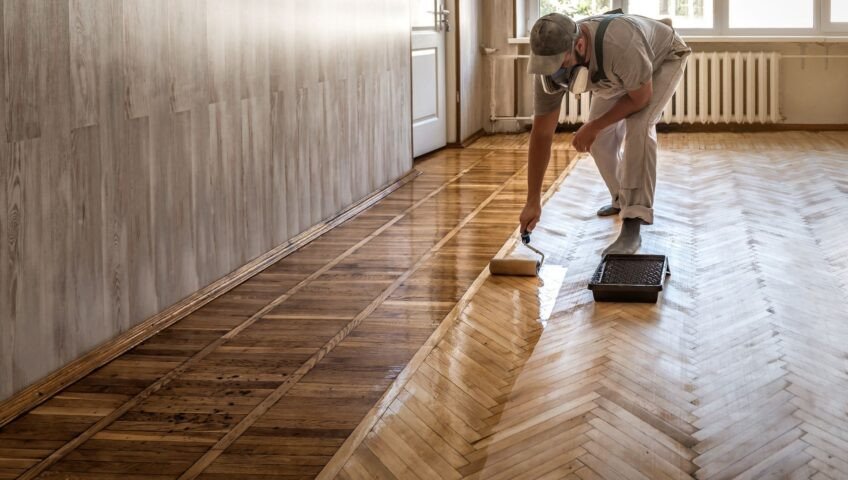

The can of deck stain says it covers four hundred square feet per gallon and dries in four hours. What the can does not say is that the deck must be cleaned and dried for twenty-four to forty-eight hours before the stain can be applied, that the stain must be applied by hand with a brush and a roller on every inch of every board, every spindle, every rail, and every stair riser, and that the drying time on the can assumes a seventy-degree day with low humidity, which is not the weather on the Saturday you planned to do this, highlights Advanced Solutions Herriman. Staining a deck is a three-day project compressed into a weekend by homeowners who underestimate the cleaning time, and the result of that compression is a deck that looks good from twenty feet away and terrible from six inches.
A two-hundred-square-foot deck, roughly twelve by sixteen feet, takes about eight to twelve hours of actual work time for a single person, spread across at least two days, plus twenty-four to forty-eight hours of drying time between cleaning and staining, plus another twenty-four to forty-eight hours of curing time after staining before furniture can be placed and feet can walk on it. The total elapsed time from starting the pressure washer to placing the last chair is three to five days, of which about a third is actual work and two-thirds is waiting.
Cleaning — The Day Before You Touch the Stain Can
A deck must be cleaned before it can be stained because stain does not bond to dirt, mildew, pollen, or the gray oxidized layer of weathered wood. Cleaning means pressure washing with a fan tip at a pressure low enough to remove the dirt and the oxidized wood fibers without gouging the wood, or scrubbing with a deck cleaner and a stiff brush. Pressure washing is faster. Scrubbing is safer for the wood. A pressure washer set too high, above about fifteen hundred PSI for softwood like cedar or pressure-treated pine, will furrow the grain and leave permanent ridges that the stain will highlight. Hold the fan tip at a consistent distance, about twelve inches from the surface, and move it in smooth overlapping passes. A pass that lingers leaves a mark.
For a two-hundred-square-foot deck, pressure washing takes about an hour to an hour and a half. Scrubbing by hand with a deck brush takes two to three hours and is physically exhausting in a way that pressure washing is not. The scrubbing method is slower, harder, and gentler on the wood. If the deck is cedar or redwood, scrubbing is the safer method. If the deck is pressure-treated pine and the pressure washer is set to a low pressure with a wide fan tip, pressure washing is fine. After cleaning, the deck must dry completely before staining. Damp wood will not absorb stain, and stain applied over damp wood will peel within weeks.
Drying time after cleaning is at least twenty-four hours in warm, dry weather. In humid weather, or if the deck is in shade for most of the day, drying can take forty-eight hours or longer. The wood must be dry to the touch and light in color. A deck that was dark gray before cleaning and is now a lighter, natural wood color is clean and ready to dry. A deck with dark spots remaining needs more cleaning. Stain will not cover dirt. It will seal the dirt under a layer of pigment, and the dirt will cause the stain to fail at those spots.
Staining — The Slow, Methodical Part
Stain is applied with a stain pad or a roller for the flat surfaces and a brush for the edges, the corners, and the railings. A pump sprayer applies the stain to the surface, but it must be back-brushed immediately to work the stain into the wood grain and prevent puddling. A sprayer without back-brushing produces a deck that looks evenly coated until the first rain, when the stain that was sitting on top of the wood washes off and the spots where the sprayer missed appear as pale patches. Back-brushing adds time but it is not optional.
The flat deck surface is the fastest part. A two-hundred-square-foot deck takes about two to three hours to stain the floor boards with a pad applicator on a pole. The railings are the slowest part. A deck with thirty linear feet of railing, with thirty spindles, a top rail, a bottom rail, and a handrail cap, takes about as long to stain as the entire floor. Each spindle must be brushed on four sides. The top rail must be brushed on three sides. The handrail cap must be brushed on the top and the edges. Every surface must be coated, and every surface faces a different direction that requires a different brush angle. Railing staining time is roughly fifteen to twenty minutes per linear foot of railing for a thorough job. A ten-foot section of railing with ten spindles takes about two and a half to three hours by itself.
Stairs multiply the time per square foot by a factor of three. A set of four stairs with risers takes about an hour to stain because each tread must be brushed, each riser must be brushed, and the stringers on the sides must be brushed. The surfaces are small, numerous, and oriented in different directions. Stairs are the part of the deck where a homeowner who is running out of daylight decides to spray and skip the back-brushing, and those stairs will need to be re-stained next year while the rest of the deck still looks acceptable.
| Deck section | Time per unit | 200 sq ft deck example |
| Floor boards (flat surface) | 2–3 hours total | ~2.5 hours |
| Railing (per linear foot) | 15–20 minutes | 30 ft railing = 7.5–10 hours |
| Stairs (per step) | ~15 minutes | 4 steps = ~1 hour |
| Cleaning (pressure washer) | 1–1.5 hours | ~1 hour |
| Drying after cleaning | 24–48 hours | 1–2 days |
| Drying/curing after stain | 24–48 hours | 1–2 days |
Weather, Temperature, and the Shrinking Window
Stain must be applied within a specific temperature range, typically fifty to ninety degrees Fahrenheit, and the deck surface must not be in direct sunlight because hot wood absorbs stain too quickly and produces lap marks. A deck on the east side of the house can be stained in the afternoon. A deck on the west side must be stained in the morning. A deck with no shade must be stained on an overcast day or worked in sections as the sun moves. The working window on a sunny day may be only a few hours before the deck surface becomes too hot to stain properly.
Stain must not be applied if rain is forecast within the curing window, typically twenty-four hours for water-based stain and forty-eight hours for oil-based stain. A deck that is stained on a Saturday afternoon and rained on Saturday night will have spots where the rain washed the uncured stain off the surface. The fix is to let the deck dry, sand the affected areas lightly, and reapply stain, which adds another day of drying time and produces a patchy appearance where the new stain overlaps the old.
FAQ — Deck Staining Time
Does the deck need one coat or two?
Most deck stains are designed for a single coat applied at the manufacturer’s recommended coverage rate. A second coat applied over a properly stained deck will sit on top of the first coat and not absorb, producing a sticky surface that peels. The exception is when the first coat was applied too thinly or unevenly, which is corrected by a second coat applied while the first coat is still tacky. Once the first coat has dried, a second coat will not bond. The time for a single thorough coat, back-brushed and applied at the correct rate, is the time budget above. A second coat doubles the application time.
Does oil-based stain take longer to apply than water-based?
The application time is similar. The drying and curing time is longer. Oil-based stain requires solvents for cleanup, takes longer to dry to the touch, and emits strong fumes that require the house windows to be closed while the stain cures. The working time with oil-based stain is longer because the stain stays wet longer, which means you can apply it to a larger section before going back to back-brush. Water-based stain dries faster, which means you must back-brush smaller sections. The total application time is roughly the same. The project elapsed time is longer with oil-based because of the extended curing window.
How much faster is a professional crew than a homeowner working alone?
A two-person professional crew can stain a two-hundred-square-foot deck with railings in a single day, about six to eight hours of work, because they work simultaneously on different sections and they have developed a pace that a homeowner working alone cannot match. A homeowner working alone will take about twice as long for the actual work and must spread it across multiple days because the cleaning and drying gaps cannot be compressed. The professional crew is faster not because they are better at staining but because there are two of them, they do not stop to read the can, and they are not also answering text messages and deciding what to make for dinner.
