
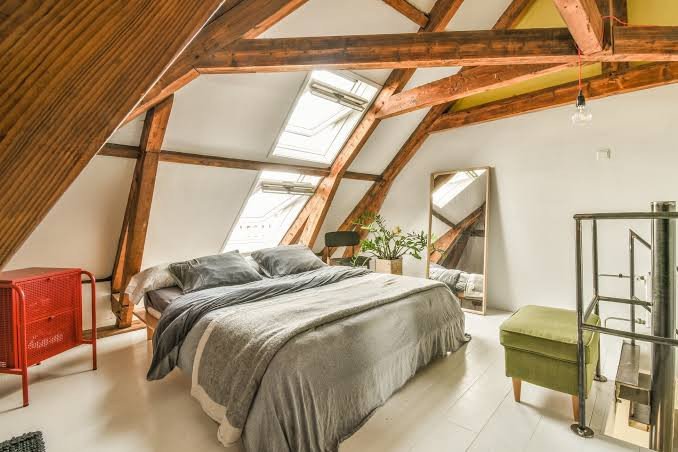

According to Keller property management, converting an attic to a bedroom adds a bedroom to the house without adding a foundation. The space is already under the roof. The square footage already exists. The question is whether it meets the legal definition of a bedroom, which is more specific than most homeowners realize. A room with a bed in it is not a bedroom in the eyes of the building code, the appraiser, or the home inspector. A legal bedroom requires an egress window, a minimum ceiling height over a minimum floor area, a closet or designated wardrobe space, a permanent staircase, a smoke detector, and an AFCI-protected electrical circuit. Missing any one of these, and the finished attic is a bonus room, not a bedroom, at resale.
What Makes a Room a Legal Bedroom
A legal bedroom is defined by building code, not by furniture placement. The seven requirements are:
- Minimum ceiling height. At least 7 feet over at least 50 percent of the floor area. The portion of the room with ceiling height below 5 feet does not count toward the minimum room area.
- Minimum floor area. At least 70 square feet of usable floor area. At least one dimension must be 7 feet or greater in any direction.
- Egress window. A window or skylight that opens directly to the outside and provides an emergency escape route. The opening must be at least 5.7 square feet, with a minimum width of 20 inches and minimum height of 24 inches. The sill must be no more than 44 inches above the floor.
- Permanent staircase. Minimum 36-inch width, 6-foot-8-inch headroom, with handrail. Pull-down ladders and spiral staircases that do not meet the tread and riser requirements are not acceptable as primary access.
- Closet or wardrobe space. A built-in closet with a door, or a designated wardrobe area with a hanging rod and shelf, is required by most appraisers to classify the room as a bedroom. The specific requirement varies by jurisdiction.
- Smoke detector. Hardwired and interconnected with the existing smoke detector system in the house. Battery-only detectors do not meet code in most jurisdictions for new construction or renovation.
- AFCI-protected electrical circuit. The bedroom outlets and lights must be on an Arc-Fault Circuit Interrupter protected circuit. This is a National Electrical Code requirement for all bedrooms.
The Egress Window: The Most Common Dealbreaker
The egress requirement is the reason many attics cannot become legal bedrooms. The window must be large enough for a firefighter in full gear to enter and for an adult to exit. A standard double-hung window in a gable end wall often meets the size requirement if it is large enough. A small dormer window may not. A skylight must be specifically designed for egress with a hinged opening mechanism. Standard fixed skylights do not qualify.
If the attic does not have an existing opening that meets egress requirements, one must be created. A new window in a gable end wall costs $1,500 to $3,000. A new dormer with an egress window costs $8,000 to $15,000. An egress skylight costs $2,500 to $4,500 installed. The egress opening is not optional. A bedroom without egress is a death trap in a fire. The building code exists because people have died in attic bedrooms with no way out.
The Closet: Built-in or Designated Wardrobe Space
A closet with a door and a hanging rod is the traditional requirement for a bedroom, but building codes are increasingly flexible on this point. A designated wardrobe area with a built-in hanging rod and shelf, even without a door, satisfies most appraisers. In an attic bedroom, the knee wall cavity is the natural location for a closet or wardrobe. The cavity is 3 to 4 feet deep at the floor and tapers to zero at the top of the knee wall. A closet rod mounted across the cavity at the 4-foot height point provides hanging space. A shelf above it provides folded storage. The access is either a door in the knee wall face or an open wardrobe with no door.
Per wikiHow’s guide, hidden storage solutions are especially valuable in attic spaces where every inch counts. The knee wall closet costs a sheet of drywall, a closet rod, and an afternoon of work. It is the least expensive element of the bedroom conversion and the one that most directly affects the room’s classification at resale.
Construction Sequence for an Attic Bedroom Conversion
- Structural assessment. Engineer evaluates floor joists. Reinforcement if needed.
- Staircase compliance. Rebuild or modify stairs to meet code.
- Egress opening. Install egress window, skylight, or dormer.
- Framing. Knee walls, closet, interior partition walls.
- Electrical rough-in. AFCI circuit, outlets, lights, smoke detector interconnect.
- Insulation. R-38 minimum in ceiling, R-13 minimum in knee walls. Ventilation baffles at soffits.
- HVAC. Mini-split or duct extension.
- Drywall. 5/8-inch Type X on ceiling.
- Flooring, paint, trim.
- Final inspection. Building inspector verifies egress, staircase, smoke detector, electrical.
Common Mistakes in Attic-to-Bedroom Conversions
- Assuming any window qualifies as egress. The window must meet specific minimum opening dimensions, sill height, and operational requirements. A fixed window or a window that is too small or too high does not qualify.
- Skipping the interconnected smoke detector. The bedroom smoke detector must connect to the house system so that a fire in the basement triggers the alarm in the attic bedroom. A standalone battery detector is not code-compliant for new construction.
- Not planning for the closet. The closet must be framed during the framing phase. Adding a closet after the drywall is up requires cutting into finished walls. Frame the closet, even if it is just a knee wall wardrobe, during the initial framing.
- Blocking the egress window with furniture. A bed placed in front of the only egress window makes the window unusable in an emergency. The furniture layout must preserve a clear path to the egress opening.
Frequently Asked Questions
Can an attic with no windows be converted to a bedroom?
No. A bedroom requires an egress opening directly to the outside. An attic with no windows and no possibility of adding one, such as an interior attic with no gable end walls accessible, cannot be a legal bedroom. It can be finished as a bonus room, office, or playroom, which do not require egress in most jurisdictions. The egress requirement is the single most common reason an attic conversion cannot be classified as a bedroom.
How much value does an attic bedroom add to a home?
A legal attic bedroom with a closet and egress window adds roughly 60 to 75 percent of the conversion cost to the home’s resale value. The return is higher than a bonus room conversion because the bedroom increases the home’s listed bedroom count, which is how homes are valued and searched for online. A 500-square-foot attic bedroom conversion that costs $40,000 adds roughly $25,000 to $30,000 in home value. The net cost is $10,000 to $15,000 for an additional bedroom. The same square footage finished as a bonus room without a closet or egress adds roughly 40 to 50 percent of the conversion cost.
The Bedroom Under the Roof
Converting an attic to a bedroom is a legal process as much as a construction process. The ceiling height must meet code. The floor must support the load. The stairs must be compliant. The window must provide egress. The closet must exist. The smoke detector must interconnect. Each of these requirements exists because someone, at some point, was injured or killed in an attic bedroom that did not meet them. The code is not an obstacle to the conversion. It is the definition of what a bedroom is. A room that meets all seven requirements is a bedroom. A room that meets six is a bonus room with a bed in it. The difference matters when the house is sold and the square footage is counted. A legal bedroom adds to the listed bedroom count. A bonus room does not. The cost of meeting all seven requirements is the cost of converting square footage that already exists into value that an appraiser can measure.