
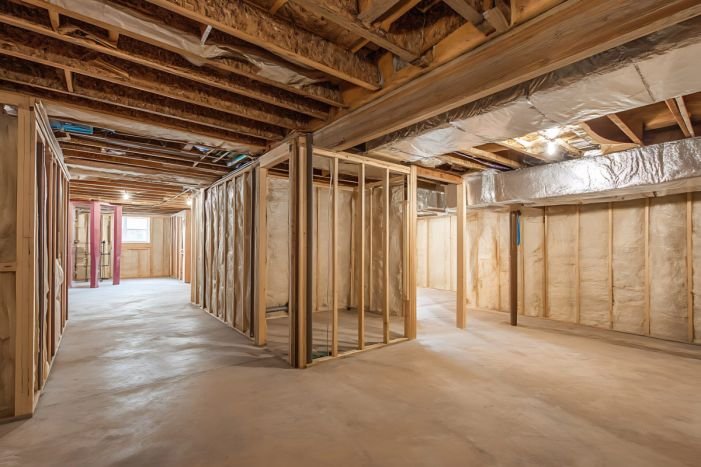

The basement wall in front of you is bare poured concrete. It is cold, gray, and slightly rough to the touch. In one corner, a white chalky film has formed on the surface. That is efflorescence, mineral salts left behind when water vapor migrated through the concrete and evaporated on the interior side. It tells you that moisture is moving through this wall. Finishing a concrete basement wall means managing that moisture while turning a bare structural surface into a finished, painted wall that looks like it belongs in a living space, observes Meridian property management.
Concrete basement walls are either poured concrete, which is smooth and continuous, or concrete block, which is a grid of mortar joints between individual blocks. The finishing method is the same for both, but block walls have mortar joints that are more permeable than the blocks themselves and require more thorough sealing. This guide covers the process from bare concrete to painted drywall, with emphasis on the moisture management that makes the difference between a wall that lasts and a wall that molds.
Poured Concrete vs. Concrete Block: What Changes
Poured concrete walls are cast in place when the foundation is built. The surface is relatively smooth but not perfectly flat. Form ties, the metal rods that held the form panels together during the pour, leave small circular divots in the wall. These divots do not need to be filled. The rigid foam insulation and framing cover them.
Concrete block walls are built from individual CMU blocks with mortar between them. The mortar joints are more permeable to moisture than the blocks. In a block wall, water vapor preferentially travels through the mortar joints. When sealing a block wall, pay extra attention to the mortar joints. Apply masonry sealer liberally into the joints with a brush before rolling the entire wall.
Both wall types follow the same finishing sequence. The block wall requires more sealer and more attention to the joints. The poured wall is faster to seal but may require more adhesive for the rigid foam because the smoother surface provides less mechanical grip.
Efflorescence: The White Powder That Tells You Water Is Moving
Efflorescence is a white, chalky deposit on the surface of concrete. It is harmless in itself. It is sodium, potassium, and calcium salts left behind when water evaporates from the concrete surface. Its presence means water vapor is moving through the wall. A small amount of efflorescence on an otherwise dry wall is normal and does not prevent finishing. Heavy efflorescence that reappears after cleaning indicates active moisture transmission that must be addressed before the wall is covered.
Brush off the efflorescence with a stiff nylon brush. Do not use water to wash it off. Water dissolves the salts and carries them back into the concrete, where they will reappear on the surface later. Dry brushing removes the salts. If efflorescence returns within a week, the wall has active moisture issues requiring exterior waterproofing or interior drain tile. Finishing over active moisture is the most expensive mistake in basement finishing because the wall assembly will need to be removed to fix the underlying problem.
Sealing the Concrete
Apply a masonry waterproofing sealer to the entire wall surface. The sealer is a liquid that penetrates the concrete pores and reduces, but does not eliminate, vapor transmission. Roll it on with a paint roller. Brush it into the mortar joints of a block wall. Let it dry for the time specified on the product label, typically 2 to 4 hours.
The sealer is a vapor retarder, not a vapor barrier. The wall can still breathe. This is intentional. A completely impermeable coating on the interior face of a concrete wall traps moisture inside the concrete, where freeze-thaw cycles in cold climates can spall the surface. The wall must be able to dry to the interior slowly. The sealer slows moisture entry to a rate that the wall assembly can manage without trapping it.
Insulation: Rigid Foam Against the Concrete
The insulation layer must be rigid foam, not fiberglass. Extruded polystyrene, XPS, minimum 1-inch thick, is glued directly to the sealed concrete with foam-compatible adhesive. The foam serves as both insulation and a secondary vapor retarder. Tape all seams between foam panels with insulation tape to create a continuous thermal break.
In cold climates, building codes typically require R-10 on basement walls, which means 2-inch XPS. The rigid foam must be continuous. Gaps in the foam create cold spots where condensation forms on the interior surface during humid summer months. The condensation drips down inside the wall cavity and collects on the bottom plate.
Framing or Furring: Two Paths to a Finished Surface
There are two methods to create a surface for drywall attachment over the rigid foam. Full 2×4 framing builds a stud wall in front of the foam, creating a cavity for electrical wiring and additional insulation. Furring uses 1×3 or 1×4 strips attached through the foam directly into the concrete with Tapcon screws. Furring saves 3 inches of floor space per wall but provides no cavity for wiring. If the wall needs electrical outlets, which most finished basements do, full framing is required. Furring is acceptable for a utility room or storage area.
With full framing, leave a 1/2-inch gap between the back of the studs and the face of the foam. This gap is a drainage and drying plane. If moisture ever gets past the foam, it drains to the floor rather than soaking into the studs. The bottom plate must be pressure-treated lumber because it contacts the concrete floor. Standard lumber in contact with concrete wicks moisture and rots.
Drywall and Finish
Use moisture-resistant drywall, green board or purple board, for all basement walls. Standard drywall absorbs humidity from the basement air and supports mold growth. Hang the drywall horizontally. Leave a 1/2-inch gap at the floor. The gap is covered by baseboard and prevents moisture wicking from the slab.
Tape, mud, and sand the drywall. Prime with PVA primer. Paint with two coats of interior latex. Install baseboard nailed to the studs, not to the floor. The floor shifts seasonally. Baseboard attached to both the wall and the floor will crack or pull away.
Frequently Asked Questions
Can I just paint the concrete wall instead of framing and drywalling it?
Yes. Painting a concrete basement wall is the least expensive finish option. Clean the wall, fill cracks with hydraulic cement, apply a concrete primer, and paint with two coats of masonry paint. The wall is still cold and hard, and it still looks like a basement wall, but it is sealed and the color is intentional rather than industrial gray. This is a $50 to $100 finish for a 20-foot wall compared to $220 to $440 for a fully framed and drywalled wall. It is appropriate for utility areas, workshops, and storage rooms. It is not appropriate for living spaces where the wall is touched, leaned against, or expected to look like an above-ground room.
Can I glue drywall directly to the rigid foam without framing?
No. Drywall adhesive does not bond reliably to rigid foam over the long term. The drywall will eventually sag or detach. The framing or furring provides mechanical fastening through screws into solid material. The screws through drywall into furring strips or studs are what hold the drywall in place for decades. Adhesive alone will not.
The Wall That Was Once Concrete
A finished concrete basement wall is the most dramatic transformation in a basement renovation. The wall goes from bare structural concrete to a painted drywall surface indistinguishable from any other wall in the house. The efflorescence is brushed off. The concrete is sealed. The rigid foam insulates. The framing provides structure. The drywall creates the finished surface. The paint is the color you chose. The wall is no longer cold to the touch. The basement is no longer a basement. It is a room.