


In a seller’s market, the demand for homes far outstrips the available supply, creating an environment where buyers often face intense competition. This imbalance can lead to bidding wars, quick sales, and a sense of urgency that can be overwhelming for prospective homeowners. Navigating such a market requires more than just finding the right property; it demands a strategic, well-informed, and often aggressive approach to crafting an offer that stands out. This comprehensive guide will equip you with the knowledge and tactics needed to make your offer not just competitive, but compelling, increasing your chances of securing your dream home amidst fierce competition, with the Legacy Realty & Management team offering a useful reference point for property planning after the purchase.
Understanding the Seller’s Perspective
To craft a truly competitive offer, it’s crucial to step into the seller’s shoes and understand their motivations. While price is undoubtedly a significant factor, it’s rarely the only one. Sellers are often driven by a combination of factors, including the net proceeds from the sale, the speed of the transaction, and the certainty that the deal will close without complications. A strong offer, therefore, goes beyond merely the highest dollar amount; it encompasses terms that address these underlying needs and concerns.
Sellers typically seek a smooth, predictable process. They want to avoid offers that come with numerous contingencies that could delay closing or, worse, cause the deal to fall apart. They also appreciate flexibility regarding closing dates and the ability to remain in the home for a short period after closing, if needed. By understanding these priorities, buyers can tailor their offers to be more attractive, demonstrating not just financial capability but also a willingness to accommodate the seller’s preferences, thereby reducing their stress and increasing the likelihood of acceptance.
Financial Strategies for a Strong Offer
The financial components of your offer are often the most impactful in a seller’s market. Beyond the sticker price, several financial strategies can significantly strengthen your position.
A. Pre-Approval vs. Pre-Underwriting: The Ultimate Financial Edge
While a mortgage pre-approval letter is essential (as discussed in our previous article), a pre-underwritten offer takes your financial credibility to the next level. Pre-underwriting means your lender has not only reviewed your financial documents but has also submitted them to the underwriting department for a preliminary review. This process is more thorough than pre-approval and signals to the seller that your financing is virtually guaranteed, pending only the property appraisal and title search. This significantly reduces the risk of financing falling through, making your offer highly attractive.
B. Offering an Attractive Price: Beyond Asking
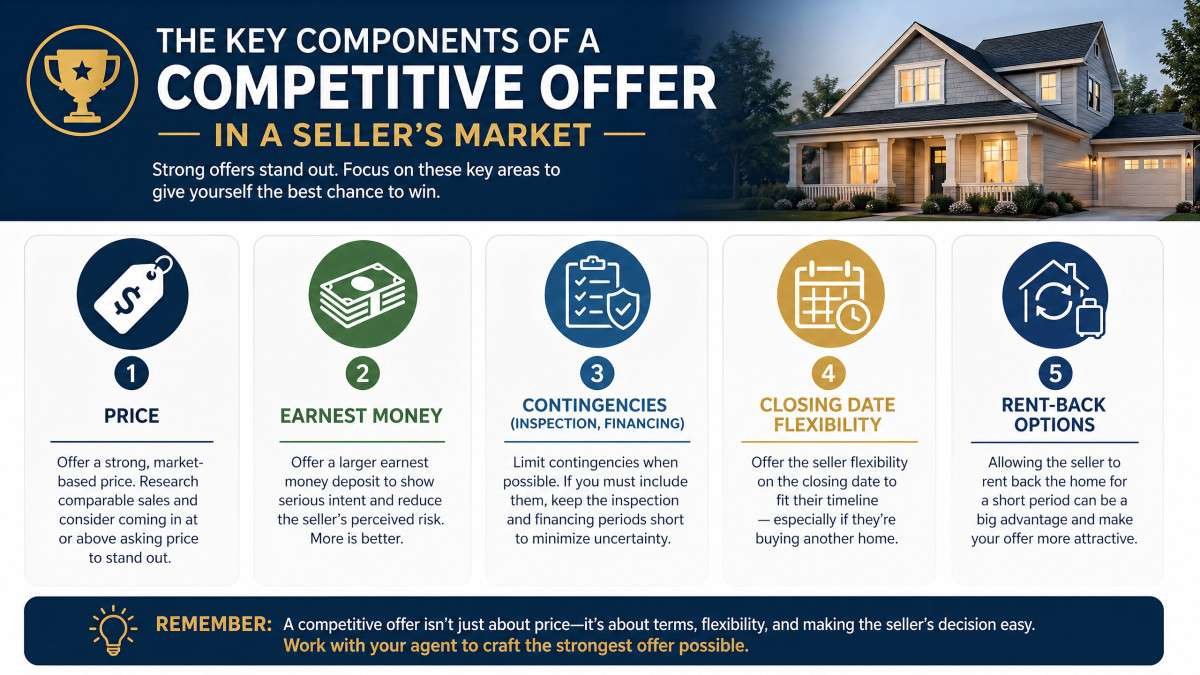
In a seller’s market, offering the asking price is often not enough. Buyers frequently need to offer above the list price to stand out. However, simply offering more isn’t always the most strategic move. Understanding the local market dynamics and recent comparable sales (comps) is crucial. An experienced real estate agent can help you determine a competitive yet reasonable offer price. Additionally, consider using an escalation clause, which states that you will increase your offer by a certain amount above any higher competing offer, up to a specified maximum. While effective, escalation clauses should be used judiciously and with clear limits to avoid overpaying.
C. The Power of a Larger Earnest Money Deposit
The earnest money deposit (EMD) is a portion of the down payment that you pay upfront to show your serious intent to purchase the home. While typically 1-3% of the purchase price, offering a larger EMD in a seller’s market can signal greater commitment and financial strength. A substantial EMD assures the seller that you are less likely to back out of the deal, as doing so would mean forfeiting a larger sum of money. This can be a powerful psychological advantage.
D. Addressing the Appraisal Gap
One of the biggest challenges in a hot market is the appraisal gap. This occurs when your offer price is higher than the home’s appraised value. Lenders typically only finance up to the appraised value, meaning you would need to cover the difference out of pocket. To mitigate this risk and make your offer more appealing, you can include an appraisal gap clause, stating that you are willing to pay the difference between the appraised value and your offer price up to a certain amount. This provides the seller with confidence that the deal won’t fall apart due to a low appraisal.
Contingency Management: Balancing Risk and Appeal
Contingencies are conditions that must be met for the sale to proceed. While they protect the buyer, they can make an offer less attractive to a seller. Strategically managing contingencies is key in a competitive market.
A. Inspection Contingency: Strategic Waivers and Information-Only Inspections
The inspection contingency allows you to back out of the deal or negotiate repairs based on the home inspection results. In a seller’s market, some buyers waive this contingency entirely, which is a high-risk strategy. A less risky approach is an
information-only inspection, where you conduct the inspection but agree not to ask the seller for repairs, only reserving the right to withdraw if major issues are found. This gives you peace of mind while still presenting a strong offer.
B. Financing Contingency: Shortening or Waiving (with caution)
The financing contingency allows you to back out of the deal if you cannot secure a mortgage. Waiving this contingency entirely is extremely risky unless you are paying all cash or have a pre-underwritten loan with absolute certainty of funding. A more common strategy in a seller’s market is to shorten the contingency period, demonstrating your confidence in your lender and financial situation. This reduces the time the seller’s property is off the market, which is a significant advantage.
C. Sale Contingency: A Major Hurdle in a Seller’s Market
A sale contingency means your offer is dependent on the sale of your current home. In a seller’s market, offers with this contingency are often overlooked in favor of those without. If you must sell your current home, consider alternative strategies like a bridge loan or selling your home before making an offer on a new one. If a sale contingency is unavoidable, try to make it as attractive as possible by having your current home already under contract or offering a very short contingency period.
Terms and Conditions that Appeal to Sellers
Beyond price and contingencies, certain terms and conditions can make your offer more appealing to a seller, demonstrating flexibility and a willingness to meet their needs.
A. Flexible Closing Dates
Sellers often have specific timelines for moving out, whether it’s coordinating with a new home purchase or a job relocation. Offering a flexible closing date that aligns with their preferences can be a significant advantage. This might mean a quicker close if they’re eager to move, or a longer close if they need more time to find their next home. Ask your agent to inquire about the seller’s ideal timeline and try to accommodate it.
B. Rent-Back Agreements (Leasebacks)
A rent-back agreement, or leaseback, allows the seller to remain in the home for a specified period after closing, typically renting it from you. This can be a huge convenience for sellers who need extra time to move or finalize their next living arrangements. Offering a rent-back can make your offer stand out, as it provides the seller with peace of mind and flexibility during a potentially stressful transition.
C. Covering Seller’s Closing Costs
While typically the buyer’s responsibility, offering to cover some or all of the seller’s closing costs can be a powerful incentive. This effectively increases the net proceeds for the seller without directly raising the purchase price, which can be appealing if they are looking to maximize their financial gain from the sale. This strategy should be carefully considered in conjunction with your overall offer price and budget.
Crafting the Offer: Presentation and Personalization
The way your offer is presented can also influence a seller’s decision. A well-crafted offer, supported by a skilled agent, can make a lasting impression.
A. The Role of Your Real Estate Agent
Your real estate agent is your most valuable asset in a seller’s market. An experienced agent will have a deep understanding of local market conditions, strong negotiation skills, and established relationships with other agents. They can help you strategize, advise on competitive pricing, and present your offer in the best possible light. Their expertise is crucial in navigating the complexities of multiple-offer situations.
B. A Clean and Concise Offer
Sellers and their agents often review multiple offers. A clean, well-organized, and concise offer is easier to understand and process, reducing the chances of misinterpretation or frustration. Avoid unnecessary complexities or overly aggressive terms that might deter a seller. Clarity and professionalism can go a long way in making your offer appealing.
C. The “Love Letter” (Use with Caution)
A personalized letter to the seller, often called a “love letter,” expresses your emotional connection to the home and your reasons for wanting to purchase it. While these letters can sometimes create a personal connection, they are increasingly viewed with caution due to fair housing laws. In some jurisdictions, they may even be prohibited. If you choose to write one, focus on objective aspects of the home you appreciate rather than personal characteristics, and always consult with your real estate agent about local regulations and best practices.
What to Do if Your Offer Isn’t Accepted
Even with the most competitive offer, there’s a chance it might not be accepted. It’s important to be prepared for this possibility and have a plan for your next steps.
A. Understanding Backup Offers
If your offer isn’t chosen as the primary, your agent might suggest submitting a backup offer. A backup offer becomes the primary offer if the first accepted offer falls through. This can be a viable strategy, especially if the primary offer has numerous contingencies or if the market is moving quickly. It keeps you in contention without having to restart your search entirely.
B. Learning from Rejection
If your offer is rejected, try to get feedback from the seller’s agent through your own agent. Understanding why your offer wasn’t accepted—whether it was price, terms, or other factors—can provide valuable insights for your next offer. Use this as a learning opportunity to refine your strategy for future bids.
C. Staying Persistent and Prepared
The homebuying journey in a seller’s market can be challenging and may involve multiple offers before success. It’s crucial to stay persistent, remain positive, and be prepared to act quickly when a new opportunity arises. Continue to work closely with your agent, refine your search criteria, and be ready to adjust your strategy as needed.
Conclusion: Winning in a Competitive Market
Making a competitive offer in a seller’s market requires a multifaceted approach that combines financial strength, strategic contingency management, seller-friendly terms, and effective presentation. By understanding the seller’s motivations, leveraging financial advantages like pre-underwriting and appraisal gap coverage, and carefully managing contingencies, you can significantly increase your chances of success. While the process can be demanding, a well-prepared buyer, guided by an experienced real estate agent, can navigate the challenges and ultimately achieve their homeownership goals. Remember, in a competitive market, every detail counts, and a thoughtful, comprehensive offer is your best tool for winning the home you desire.