
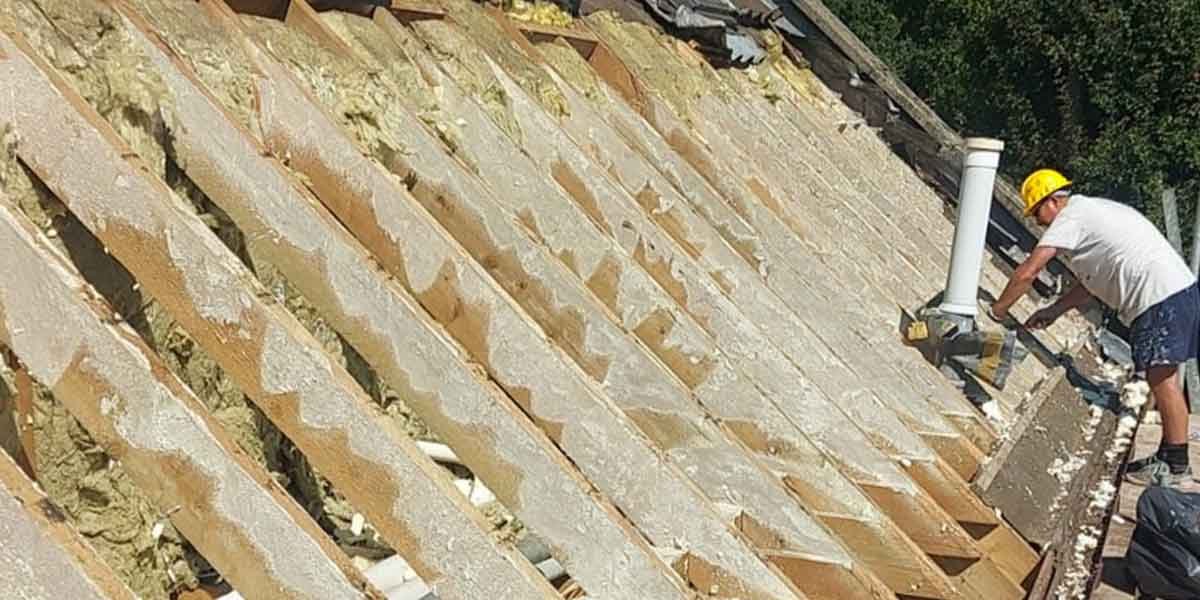

Spray foam insulation has to be cut off once it has cured.
No jug on a shelf undoes that, because the two liquids that make the foam react into a thermoset plastic, and the material left on a rafter or a rim joist is no longer soluble in anything a homeowner can buy.
What decides the size of the work is not the foam itself. It is the three things the foam grabbed: the wood it bonded to, the wiring it swallowed, and whatever it was hiding underneath. A patch of overspray on a garage wall is an afternoon with a scraper and a shop vac. Six inches of closed-cell foam bonded to a roof deck is a containment job, and the removal uncovers whatever the foam was covering.
Why No Solvent Does the Work
Once the two components cross-link, the foam resists every household solvent. Products sold as cured-foam removers soften the top layer so a scraper can bite, and their own instructions end with the words “then remove mechanically.”
Dow’s directions for its Great Stuff cans state the limit plainly: once the foam has dried, it cannot be removed with any solvents or cleansers, and cured foam on skin or a surface has to be taken off by hand or allowed to wear away. That wording is not a knock on one brand. The foam left on the framing is a thermoset plastic, a cross-linked polymer that heat will not re-melt and solvents cannot reopen, and the description holds for the sprayed-in product a contractor installs as well as it holds for a can in a homeowner’s hand.
Acetone is where the confusion starts. Gun cleaners sold for foam dispensers are acetone-based, and they work, because they are formulated for foam that has not finished reacting. On a fully cured pass, acetone penetrates the outside, swells or softens it slightly, and stops there. A DIY forum test on cured expanding foam left in acetone for five minutes came back softened at the surface and intact underneath.
WD-40 behaves the same way. It creeps into cured foam and eases the grip between the foam and the wood under it, which makes a scraper more effective and does nothing to the material itself. The specialty removers aimed at cured foam are honest about this in their technical sheets: PENOSIL’s cured foam remover is poured on, left five to twenty minutes, and then the softened foam is removed mechanically, while TYTAN’s data sheet adds that the isocyanate hardener residue is extremely difficult to dissolve at all.
So the solvent question has a short answer and it is not the one that saves labor. A chemical loosener earns its place around the edges of a job — along the seam where foam met a stud, on the last film stuck in wood grain — and never as the method. Anyone who buys a gallon of anything expecting the foam to let go is going to be scraping anyway, through a wet, smeared mess.
Open-Cell Comes Off in Chunks, Closed-Cell Fights Every Inch
Open-cell foam weighs about half a pound per cubic foot and cuts loose in soft chunks. Closed-cell foam runs near 2 pounds per cubic foot, bonds harder to framing, and has to be ground or scraped away in thin passes.
The R-values explain why the second product behaves so differently under a blade. Open-cell foam insulates at roughly R-3.5 to R-3.7 per inch, so the same cavity carries a much thicker layer of it, and thick soft foam is spongy enough for a serrated blade to slice. Closed-cell foam insulates at roughly R-6 to R-7 per inch, which means a thinner layer does the same work, and that thinner layer is dense, rigid, and stuck to the wood with more contact area per inch of thickness.
A thumbnail settles which of the two is in front of you before any tool comes out. Pressed into foam that has finished reacting, the nail gets nothing back; pressed into a pass that is still soft, it sinks in.
Those two facts set the whole shape of a removal, from the first tool out of the truck to the number of vacuum bags it takes.
| What the removal looks like | Open-cell | Closed-cell |
|---|---|---|
| Tool that does most of the work | Serrated blade or oscillating flush-cut blade | Grinder with a wire cup or coarse disc, plus a hand scraper |
| How it leaves the wood | Chunks lift off, a film stays in the grain | Dust and a bonded skin that has to be ground back |
| Debris in the bags | Large, light, fast to fill a bag | Fine, heavy, fills a vacuum canister quickly |
| Risk to the framing | Low when the blade stays flat on the wood | High: a caught edge takes timber along with the foam |
| Time on a 10 by 12 roof section | One pass with a blade, few tool changes | Multiple passes with more dust control and more vacuum time |
A ground-edge putty knife belongs in a toolbox, not on a rafter. I learned that on a closed-cell pass where the blade caught the edge of the foam, jumped, and left a groove in the face of the timber — a groove that had to be filled and sanded before anything could go back over it.
Flat is the operative word for every hand tool in this work. A blade held at an angle digs; a blade held flat rides along the wood and takes only what is above it. On closed-cell foam, an oscillating tool with a rigid scraper blade does more useful cutting than a knife, and a grinder with a wire cup finishes what the blade starts, provided the cup is kept moving so it does not chew a hollow into a rafter.
Dust, Vapor, and Choosing a Respirator Worth Wearing
Removing cured spray foam insulation is a dust job, so an N95 or better covers scraping and cutting. Anything that generates vapor, heat tools included, needs an organic-vapor cartridge with a P100 filter, and OSHA’s ceiling for isocyanate exposure in a workplace is 0.02 ppm.
That 0.02 ppm figure is an employer duty under OSHA’s air contaminant standards (29 CFR 1910.1000), written for the people who spray the foam and the helpers who stand near them. It is not a residential exposure limit, and it is not a number a homeowner can measure at the top of a ladder. It does explain why a removal crew arrives in supplied-air or full-face gear, why the containment goes up before the first cut, and why “just open a window” is not the same plan.
Cartridge choice follows the work. Cutting and scraping cured foam sheds particulate, which a P100-class filter captures. Sanding with a power tool in a hot attic also sheds particulate, and the guidance is the same. Heat is the part that changes the hazard class. Thermally degrading cured foam releases isocyanates, carbon monoxide, nitrogen oxides, and hydrogen cyanide, so a torch, a heat gun pushed past softening, or any welding near installed foam is a different job with different controls than scraping. Dust-only cartridges have no place in an atmosphere with solvent vapor in it.
Water mist is the cheapest control on the list. Dampening the foam before cutting knocks down airborne dust, and a HEPA vacuum at the cutter keeps the rest out of the air. In a hot attic the dust smells sweet and chemical, and the vacuum should be running at the cut for the entire pass. Disposable coveralls, nitrile gloves, and eye protection come next, and the coveralls come off before the person wearing them walks through the rest of the house.
A 2019 consumer fact sheet from the Consumer Product Safety Commission states that there is no standard process for removing or remediating misapplied spray foam, and that disturbing the material, especially with anything that heats it, can generate dust or hazardous material. For a house where foam smelled wrong at installation or where occupants started reacting afterward, that is the boundary where the answer moves from a scraper to a laboratory and a remediation crew.
What Spray Foam Insulation Hides in the Framing
Foam hides moisture. A roof deck covered in closed-cell foam keeps a slow leak out of sight until the sheathing behind it has softened, which is why the inspection happens as the foam comes off and not after.
Look at the wood, not the foam. Dark bands on rafters, rusted fastener heads, a soft spot at a ridge board, and staining that repeats on every third or fourth rafter all point at moisture that has been running for more than one season. Any of them changes the project from an insulation swap into a repair.
Wiring comes next. Foam sprayed over a cable or a junction box has to be cut away from it, and the circuit in question should be off while that happens, since a blade and a live conductor in the same motion is how the worst version of this afternoon ends.
Then check that the exposed wood is dry before new insulation goes back. The Environmental Protection Agency’s mold guidance puts the order plainly: fix the moisture source first, then deal with the material it damaged.
Where the Homeowner Job Ends
A shallow open-cell patch on an accessible flat surface is a homeowner job. Closed-cell foam bonded to a roof deck, an entire attic ceiling, or any removal that has turned up rot or wiring damage belongs to a crew with containment, industrial vacuum equipment, and a way to dispose of the waste.
Four signals say stop, and they show up early.
- The foam is closed-cell and thicker than about an inch.
- The material behind it is a roof deck, not a wall or a joist bay.
- Wiring, ducts, or plumbing runs through it.
- The only way in is a hatch too small to work from safely.
Grinders, negative-air machines, and respirator programs are not weekend rentals, and the cleanup standard for foam dust is set by the fact that the dust is an irritant people inhale.
Regulation is tightening around the product even where removal is unregulated. The California Department of Toxic Substances Control issued its notice of final determination on October 6, 2025 for spray polyurethane foam systems containing unreacted MDI, requiring enhanced labeling, restricting sales to applicators who have completed the Center for the Polyurethanes Industry health and safety training, and adding a green chemistry fee of two cents per pound of foam sold, first payable January 1, 2026. Nothing in that package tells a homeowner how to take foam off a wall. What it confirms is that the training and labeling around this material are being treated as load-bearing, which is a poor place to save money on a removal that also has to pass an inspection.
After the Foam Is Gone
When the last pass is done, the job is not finished: the wood carries a thin film of foam that has to come off before anything is rebuilt on top of it, because new insulation sprayed or blown over that film keys to the film instead of the framing.
Angle the beam along the wood. A flat flashlight held almost parallel to a rafter shows the leftover pin layer that a straight-on look hides, and coarse sanding or a wire brush takes it back to bare grain. The work is done when the wood feels like wood, not when the surface looks gray.
Then the re-insulation decision arrives, and it is a real fork. Some attics get vented and blown-in fill instead of foam, some get foam again with a vapor strategy that matches the climate, and the choice depends on whether the roof deck is meant to be conditioned. That is a design call a contractor makes with the house in front of them.
Bids for this work move on the inputs that also drive spray foam cost: how many square feet are covered, how thick the old foam is, whether it is open-cell or closed-cell, how much of it sits over framing versus between it, how tight the access is, what disposal costs locally, and what repairs the removal exposes. The one line most homeowners misjudge is the last one.
Questions Homeowners Ask About Spray Foam Insulation
Can spray foam insulation be removed easily?
Yes for open-cell foam sprayed on an accessible flat surface, and no for closed-cell foam bonded to framing or a roof deck. Open-cell foam slices off in chunks with a blade; closed-cell foam has to be ground back in thin passes, and the tooling and dust control that takes is what makes it a professional job.
Will WD-40 remove spray foam?
No. WD-40 softens cured foam and loosens its grip on the material underneath, which helps a scraper do its work, but it does not break the foam down. Manufacturer guidance for polyurethane foam is the same from brand to brand: once it has dried, no solvent removes it.
What dissolves spray foam insulation?
No household product dissolves cured spray foam. Acetone and gun cleaners work on foam that is still reacting, and specialty removers sold for cured foam soften it enough to scrape; their own technical sheets describe exactly that limit.
Does spray foam insulation always have to be removed?
No. Foam that is dry, well bonded, and doing its job stays where it is, and it can be left in place during a re-insulation in most cases. Removal enters the conversation when moisture, odor, a failed inspection, or a property sale pushes it there.
If the foam is closed-cell and it is on the underside of a roof deck, treat the removal as a repair project with an insulation step at the end, not as an insulation project with cleanup at the end. Whoever does the work has to be able to open the structure, look at what the foam was hiding, and put it back together.