


Screening tenants properly means setting written criteria before advertising, requiring a complete rental application, running a credit and background check, verifying income at 2.5 to 3 times the monthly rent, and calling previous landlords for references. A consistent, documented process protects you from costly mistakes and from fair housing complaints, which is why working with a Forest Oaks Property Management Company can support a more organized rental process.
Understand Fair Housing Laws Before You Begin
Every landlord in the United States must comply with the Fair Housing Act, which prohibits discrimination based on seven protected classes: race, color, national origin, religion, sex, disability, and familial status. Applying your screening criteria inconsistently, even unintentionally, can expose you to federal complaints and civil penalties.
Many states and cities add more protected categories on top of federal law. These often include sexual orientation, gender identity, source of income, marital status, age, and veteran status.
According to the U.S. Department of Housing and Urban Development (HUD), the most common fair housing violations involve landlords applying different standards to different applicants, making statements that reveal discriminatory preferences, or refusing to make reasonable accommodations for applicants with disabilities.
The safest approach: write your criteria down before you list the property and apply them the same way to every person who applies. Consistency is the first line of legal defense.
That consistency is also where most inexperienced landlords fall short. A well-intentioned gut feeling, applied differently from one applicant to the next, is legally indistinguishable from intentional discrimination.
How to Screen for Tenants: 6 Steps That Work
A reliable tenant screening process follows six steps: set written qualification criteria, collect a completed rental application, run credit and background checks, verify income and employment, contact previous landlords, and conduct a brief interview. Each step builds on the last and creates a paper trail you can defend if challenged.
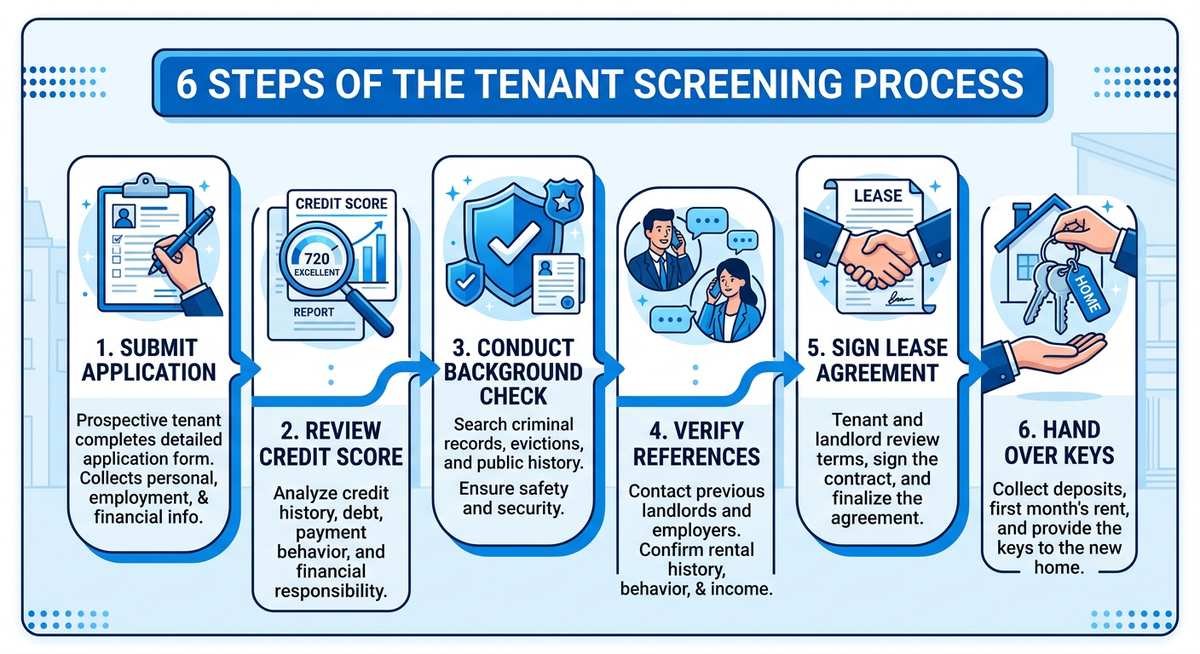
Step 1: Set Written Qualification Criteria
Decide your minimum requirements before anyone applies. Common benchmarks include a minimum credit score (many landlords set 620 or above), gross monthly income of 2.5 to 3 times the rent, no evictions within the past five years, and no prior felony convictions directly related to property damage or violent crime.
Post these criteria in your listing so applicants can self-screen before spending time on an application.
Step 2: Collect a Completed Rental Application
A written application is your primary data-gathering tool. At minimum it should capture current and prior addresses with dates, employer name, supervisor contact, and gross monthly income, names and contact details for all occupants, pet information, and a signed authorization to run credit and background checks.
A good application also asks for prior landlord names and phone numbers directly, rather than relying on the applicant to produce references only if asked.
Step 3: Run a Credit and Background Check
Credit reports score from 300 to 850 and reveal payment history, outstanding debt loads, bankruptcies, and collections. A pattern of late payments on utilities or prior rent is a meaningful signal, even if the overall score looks acceptable.
Background checks surface criminal records, prior evictions, and public court filings such as unpaid judgments. Services like TransUnion SmartMove, Rentec Direct, and Avail pull all three reports together for fees typically ranging from $25 to $45 per applicant.
Note that some states restrict how landlords can use criminal records. California, for example, requires an individualized assessment rather than a blanket policy of rejecting all applicants with any criminal history.
Step 4: Verify Income and Employment
Do not take income claims at face value. Ask for the last two pay stubs, the most recent W-2 or tax return, and an employer contact you can call to confirm employment status and salary.
Self-employed applicants should provide two years of tax returns and recent bank statements showing consistent deposits. The 3x monthly rent rule is a useful floor, but a full picture of fixed monthly obligations, not just gross income, gives a more accurate view of what the applicant can actually afford.
Step 5: Contact Previous Landlords for References
Call the phone numbers directly from the application rather than accepting landlord contact information the applicant has pre-arranged. The most useful questions to ask: Did they pay on time? Would you rent to them again? Were there noise complaints or property damage? Did they give proper notice before moving out?
One red flag that experienced landlords consistently mention: when a current landlord is effusively enthusiastic, it sometimes signals they are eager to have someone difficult move on. A lukewarm or vague reference often tells you more than a glowing one.
Step 6: Conduct a Brief Pre-Screening Call or Interview
A short phone call or in-person meeting before approving an application lets you clarify anything unclear on paper, confirm move-in timeline compatibility, and ask whether the information on the application is accurate.
Keep questions focused on logistics and the rental itself. Asking about occupation, prior neighborhoods, or anything touching protected class characteristics, even conversationally, creates legal risk even if the intent was innocent.
Red Flags to Watch for When Reviewing Applications
The clearest warning signs when reviewing a tenant application are unexplained gaps in rental history, income figures that shift between documents, addresses that cannot be verified, and former landlords who are listed as “deceased” or otherwise unreachable after every tenancy.
Other patterns worth investigating closely:
- An application submitted within hours of listing, filled out perfectly, with all supporting documents attached immediately, can indicate someone who has extensive practice navigating the screening process.
- Income that appears to be exactly 3x the rent to the dollar, with no variation, sometimes reflects coaching rather than genuine financial documentation.
- Reluctance to provide a social security number for a background check, while understandable from a privacy standpoint, makes verification impossible.
- A pattern of short tenancies (six to nine months each) over several years without a clear explanation like relocating for work.
- Previous landlord references who only confirm dates of tenancy but volunteer nothing else when you ask open-ended questions.
None of these alone disqualifies someone. Combined with other thin documentation, they warrant follow-up questions before you approve.
Portable Tenant Screening Reports: A Growing Option
A Portable Tenant Screening Report (PTSR) is a background and credit check the applicant pays for once and then shares with multiple landlords during an active housing search. Colorado became the first state to require landlords to accept PTSRs under state law, and discussions in several other state legislatures suggest the model is spreading.
From a landlord’s perspective, the main benefit is that you save on per-applicant screening fees. The primary concern is that you did not order the report directly from the reporting agency. To mitigate this, confirm the report is less than 30 days old, was generated by a recognized service like TransUnion or Equifax, and includes a complete credit file and eviction history, not just a summary score.
For applicants, particularly in competitive rental markets where application fees add up quickly, PTSRs reduce a meaningful financial barrier. That practical reality is increasingly shaping rental law.
How to Legally Decline an Applicant
When rejecting an applicant, send a written adverse action notice. Under the Fair Credit Reporting Act (FCRA), any denial based on a credit or background report requires you to notify the applicant within 30 days, identify the reporting agency, and inform them of their right to dispute inaccurate information.
Your written denial should state the factual reason: income did not meet minimum requirements, credit score below the threshold listed in your criteria, or eviction within the past five years. It should not mention anything that could be tied to a protected characteristic.
Keep records of every application you receive and the documented reason for your decision on each one. If a fair housing complaint is filed later, a complete, consistent paper trail is your strongest defense.
| Rejection Reason | Acceptable | What to Document |
|---|---|---|
| Credit score below threshold | Yes, if criteria set in advance | Score, threshold, date of check |
| Income below 2.5x rent | Yes, if criteria set in advance | Stated income, verified income, policy |
| Prior eviction within 5 years | Yes, in most states | Eviction date, screening report |
| Refused to authorize background check | Yes | Written authorization request, refusal |
| Race, nationality, religion, family status | Never | N/A, prohibited by federal law |
Tenant Screening Services Worth Knowing
Most tenant screening services return credit, background, and eviction reports together for a per-applicant fee between $25 and $50. The best platforms integrate screening into a broader rental management workflow, letting you collect applications, run checks, and communicate with applicants in one place.
| Service | Who Pays | Reports Included | Best For |
|---|---|---|---|
| TransUnion SmartMove | Applicant | Credit, background, eviction | Independent landlords |
| Zillow Rental Manager | Applicant | Credit, background, income verification | Landlords already on Zillow |
| Avail | Landlord or applicant | Credit, criminal, eviction | Small portfolio landlords |
| Rentec Direct | Landlord or applicant | Credit, criminal, SSN verification | Property managers |
| Baselane | Applicant | Credit, background, income | Landlords wanting all-in-one banking |
Most services pull from TransUnion, Equifax, or Experian. The differences come down to pricing structure, whether the report is landlord-initiated or tenant-initiated, and what additional tools are bundled into the platform.
When More Than One Applicant Qualifies
A first-come, first-served policy based on completed application receipt is the most defensible approach when multiple applicants meet your stated criteria. Document the exact time and date each application came in, and apply the rule consistently.
Do not hold an application while waiting for a “better” one that might arrive. That practice opens the door to implicit bias claims, even when the intent is simply to find the strongest financial profile.
If two applications arrive within hours of each other and both qualify, some landlords give preference to the first applicant to submit all required verification documents in full. Whatever your policy, write it down before you need to use it.
Frequently Asked Questions About Tenant Screening
What credit score is needed to rent an apartment?
Most landlords require a minimum credit score between 600 and 650, though requirements vary by market. In competitive urban areas some landlords set thresholds at 700 or above. The score itself matters less than the payment history it reflects: a score of 620 built on steady on-time payments is often preferable to a 680 built on recent debt consolidation.
How much income should a tenant make relative to rent?
The standard guideline is gross monthly income of at least 2.5 to 3 times the monthly rent. For a $1,500 apartment, that means a minimum of $3,750 to $4,500 per month before taxes. Some landlords in lower-cost markets use 2x. What matters is that the threshold is set before you advertise and applied to every applicant equally.
What shows up on a tenant background check?
A standard tenant background check typically shows criminal records going back 7 to 10 years depending on state law, prior evictions, civil court judgments, sex offender registry status, and in some cases, Social Security number verification. It does not show employment history, which must be verified separately.
Can a landlord refuse to accept Section 8 vouchers?
Whether a landlord can refuse Section 8 housing vouchers depends on state and local law. Federally, there is no requirement to accept vouchers, but over 20 states and many cities have laws prohibiting discrimination based on source of income, which includes housing subsidies. Check your specific jurisdiction before making any policy decision.
How long does the tenant screening process take?
Most credit and background reports are returned within 24 to 48 hours when ordered through an online screening service. The full process, including income verification and landlord reference calls, typically takes three to five business days. Rushed decisions on rental applications are a common source of landlord regret.
What questions can a landlord not ask a prospective tenant?
Landlords cannot ask about national origin, religion, race, family status (whether someone is pregnant or has children), disability, sex, or any other federally or locally protected characteristic. Questions about how many people will live in the unit are permissible only when tied to a specific occupancy standard applied consistently, not used as a proxy for family size.
What is a Portable Tenant Screening Report?
A Portable Tenant Screening Report (PTSR) is a credit and background check that the applicant orders and pays for once, then provides to multiple landlords. Colorado law currently requires landlords to accept PTSRs from state-approved providers if an applicant presents one. Other states are considering similar requirements. As a landlord, verify the report is recent (within 30 days), complete, and from a recognized provider before relying on it.
Finding a Good Tenant Starts Before You Post the Listing
Landlords who struggle most with tenant problems are usually those who built their screening process reactively, tightening criteria only after a bad experience. The landlords with the fewest issues tend to be the ones who wrote their criteria down first, before any applicant was in the picture.
The steps are straightforward: define your requirements, collect a complete application, run the checks, verify the income in writing, and call the previous landlords. Documentation at every step protects you legally and helps you make the same decision your future self will respect.