


This article is for informational purposes only and does not constitute financial or legal advice. Consult a licensed mortgage lender or financial advisor for guidance specific to your situation.
Getting pre-approved for a mortgage takes one to three business days and requires submitting financial documents — pay stubs, tax returns, and bank statements — to a lender who then verifies your income, assets, and credit history. The letter you receive tells sellers exactly how much financing you can secure, giving your offer real credibility in a competitive housing market, especially when broader ownership plans are considered with the Keyrenter PM Clayton team.
Most first-time buyers are surprised to find the process has more moving parts than the online applications suggest.
Pre-Approval vs. Pre-Qualification: Know the Difference
Pre-qualification is an informal estimate based on numbers you self-report; mortgage pre-approval requires a lender to verify those numbers by pulling your credit report and reviewing actual financial documents. Sellers and their agents treat pre-approval letters seriously — pre-qualification letters, far less so.
With pre-qualification, you describe your income and assets to a loan officer, and the lender returns a ballpark range. Nobody checks the math.
Pre-approval reverses that dynamic. The lender pulls a hard inquiry on your credit file, reviews two years of tax returns, and evaluates your debt load before issuing any letter with a dollar amount attached.
| Factor | Pre-Qualification | Pre-Approval |
|---|---|---|
| Information Source | Self-reported | Verified by lender |
| Credit Check | Soft inquiry (no score impact) | Hard inquiry (~5-point drop) |
| Documents Required | None | Full documentation package |
| Time Required | Minutes | 1–3 business days |
| Seller Credibility | Low | High |
| Accuracy of Amount | Estimate only | Conditionally verified |
That distinction matters more than most buyers expect. In a seller’s market where multiple offers are common, showing up with only a pre-qualification letter can mean your offer goes straight to the bottom of the pile.
Documents Required for Mortgage Pre-Approval
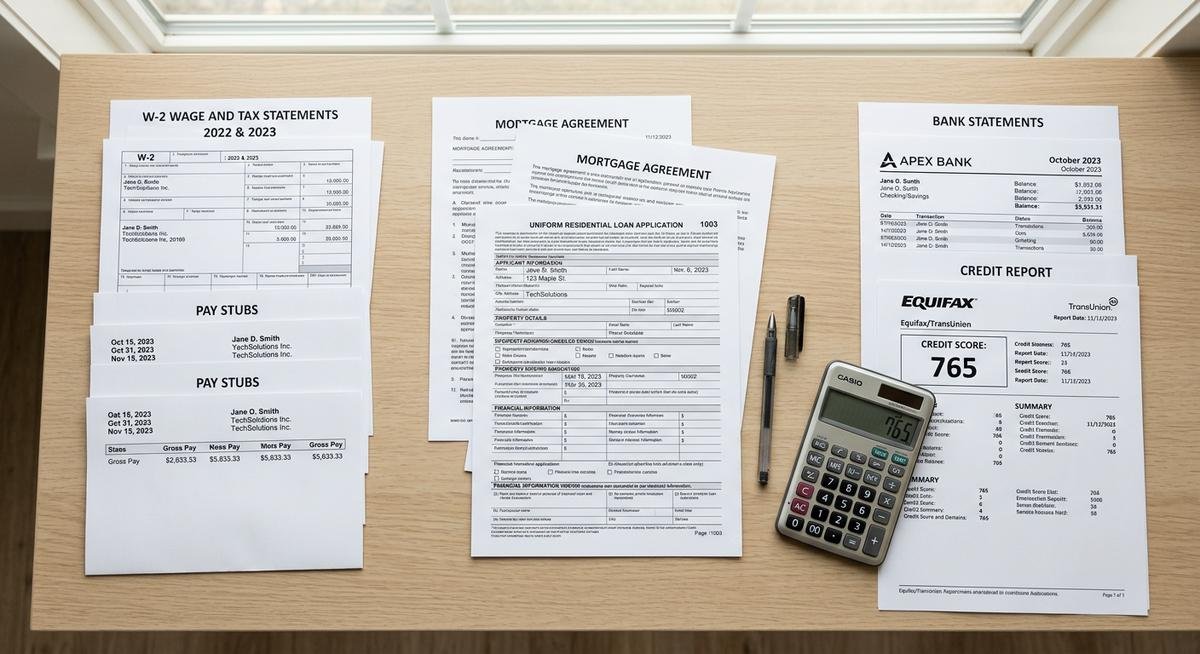
Lenders typically require two years of W-2 forms and federal tax returns, 30 days of recent pay stubs, two to three months of bank statements, a government-issued photo ID, and documentation for any additional income sources such as rental income or alimony. Having these organized before you contact a lender cuts processing time significantly.
Employment history matters as much as the paperwork. Most lenders want to see at least two consecutive years in the same field — gaps or sudden industry changes trigger additional scrutiny from underwriters.
Self-employed borrowers face a higher documentation bar. Instead of W-2s, they must provide two years of personal and business tax returns, plus a year-to-date profit-and-loss statement, sometimes signed by a CPA.
- Income verification: Last two years’ W-2s or 1099s, two most recent pay stubs, federal tax returns (all pages)
- Asset documentation: Two to three months of bank statements (all accounts), retirement and investment account statements, gift letters if any down payment funds come from family
- Identity and employment: Government-issued photo ID, two-year employment history, landlord contact information if currently renting
- Debt documentation: Current statements for all outstanding loans (student, auto, personal), credit card statements
The two-year documentation window catches many first-time buyers off guard. That paper trail is longer than most car loan requirements, for a loan that could be 20 times larger.
Step-by-Step: How to Get Pre-Approved for a Mortgage
The process runs through five stages: review and improve your credit profile, calculate your debt-to-income (DTI) ratio, gather your document package, compare at least two to three lenders, then submit your application and receive the underwriter’s decision.
- Check your credit report and score. Pull free copies from AnnualCreditReport.com and dispute any errors before applying. Most conventional lenders require a minimum score of 620; FHA loans allow 580 with a 3.5% down payment, according to standard mortgage program guidelines. Giving yourself 30 to 60 days to address errors can meaningfully shift your rate tier.
- Calculate your debt-to-income ratio. Add up all monthly debt payments (minimum credit card payments, auto loans, student loans), then divide by your gross monthly income. Most lenders cap DTI at 43%; some go up to 50% for well-qualified borrowers. Knowing your number before you walk in tells you whether to pay down debt first.
- Assemble your document package. Use the checklist above. Organize everything in a single folder, digital or physical, so you can submit to multiple lenders without hunting for files each time.
- Shop multiple lenders. Apply to two or three lenders within a 14- to 45-day window, the FICO rate-shopping window treats multiple mortgage inquiries during that period as a single hard pull. Comparing offers from a bank, a credit union, and an online lender gives you real rate data, not marketing estimates.
- Submit your application and await the decision. The lender’s underwriting team reviews your documents, verifies employment by phone, and checks your credit file. Most decisions come back within one to three business days; several online lenders now return conditional approvals the same day.
How Long Does Pre-Approval Take, and How Long Does It Last?
Most lenders process mortgage pre-approval in one to three business days; online lenders such as Rocket Mortgage and Better often deliver conditional decisions within hours using automated underwriting systems. The pre-approval letter itself typically remains valid for 60 to 90 days before it expires and requires renewal.
Traditional banks and credit unions tend to take longer because a human loan officer reviews the full file. Online lenders move faster by running documents through automated underwriting, though a manual review can still be triggered by anything unusual in your file.
| Lender Type | Typical Decision Time | Pre-Approval Validity |
|---|---|---|
| Online lenders (Rocket, Better) | Same day to 24 hours | 60–90 days |
| Large national banks | 1–3 business days | 60–90 days |
| Credit unions | 2–5 business days | 60–120 days |
| Mortgage brokers | 2–4 business days | 60–90 days |
A 60-day letter can run out before a slow market produces the right house. Renewing means another hard credit inquiry, so timing the application to align with your actual house hunt matters more than most buyers plan for.
Why Pre-Approval Gets Denied, and How to Fix It
The four most common denial triggers are a credit score below the lender’s minimum, a debt-to-income ratio above 43 percent, insufficient verifiable income, and large unexplained deposits in bank statements. Each has a clear recovery path.
According to the Consumer Financial Protection Bureau (CFPB), DTI is one of the single largest factors in whether a mortgage application advances through underwriting. Paying down revolving credit balances by 20 to 30 percent before applying can move that ratio meaningfully.
| Denial Reason | Fix | Typical Recovery Time |
|---|---|---|
| Credit score too low | Pay down balances, dispute errors, avoid new credit | 3–6 months |
| DTI too high | Pay down revolving debt, increase income, or apply for a smaller loan | 1–3 months |
| Insufficient income documentation | Gather missing returns, add co-borrower, document all income sources | 2–4 weeks |
| Unexplained large deposits | Provide paper trail (sale receipt, gift letter, inheritance documentation) | Immediate with documentation |
| Recent job change | Wait 6–12 months at new employer, or document career continuity | 6–12 months |
A pattern that surfaces repeatedly among first-time buyers: disciplined finances for months, then a major purchase, a new car, appliances, furniture, weeks before applying. Any new monthly payment obligation increases DTI and can push an approval over the threshold into denial territory.
Frequently Asked Questions About Mortgage Pre-Approval
How much will my credit score drop after a mortgage pre-approval application?
A mortgage pre-approval hard inquiry typically drops your credit score by two to five points, and the impact usually fades within 12 months. If you apply to multiple lenders within a 14- to 45-day window, FICO scoring models count all the inquiries as a single event, minimizing the total damage.
Should I pay off credit cards before applying for mortgage pre-approval?
Paying down credit card balances before applying is generally a smart move because it both lowers your DTI ratio and improves your credit utilization rate, which can lift your score. Focus on getting utilization below 30 percent on each card rather than zeroing them out completely, keeping some small balance on a card shows active management.
Can I get pre-approved for a mortgage with student loan debt?
Yes, student loan debt does not disqualify you from mortgage pre-approval as long as your total DTI stays within the lender’s threshold. Lenders count your required monthly student loan payment in the DTI calculation; income-driven repayment plans with lower payments can help keep that number manageable.
How many lenders should I get pre-approved with?
Applying with two to three lenders is the standard recommendation, as it gives you genuine rate comparison data without creating excessive credit inquiries. Do all applications within a two-week window to take advantage of the FICO rate-shopping rule, which treats the cluster of inquiries as one.
What happens after mortgage pre-approval?
After receiving your pre-approval letter, you work with a real estate agent to make offers on homes; sellers will ask to see the letter with any offer. Once an offer is accepted, your lender moves into full underwriting, orders an appraisal, and, assuming no material changes to your finances, proceeds to closing, typically 30 to 45 days after the accepted offer.
Should I borrow the maximum amount my pre-approval allows?
Pre-approval limits what a lender will offer, not what you can comfortably afford. Many financial planners recommend keeping total housing costs (mortgage, taxes, insurance) below 28 percent of gross monthly income, a figure that’s often well below your maximum pre-approved amount. Just because a lender will approve a larger loan does not mean carrying that payment is financially prudent.
Getting Your Pre-Approval Done Right
Mortgage pre-approval is a straightforward process once you know what lenders are actually checking: verified income, stable employment, manageable debt, and a credit score that meets program minimums. Gathering documents before you contact a lender, comparing at least two offers, and timing the application to your actual house-hunting timeline are the three moves that consistently shorten the process.
The letter itself is only valid for 60 to 90 days, so apply when you’re genuinely ready to make offers, not months before you start looking.