


Refinancing a mortgage involves replacing an existing home loan with a new one, often to secure a lower interest rate or adjust the loan terms, explains SGI Property Management Phoenix specialists. Determining if refinancing is worthwhile depends on multiple factors such as current interest rates compared to your existing rate, the amount of equity you have in the home, and how long you plan to remain in the property. A calculated approach helps ensure refinancing will save money rather than increase expenses.
Lower interest rates can significantly reduce monthly payments and total interest paid over the life of the loan. However, refinancing comes with closing costs that must be recouped through monthly savings to make the process financially sensible. Evaluating the break-even period—the time it takes for savings to cover refinancing costs—is crucial before proceeding.
In addition to rate savings, refinancing offers options like switching from an adjustable-rate mortgage (ARM) to a fixed-rate loan, shortening the loan term, or accessing home equity through a cash-out refinance. Each scenario has distinct financial implications and should be assessed carefully in light of your credit profile, home equity, and long-term plans.
Refinancing can also be a strategic tool to improve your financial flexibility. For example, some homeowners use refinancing to consolidate high-interest debts, which can streamline payments and potentially reduce overall interest costs. Others may seek to free up cash for large expenses such as education, medical bills, or major home renovations. Understanding how these financial goals interplay with your mortgage terms can help you determine if refinancing aligns with your broader financial strategy.
Market conditions and economic trends also play a role in deciding when to refinance. Interest rates fluctuate based on various economic factors including inflation, Federal Reserve policies, and housing market dynamics. Staying informed about these trends and how they impact mortgage rates can provide an advantage when considering whether to refinance now or wait for more favorable conditions. Timing can influence not only savings but also qualification criteria and loan options.
Understanding Mortgage Refinancing Basics
Mortgage refinancing replaces your current home loan with a new one, usually to obtain better loan conditions. The most common goal is to reduce the interest rate, which lowers monthly payments and total interest over time. Refinancing may also involve shortening the loan term from 30 years to 15 years, which increases monthly payments but decreases overall interest costs. Alternatively, refinancing can provide access to home equity through a cash-out option, enabling funds for home improvements or debt consolidation.
There are different types of refinancing strategies. Rate-and-term refinancing focuses on obtaining a lower interest rate or adjusting the loan duration without increasing the loan amount. Cash-out refinancing increases the loan balance to withdraw equity as cash. Another common reason is switching from an adjustable-rate mortgage to a fixed-rate loan to avoid future rate increases. Each approach carries distinct trade-offs in terms of costs, monthly payments, and loan length.
Understanding the terms and conditions of your new loan is critical when refinancing. Factors such as prepayment penalties, loan fees, and mortgage insurance requirements should be carefully reviewed. Some loans may have penalties for paying off the original mortgage early, which could offset savings. Additionally, changes to loan servicing or escrow accounts might affect your monthly obligations and overall loan management.
Refinancing also impacts your credit report and score since it involves a new credit inquiry and potentially affects your debt-to-income ratio. While the initial inquiry may cause a slight dip in your credit score, responsible management of the new loan can improve your credit profile over time. Being aware of these nuances allows you to plan refinancing in a way that supports your financial health.
Key Factors to Evaluate When Considering Refinancing
Deciding whether to refinance requires analyzing several elements. The difference between your current interest rate and the new rate is critical; generally, a drop of at least 0.5 to 1 percent is needed to justify refinancing. Closing costs, which typically range from 2 to 5 percent of the loan amount, must be weighed against expected monthly savings. These costs include appraisal fees, title insurance, origination fees, and recording charges.
Another important consideration is the break-even period, calculated by dividing the total closing costs by the monthly savings gained from refinancing. If you plan to stay in your home beyond this break-even timeframe, refinancing becomes financially advantageous. Additionally, your credit score and the amount of equity in your home affect loan eligibility and terms. A higher credit score generally results in lower rates, and at least 20 percent equity is often required to avoid private mortgage insurance.
It is also essential to assess your long-term financial plans and stability. If you anticipate major life changes such as relocation, job shifts, or changes in household income, refinancing may not be the best option despite favorable rates. Conversely, if you foresee staying in your home for many years, locking in a lower interest rate can provide sustained savings. Evaluating your financial resilience and future goals helps ensure refinancing aligns with your overall financial well-being.
Market conditions and lender offers vary, so shopping around for the best refinance terms is prudent. Different lenders may provide varying interest rates, fees, and loan programs that could significantly affect your costs and savings. Comparing multiple offers allows you to identify the most beneficial deal tailored to your credit profile and financial goals. Additionally, reviewing customer service and lender reputation can impact your refinancing experience.
Refinancing Options Comparison
There are several refinancing options, each suited to different financial goals. Rate-and-term refi is ideal for lowering interest rates or changing loan duration without increasing debt. Cash-out refinancing allows homeowners to tap into equity for expenses but increases the loan balance and monthly payment. No-closing-cost refinancing rolls fees into the loan or interest rate, beneficial for those planning to sell soon as it reduces upfront expenses but may result in a higher rate.
Term changes in refinancing can reduce interest costs by shortening the loan from 30 to 15 years, but this raises monthly payments. Switching from an ARM to a fixed-rate loan provides payment stability, which is advantageous if rates are expected to rise. Each option has trade-offs between upfront costs, monthly payments, loan length, and total interest paid over the life of the loan.
Choosing the right refinancing option depends on your immediate financial needs and long-term objectives. For example, a cash-out refinance might be appealing if you need funds for a major project, but it can also increase your debt burden and monthly payments. On the other hand, a no-closing-cost refinance reduces initial expenses but might carry a higher interest rate, leading to more paid interest over time. Understanding these trade-offs ensures your decision supports your financial health.
Some borrowers may consider hybrid approaches, such as refinancing to a shorter term loan while also accessing some cash-out funds, but these options require careful analysis. The impact on monthly cash flow, total interest, and loan duration should be simulated using mortgage calculators or by consulting with financial advisors. Tailoring refinancing to your unique situation optimizes benefits and minimizes financial risks.
| Refinancing Option | Primary Benefit | Typical Closing Costs | Effect on Monthly Payment | Best For |
|---|---|---|---|---|
| Rate-and-Term Refinance | Lower interest rate or change loan term | 2–5% of loan amount | Usually lowers payment | Reducing monthly payments or shortening loan |
| Cash-Out Refinance | Access home equity as cash | 2–5% of loan amount | Increases payment due to higher loan balance | Home improvements, debt consolidation |
| No-Closing-Cost Refinance | Minimal upfront fees | None upfront; costs rolled into loan or rate | May increase payment due to higher rate | Selling soon or short-term ownership |
| ARM to Fixed-Rate Refinance | Lock in stable interest rate | 2–5% of loan amount | Payment may increase or decrease depending on rate | Protect against rising interest rates |
| Term Reduction Refinance | Save interest by shortening loan | 2–5% of loan amount | Monthly payment increases | Pay off mortgage faster, save interest |
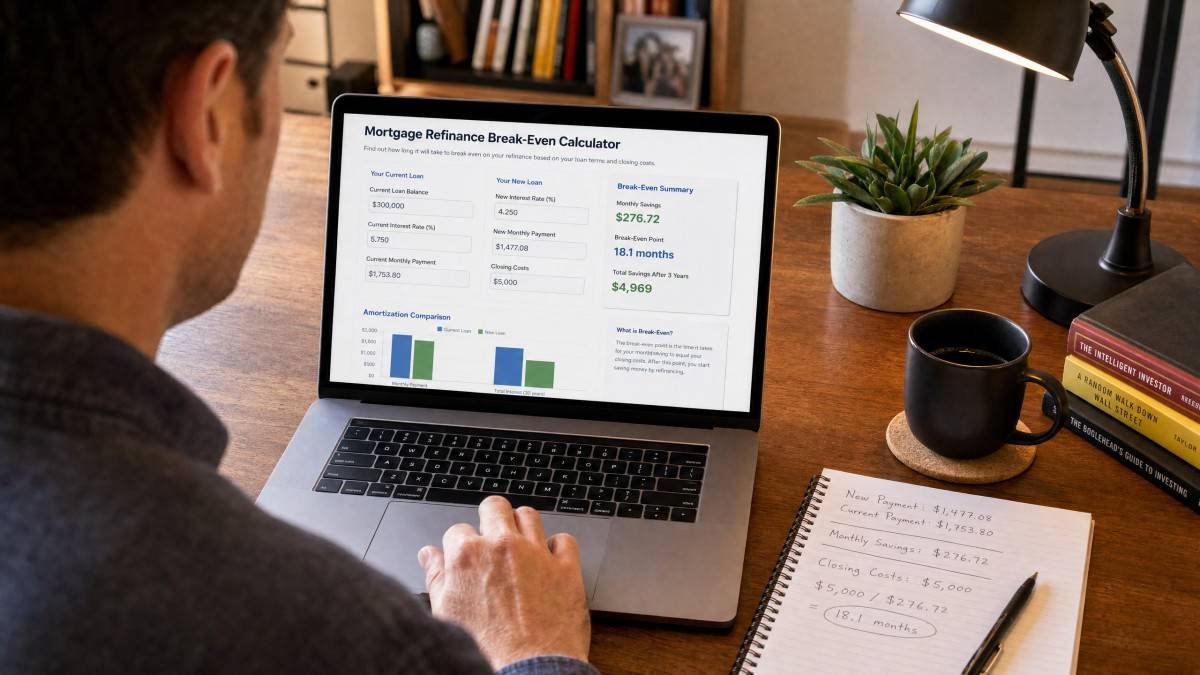
Calculating Break-Even and When to Refinance
The break-even period is a key metric in refinancing decisions. It represents how many months it takes for your monthly savings from a lower interest rate to cover the closing costs incurred during refinancing. This is calculated by dividing the total closing costs by the monthly savings amount. For example, if closing costs are $5,000 and monthly savings are $200, the break-even point is 25 months.
If you plan to stay in your home longer than the break-even period, refinancing usually makes financial sense because you will recoup the initial expense and benefit from lower payments afterward. Conversely, if you expect to sell or move before reaching this point, refinancing may result in a net loss. Additional factors such as remaining loan term and how much interest you have already paid also impact whether refinancing is beneficial.
It is also helpful to consider how changes in interest rates might affect your break-even analysis. If rates are expected to decline further, waiting might yield better opportunities, whereas rising rates might incentivize refinancing sooner. Additionally, personal financial changes such as an increase in income or improved credit score could qualify you for better refinance terms, thereby shortening your break-even period and enhancing potential savings.
Refinancing decisions should incorporate a holistic view of your mortgage timeline. For example, if you are in the early years of a 30-year mortgage, more interest remains to be paid, so refinancing can have a greater impact. However, if you are near the end of your mortgage term, savings from a rate reduction might be marginal. Evaluating how much time remains on your current loan alongside break-even calculations can guide whether refinancing is a prudent financial move.
Frequently Asked Questions About Refinancing
Minimum Rate Drop Needed to Refinance?
Typically, lenders and financial advisors suggest refinancing is worthwhile if the new interest rate is at least 0.5 to 1 percent lower than your current mortgage rate. Smaller differences may not generate enough monthly savings to offset closing costs and fees, making refinancing less beneficial. The exact threshold depends on your loan size, closing costs, and how long you plan to keep the new loan.
How Is the Break-Even Period Calculated?
The break-even period is found by dividing the total closing costs by the amount saved each month after refinancing. For instance, if closing costs are $4,500 and monthly savings are $180, the break-even period is 25 months. This tells you how long you must keep the new loan to recover expenses. It is a crucial figure to avoid refinancing losses.
What Is a Cash-Out Refinance?
A cash-out refinance replaces your existing mortgage with a larger loan, allowing you to receive the difference in cash. This is often used to fund home renovations or pay off higher-interest debts. However, it increases your loan balance and monthly payments, so the costs and benefits should be carefully evaluated. Consider whether the cash will generate value exceeding the additional loan costs.
What Are Typical Closing Costs for Refinancing?
Closing costs on a refinance typically range from 2 to 5 percent of the loan amount. These fees cover loan origination, home appraisal, title insurance, recording fees, and other administrative expenses. For a $200,000 loan, closing costs might fall between $4,000 and $10,000. Some lenders may offer no-closing-cost options that roll fees into the loan balance or interest rate.
What Credit Score Is Needed for Refinancing?
Lenders usually require a minimum credit score of about 620 to qualify for refinancing. Borrowers with scores above 740 generally receive the best interest rates and loan terms. Higher credit scores improve your chances of approval and better financial conditions. Maintaining timely payments and reducing debt helps improve creditworthiness prior to applying.
Can Refinancing Affect My Credit Score?
Yes, refinancing can impact your credit score in several ways. When you apply, a hard inquiry is made, which may cause a slight temporary dip. Opening a new loan and closing the old one can also affect the length of your credit history and credit mix. However, if managed responsibly, refinancing can improve your credit profile over time by lowering your debt-to-income ratio and ensuring timely payments.
Is It Advisable to Refinance Multiple Times?
Refinancing multiple times can be beneficial if each refinance reduces your interest rate or improves loan terms significantly. However, frequent refinancing may lead to repeated closing costs and potential credit score impacts. It is important to evaluate if the cumulative savings outweigh the costs and disruptions. Consulting with a mortgage professional can help determine the optimal refinancing frequency for your situation.
Conclusion
Refinancing a mortgage can provide significant financial benefits, particularly when current interest rates are substantially lower than your existing rate and you plan to remain in your home beyond the break-even period. Understanding the types of refinancing options, associated costs, and your personal financial situation is essential to making an informed decision. Carefully calculating monthly savings and closing costs will help determine if refinancing aligns with your goals.
It is equally important to consider factors such as your credit score, amount of home equity, and loan term remaining. Refinancing is not advantageous for everyone, especially if you intend to move soon or have already paid off most interest on your current loan. A prudent evaluation of these variables ensures refinancing will enhance your financial position rather than create unnecessary expenses.