
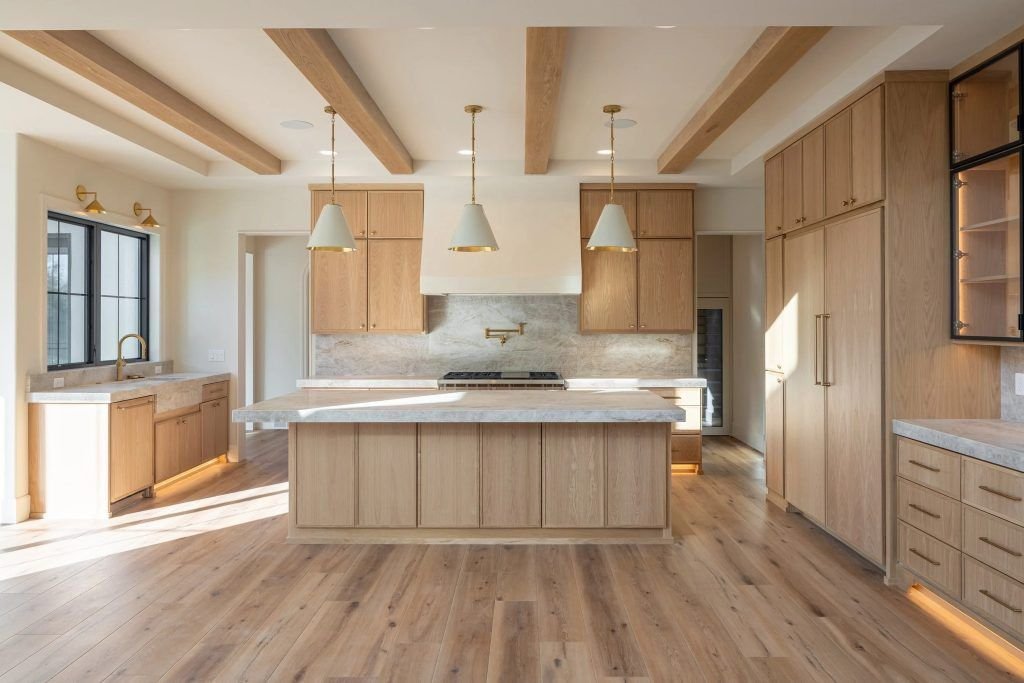

According to Menifee property management, the most expensive kitchen cabinet mistake is not choosing the wrong color or the wrong door style. It is choosing particleboard boxes instead of plywood. A particleboard cabinet box that gets wet swells and crumbles. The cabinet is not repairable.
Kitchen cabinets cost $8,000 to $40,000 depending on the grade. The mistakes cost more. Cabinets that are the wrong size, the wrong configuration, or the wrong material cannot be returned. They are made to order. The lead time is 4 to 16 weeks. The mistake is discovered on installation day. The replacement takes another 4 to 16 weeks. The kitchen is without cabinets for the duration. The mistake costs time and money. The time is measured in months without a kitchen. The money is measured in thousands. Here are the mistakes to avoid.
Mistake 1: Choosing Particleboard Boxes Where Water Exists
Particleboard is made from wood particles bonded with resin. It is heavy, dimensionally stable, and the standard material for stock and budget semi-custom cabinets. It is also highly susceptible to water damage. A slow sink leak that drips onto the bottom of the sink base cabinet for months — the most common kitchen leak, will swell the particleboard, causing the bottom panel to crumble and the sides to delaminate. The cabinet is destroyed. The water that caused the damage may have been a $5 supply line connection that was seeping. The $5 leak destroyed a $1,000 cabinet. The $50 upgrade to plywood would have prevented the destruction.
Plywood is made from layers of wood veneer cross-laminated for strength. It resists moisture better than particleboard, holds screws more securely, and can survive a minor water event. Plywood is not waterproof, prolonged water exposure will damage it. The difference is that plywood survives the leak long enough for the homeowner to notice and fix it. Particleboard absorbs water and fails before the homeowner notices the leak. The plywood buys time. The particleboard does not. The plywood upgrade is the insurance policy against the inevitable kitchen leak. The premium is $1,000 to $3,000. The claim is a cabinet box that is still structurally sound after the sink supply line drips for two weeks while you are on vacation. The particleboard box would be destroyed. The plywood box needs to be dried. The insurance is worth the premium.
The National Association of Home Builders (NAHB) identifies kitchen cabinets as the single largest material expense in a kitchen remodel. The cabinet construction quality determines how long the cabinets last. The doors can be refinished. The hardware can be replaced. The boxes are permanent. The plywood boxes will still be solid when the doors are being repainted 15 years from now. The particleboard boxes may not make it to the repaint.
Mistake 2: Choosing the Wrong Cabinet Sizes for the Space
Stock cabinets come in fixed widths, 3-inch increments from 9 to 48 inches. The space between the last cabinet and the wall is filled with a filler strip, a piece of trim that bridges the gap. A kitchen designed with stock cabinets will have filler strips. The strips are visible. The strips are the evidence that the cabinets were not made to fit the space. Semi-custom and custom cabinets can be made to any width. The filler strips disappear. The cabinets appear to have been built for the kitchen because they were. The semi-custom upgrade costs $100 to $300 per linear foot more than stock, $2,000 to $6,000 for a typical kitchen. The upgrade eliminates the filler strips. The filler strips cost nothing. The upgrade costs money. The upgrade looks intentional. The filler strips look like a compromise.
Upper cabinets that stop 12 to 18 inches below the ceiling create a dust-collecting gap. The gap serves no purpose except to make the room feel shorter. Full-height upper cabinets, cabinets that extend to the ceiling, eliminate the gap. The cabinets run from the countertop to the ceiling. The storage capacity increases. The room feels taller. The dust gap disappears. The full-height cabinets cost $500 to $1,500 more than standard-height cabinets. The cost is the additional cabinet height. The return is storage and a room that feels taller. The gap above the cabinets is the builder-grade default. The ceiling-height cabinets are the upgrade. The builder did not want to pay for the extra cabinet height. The homeowner lives with the gap. The gap collects dust. The ceiling-height cabinets collect storage. Choose storage over dust.
Mistake 3: Skipping Soft-Close Hardware
Soft-close drawer slides and door hinges cost $10 to $30 per drawer or door more than standard hardware, $200 to $600 for a typical kitchen. The soft-close mechanism catches the drawer or door as it closes and pulls it gently shut. The drawer does not slam. The door does not bounce. The kitchen is quieter. The hardware lasts longer because the soft-close mechanism prevents the impact that wears out standard slides and hinges. The soft-close upgrade is the cheapest luxury in a kitchen remodel. The luxury is silent. The silence is the luxury. The silence costs $300. The slamming is free. The slamming is the sound of standard hardware. The silence is the sound of soft-close. The silence is worth $300.
Soft-close hardware is standard on most semi-custom and all custom cabinets. It is an upgrade on stock cabinets. The upgrade is available at the time of purchase. It cannot be retrofitted later without replacing the hinges and the drawer slides, which costs more than the original upgrade because the old hardware must be removed and the new hardware must be installed. The upgrade price at purchase is $300. The retrofit price later is $800 to $1,200. The upgrade is cheaper now. The retrofit is more expensive later. The slamming continues until the retrofit. The slamming is free. The silence costs $300. The silence is cheaper now than later. Buy the silence now.
Mistake 4: Not Including Pull-Out Shelves in Base Cabinets
A fixed shelf in a base cabinet stores items in two dimensions, front to back, left to right. The items at the back are accessible only by kneeling on the floor and reaching into the dark. A pull-out shelf adds the third dimension, the shelf comes to you. Full-extension ball-bearing slides bring the entire shelf out of the cabinet. Nothing is lost at the back. The pull-out shelves cost $100 to $300 per shelf, $1,500 to $4,000 for a kitchen with 15 to 20 base cabinets. The cost is significant. The daily experience of opening a cabinet and having the contents come to you is transformative. The pots that lived at the back of the cabinet for years are now accessible. The cabinet that used to hold four items now holds eight because the entire depth is usable. The pull-out shelves do not add storage space. They make the existing storage space accessible. The accessible storage space is the storage space you actually use. The inaccessible storage space is the storage space you avoid. The pull-out shelves convert avoided space into used space. The conversion costs $3,000. The conversion is worth it every time you open a base cabinet.
Mistake 5: Choosing the Wrong Finish for Your Lifestyle
High-gloss cabinet finishes show every fingerprint, every scratch, and every imperfection in the underlying surface. They are beautiful in a showroom. They are unforgiving in a kitchen where people cook, children touch things, and grease settles on every horizontal and vertical surface near the cooktop. A matte or satin finish hides fingerprints, hides minor scratches, and reads as intentional even when it is slightly dirty. The matte finish is the practical choice for a kitchen that is used. The gloss finish is the showroom choice for a kitchen that is photographed. The kitchen that is used should have a matte finish. The kitchen that is photographed can have a gloss finish. Most kitchens are used. Most kitchens should have a matte finish.
Thermofoil cabinet doors, a vinyl wrap heat-bonded to an MDF core, are common on stock cabinets. They are durable and easy to clean. They are not repaintable. They peel if exposed to heat from a nearby oven, a toaster, or a dishwasher vent. A thermofoil cabinet next to a built-in oven will eventually delaminate. The heat softens the adhesive that bonds the vinyl to the MDF. The vinyl peels. The cabinet door is not repairable. It must be replaced. The replacement door costs $50 to $200. The replacement may not match the adjacent doors because the thermofoil on the adjacent doors has faded at a different rate. The mismatch is permanent. The thermofoil door next to a heat source is a mistake that cannot be remedied without replacing all the doors on that run of cabinets. The painted or wood-veneer door next to the same heat source does not delaminate. The painted door can be repainted. The thermofoil door cannot. Choose the door material that survives its location. The location is next to the oven. The oven produces heat. Thermofoil and heat are incompatible. The incompatibility is permanent. The thermofoil door will peel. The painted door will not.
Frequently Asked Questions
What is the best cabinet box material for a kitchen?
Plywood is the best cabinet box material. It resists moisture better than particleboard, holds screws more securely, and survives minor water events that destroy particleboard. The plywood upgrade costs $50 to $150 per cabinet, $1,000 to $3,000 for a typical kitchen. Plywood boxes will still be solid when the doors are being repainted 15 years from now.
Are stock cabinets good enough or should I upgrade to semi-custom?
Stock cabinets are good enough for a rental, a flip, or a budget kitchen where the layout is simple and the walls are straight. Semi-custom cabinets are worth the upgrade, $100 to $300 per linear foot more, for a kitchen in a home you plan to live in for more than 5 years. The upgrade eliminates filler strips, allows custom widths, and provides plywood boxes and soft-close hardware as standard or easily upgraded options.
What cabinet features are most important in a kitchen remodel?
Plywood boxes are the most important feature. Soft-close hardware is second. Pull-out shelves in base cabinets are third. Full-extension drawer slides are fourth. These four features determine the durability and the usability of the cabinets. The door style and the finish determine the appearance. The features determine the experience. The experience is daily. The appearance is visual. The experience matters more than the appearance.
Should upper cabinets go all the way to the ceiling?
Yes. Full-height upper cabinets eliminate the dust-collecting gap above the cabinets, increase storage capacity by 20% to 30%, and make the ceiling feel higher. The upgrade costs $500 to $1,500. The gap above the cabinets is the builder-grade default. The ceiling-height cabinets are the upgrade worth choosing.
What is the best cabinet door material for a kitchen?
Solid wood or wood veneer over an MDF core is the best door material. Solid wood can be sanded and refinished. Wood veneer is dimensionally stable, it does not warp the way solid wood can. Painted MDF doors are a durable, lower-cost alternative. Avoid thermofoil doors next to heat sources, ovens, toasters, dishwasher vents, because the vinyl wrap delaminates when exposed to heat.
How much should cabinets cost as a percentage of a kitchen remodel?
Cabinets should account for 25% to 35% of the total kitchen remodel budget. A $40,000 remodel should allocate $10,000 to $14,000 to cabinets. The cabinets are the largest single expense and the most permanent. The countertops can be replaced. The appliances can be upgraded. The cabinets will be there for 20 to 40 years. Spend the budget where the permanence lives. The cabinets are permanent. The budget should reflect the permanence.
The Cabinets That Last
Plywood boxes. Soft-close hardware. Pull-out shelves in every base cabinet. Full-height uppers to the ceiling. A matte or satin finish that hides fingerprints. Doors made of wood, wood veneer, or painted MDF, not thermofoil next to heat sources. These five decisions cost $5,000 to $10,000 above the base cabinet price and determine whether the cabinets last 10 years or 30. The doors can be refinished. The hardware can be replaced, once, at the end of its service life, but not upgraded from standard to soft-close without significant expense. The boxes are permanent. The decisions made at the cabinet showroom are the decisions lived with for the next 20 to 40 years. The showroom is temporary. The kitchen is permanent. Make the decisions for the kitchen. The showroom will sell you what is in stock. The kitchen needs what will last. The two are not always the same. Choose what will last. The kitchen will still be there when the showroom has been remodeled twice. Ever opened a cabinet under the sink and found the bottom panel swollen into a soft, crumbling mess — the victim of a leak that you did not even know had happened? The leak was a $5 supply line. The cabinet was $1,200. The leak was slow. The particleboard absorbed the water silently for months. The cabinet failed before the leak was visible. The plywood cabinet next to it — the one that cost $150 more — was wet but intact. The plywood dried. The particleboard did not. The $150 upgrade would have saved the cabinet. The decision was made in the showroom. The consequence was discovered under the sink.