
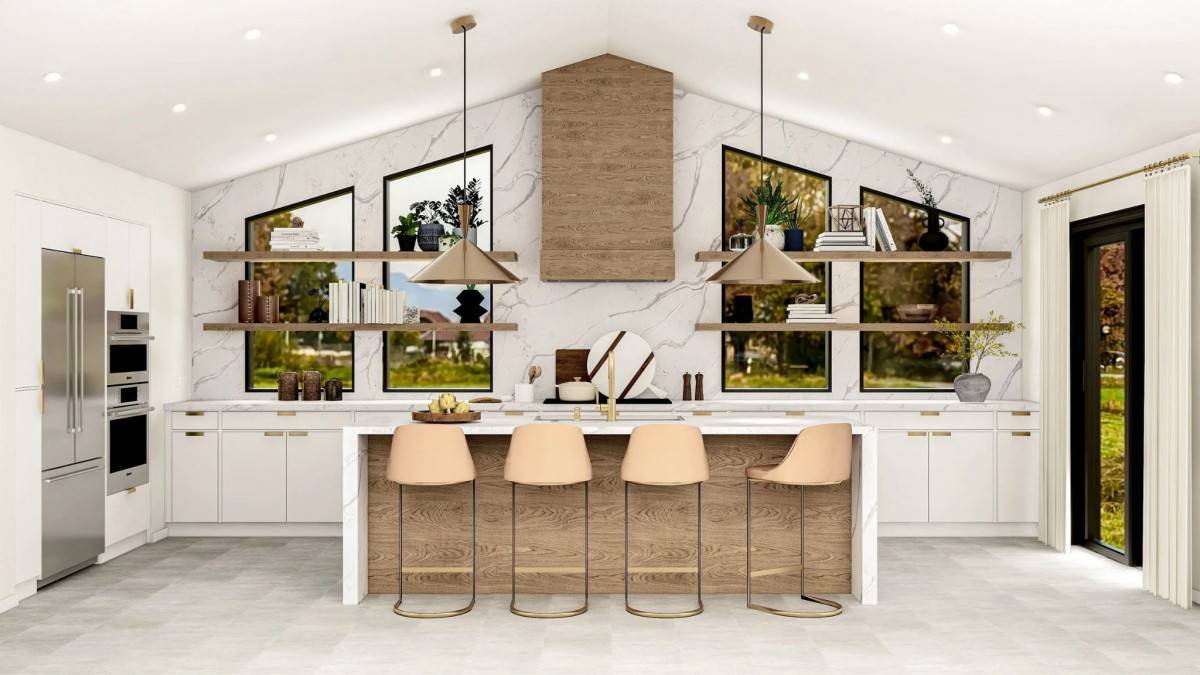

Kitchen island lighting is not decorative. The pendants you hang above the island are the primary task lighting for the single most-used work surface in the kitchen. They need to illuminate the island evenly, hang at a height that does not block sightlines across the room, and match the scale of the island so that the fixtures do not look like they were borrowed from a different kitchen. The three decisions that determine whether island lighting works — how many pendants, how far apart, and how high — are pure math. The fourth decision — what style — is taste. The first three are engineering. Get the engineering right and any style looks intentional. Get the engineering wrong and the most expensive pendants on the market look like a mistake.
The most common island lighting error is not the pendant style, highlight Real Property Management Partners professionals. It is the number of pendants and their spacing. A 5-foot island with two oversized pendants 12 inches apart looks top-heavy. A 10-foot island with two small pendants 60 inches apart leaves the middle of the island in shadow. The formulas below produce even, functional lighting for any island size, and the style categories after the formulas show you how to apply them to different kitchen aesthetics.
“Please help us choose a pendant lighting for our kitchen! We’re paralyzed by the options. Two big or three small? Clear glass or frosted? Brass or black? It feels like the wrong choice will haunt us every time we walk into the kitchen.”
— r/HomeDecorating, June 2024 (107 upvotes, 230 comments), source
The paralysis is real because the decision feels permanent — the junction boxes are in the ceiling, the drywall is finished, and changing your mind means an electrician cutting new holes and patching old ones. The sequence that breaks the paralysis: first, decide how many pendants based on island length. Second, decide the pendant diameter based on the spacing between them. Third, decide the style based on the kitchen’s dominant design language. Fourth, decide the finish based on the cabinet hardware and faucet. By the fourth decision, the options have narrowed from hundreds to a handful, and the choice is manageable.
How Many Pendants and How Far Apart, The Spacing Formula
The number of pendants over an island is determined by the island length. Under 5 feet: one pendant centered, or two small pendants if the island is exactly 5 feet. Five to 7 feet: two pendants. Seven to 10 feet: three pendants. Over 10 feet: three large or four small pendants.
The spacing between pendants is determined by the island length and the number of pendants. The formula: subtract 12 inches from each end of the island for the pendant’s outer edge clearance, the pendant should not hang directly over the edge of the island where someone sitting at the counter would bump their head, then divide the remaining length by the number of pendants minus one. For a 7-foot island (84 inches) with two pendants: 84 minus 24 (12 inches from each end) equals 60 inches of pendant zone. Two pendants with one gap between them: 60 divided by 1 equals 60 inches between pendant centers. The pendant centers are 60 inches apart. The outer edges of the pendants are 12 inches from the ends of the island.
For a 9-foot island (108 inches) with three pendants: 108 minus 24 equals 84 inches of pendant zone. Three pendants with two gaps between them: 84 divided by 2 equals 42 inches between pendant centers. A simpler rule that produces roughly the same result: space the pendants 24 to 30 inches apart, center to center, with the outer pendants 12 inches from the island ends.
| Island Length | Number of Pendants | Spacing (Center-to-Center) | Pendant Diameter |
| 4–5 ft (48–60″) | 1–2 | Single centered, or 24–30″ | 10–15″ |
| 5–7 ft (60–84″) | 2 | 30–36″ | 12–18″ |
| 7–9 ft (84–108″) | 3 | 24–30″ | 10–14″ |
| 9–12 ft (108–144″) | 3–4 | 24–30″ | 10–14″ |
Pendant Height Above the Island, 30 to 36 Inches
The bottom of the pendant should hang 30 to 36 inches above the countertop surface. Thirty inches is the minimum for task lighting, close enough to illuminate the work surface without casting shadows from the person standing at the island. Thirty-six inches is the maximum before the pendant stops functioning as task lighting and becomes ambient ceiling light that happens to be lower than the ceiling. The standard height for most kitchens is 32 to 34 inches. The exact height depends on ceiling height and sightlines. The pendants should not block the line of sight between the kitchen and the adjacent room, if the kitchen opens to the living or dining area, the pendants should hang high enough that a seated person in the adjacent room can see over or through them.
For vaulted or cathedral ceilings, the height rule changes. The pendant should hang so that the bottom of the lowest pendant is at the 30-to-36-inch mark above the counter, and the suspension rods or chains are adjusted to compensate for the sloped ceiling. On a steeply sloped ceiling, the pendants will hang at different heights relative to the ceiling but the same height relative to the countertop, the bottom of each pendant is level, and the chains or rods are different lengths. This requires adjustable-hang pendants and careful installation measurements. A fixed-length pendant on a vaulted ceiling will hang at an angle or at the wrong height.
Pendant Styles by Kitchen Design Language
Modern and minimalist kitchens. Clear glass globes, frosted cylinders, or simple metal cones in black, white, or brushed nickel. The pendant should read as a geometric shape, not as an ornament. Single-material pendants, all glass, all metal, work better than mixed-material ones. The pendant is background architecture, not foreground decoration.
Industrial kitchens. Exposed-bulb pendants with metal cages, factory-style shades in galvanized steel or matte black, or wire-frame designs. Edison-style LED bulbs with visible filaments complete the look. The pendants should look functional first and decorative second, the aesthetic is workshop lighting elevated to kitchen lighting.
Farmhouse and transitional kitchens. Lantern-style pendants, seeded glass shades, or wood-and-metal combinations. Wrought iron, oil-rubbed bronze, and brushed brass finishes anchor the farmhouse look. The pendant should feel warm and handmade, with visible construction details like rivets, straps, or cage framing.
Coastal and organic kitchens. Rattan, wicker, woven bamboo, or textured glass pendants in natural tones, beige, sand, driftwood gray. The pendant adds texture to a kitchen that might otherwise be all smooth surfaces. The light that filters through a woven shade casts patterned shadows on the ceiling and walls, adding visual interest without adding color.
According to ENERGY STAR, LED light fixtures are the most energy-efficient option for kitchen island lighting, consuming up to 75% less energy than incandescent equivalents and lasting 15 to 25 times longer, making them both a design and efficiency upgrade.
Linear Suspension vs. Multiple Pendants, When to Choose Which
A linear suspension, a single fixture with multiple light sources arranged in a row, suspended by two rods or cables, is an alternative to multiple individual pendants. A linear fixture works best on islands 6 to 10 feet long where the visual continuity of a single fixture reads as more intentional than three separate pendants fighting for attention. Linear fixtures are the default choice for modern and minimalist kitchens. They are the wrong choice for traditional, farmhouse, or eclectic kitchens where individual pendants add the personality that a single unified bar of light does not.
The linear fixture should be roughly one-third to two-thirds the length of the island. A 6-foot island pairs with a 2-to-4-foot linear fixture. A 10-foot island pairs with a 3-to-6-foot fixture. The fixture should be centered on the island lengthwise and widthwise. The hanging height is the same 30 to 36 inches above the countertop as individual pendants.
Finish Matching and Bulb Selection, The Details That Finish the Look
The pendant finish should match the dominant metal finish in the kitchen, which is usually the cabinet hardware or the faucet. If the cabinet pulls are brushed nickel, the pendant finish should be brushed nickel or a compatible tone, polished nickel, chrome, or stainless steel. If the faucet is matte black, the pendant should be matte black or a dark oil-rubbed bronze that reads as black from a distance. Mixing metal finishes in the same sightline, brass pendants above a chrome faucet, works if the kitchen design is eclectic and the mixing is intentional, with other brass elements in the room to anchor the mix. A single brass element in an otherwise all-chrome kitchen reads as a mistake.
The bulb color temperature for kitchen island lighting is 2700K to 3000K. Warmer than 2700K reads as yellow and distorts food colors. Cooler than 3000K reads as clinical and makes the kitchen feel like an operating room. All bulbs in a multi-pendant installation must be the same color temperature. Two 2700K bulbs and one 3000K bulb, or vice versa, will be visible from across the room. The dimmer switch is not optional. Kitchen island lighting must be dimmable because the light level needed for chopping vegetables at 6 p.m. is four times the light level appropriate for a glass of wine at 9 p.m.
Frequently Asked Questions
How do I choose the right pendant size for my island?
The pendant diameter should be roughly one-third to one-half the width of the island in inches. A 36-inch-wide island pairs with pendants 12 to 18 inches in diameter. A 48-inch-wide island pairs with pendants 16 to 24 inches in diameter. If the island has seating on one side, the pendants should not hang low enough or wide enough to interfere with someone sitting at the counter. The pendant should clear the seated person’s head by at least 6 inches, and the outer edge of the pendant should be at least 6 inches inside the counter edge on the seating side.
Can I mix pendant lights with recessed lighting over an island?
Yes. Recessed lights provide ambient illumination for the entire kitchen. Pendants provide task lighting for the island work surface. The two serve different functions and should be on separate switches and separate dimmers. The recessed lights around the perimeter of the kitchen go on one circuit. The island pendants go on another. This allows the pendants to be dimmed for ambiance while the recessed lights are off, or the recessed lights to provide general illumination while the pendants are off during the day. Recessed lights directly above the island are redundant with pendants and cast shadows when someone stands between the recessed light and the counter. If the island has pendants, place the recessed lights around the perimeter of the kitchen, not directly above the island.