
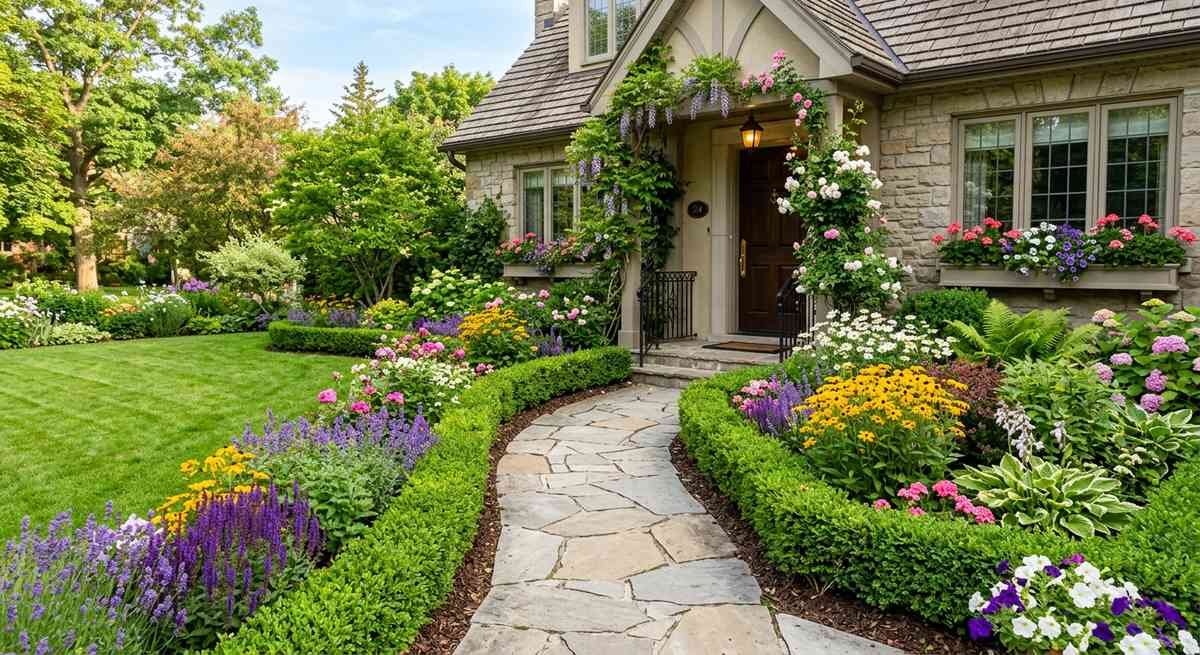

A well-planned front garden adds 5 to 10 percent to a home’s resale value, according to a widely cited study by Michigan State University’s Department of Horticulture. That return rivals some kitchen renovations, yet most homeowners underestimate how dramatically a thoughtful front yard makeover can shift buyer and neighbor perception alike, a point the Keyrenter Silicon Valley Palo Alto team can help owners consider within a broader property strategy.
The front garden is the one outdoor space every passerby judges. The best landscaping ideas front garden owners act on balance aesthetics, maintenance reality, climate, and budget within a space that typically gets less attention than the backyard.
Assess Your Front Garden Before You Plant Anything
Before buying a single plant or bag of mulch, spend time observing how your front yard actually behaves. Take note of where puddles sit after rain, which spots get harsh afternoon sun, and where shadows fall from the house or street trees.
Three factors dictate every landscape design decision: light, drainage, and scale. A front garden shaded by a mature oak needs entirely different plants than a south-facing strip that bakes from June through September.
Walk to the curb and study the view back toward your house. Most homeowners never do this. Notice the proportion between open lawn, planting beds, and hardscaping. A yard dominated by a single element, all lawn or all mulch beds, reads as unfinished regardless of how neat it looks.
Check your local HOA guidelines or municipal codes before planning anything structural. Fences, retaining walls, and even certain plant heights can require permits or neighbor notification in many communities.
Landscaping Ideas Front Garden: Design Styles and Aesthetics
Choosing a coherent design style prevents the cluttered, mismatched look that plagues many DIY front yards. Each style below suits different house architecture, maintenance tolerance, and climate.
| Design Style | Key Characteristics | Best For | Maintenance Level | Est. Cost (500 sq ft) |
|---|---|---|---|---|
| Formal / Classic | Symmetry, clipped hedges, defined borders | Colonial, Georgian homes | High (regular pruning) | $2,500–$6,000 |
| Cottage Garden | Informal, layered perennials, colorful blooms | Craftsman, Victorian homes | Medium | $800–$2,500 |
| Modern / Minimalist | Clean lines, ornamental grasses, bold texture | Contemporary, midcentury homes | Low–Medium | $1,500–$4,000 |
| Mediterranean | Gravel, drought-tolerant shrubs, terracotta | Spanish-style, stucco homes | Low | $1,000–$3,000 |
| Native / Naturalistic | Regional wildflowers, grasses, no lawn | Any style, eco-conscious owners | Very Low | $600–$2,000 |
| Cottage Rock Garden | Boulders, ground covers, alpine plants | Sloped lots, xeric climates | Very Low | $700–$2,200 |
The most common mistake is mixing elements from two or three incompatible styles. Cottage garden abundance doesn’t pair well with minimalist concrete paths. Pick one direction and commit to its plant palette and hardscape vocabulary.
That commitment is also where most resale value gets created. A yard with a recognizable, coherent identity photographs better and reads as “cared for” to buyers who can’t name a single plant in it.
Plant Selection: Flowers, Shrubs and Trees That Actually Thrive
The right plant in the right place is not a cliché but a practical rule that saves hundreds of dollars every year. A plant stressed by wrong light or soil conditions becomes a maintenance burden and rarely looks as good as the same species planted correctly elsewhere in the yard.
For foundation plantings, compact evergreens such as dwarf yew (Taxus densiformis), boxwood (Buxus sempervirens), or inkberry holly (Ilex glabra) provide year-round structure without outgrowing their space within five years. Many older suburban homes suffer from foundation shrubs that have grown into the windows because the original installer chose the wrong mature size.
Flowering perennials add seasonal color with less replanting effort than annuals. Coneflowers (Echinacea purpurea), black-eyed Susans (Rudbeckia fulgida), and catmint (Nepeta racemosa) return reliably in USDA zones 3 to 8 and require minimal supplemental water once established.
For front garden trees, scale matters above all else. A Japanese maple (Acer palmatum) stays under 15 feet at maturity, making it a proportionate choice for most residential lots. Fast-growing shade trees, by contrast, can crack sidewalks and create root conflicts with sewage lines within 15 to 20 years.
According to the National Gardening Association’s 2024 consumer research, 63 percent of homeowners cite “wrong plant choice” as the primary reason their front yard projects fail within three years. Matching plant to site, not to the nursery display, is the most impactful single decision in any front garden redesign.
Hardscaping Ideas: Paths, Borders and Surfaces That Last
Hardscaping provides the permanent framework that defines your planting beds and directs foot traffic. Done well, it also dramatically reduces ongoing maintenance by minimizing the lawn area that needs mowing and edging.
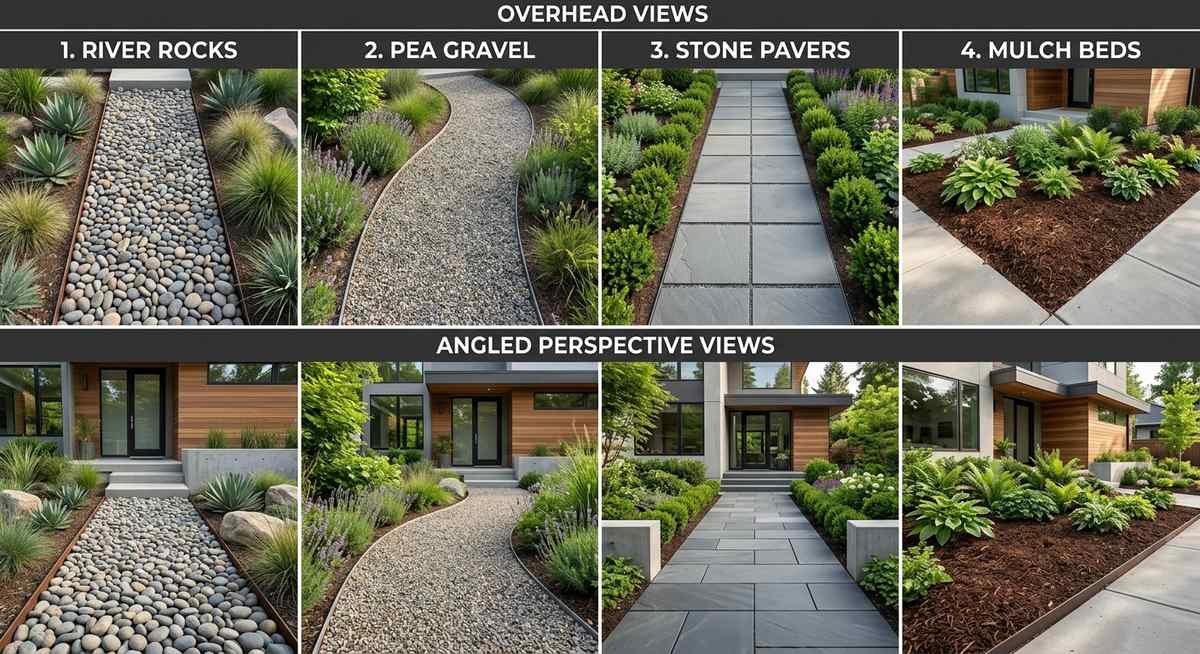
Material selection shapes both the look and the lifetime cost of any hardscape project. The table below compares the most common options for front garden surfaces and borders.
| Material | Cost per sq ft (installed) | Lifespan | Maintenance | Best Use |
|---|---|---|---|---|
| Concrete pavers | $8–$20 | 25–50 years | Low (occasional re-leveling) | Paths, driveways |
| Natural stone (flagstone) | $15–$30 | 30+ years | Low–Medium | Accent paths, patios |
| Pea gravel | $2–$5 | Indefinite | Medium (weed control, raking) | Bed fill, dry streambeds |
| River rock (2–3 inch) | $3–$7 | Indefinite | Low | Borders, dry creek beds |
| Mulch (shredded hardwood) | $2–$4 | 1–3 years | Annual refresh needed | Planting beds |
| Concrete edging | $3–$8 (linear ft) | 10–20 years | Low | Bed borders |
Pathway design has a direct effect on how the house reads from the street. A straight path from sidewalk to front door looks formal and intentional. A gently curved path with planted borders on both sides reads as relaxed and inviting. Match the pathway geometry to your chosen design style, and you’ve solved 40 percent of the visual coherence problem without touching a plant.
Front Garden Landscaping with Rocks and Drought-Tolerant Plants
Rock gardens and xeriscaping represent the fastest-growing segment of residential front yard landscaping, driven by water restrictions in Western states and a broader cultural shift away from high-maintenance lawns. In California alone, the state Water Resources Control Board reports that outdoor irrigation accounts for approximately 50 percent of residential water use.
A rock-based front garden typically combines three elements: a weed-suppressing underlayer (landscape fabric or cardboard), a layer of decorative stone or gravel 3 to 4 inches deep, and carefully spaced drought-tolerant plants that provide texture and seasonal interest.
Effective drought-tolerant plant pairings for rock gardens include:
- Ornamental grasses: Blue oat grass (Helictotrichon sempervirens) and feather reed grass (Calamagrostis acutiflora) provide movement and four-season interest.
- Low-growing perennials: Sedum (Sedum acre), creeping thyme (Thymus serpyllum), and hen-and-chicks (Sempervivum) fill gaps and suppress weeds without irrigation.
- Flowering shrubs: Russian sage (Salvia yangii), lavender (Lavandula angustifolia), and salvia provide color and pollinator habitat with minimal water once established.
- Boulders as focal points: One or two large boulders (12 to 24 inches) anchored 20 to 30 percent into the soil look natural and create visual weight that smaller rocks cannot provide.
Rock gardens do have a failure mode: the “dumped gravel” look that results from too little plant density relative to stone area. A ratio of roughly 60 percent ground cover plants to 40 percent exposed stone is a practical starting target. Thin that over time as plants spread.
Low-Maintenance Front Garden Landscaping
Low-maintenance does not mean no-maintenance, and understanding that distinction saves significant frustration and money. Every garden requires some input. The goal is to design a system where that input is predictable, modest, and seasonal rather than weekly and reactive.
The single most impactful low-maintenance decision is replacing lawn with planted beds or hardscaping. Lawn requires more labor hours per square foot than almost any other landscape element: weekly mowing, seasonal aeration, fertilization, and weed control. A 200 square foot planting bed planted with established perennials typically needs 4 to 6 hours of annual attention. The same area in lawn requires 20 to 30 hours per growing season.
Native plants are the other high-value choice. Once established (typically 2 to 3 growing seasons), plants native to your region require no supplemental irrigation, minimal or no fertilization, and rarely suffer from pest pressure serious enough to require intervention. The National Wildlife Federation’s native plant finder (available at nwf.org) allows homeowners to search by zip code for species native to their specific county.
Mulching planting beds 2 to 3 inches deep each spring suppresses weeds, retains moisture, and moderates soil temperature, effectively doing the work of several hours of weeding per season. Per the University of Minnesota Extension, a proper mulch layer reduces weed germination by 50 to 80 percent compared to unmulched beds.
Budget-Tiered Front Garden Makeover Plans
Front garden projects succeed at almost any budget when the scope is matched honestly to available funds. The three tiers below are based on material costs (labor not included for DIY) for a typical 400 to 600 square foot front garden.
Under $400: The Refresh
A front garden refresh at this budget focuses on maximum visual impact per dollar. Edge all existing beds cleanly, add 3 inches of fresh mulch (one cubic yard covers approximately 100 square feet at that depth), and introduce three to five focal plants in strategic positions: at the mailbox, flanking the front door, and at the corner of the main bed.
Recommended plants at this tier: ornamental grasses ($8–$15 per 1-gallon container), black-eyed Susans from seed ($3–$6 per packet), and one dwarf ornamental shrub near the entryway ($25–$40). Total materials including mulch and edging: $150–$380 depending on existing bed square footage.
$400–$1,500: The Redesign
At this budget, a front garden redesign can include a new pathway section, a defined planting bed with a mix of perennials and a small feature shrub, and a modest hardscaping element (landscape border stones or stepping stones to the mailbox or side gate).
A practical allocation: $80–$150 on pathway materials or border edging, $200–$500 on plants (mix of 3-gallon perennials and one small ornamental tree), $80–$200 on mulch and soil amendment, and $40–$150 on tools if needed. Remaining budget covers contingencies.
$1,500 and Above: The Transformation
A full front garden transformation at this level can include a new concrete paver or flagstone path, a complete bed redesign with layered plantings, hardscaping edging in stone or concrete, and a focal tree or large structural shrub. Professional plant installation for this scope typically runs $2,500 to $6,000 in most U.S. markets, making DIY installation at $1,500 to $3,000 in materials a substantial saving.
The landscaping industry’s own data, from the National Association of Landscape Professionals’ 2023 survey, indicates that the median homeowner spends $3,200 on front yard landscaping projects, with the highest-value projects centering on hardscaping (patios, paths, retaining walls) rather than plant material alone.
Small Front Garden Landscaping Ideas
A compact front garden, under 300 square feet, rewards restraint and vertical thinking more than any other yard type. Every element needs to earn its space twice over.
The most effective technique for small front gardens is vertical layering: ground cover plants at the lowest level (under 12 inches), mid-layer perennials and ornamental grasses at 18 to 36 inches, and one structural vertical element at 4 to 8 feet, whether a small ornamental tree, a trained espalier against the house, or a trellis with a climbing rose or clematis.
Restraint in plant variety matters as much as vertical structure. Three to five plant species in a small front garden read as designed. Twelve species in the same space read as collected or accidental. Pick a palette of two or three complementary colors and repeat those same species in multiple places to create visual rhythm within the limited footprint.
For town houses and narrow lots with a strip of garden rather than a true yard, a row of uniform plantings, three to five identical ornamental grasses or box balls, creates structure and intentionality that a random assortment never achieves, regardless of how individually attractive each plant is.
Common Front Garden Landscaping Mistakes to Avoid
Most front garden mistakes fall into one of two categories: planting errors (wrong plant, wrong place, wrong scale) and design errors (no focal point, no coherent style, no defined path). Knowing the specific failure modes prevents expensive backtracking.
- Over-planting and crowding: Plants installed at nursery size look sparse for two to three years, prompting many homeowners to add more plants that eventually crowd each other. Match spacing to mature size, not current size, and use annual flowers to fill gaps in the first few seasons.
- Choosing plants for the display tag photo, not the real site: A plant that thrives in full sun will decline slowly in partial shade. That decline takes one to two seasons to become obvious, by which time the plant is too stressed to recover easily.
- Ignoring drainage: Areas where water pools after rain will rot the roots of most ornamental plants within one to two seasons. Correct drainage problems before planting by grading soil away from the house and installing French drains where necessary.
- No focal point: A front garden without a visual anchor reads as background rather than design. One specimen tree, a large decorative urn, a distinctive pathway material, or a well-placed boulder provides the focal point that makes everything else read as intentional.
- Skipping edge definition: Clean edges between lawn and planting beds are the single fastest visual upgrade available to any front garden. A half-moon edger and 30 minutes of work transforms a ragged, neglected-looking border into something that reads as maintained, regardless of what’s growing inside it.
- Mismatching hardscape materials to house style: Rustic flagstone paths clash with a sleek contemporary facade. Polished concrete pavers look odd in front of a Victorian cottage. Match the hardscape material’s texture and color palette to the house’s architectural character.
- Underestimating maintenance commitment: Formal box hedges and rose borders are beautiful but require consistent pruning and care. Low-maintenance native beds require almost no care but look “wild” for the first two seasons while establishing. Choose the maintenance level that matches your actual available time, not your ideal scenario.
Front Garden Landscaping FAQs
What landscaping ideas front garden owners can do on a small budget?
Clean, defined bed edges and a fresh layer of mulch produce the highest visual return for the lowest material cost. Add three to five well-placed plants in complementary colors, and even a neglected front garden reads as intentional. Budget: $80–$200 in materials for most typical front gardens.
What are the best plants for a front garden?
For structure: dwarf boxwood, inkberry holly, or ornamental grasses. For color: coneflowers, black-eyed Susans, and catmint. For trees: Japanese maple or serviceberry. All tolerate typical residential conditions and provide multi-season interest with moderate to low maintenance.
How much does a front garden landscaping project cost?
A basic refresh (mulch, edging, a few plants) runs $150 to $400 in materials for a 400 to 600 square foot front garden. A full redesign with new hardscaping and layered planting typically costs $1,500 to $3,000 DIY, or $3,000 to $8,000 professionally installed. According to the National Association of Landscape Professionals, the median U.S. homeowner spends $3,200 on front yard projects.
What is the best low-maintenance front garden landscaping?
A combination of regional native perennials, a 3-inch mulch layer, and defined hardscape edging requires the least ongoing labor. Native plants, once established (typically two to three seasons), need no supplemental irrigation and minimal fertilization. Replacing even 30 percent of lawn with planted beds cuts annual maintenance time significantly.
How do I create a rock garden in my front yard?
Install a weed-suppressing layer (landscape fabric or two layers of cardboard), add 3 to 4 inches of your chosen stone or gravel, and plant drought-tolerant species at a density of one plant per 2 to 3 square feet. Anchor one or two larger boulders by burying 20 to 30 percent of their height for a natural appearance. Allow ground cover plants to fill in over two to three seasons.
Does front garden landscaping increase home value?
Yes, consistently. Michigan State University research found well-executed front yard landscaping increases perceived home value by 5 to 10 percent. That translates to $15,000 to $30,000 on a $300,000 home. Hardscaping (paths, walls, defined structure) and mature trees provide the strongest individual ROI. Overgrown or poorly maintained landscaping, by contrast, can reduce perceived value by 5 to 15 percent.
How do I design a front garden landscaping plan from scratch?
Start with a simple site assessment: light levels, drainage patterns, and the scale relationship between house and yard. Choose a single design style that matches your home’s architecture. Define the path, beds, and lawn areas before buying any plants. Select plants last, choosing species suited to your assessed light and drainage conditions. The best front garden landscaping ideas always begin with honest site observation, not catalog browsing.
When is the best time to execute landscaping ideas front garden projects?
Fall is the optimal planting season for trees, shrubs, and perennials in most of North America. Soil is still warm enough for root establishment, but cooler air temperatures reduce transplant stress. Spring is the second-best window. Summer planting is possible but requires consistent irrigation for the first season. Avoid planting during heat waves or when ground is frozen.
What should I avoid when landscaping my front garden?
The most common mistakes are over-planting (choosing spacing based on current nursery size, not mature plant size), ignoring drainage problems before planting, and selecting plants based on visual appeal rather than site conditions. Also avoid mixing incompatible design styles and skipping regular bed edging, which has an outsized effect on overall appearance.
Putting Your Landscaping Ideas Front Garden Plans Into Action
Acting on the right landscaping ideas front garden style requires starting with the lowest-effort, highest-impact changes: clean edges, fresh mulch, and three well-placed plants in key visual positions. That single afternoon of work establishes the baseline from which every future improvement becomes easier to see and plan.
From there, choose one design direction, consult your site conditions honestly, and add elements in sequence rather than all at once. A front garden built in stages over two to three seasons tends to look more coherent and considered than one installed in a single weekend push.
The yards that hold their appeal and value year after year share one quality: they were designed for the actual conditions of the site, not for an imagined version of it.