
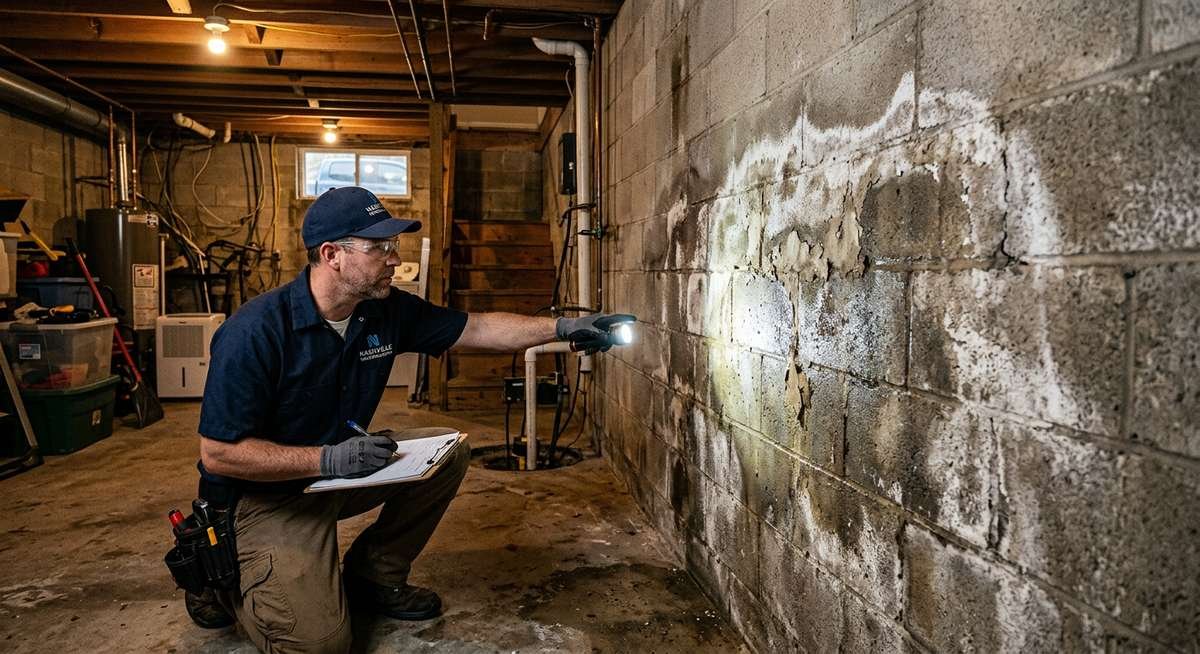

Nashville homeowners deal with one of the most water-prone environments in the country. The city receives roughly 47 inches of rain each year, according to the National Weather Service’s Nashville office, and Middle Tennessee’s clay-heavy soils hold that moisture directly against foundation walls for weeks at a time.
That combination, clay soil plus heavy seasonal rainfall, is the core reason basement water intrusion is so common in the Nashville metro. Addressing it early, before water compromises structural materials or triggers mold growth, is almost always significantly cheaper than waiting.
Why Nashville Basements Are Especially Vulnerable
Nashville basements leak more frequently than those in drier regions because of three intersecting factors: annual rainfall above the national average, clay-dominated soils that drain poorly, and an underlying limestone karst geology that creates unpredictable water migration pathways beneath homes.
Clay soil expands when wet and contracts when dry, cycling through this process dozens of times each year. That expansion pushes against basement walls with what engineers call hydrostatic pressure, forcing water through hairline cracks and porous concrete block at a rate that accelerates over time.
Limestone karst, which underlies significant portions of Davidson and the surrounding counties, adds a second variable. Water moves through dissolved channels in the bedrock, occasionally surfacing beneath a slab without any visible surface indication of where it originated.
The humid climate compounds both problems. The National Weather Service Nashville office reports that Nashville’s average annual precipitation has trended slightly upward over the past two decades, with spring rain events becoming more intense. A basement that handled moisture fine for 20 years can begin showing problems after a single abnormally wet season, not because the waterproofing failed, but because the volume of water finally exceeded what the original drainage design anticipated.
6 Warning Signs Your Nashville Basement Needs Attention
The most reliable early warnings of basement water intrusion are efflorescence (white chalky deposits on walls), visible damp spots or tide lines, a persistent musty smell, and any active mold growth. Catching these signals before they escalate is the difference between a drainage installation and a structural repair bill.
Most Nashville homeowners notice problems in spring, when the ground saturates from March through May. Here are the six signs worth taking seriously:
| Warning Sign | What It Indicates | Urgency |
|---|---|---|
| Efflorescence (white powder on walls) | Water moving through concrete, carrying salts to the surface | Moderate — address within one season |
| Damp spots or water stains | Intermittent or active seepage through walls or floor | Moderate to high |
| Musty odor | Elevated humidity or hidden mold growth | Moderate — mold can spread quickly |
| Visible mold or mildew | Sustained moisture above 60% relative humidity | High — health risk |
| Cracks in walls or floor | Hydrostatic pressure, settling, or freeze-thaw cycles | Variable — horizontal cracks are urgent |
| Standing water or pooling after rain | Active drainage failure or foundation breach | High, address immediately |
Horizontal cracks in block or poured concrete walls deserve particular attention. Vertical cracks typically indicate shrinkage or minor settling; horizontal ones signal lateral pressure from saturated soil, which is a structural concern separate from waterproofing.
According to the U.S. Environmental Protection Agency, mold can begin colonizing damp surfaces within 24 to 48 hours of a water event. A damp Nashville basement that smells fine today can have active mold behind a finished wall within days of a significant rain event.
4 Waterproofing Methods That Work in Middle Tennessee
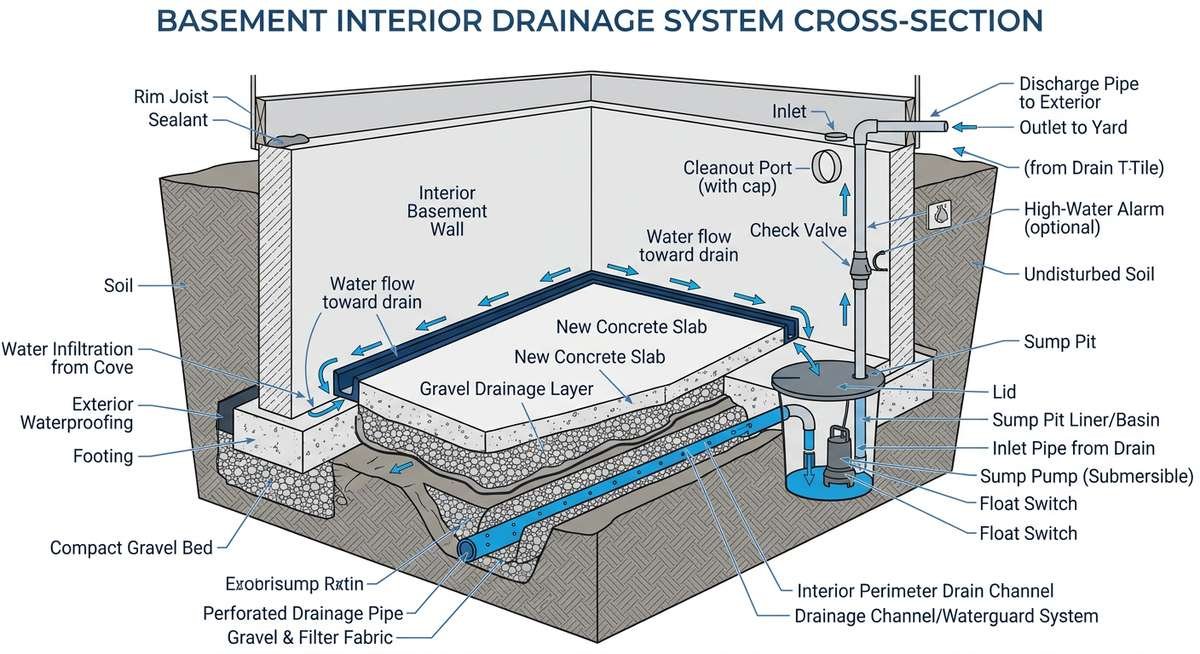
For most Nashville homes, interior drainage systems paired with a sump pump represent the most practical and cost-effective solution. Exterior waterproofing addresses the problem at the wall surface but requires excavation, and crack injection addresses isolated entry points without solving broader drainage problems. Choosing the right method depends on where the water is entering and how much pressure is involved.
| Method | How It Works | Best For | Typical Cost Range |
|---|---|---|---|
| Interior drainage system | Perimeter channel installed at floor-wall joint directs water to a sump pit | Seepage through walls or floor; hydrostatic pressure | $3,000–$12,000 |
| Exterior waterproofing | Excavation, waterproof membrane applied to exterior wall, drainage board installed | Active cracks; new construction; severe hydrostatic pressure | $10,000–$30,000+ |
| Sump pump system | Collects water from drainage system or floor; pumps it away from foundation | Any home with interior drainage; flood-prone areas | $1,200–$5,000 |
| Crack injection (polyurethane or epoxy) | Fills hairline cracks in poured concrete walls from the interior | Isolated cracks in poured concrete (not block walls) | $300–$2,500 per crack |
Interior drainage is by far the most common approach in Nashville for an important reason: excavating exterior walls in clay soil is expensive, disruptive, and sometimes requires permits. Interior systems handle the same water volume at a fraction of the cost and can be installed in a single day for most homes.
Sump pumps are nearly always part of the picture. Nashville’s storm intensity means that even a well-designed drainage channel can be overwhelmed without a pump to move accumulated water away from the foundation. A battery backup on the pump matters here, because Nashville loses power during the same storms that produce the highest basement water risk.
Crack injection works for poured concrete foundations with isolated hairline or step cracks but does not address block walls or widespread seepage. Many contractors offer it as a standalone service, and it is genuinely effective when the crack is the only entry point.
Nashville Basement Waterproofing Costs: What Homeowners Actually Pay
Most Nashville homeowners pay between $4,000 and $15,000 for a complete basement waterproofing project involving an interior drainage system, sump pump, and any necessary crack repair. Smaller jobs addressing a single seeping crack can run $500–$2,500; full exterior waterproofing on a larger home can exceed $35,000.
Several factors push costs higher in Middle Tennessee specifically:
- Clay soil removal: Excavating clay for exterior work takes longer and requires more equipment than sandy soil.
- Block vs. poured concrete: Block foundations are more porous and often require more extensive drainage than poured concrete walls.
- Basement size: Interior drainage is priced per linear foot of perimeter, typically $75–$150 per foot in the Nashville market.
- Battery backup system: Adds $500–$1,500 but is strongly recommended given Nashville’s storm patterns.
- Permits: Davidson County requires permits for structural work; add $150–$500 depending on scope.
“Got quotes ranging from $7k to $30k for sump pump installation and basement waterproofing. The spread is insane.”
— r/basement (homeowner community thread on waterproofing quote variance; r/basement is a community focused on basement improvement and repair)
That price spread is real, and it reflects genuine differences in scope rather than contractor gouging. A quote at $7,000 might include a single sump pump and 40 linear feet of drainage. One at $28,000 might include full-perimeter interior drainage, a primary and backup sump system, wall crack repairs, and a dehumidifier installation.
The single most consistent piece of advice from experienced homeowners: get at least three written estimates from contractors who inspect the basement in person. Phone or website quotes for basement waterproofing are essentially meaningless without seeing the actual space.
Most Nashville waterproofing contractors offer financing, which is worth asking about. Payment is typically structured so the full amount is not due until after installation is complete.
How to Choose a Basement Waterproofing Contractor in Nashville
The most reliable Nashville basement waterproofing contractors carry an A or A+ Better Business Bureau rating, hold a Tennessee contractor’s license, offer a lifetime transferable warranty on drainage systems, and have documented local project history in Middle Tennessee. A transferable warranty adds measurable resale value to a home, making it one of the more financially significant selection criteria.
Several red flags are worth watching for:
- High-pressure sales tactics: Any contractor who insists you sign a contract the same day they walk through your basement, especially citing a “one-day-only” discount, is worth avoiding.
- No in-person inspection: Legitimate waterproofing proposals require seeing the actual basement, checking crack locations, testing wall moisture, and assessing drainage outlets.
- No written warranty: Verbal lifetime warranties are not warranties. Get the terms in writing, and check whether the warranty transfers to a new buyer if you sell the home.
- Waterproofing paint as the proposed solution: Paint-based sealants can slow minor condensation but do nothing against active water intrusion or hydrostatic pressure. When a quote leads with paint, the contractor either does not understand the problem or is not equipped to solve it.
- No licensed subcontractors for electrical: Sump pump installations involve electrical work. Any contractor performing that work needs to use a licensed electrician or hold the license themselves.
Tennessee’s contractor licensing board (tn.gov) maintains a searchable database where you can verify that a contractor’s license is current before signing anything. Checking BBB complaints and Google Reviews for Nashville-specific projects (not just general reviews from across multiple states) gives a much better picture than star ratings alone.
Frequently Asked Questions
How much does basement waterproofing cost in Nashville?
Most Nashville homeowners pay $4,000–$15,000 for a full interior drainage system with a sump pump. Smaller jobs (isolated crack repair) run $500–$2,500, while full exterior waterproofing can reach $30,000 or more. Cost varies based on basement size, foundation type, and the drainage method required.
Is interior or exterior waterproofing better for Nashville homes?
Interior drainage systems are the practical choice for most Nashville homes because they cost significantly less and do not require excavating in clay soil. Exterior waterproofing provides a true barrier at the wall surface and is better for new construction or severe structural cracks, but the added cost is rarely justified for standard seepage problems.
How long does basement waterproofing last?
Professional interior drainage systems typically last 20–30 years when properly maintained, and many come with lifetime warranties. Sump pumps have a shorter service life, averaging 10–15 years, and should be tested annually. Exterior membrane waterproofing can last 20–30 years but may need inspection if significant soil movement occurs.
What causes basement flooding in Nashville?
The most common causes in Middle Tennessee are hydrostatic pressure from clay soil retaining rainwater, cracks in block or poured concrete walls, failed or overwhelmed sump pump systems, and poor grading that directs surface water toward the foundation. Clogged gutters and downspouts discharging too close to the house account for a significant percentage of water intrusion calls.
Can I waterproof my basement myself?
DIY options like waterproofing paint or hydraulic cement can address very minor moisture or pinhole leaks, but they cannot solve hydrostatic pressure, active cracks, or drainage failures. For anything more than surface condensation, professional installation is the only approach that actually resolves the underlying problem and comes with a warranty.
Does waterproofing a basement increase home value?
Yes. A dry, professionally waterproofed basement with a transferable lifetime warranty is a documented selling point in Nashville’s real estate market. Home inspectors flag water intrusion evidence as a material defect; eliminating that defect removes a negotiating point for buyers and can prevent a sale from falling through entirely during inspection contingency periods.
Getting Started with Nashville Basement Waterproofing
Nashville’s climate is not going to get drier. For homeowners noticing early warning signs, the calculation is straightforward: a $6,000 interior drainage system installed now costs far less than $20,000 in structural repairs three years from now.
The EPA’s mold guidance recommends addressing any moisture source within 24 to 48 hours to prevent colonization. In a Nashville basement that means not deferring an inspection after the first wet spring. Getting three in-person estimates from licensed local contractors, checking BBB ratings and Tennessee contractor license status, and asking specifically about transferable warranties covers the essential bases before signing anything.