


Selling without a listing agent saves 2.5% to 3% in commission on a typical sale, but the National Association of Realtors’ 2025 data shows FSBO homes sold for an average of $360,000 compared to $435,000 for agent-listed properties. That $75,000 gap matters more than the commission in most cases. Whether it works in your favor depends almost entirely on your situation, your market, and what you actually know about the process, which is where KRS Charlottesville specialists can offer useful property-focused perspective.
About 5% of all U.S. home sales in 2024 were completed without a listing agent through for sale by owner (FSBO) arrangements, an all-time low according to NAR. That number has fallen steadily for a decade. But context is everything: 65% of those FSBO sellers already knew their buyer before listing. The “FSBO success story” you’ve heard from a neighbor probably involved selling to a relative or coworker, not finding a buyer cold in a competitive market.
The Real Cost of Selling Without a Realtor
Skipping a listing agent eliminates 2.5% to 3% of the sale price in listing commission, which is genuinely significant money. On a $400,000 home, that’s $10,000 to $12,000 staying in your pocket. But the full cost picture is more complicated than the commission savings alone, especially since the real estate commission rules changed in August 2024.
Under the pre-2024 rules, sellers typically paid both sides: the listing agent (2.5–3%) and the buyer’s agent (2.5–3%), for a combined 5–6% commission. The NAR settlement, which took effect in August 2024, severed that link. Sellers are no longer required to offer buyer’s agent compensation through the MLS. You can now offer $0 to the buyer’s agent and handle that negotiation separately.
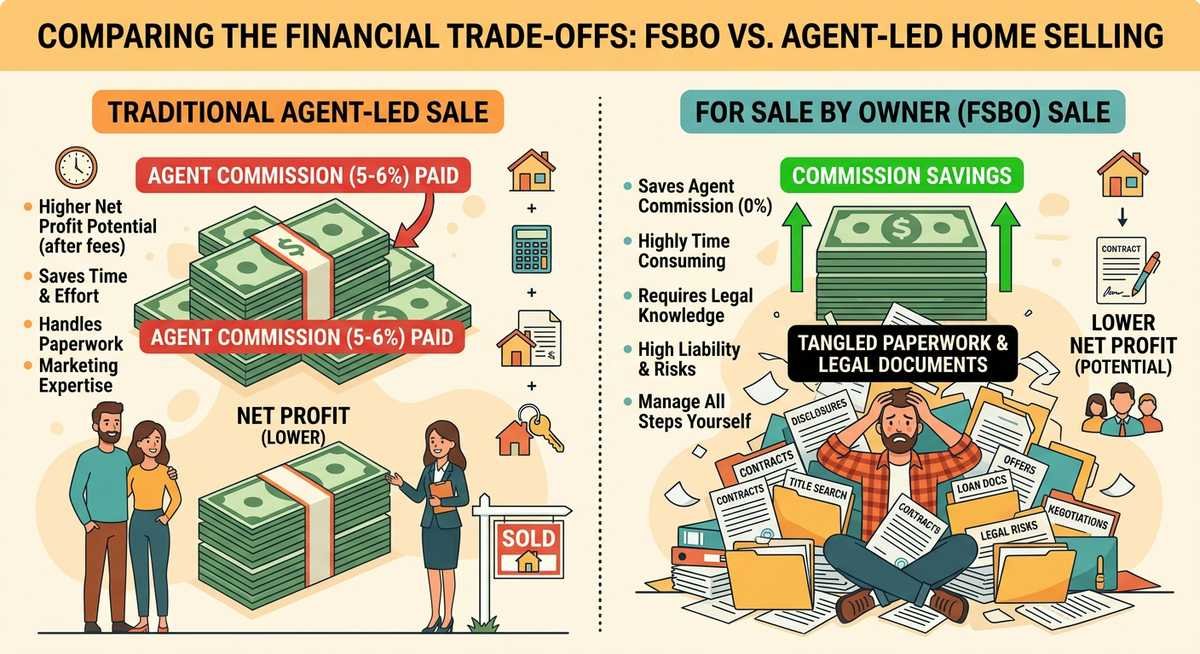
| Cost Item | With Listing Agent ($400k home) | FSBO ($400k home) |
|---|---|---|
| Listing agent commission | $10,000–$12,000 (2.5–3%) | $0 |
| Buyer’s agent commission (negotiable post-2024) | $10,000–$12,000 (2.5–3%) | $0–$12,000 (your call) |
| Professional photography | Usually included | $200–$400 (required) |
| Flat-fee MLS listing (optional) | Included | $99–$500 |
| Real estate attorney (recommended) | Optional | $500–$1,500 (strongly advised) |
| Pricing risk (selling below market) | Low (agent provides CMAs) | High (no professional data) |
One seller in Sarasota, Florida saved $18,000 in listing commission on a $600,000 property, only to accept an offer $30,000 below what comparable homes sold for that month because she priced without access to recent closed-sale data. The net outcome was a $12,000 loss compared to listing with an agent. That pattern is common enough that the NAR tracks it as a systemic feature of FSBO sales, not an outlier.
The Main Pros of Selling Without a Realtor
The strongest case for FSBO combines meaningful commission savings with full control over every decision in the sale. For sellers in the right circumstances, that combination is genuinely valuable, not just theoretically appealing.
The commission savings are real. Even if you offer buyer’s agent compensation to stay competitive (typically 2.5–3%), eliminating your own listing agent saves $10,000 to $15,000 on a median-priced home. In a hot seller’s market where your property will sell regardless, you capture that money without sacrificing outcome.
- Full pricing and negotiation control: You set the price, respond to offers directly, and negotiate without a middleman. Some sellers prefer having no one between them and the buyer.
- Scheduling flexibility: You decide when to show the property and how to stage it. No need to coordinate around an agent’s calendar.
- Direct buyer relationship: Particularly valuable when selling to a known buyer (family, neighbor, coworker). Skipping the agent in these cases is genuinely efficient.
- Privacy: FSBO transactions are generally less public. No open houses if you don’t want them, no lockbox, no strangers touring without your presence.
| Market Condition | FSBO Viability | Reason |
|---|---|---|
| Strong seller’s market (low inventory) | High | Homes sell fast regardless; commission savings matter more |
| Balanced market | Medium | MLS access becomes important; flat-fee MLS is a strong option |
| Buyer’s market (high inventory) | Low | Competition requires professional marketing and pricing expertise |
| Selling to a known buyer | Very High | 65% of all FSBO sales fit this profile; agent adds little value |
That 65% figure is worth sitting with. A large majority of people who successfully sell without an agent aren’t competing on the open market at all. They’re completing a transaction with someone they already trust, where the agent’s role as buyer-finder simply isn’t needed.
The Main Cons and Hidden Risks
The most common pitfalls of FSBO aren’t about paperwork complexity or marketing effort. They center on pricing without professional data, legal exposure from missed disclosures, and the psychological difficulty of negotiating about your own home.
Pricing is where most FSBO sales go wrong. Real estate agents run comparative market analyses (CMAs) using recent closed sales, active listings, and neighborhood-level data that isn’t publicly available in a usable format for most homeowners. Eighteen percent of FSBO sellers end up pricing their home incorrectly, according to NAR research, either leaving money on the table or sitting on the market too long and triggering price reductions that signal desperation to buyers.
- Limited MLS access: Most buyers’ agents find properties through the MLS. Without a listing there (or through a flat-fee service), your exposure is limited to Zillow, Craigslist, and word of mouth.
- Legal disclosure requirements: Every state has mandatory disclosure forms. Missing or incorrectly completing these can create post-sale liability, including lawsuits from buyers who discover undisclosed defects.
- Negotiation bias: Joel Carson, a top real estate agent in Salt Lake City with over 30 years of experience, is direct about this: “Selling a home is the largest transaction that people do in their lives. Without having a professional who does this for a living, looking over documents and making sure the seller understands all aspects, a lot of that is lost.”
- Buyer’s agent friction: Agents who represent buyers are legally required to show properties matching their client’s criteria regardless of whether a listing agent is involved. But in practice, buyer’s agents who know a FSBO won’t pay a commission may spend less time promoting the property, or may tell buyers the process will be more complex.
The emotional difficulty of negotiating about your own home is underestimated until it happens. When a buyer sends a low offer with an attached inspection report full of minor issues, a homeowner tends to feel attacked. An agent absorbs that friction. Without one, sellers often either capitulate to unreasonable demands or dig in on points that don’t matter, damaging the deal.
How the 2024 NAR Settlement Changed the Equation
As of August 17, 2024, sellers are no longer required to offer buyer’s agent compensation through the MLS. This is the most significant shift in U.S. real estate commission structure in decades, and it directly affects the FSBO calculation in ways most sellers haven’t fully processed.
Before the settlement, the standard practice was sellers paying both agents. A FSBO seller still had to decide whether to offer buyer’s agent compensation to stay competitive — most did, paying 2.5–3% to the buyer’s agent even while avoiding the listing agent fee. That still represented real savings.
| Factor | Pre-August 2024 | Post-August 2024 |
|---|---|---|
| Seller obligation to offer buyer’s agent commission | Required via MLS rules | Not required, fully negotiable |
| Buyer representation | Often informal | Mandatory written buyer agreements before showings |
| Total commission range | Typically 5–6% | More variable; 2–4% now possible |
| FSBO advantage | Saved listing agent (2.5–3%) | Can save both sides in direct-buyer sales |
The post-settlement world theoretically benefits FSBO sellers who have a direct buyer. In a direct sale to a known party, with no agents on either side, a seller can capture the entire commission that would otherwise go to two professionals. Whether buyers are willing to forego representation in this environment is another question. Most buyers, especially first-time buyers, will still want agent representation and will ask the seller to cover that cost in the negotiation.
The rule change is probably more significant for the overall industry than for the typical FSBO seller. But understanding it prevents the outdated assumption that you must pay 5–6% regardless.
When Does FSBO Actually Make Sense?
FSBO makes the most financial sense in three specific scenarios: a strong seller’s market where your home will generate multiple offers regardless, a direct sale to a buyer you already know, or a transaction where you have real estate experience and can genuinely handle pricing, legal paperwork, and negotiation without professional support.
If your home is distinctive — a rare property type, a location with no real comparables — pricing may actually be more art than science, and your intimate knowledge of the property may be more useful than an agent’s MLS data. That’s a legitimate case for FSBO. But it’s not the case for most standard residential sales.
| You Should Consider FSBO If… | You Should Hire an Agent If… |
|---|---|
| You already have a buyer lined up | You need maximum market exposure |
| You’re in a hot seller’s market with low inventory | You’re in a buyer’s market or balanced market |
| You have real estate experience or legal knowledge | You’ve never sold a home before |
| You have time to manage showings, offers, and paperwork | You’re relocating or have time constraints |
| The property has a strong, obvious value | Pricing requires deep comparable-sale analysis |
A flat-fee MLS service is worth knowing about regardless of which direction you choose. For $99 to $500, you get your listing on the MLS and syndicated to Zillow, Realtor.com, and Redfin without paying a full listing agent commission. You handle showings, negotiations, and paperwork yourself, but your listing reaches buyer’s agents and their clients. This middle path captures most of the exposure benefit of working with an agent at a fraction of the cost.
According to the National Association of Realtors’ 2025 Profile of Home Buyers and Sellers, FSBO homes are at an all-time low share of sales, which speaks to how demanding the process has become in competitive markets. That trend doesn’t mean FSBO is never right. It means the bar for doing it well is higher than it used to be.
Frequently Asked Questions
How much money do you actually save selling without a realtor?
You save 2.5% to 3% by eliminating the listing agent commission, which amounts to $10,000 to $12,000 on a $400,000 home. You may still choose to offer buyer’s agent compensation (another 2.5–3%) to attract buyers. Keep in mind that NAR data shows FSBO homes sell for an average of $75,000 less than agent-listed homes, though that gap narrows significantly when the seller has a known buyer.
What are the legal requirements for FSBO in most states?
Most states require sellers to complete mandatory disclosure forms covering known defects, environmental hazards (lead paint, radon), flood zone status, and material facts about the property’s condition. Requirements vary by state. Failing to disclose can result in post-sale lawsuits. A real estate attorney for $500 to $1,500 can review your documents and protect you from disclosure errors.
Can I list on Zillow without a realtor?
Yes. Zillow allows FSBO listings directly through its platform at no charge, though these listings are typically displayed separately from agent-listed homes. For MLS access (the database that buyer’s agents use), you’ll need a flat-fee MLS service, which costs $99 to $500 and gets your listing on the MLS without requiring a full listing agent.
Do I still need a real estate attorney if I sell FSBO?
In some states (Massachusetts, New York, South Carolina, and others), an attorney is legally required for real estate closings. In all other states, it’s strongly advisable. Without an agent reviewing contracts and disclosures, a real estate attorney is your main safeguard against legal errors that could expose you to liability after the sale closes.
What is a flat-fee MLS service and how does it work?
A flat-fee MLS service lists your home on the local Multiple Listing Service for a one-time fee (typically $99 to $500) without requiring you to hire a full-service listing agent. Your listing gets syndicated to Zillow, Realtor.com, and Redfin. You remain responsible for showing the property, negotiating offers, and handling paperwork. Companies like Houzeo, FSBO.com, and various local brokerages offer this service.
How do FSBO homes compare to agent-listed homes in final sale price?
According to NAR’s 2025 Profile of Home Buyers and Sellers, the median FSBO sale price was $360,000 compared to $435,000 for agent-assisted sales, a gap of $75,000. Researchers note that this gap is partly explained by the fact that FSBO homes tend to be smaller and in less competitive markets, but pricing errors and limited MLS exposure also contribute materially to lower sale prices in open-market FSBO transactions.
The Bottom Line
The case for FSBO is real but narrow. If you have a buyer, you’re in a hot market, or you have relevant professional experience, the commission savings are legitimate and meaningful. For most sellers navigating a standard open-market sale, the combination of pricing risk, MLS access limitations, and legal paperwork complexity makes agent representation worth the cost.
If you’re on the fence, a flat-fee MLS service offers a practical middle path: get on the MLS, reach buyer’s agents and their clients, and keep your listing agent commission. You’ll still need to manage the transaction yourself, but you solve the biggest disadvantage of pure FSBO without paying full commission.
The 2024 NAR settlement genuinely changed commission structures. It’s worth understanding those changes before you decide, not after. The old assumption that you must pay 5–6% regardless of what you do is no longer accurate.
