

The red guard waterproofing membrane from Custom Building Products is an IAPMO-listed, polymer-based liquid barrier that turns bright red when fully cured, giving installers a reliable visual cue before tiling. One gallon covers 55 square feet as a waterproof membrane, though coverage drops to 40 square feet in pan liner applications. Understanding those numbers upfront saves both material waste and costly callbacks.
What RedGard Waterproofing Membrane Actually Does
Red guard waterproofing membrane is a ready-to-use liquid that creates a seamless barrier under tile, bonding directly to cement board, concrete, masonry, and clean metal drain assemblies including PVC, stainless steel, and ABS components. It meets ANSI A118.10 (IAPMO shower pan liner standard) and ANSI A118.12 (crack isolation), and carries an extra heavy-duty rating for steam shower installations.
The product works by forming a flexible elastomeric film over the substrate. Where traditional PVC liner systems trap water and require perfect seam welding, RedGard creates a monolithic membrane with no seams except at corners, where fabric reinforcement fills the gap. Custom Building Products (a subsidiary of The QUIKRETE Companies) manufactures it for both residential and commercial tile and stone applications.
Applied over a slab-on-grade concrete floor, it also functions as a moisture vapor barrier under all types of floor coverings, which makes it a two-in-one solution for basement tile jobs. The product ships ready to use with no mixing required.
RedGard Coverage Rates Per Gallon
A 1-gallon pail covers different square footage depending on how the membrane is used. As a standard waterproof membrane, expect 55 square feet per gallon. For IAPMO-certified shower pan liner installation, that drops to 40 square feet per gallon due to the required film thickness. The crack prevention use case covers significantly more area at 100 square feet per gallon.
According to Custom Building Products’ published coverage chart, the complete breakdown is as follows:
| Application Use Case | 1 Gallon (3.78 L) | 3.5 Gallon (13.2 L) |
|---|---|---|
| Crack Prevention Membrane | 100 sq ft (9.3 m²) | 350 sq ft (32.5 m²) |
| Crack Prevention (ANSI A118.12) | 25 sq ft (2.3 m²) | 88 sq ft (8.2 m²) |
| Waterproof Membrane | 55 sq ft (5.1 m²) | 192 sq ft (17.8 m²) |
| IAPMO Pan Liner (ANSI A118.10) | 40 sq ft (3.7 m²) | 140 sq ft (13 m²) |
The spread between 25 and 100 square feet per gallon tells the real story. Crack prevention applications can stretch a gallon far because the film is thinner. Certified shower floor installations require multiple coats building up to the minimum dry film thickness, which consumes more product. Calculate your shower floor and wall areas separately using the appropriate row in the table.
One gallon runs roughly $50 at most tile supply houses. One failed shower rebuild, by contrast, runs several thousand dollars in labor, tile removal, substrate replacement, and re-installation. The math on buying an extra gallon is not complicated.
How to Apply RedGard: Step-by-Step
RedGard application follows six steps: surface preparation, fabric reinforcement at corners and seams, first coat, drying verification by color change, second coat, and final cure check before tiling. Skipping the fabric tape at inside corners is the single most common DIY mistake, and it is also the most common source of cracks and eventual moisture intrusion at those joints.
Step 1: Prepare the substrate. The surface must be clean, solid, and free of standing water, oil, paint, or form-release agents. Cement board seams should be taped with alkali-resistant fiberglass mesh tape and filled with thinset. Let the thinset cure before proceeding. On concrete, fill any cracks or voids first.
Step 2: Apply fabric membrane at critical joints. Before the first coat of RedGard, embed RedGard Fabric Membrane into the membrane at all inside corners (floor-to-wall joints), around drain flanges, and at any substrate transitions. Use a brush to work a thin layer of RedGard into the corner first, press the fabric into it, then brush over the top. This step cannot be skipped on shower floors.
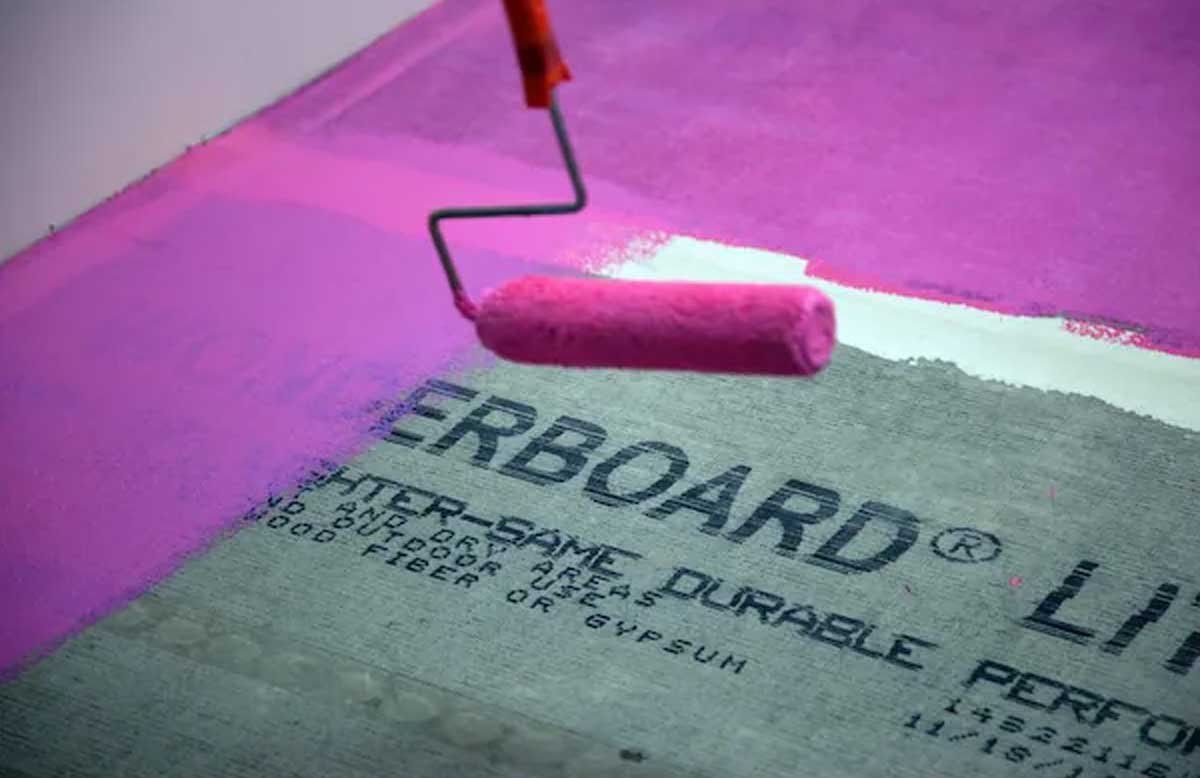
Step 3: Apply the first coat. Pour RedGard onto the surface and spread with a 3/8-inch nap roller or a brush. Work in consistent, overlapping strokes to avoid thin spots. Cover the entire surface, including the base of walls where they meet the floor. The product starts as a bright pink liquid.
Step 4: Check the color before applying the second coat. Tile pros who do a hundred shower installations a year rely on one visual rule: uniform red color across the entire surface means the coat is dry. Any remaining pink spots mean moisture is still present in the film. Do not apply the second coat over pink areas. Depending on humidity and temperature, drying takes one to two hours per coat.
Step 5: Apply the second coat. Roll or brush the second coat perpendicular to the first for complete coverage. Two full coats are the minimum for any wet area application. Steam showers and shower floors may require a third coat to achieve the required film thickness for the ANSI A118.10 pan liner rating.
Step 6: Verify full cure before tiling. The entire surface must be uniformly deep red with no pink areas before any thinset or tile goes down. Setting tile on incompletely cured RedGard traps moisture in the film and compromises adhesion. In high-humidity conditions, run ventilation fans during curing.
Substrate Compatibility and System Mixing
RedGard bonds reliably to cement board (HardieBacker, Durock, and similar), concrete, masonry, plywood on floors rated for wet areas, and clean metal drain components. It does not bond reliably to painted surfaces, gypsum-based boards not rated for wet areas, or substrates with active efflorescence. Surface preparation determines whether the membrane holds long-term.
The more contentious compatibility question involves Schluter Systems Kerdi membrane. A significant volume of discussion in r/Tile and r/HomeImprovement centers on installers who have tried to use both systems together, either applying RedGard over a section of Kerdi or vice versa. The two products come from different waterproofing philosophies and are designed as complete, standalone systems.
Kerdi is a bonded sheet membrane; RedGard is a liquid-applied membrane. Their adhesive chemistries, movement tolerances, and substrate bonding characteristics differ. According to discussions in r/Tile following real shower leak investigations, mixing the two systems can create voids and delamination at transition points that neither system was designed to handle.
Custom Building Products’ technical documentation makes no provision for Kerdi integration. Using one system throughout a single installation is the correct approach.
“Help interpreting shower leak and mixed waterproofing system (Kerdi + RedGard + HardieBacker)”
r/Tile · 51 comments · View thread
“Is my contractor applying red guard correctly? Pictures inside.”
r/HomeImprovement · 52 comments · View thread
“Anyone ever used Red Guard for showers?”
r/HomeImprovement · 44 comments · View thread
“Red guard – discuss”
r/Tile · 41 comments · View thread
RedGard vs. Other Waterproofing Options
The red guard waterproofing membrane competes primarily with Schluter Kerdi sheet membrane, Laticrete Hydro Ban, and USG Durock Tile Membrane. Each has a distinct use profile. RedGard’s main advantages are price point and flexibility for irregular surfaces; its main limitation is requiring multiple coats and careful drying time management.
| Product | Type | Approx. Cost/Gallon | Best For | IAPMO Listed |
|---|---|---|---|---|
| RedGard (Custom Building Products) | Liquid membrane | ~$50/gal | Showers, floors, steam rooms, slab moisture barriers | Yes |
| Schluter Kerdi | Sheet membrane | ~$3–4/sq ft | Full Schluter system installs, consistent film thickness | Yes |
| Laticrete Hydro Ban | Liquid membrane | ~$60/gal | Fast-track installs (tile in 2 hours), crack isolation | Yes |
| USG Durock Tile Membrane | Liquid membrane | ~$45/gal | Durock board systems, interior wet areas | No |
Kerdi’s advantage is predictable film thickness across the surface, since the sheet product has a defined mil thickness built in. RedGard requires the installer to build up thickness through multiple coats and verify coverage by color. For experienced tile setters comfortable with liquid membranes, the cost savings are real. For first-time DIYers in a tight shower enclosure, Kerdi’s simplicity has genuine appeal.
Laticrete Hydro Ban permits tiling in as little as two hours after application, which makes it attractive for commercial installs on tight schedules. RedGard requires full cure to uniform red coloration before tiling, which can take several hours in humid conditions. Neither system is universally better; the correct choice depends on the substrate, the installer’s experience, and the project timeline.
Frequently Asked Questions About RedGard Waterproofing Membrane
How many coats of RedGard do you need?
Two coats minimum are required for any wet area application. Shower floors intended to meet the IAPMO ANSI A118.10 shower pan liner standard may require a third coat. Each coat must be uniformly red (no remaining pink areas) before the next coat is applied.
How long does RedGard take to dry between coats?
Red guard waterproofing membrane drying time is typically one to two hours per coat under normal indoor conditions. High humidity, low temperatures, or thick application all extend drying time. The product’s color change is the authoritative indicator: pink means wet, and red means dry. Do not rely on clock time alone.
Can you use red guard waterproofing membrane over cement board?
Yes. Cement board (HardieBacker, Durock, Permabase) is one of the primary substrates for RedGard in shower installations. Tape cement board seams with alkali-resistant fiberglass mesh and fill with thinset before applying the membrane. Let the thinset cure before waterproofing.
What causes RedGard to peel?
Adhesion failure typically traces back to a contaminated or unprepared substrate (dust, paint, oils), applying over a wet or incompletely cured surface, or tiling while the membrane is still pink. Mechanical damage from removing tile can also lift the membrane. Patching requires sanding the edge of existing membrane and applying fresh product with a brush.
Is RedGard rated for steam showers?
Yes. Custom Building Products carries an extra heavy-duty steam shower rating for RedGard, with a supporting technical bulletin (TB63) specifically covering steam shower installations. Steam applications require careful attention to coverage on walls, ceiling, and all penetrations.
Can RedGard be used as a vapor barrier under flooring?
Yes, but only on slab-on-grade concrete. Applied to a clean concrete slab, RedGard functions as a moisture vapor barrier under all types of floor coverings including hardwood, laminate, vinyl, and tile. It is not a substitute for proper site drainage and is not rated for applications where hydrostatic pressure is present.