
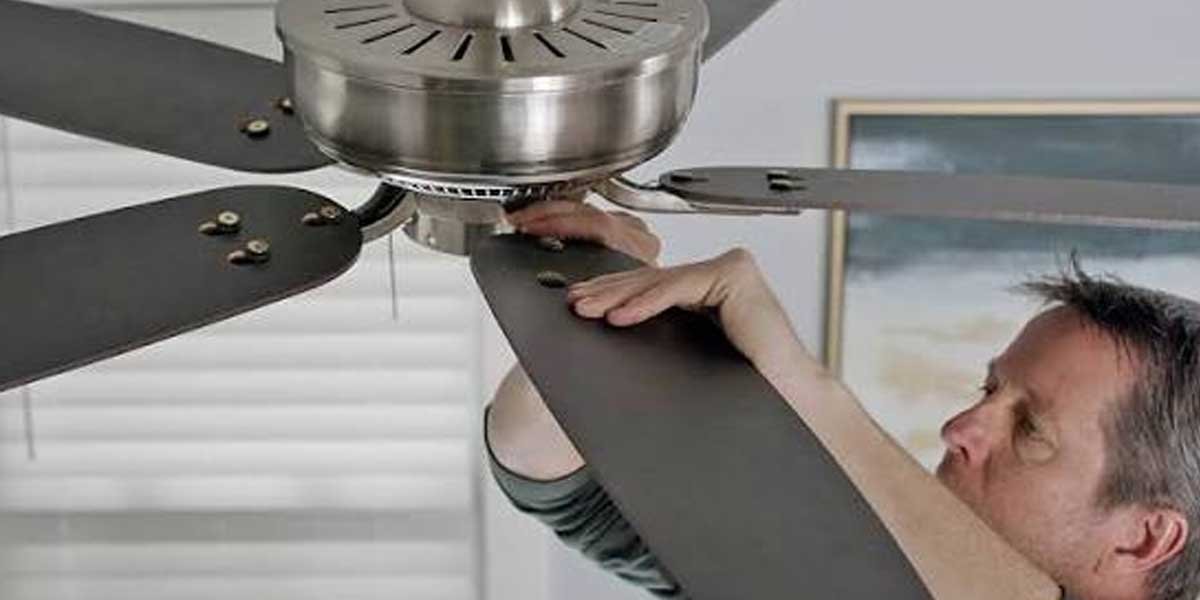

The signs your home needs ceiling fan installation are rooms that feel hot and stuffy, an air-conditioning bill that climbs higher than the heat should, a high ceiling or a windowless room that the cool air never reaches, and a bedroom or a living area that leans on a floor fan to make the afternoon bearable, because a ceiling fan lets you raise the thermostat about 4 degrees without giving up comfort, per the Energy Department’s guide to cooling, and an ENERGY STAR fan runs the airflow more efficiently. A fan’s value is that you can run the air conditioner less, so the rooms where you sit and sleep earn the fan, and a fan left on in an empty room saves nothing.
Below is where a fan pays, how it saves the money, the safe first check, and when the wiring calls for a licensed electrician.
Signs your home needs ceiling fan installation, and where it pays
Match each hot, stuffy, or wasteful room to a ceiling fan that pays, and sort the job into the swap you can do yourself and the wiring a licensed electrician should handle, because a fan earns its keep in the rooms where you actually sit and sleep. The table lines up the signal, the cause, the worth, and the starting point, explains the Keyrenter Silicon Valley team.
| Symptom | Likely cause | Worth it? | Starting point |
|---|---|---|---|
| AC bill climbs in the heat | Thermostat run low | Worth it | Fan lets you raise it (DIY) |
| A room stays hot and stuffy | Still air, no circulation | Worth it | Fan for the room (DIY) |
| High ceiling or windowless room | Cool air never reaches | Worth it | High-mounted fan (DIY/pro) |
| A floor fan does the work | No ceiling airflow | Worth it | Ceiling fan instead (DIY) |
| Need a new fan-rated box or wiring | No ceiling box or circuit | Check first | Licensed electrician |
| Old wiring or unsure capacity | Aged or overloaded system | Check first | Licensed electrician |
The table is the honest split. A room that stays hot, a bill that climbs, a high or windowless space, or a bedroom and a living area that lean on a floor fan are all worth a ceiling fan, and if the ceiling already has a fan-rated junction box with wiring, swapping in a fan is a job you can do yourself. A room with no ceiling box, no wiring, or a need for a new circuit, or an old, overloaded, or unsure system, is a licensed electrician’s call, since it touches the home’s wiring and the power. Before any upgrade, check what the ceiling has, and the how to install a ceiling fan guide walks the swap once you know the ceiling is ready.
How a ceiling fan saves you money
A ceiling fan saves money by letting you set the thermostat higher, not by cooling the room itself, since a fan moves air over your skin to make the space feel cooler, and the Energy Department notes you can raise the setting about 4 degrees. It pays only while the room is occupied, so switch it off when you leave.
The saving is real but specific. A ceiling fan does not cool a room; it makes you feel cooler by moving the air, which lets you raise the thermostat by roughly 4 degrees and run the air conditioner less, and an ENERGY STAR-rated fan moves that airflow with less energy. It pays for itself the most where you sit and sleep, the bedroom at night and the living area in the day, and it saves nothing if it runs in an empty room, so turn it off when you leave. The direction matters too, counterclockwise in summer to push the cool down and clockwise in winter to pull the warm up, and matching the fan to the season and the occupancy turns the thermostat savings into a real bill drop. That is why a high or windowless room that a fan can reach repays its install quickly.
The rooms that earn a fan most
Put the fan in the rooms where you actually sit and sleep, the bedroom, the living area, a high-ceiling or windowless space, and a room an older family member uses at night, because those are where the airflow makes you and the thermostat both comfortable. The room, not the whole house, is the honest unit.
The priority is by use. A bedroom earns its fan for the night, a living area for the afternoon and the evening, and a high-ceiling or windowless room, where the air conditioner’s cool never settles, repays a fan fast, since the fan pulls the airflow down to where you sit. An older family member who needs a gentle, steady draft at night, or a room with no window to let the heat out on its own, is worth a fan too, and a fan mounted high with the blade low enough to move the air reaches more of the room. You do not need one in every room, only in the ones you use and sit in, so start where the heat bothers you most and add as it pays.
A safe first check: what the ceiling has
Check the ceiling before you buy, to see whether a fan-rated electrical box is already there with wiring, which makes the swap a you-can-do job, and shut the breaker off and keep it off before any work near the wiring. A fan is only a DIY when the box and the circuit are ready for it.
The first check is safe. Look up at the ceiling to see whether a fan-rated junction box is mounted and whether a switch and a circuit feed it, and confirm the box is rated to hold a fan’s weight, since a light-fixture box can fall with a fan on it. If the box and the wiring are already there and rated, replacing a light or an old fan with a new fan is a job you can do yourself, and if there is no box, no wiring, or the box is not fan-rated, that is wiring work for a licensed electrician. Before touching anything near the wiring, shut the breaker off and keep it off, verify with a tester that the circuit is dead, and only then work, and when the ceiling needs a new box, a new circuit, or the panel opened, stop and call the electrician. The DIY part is the safe swap; the wiring part is the professional’s.
When to call a licensed electrician
Call a licensed electrician when the ceiling needs a new fan-rated box, new wiring, a new circuit, or any panel work, or when the home’s wiring is old, aluminum, or unsure, since a fan not mounted to a proper box is a safety risk. A fan is only a DIY when the rated box and the wiring are there.
The line is honest. Replacing a fan where a fan-rated box and a circuit already exist is safely yours, but installing a fan where there is no box, where the box is not fan-rated, where new wiring or a new circuit is needed, or where the panel must be opened is a licensed electrician’s job, since it touches the home’s power. Follow the basic placement, too, a fan blade low enough to reach the room but high enough not to strike, roughly 7 to 9 feet above the floor, and clear of the walls and the lights by at least a blade span, and an ENERGY STAR or a matched-height unit for a high ceiling. Shut the breaker and keep it off before any work near a box or the wiring, and treat any old, aluminum, or overloaded wiring as a reason to call the electrician before the fan. The wiring and the mount decide safety, so match the job to the box and the circuit you have.
Frequently asked questions
How do I tell if I can install a ceiling fan? You can install a ceiling fan yourself where a fan-rated junction box and a switch circuit already exist, and you should hire a licensed electrician where there is no box, no wiring, or the wiring is old or unsure. Check the box, the circuit, the capacity, and the breaker first.
Are ceiling fans outdated in 2026? No, a ceiling fan is still a useful, energy-stingy way to cool a room, since it lets you raise the thermostat and run the air conditioner less, and an ENERGY STAR-rated fan moves air with less energy. It earns its place in the rooms you use.
What are the rules for installing ceiling fans? Mount a fan on a fan-rated box, set the blade roughly 7 to 9 feet above the floor, and keep it clear of the walls and the fixtures by at least a blade span, and use a matched or an extended downrod on a high ceiling. The box must be rated to hold the fan’s weight.
How much should it cost to have someone install a ceiling fan? A ceiling fan installation can vary with the fan, the existing wiring, and the region, so a licensed electrician’s quote for your ceiling settles it, and replacing where a rated box exists usually costs less than adding new wiring. Match it to the job.
Does a ceiling fan save money in the winter too? Yes, run a ceiling fan clockwise in the winter at a low speed to pull the warm air down from the ceiling and even out the room, which can let you set the heat a little lower. Use the fan only when the room is occupied.
Let the room, the bill, and the ceiling box decide
Judge the signs your home needs ceiling fan installation by the room, the bill, and the ceiling box: a hot, stuffy room, a high or windowless space, or a bedroom and a living area that lean on a floor fan all earn a fan, and a fan lets you raise the thermostat so the air conditioner runs less, which is where the money comes back. A fan pays in the rooms you use, so start there and turn it off when you leave, and match the job to the ceiling, replacing where a fan-rated box and a circuit already exist and calling a licensed electrician where the box, the wiring, or the capacity is missing. The fan that moves the air you need and lets the budget breathe is the one worth installing.