

Core Types of Garage Storage Solutions Compared
A cluttered garage often becomes a source of frustration, turning a potentially functional space into a landing zone for random boxes and forgotten tools. Many homeowners struggle to find the right balance between keeping their gear accessible and maintaining enough floor space to actually park their vehicles. Whether you are dealing with seasonal sports equipment, heavy-duty power tools, or general household overflow, finding the right system is the first step toward reclaiming your garage. By comparing the best garage storage systems compared to your specific needs and layout, we can help you turn your garage into a clean, efficient workspace that truly works for your home.
[Up: Our Full Garage Storage Catalog] | [Down: Contact Our Professional Installation Team]
Our team at Door Serv Pro understands that every home has unique spatial challenges. In this guide, we break down the most popular storage solutions to help you identify which options provide the best durability, safety, and organization for your specific setup. Whether you are considering high-capacity overhead racks, modular wall-mounted tracks, or heavy-duty steel cabinets, we will walk you through the technical trade-offs you need to consider before making your investment. If you want to dive deeper into the specific brands we trust, you can explore our detailed insights on garage storage solutions to see how these systems perform in real-world conditions.
Ready to transform your garage into an organized, stress-free space? Contact our professional team today to discuss your project.
When evaluating the vast array of organization products, it helps to categorize them by how they utilize your garage’s footprint. Most effective setups rely on a combination of these types, but understanding their individual strengths is vital for long-term success.
System Type Best For Spatial Impact Durability Overhead Racks Seasonal/Bulky Items High (Ceiling-based) High Wall Tracks Daily-use Tools Medium (Wall-based) High Slatwall Systems Versatile/Custom setups Medium (Wall-based) Moderate Modular Cabinets Secure/Hazardous items Low (Floor-based) Very High Freestanding Shelving Heavy-duty bulk storage Low (Floor-based) High These garage storage solutions offer varying levels of flexibility. While overhead racks are unbeatable for reclaiming floor space, modular cabinets provide the security and aesthetic finish that turn a workshop into a professional-grade environment.
Overhead and Ceiling-Mounted Garage Storage Solutions
Overhead storage is the ultimate “space-maker” in a garage. By utilizing the vertical space above your garage door tracks, you can store items you only need once or twice a year—such as holiday decor, camping gear, or off-season sports equipment.
The success of these systems hinges entirely on structural integrity. You must mount these units directly into your ceiling joists. Before purchasing, verify your joist spacing (typically 16 or 24 inches on center) and ensure your ceiling height allows for the desired drop clearance. You should also ensure that ceiling racks never interfere with the travel path of your overhead garage door opener, torsion spring assemblies, or emergency release cords. Always maintain a safety margin; even if a rack is rated for 600 pounds, loading it to 80% of its capacity is a standard best practice to account for dynamic weight shifts and long-term structural settling. Heavy-gauge steel wire decking with integrated safety lip brackets prevents storage bins from shifting during loading and unloading.
Wall-Mounted Rails, Slatwalls, and Metal Pegboards
Wall systems are the workhorses of the garage. They keep your most frequently used items—shovels, rakes, wrenches, and power tools—at eye level and ready for action.
Track-based systems and slatwalls are superior to traditional fiberboard pegboards because they are made from high-density materials like steel, aluminum, or heavy-duty cellular PVC. Extruded aluminum and cellular PVC panels resist moisture, rot, and mold, making them ideal for unconditioned garages where humidity fluctuates throughout the seasons. These systems allow you to slide hooks, magnetic tool strips, wire baskets, and specialty tool holders along continuous horizontal channels, giving you the freedom to reorganize as your tool collection grows. When installing these, precision is key. Using a laser level and finding the center of your wall studs is non-negotiable. If you are mounting heavy power stations, ladders, or multi-tool battery chargers, ensure the track is anchored into every available stud with heavy-duty structural fasteners to distribute the load evenly across the entire wall framing.
Modular Cabinets and Heavy-Duty Freestanding Shelving
When you need to store chemicals, sharp objects, expensive power tools, or automotive fluids, nothing beats a locking cabinet system. Look for steel gauge ratings—lower numbers (like 18-gauge or 16-gauge) indicate thicker, more durable steel than higher numbers (like 24-gauge).
Fully welded cabinet bodies provide significantly more rigidity and load-bearing strength than flat-packed, bolt-together alternatives that can flex under heavy tool sets. If your garage floor has a standard drainage slope or minor surface irregularities, prioritize systems with heavy-duty adjustable leveling feet or wall-hung mounting brackets that elevate the cabinet base above standing water. This elevation protects your storage investment from floor washdowns, winter slush, and road salt runoff. For heavy-duty freestanding shelving, choose units with rolled-edge industrial steel posts, welded wire or solid steel decking, and diagonal cross-bracing to eliminate lateral swaying under massive loads.
Key Technical Criteria for Evaluating Storage Systems
When selecting components for your garage, you are essentially outfitting a space that faces harsh environmental stressors. Unlike an indoor closet, your garage is subject to extreme temperature swings, high humidity, exhaust fumes, and seasonal moisture brought in by wet or snow-covered vehicles.
Sizing and Customizing Modular Garage Storage Solutions
Before you commit to a specific cabinet run or shelving layout, measure your space thoroughly. Consider not just the static floor dimensions, but the full dynamic operational footprint of your garage. Does the cabinet door swing or drawer extension collide with your vehicle door when parked inside? Will deep shelving units restrict walking pathways or block mandatory access clearances around your electrical breaker panel, GFI outlets, water heater, furnace, or attic pull-down stairs? Most building safety codes mandate at least 36 inches of unobstructed clearance in front of main electrical panels.
Modularity is your greatest asset over time. A modular system that allows you to add an overhead bridge cabinet, incorporate an integrated butcher block workbench, or swap standard shelving for full-extension ball-bearing drawers provides enduring utility as your storage demands evolve. If you plan to expand your organization setup gradually, select reputable manufacturers that offer consistent dimensions, colorways, and mounting hardware across their broader product lines.
Safety, Wall Anchoring, and Installation Feasibility
The most common and hazardous mistake in DIY garage organization is relying on hollow-wall drywall anchors for high-load installations. Standard drywall is not a structural material; it quickly crumbles under the shear weight of a loaded tool cabinet or overhead rack.
Always fasten structural wall tracks and overhead brackets directly into solid wood framing using heavy-duty lag bolts or exterior-grade structural timber screws with a minimum embedment depth of two to three inches into the center of the stud. If your garage walls consist of poured concrete, cinder block, or masonry, use dedicated mechanical masonry anchors, such as heavy-duty wedge anchors or sleeve anchors, installed with a hammer drill and torqued to manufacturer specifications. If you are uncertain about joist load limits, electrical wire routing behind drywall, or proper anchor torque ratings, hiring professional installers ensures complete structural safety for your vehicles, home, and family.
Strategic Planning: The Three-Zone Garage Layout
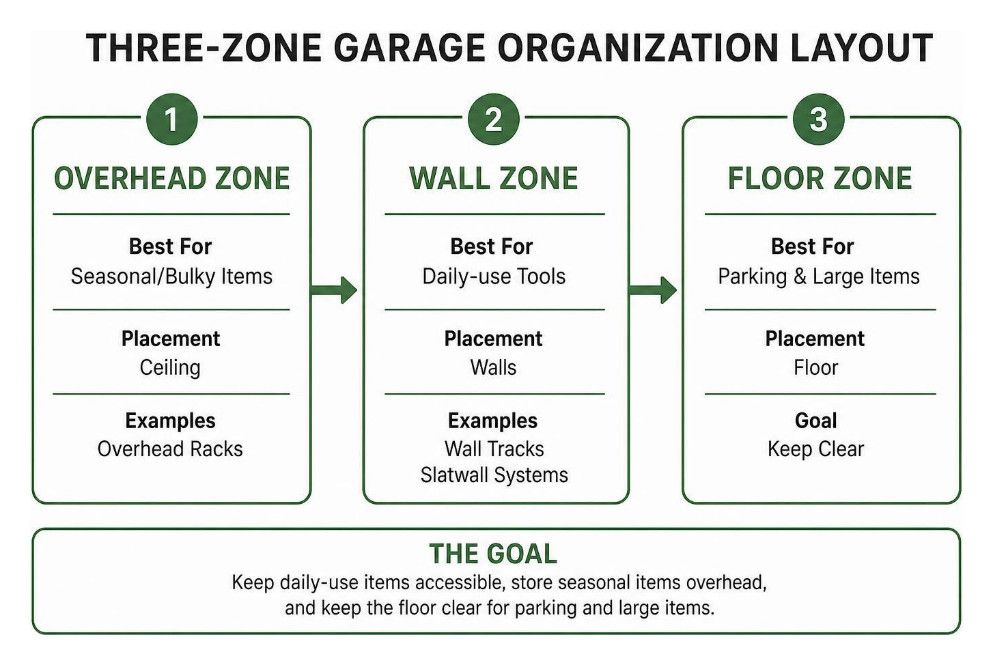
To maintain a clean and sustainable garage, you need a disciplined layout plan that categorizes items by access frequency and safety requirements. We recommend the “Three-Zone” organization approach:
The Daily Zone: Items you use weekly (gardening tools, daily hand tools, extension cords, brooms, and routine cleaning supplies) belong on wall-mounted track rails, slatwalls, or open intermediate shelving at waist-to-eye level (roughly 30 to 60 inches above the floor). Keeping these items visible and unobstructed makes retrieving and returning them effortless.
The Secure Zone: Items that present safety hazards or carry high monetary value (automotive fluids, lawn chemicals, sharp blades, expensive diagnostic equipment, and cordless power tool kits) belong inside locked, floor-based or securely wall-mounted steel cabinets. This keeps toxic materials away from children and pets while protecting valuable tools from unauthorized access and dust.
The Seasonal Zone: Items you touch only once or twice a year (holiday decoration bins, camping tents, seasonal sporting gear, patio cushions, and luggage) should be stored in high overhead ceiling racks or on the highest cabinet shelves.
By keeping floor perimeters clear and establishing dedicated vertical storage zones, you maximize usable square footage, streamline vehicle parking, and make routine sweeping and pressure washing quick and simple.
Frequently Asked Questions About Garage Organization
How much weight can typical garage ceiling racks and wall systems hold?
Most high-quality overhead garage storage racks are engineered and rated to hold between 500 and 750 pounds of static weight when distributed evenly across the platform. However, the ultimate limiting factor is not the steel rack itself, but the structural load capacity of your home’s ceiling joists or roof trusses. If you plan to store heavy gear, distribute the weight across multiple joists and avoid concentrating heavy items in a single corner. For wall tracks and slatwall panels, weight capacities are typically rated per linear foot or per square foot. Commercial-grade wall tracks can hold 75 to 100 pounds per linear foot when properly anchored into solid wood studs at standard 16-inch intervals.
What is the most durable material for non-climate-controlled garages?
Heavy-gauge powder-coated steel is widely regarded as the gold standard for garage storage. The electrostatic powder-coating process creates a thick, resilient, baked-on barrier that outperforms conventional liquid paint in resisting abrasion, chipping, rust, automotive chemical spills, and oxidation. For wall paneling, heavy-duty cellular PVC and anodized aluminum offer exceptional longevity because they are impervious to water damage, mold, and rot. In non-climate-controlled spaces with substantial humidity swings, avoid untreated raw wood, particleboard, and thin unpainted sheet metal, as these materials tend to warp, sag, or corrode over time.
How do you prevent garage storage systems from damaging walls or ceilings?
Preventing structural and cosmetic damage requires precise installation and vibration isolation. Always use anti-tip wall brackets anchored into solid studs for tall freestanding shelving and cabinet towers; this prevents forward tipping and eliminates drywall scuffing. When installing continuous wall tracks or heavy backer boards, placing a thin closed-cell foam or rubber gasket strip behind the metal plate acts as a protective buffer, absorbing vibrations from garage doors and dampening acoustic transfer into adjacent living spaces. Pre-drilling pilot holes into studs also prevents wood splitting during lag bolt fastening.
Conclusion
Reclaiming your garage is a high-value home improvement project that pays lasting dividends in daily convenience, safety, and property appeal. By investing in the right garage storage solutions and implementing a functional Three-Zone organization layout, you can permanently eliminate the clutter that crowds out your vehicles and work area. Whether you begin with a targeted wall track installation for garden tools or complete a comprehensive garage makeover featuring welded steel cabinetry and high-capacity ceiling racks, prioritizing durable materials and proper structural anchoring is essential for lasting performance. With the right strategy and equipment, you can transform your garage into an organized, efficient workspace tailored perfectly to your lifestyle.