
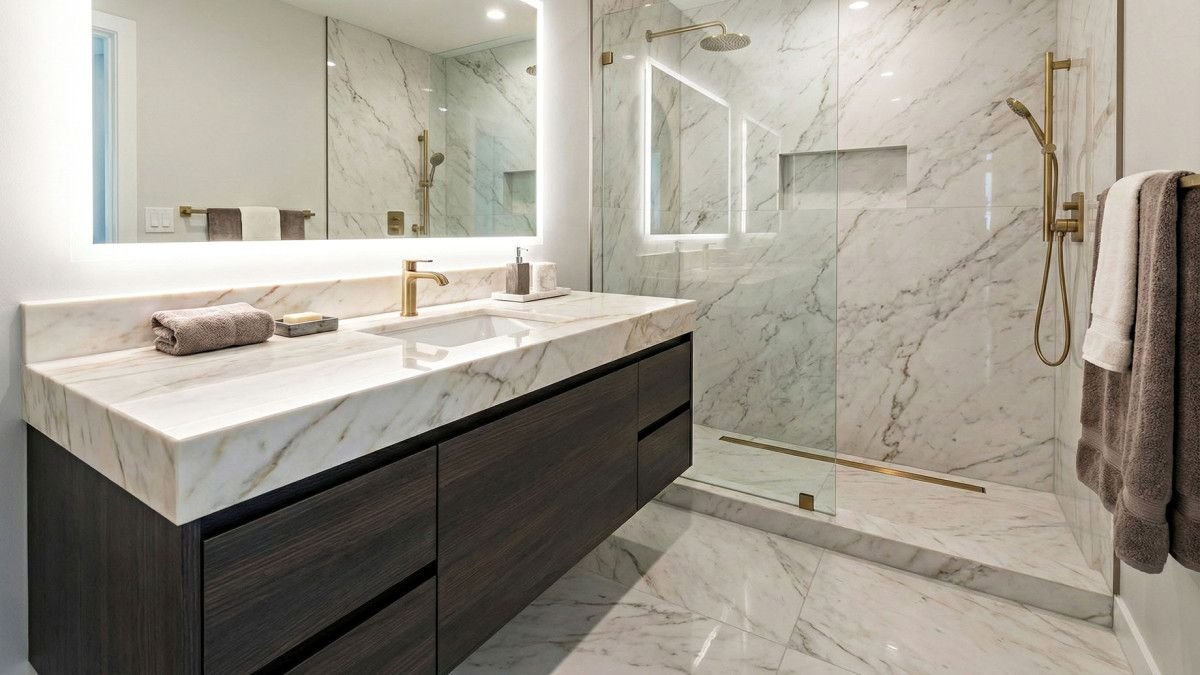

This guide covers waterproof and durable bathroom remodel options — from tile membranes to glass enclosures. The most waterproof and durable bathroom remodel option is a full porcelain tile installation — floor-to-ceiling large-format porcelain tile on the walls, porcelain tile on the floor, and a waterproof sheet membrane or liquid-applied membrane behind every tile surface in the shower and on the bathroom floor, notes Yourway Properties.
A bathroom is the wettest room in the house. Water pours from the shower head. Water splashes from the sink. Water condenses on the walls and the ceiling. Water stands on the floor. Every surface in the bathroom is exposed to water daily for decades. The surfaces that are not waterproof will fail. The drywall that gets wet will mold. The wood vanity that absorbs humidity will swell and crack. The laminate floor that gets wet will delaminate. The bathroom remodel that prioritizes appearance over durability is a bathroom that will be remodeled again in 10 to 15 years, sometimes less. The bathroom remodel that prioritizes waterproofing and durability will last 30 to 50 years. The difference is the materials. The materials are the choice. Here are the waterproof and durable options for every surface in the bathroom.
Porcelain Tile Walls with a Waterproofing Membrane, the Gold Standard
The most waterproof and durable wall system for a bathroom is a waterproofing membrane, a sheet membrane such as Schluter Kerdi or a liquid-applied membrane, installed over cement backer board or waterproof foam board, with large-format porcelain tile set on top. The membrane is a continuous, waterproof barrier that seals every seam, every corner, and every penetration. The membrane is the waterproofing. The tile is the surface. The tile protects the membrane from abrasion and UV damage. The membrane protects the wall framing from water. The tile and membrane together are a system. The system is the shower. The system is the bathroom walls. The system will not leak.
A sheet membrane system, Schluter Kerdi or similar, costs $3 to $6 per square foot in materials and is the most reliable waterproofing method. The membrane is a continuous sheet of polyethylene with a fleece backing that bonds to thinset. The seams are sealed with waterproof tape or overlapping membrane strips. The corners are reinforced with pre-formed corner pieces. The penetration around the shower valve and the shower arm are sealed with pre-formed gaskets. The sheet membrane is the premium waterproofing method. The premium is the reliability. The reliability is the system. The system is the membrane, the tape, the corners, and the gaskets. The system is designed to be installed by a professional tile setter who has been trained on the specific product. The training is the quality. The quality is the installation. The installation is the waterproofing. The waterproofing is the durability.
The National Association of Home Builders (NAHB) identifies bathroom waterproofing as a critical element of bathroom construction. Water damage from improperly waterproofed showers is one of the most common and most expensive bathroom failures. The waterproofing is invisible when it works. The waterproofing is very visible when it fails, the water stain on the ceiling below the bathroom is the evidence. The evidence arrives years after the mistake. The mistake was skipping the membrane or improperly sealing the seams. The membrane is the prevention. The prevention costs $500 to $1,500 in materials and labor. The prevention is the cheapest part of the shower. The prevention is the most important part.
Waterproof Bathroom Flooring Options
| Material | Waterproof Rating | Cost Per Sq Ft (Installed) | Durability | Best For |
| Porcelain tile | Excellent, fully waterproof | $10 – $25 | 50+ years | Best overall choice; grout must be sealed |
| Ceramic tile | Excellent, fully waterproof | $8 – $20 | 30 – 50 years | Budget alternative to porcelain; slightly more porous |
| Luxury vinyl plank (LVP) | Excellent, fully waterproof | $5 – $10 | 15 – 25 years | Warm underfoot; best budget waterproof option |
| Sheet vinyl | Excellent, seamless waterproof | $3 – $8 | 10 – 20 years | Budget option; no seams for water to penetrate |
| Natural stone (properly sealed) | Good, requires annual sealing | $15 – $40 | 50+ years if maintained | Premium aesthetic; requires maintenance commitment |
Water-Resistant and Durable Vanity Options
A bathroom vanity made of solid wood or plywood with a waterproof finish, a catalyzed lacquer or a polyurethane topcoat, will resist the humidity of a bathroom for 20 to 30 years. A vanity made of particleboard with a thermofoil wrap will absorb moisture through the seams, the screw holes, and the back panel, and will swell and crumble within 10 to 15 years. The material is the durability. The plywood vanity costs $100 to $300 more than the particleboard vanity. The plywood vanity survives the humidity. The particleboard vanity is destroyed by it. The plywood is the upgrade. The upgrade is the durability. The durability is the 20 years of additional service. The additional service is the return on the $200 premium.
A wall-mounted floating vanity, hung on the wall with the floor exposed underneath, eliminates the toe kick as a water entry point. The floor is visible. The floor is sweepable. The floor is moppable. The water that splashes on the floor does not pool around the base of the vanity because there is no base. The floating vanity is the most practical vanity for a bathroom that gets wet. The floating vanity costs $200 to $500 more than a floor-mounted vanity, the cost of the wall blocking and the mounting hardware. The floating vanity is the premium. The premium is the practicality. The practicality is the exposed floor. The exposed floor is the ease of cleaning. The ease of cleaning is the durability of the floor and the vanity. The durability is the return.
Glass Shower Enclosures, Durable and Easier to Maintain Than Curtains
A frameless glass shower enclosure, a single panel of 3/8-inch or 1/2-inch tempered glass, eliminates the shower curtain and the curtain rod as failure points. The glass panel is supported by wall-mounted hinges or a header at the ceiling. The glass has no frame. The absence of a frame eliminates the channels where water, soap scum, and mold accumulate. The frameless glass is easier to clean than a framed enclosure or a shower curtain. The glass is treated with a hydrophobic coating, applied at the factory or after installation, that causes water to bead up and roll off. The coating reduces cleaning frequency by 50% to 70%. The frameless glass enclosure costs $800 to $2,500 installed. The shower curtain costs $20. The frameless glass is the premium. The premium is the durability and the ease of cleaning. The curtain is the budget. The budget is the frequent replacement, every 1 to 2 years, and the mold that accumulates at the hem and on the liner. The glass is permanent. The curtain is temporary. The glass is the durable choice.
Frequently Asked Questions
What is the most waterproof and durable wall material for a bathroom?
Large-format porcelain tile installed over a waterproofing membrane, a sheet membrane or a liquid-applied membrane over cement backer board, is the most waterproof and durable bathroom wall system. The membrane is the waterproof barrier. The tile is the surface. The combination will not leak, will not mold, and will last 50 years or more with proper installation. The grout must be sealed annually.
Is luxury vinyl plank waterproof enough for a bathroom floor?
Yes, luxury vinyl plank with a WPC or SPC core is fully waterproof and suitable for a bathroom floor. The planks interlock and the seams resist water penetration, but standing water should be wiped up, not left to seep into the seams. LVP is warmer underfoot than tile, costs $5 to $10 per square foot installed, and lasts 15 to 25 years. Tile is more durable. LVP is warmer and less expensive. Both are waterproof.
Can I use regular drywall in a bathroom, or do I need moisture-resistant drywall?
Moisture-resistant drywall, green board or purple board, is the minimum for bathroom walls outside the shower. The moisture-resistant drywall is not waterproof, it resists moisture better than standard drywall but will still be damaged by direct water contact. Inside the shower and on the ceiling above the shower, cement backer board or waterproof foam board with a waterproofing membrane is required. Never use standard drywall or moisture-resistant drywall inside a shower.
What vanity material is best for a humid bathroom without a ventilation fan?
Plywood with a catalyzed lacquer or polyurethane finish is the best vanity material for a humid bathroom. Plywood resists moisture better than particleboard and does not swell or crumble when exposed to humidity. A floating vanity eliminates the toe kick contact with the floor, reducing moisture exposure. If the bathroom has no ventilation fan, install one, the fan is the most important moisture-control device in the bathroom. The fan costs $200 to $500 installed and prevents the humidity that damages every surface in the room.
How do I waterproof a bathroom floor in a remodel?
Install a waterproofing membrane, a sheet membrane or a liquid-applied membrane, under the tile on the bathroom floor. The membrane extends up the walls by 2 to 3 inches, creating a waterproof tray at the base of the room. The membrane catches any water that penetrates the tile and the grout and prevents it from reaching the subfloor. This is the same waterproofing method used in a shower pan, applied to the entire bathroom floor. The material costs $2 to $5 per square foot. The waterproofing is the insurance against the splashed water, the overflowed toilet, and the wet feet on the floor. The insurance costs $500 for a typical bathroom. The water damage to the ceiling below costs $3,000 to $8,000. The insurance is cheaper.
How long should a well-built bathroom remodel last?
A bathroom remodel built with porcelain tile, a waterproofing membrane, a plywood vanity, and a frameless glass enclosure should last 30 to 50 years with proper maintenance, annual grout sealing and prompt repair of any cracked grout or caulk. The tile and the membrane are permanent. The vanity may need refinishing at year 15 to 20. The glass enclosure is permanent unless broken. The plumbing fixtures, faucet, shower valve, toilet, will need replacement at year 15 to 25. The structure of the bathroom outlasts the fixtures. The fixtures are replaceable. The waterproofing is not, without demolition. Build the waterproofing to last. The fixtures can be changed. The waterproofing cannot.
The Bathroom That Stays Dry
Porcelain tile on the walls and the floor. A waterproofing membrane behind every tile surface, sheet membrane in the shower, liquid membrane on the bathroom floor extending 3 inches up the walls. A plywood vanity with a catalyzed lacquer finish, hung on the wall. A frameless glass shower enclosure treated with a hydrophobic coating. These four decisions cost $2,000 to $5,000 more than the budget alternatives, painted drywall, a particleboard vanity, a shower curtain, and a vinyl floor without a membrane. The premium is the waterproofing. The premium is the durability. The premium is the bathroom that will not leak, will not mold, will not rot, and will not need to be remodeled again for 30 to 50 years.
The budget bathroom costs $8,000 to $15,000 and lasts 10 to 15 years. The waterproof bathroom costs $12,000 to $20,000 and lasts 30 to 50 years. The per-year cost of the budget bathroom is $800 to $1,500. The per-year cost of the waterproof bathroom is $400 to $670. The waterproof bathroom costs more upfront. The waterproof bathroom costs less per year. The per-year math favors the waterproof materials. The per-year math is the financial argument for the upgrade. The practical argument is the ceiling below the bathroom. The ceiling that stays white is the proof. The proof is the membrane behind the tile. The membrane is invisible. The white ceiling is visible every day. The white ceiling is the evidence that the bathroom was built correctly. The correct bathroom is the waterproof bathroom. The waterproof bathroom is the durable bathroom. The durable bathroom is the one that was built once. The one that was built once is the one that costs less per year. The one that costs less per year is the financially correct decision. The financially correct decision is the waterproof and durable remodel. The remodel is the tile, the membrane, the plywood vanity, and the glass enclosure. The remodel is the bathroom that stays dry. The dry bathroom is the goal. Ever walked into a bathroom that was remodeled five years ago and noticed the grout cracking at the corners of the shower, the baseboard swelling at the floor, and the vanity doors that no longer closed squarely — the evidence of a remodel built with budget materials that were never intended to last? The bathroom was beautiful on the day it was finished. The bathroom was failing five years later. The failure was the materials. The materials were the budget. The budget was chosen over durability. The waterproofing membrane was skipped. The plywood vanity was downgraded to particleboard. The choices were the failure. The failure is the second remodel. The second remodel costs the same as the first. The first remodel could have been the only remodel. The only remodel is the waterproof and durable remodel. The waterproof and durable remodel is the one that costs less per year. The per-year cost is the math. The math is the membrane. The membrane is the difference. The goal is achieved with the waterproof materials. The materials are the choice. The choice is the premium. The premium is the per-year savings. The savings are the return. The return is the bathroom that is remodeled once.