Bituminous Membrane Waterproofing: Types, Features, and Installation

Bituminous membrane waterproofings are water-dissolved, sticky, higher temperature sensitive, and have a higher viscosity and higher deform at room temperature, black colored, liquid, or semi-solid forms of petroleum that are used to prevent water leaking from basements, foundations, bathrooms, balconies, rooftops, slabs, and construction surfaces.
Bituminous waterproofing membrane thickness varies from 1.5mm to 5mm. Bituminous waterproofing membranes can last 10 to 15 years. It is not a breathable membrane. But it is a flexible, chemical-resistant, UV-resistant, cost-effective, and easy-to-maintain waterproofing solution for construction. Due to the material properties, it has a wider range of advantages.
Bituminous waterproofing membranes are mainly of two types such as sheet membranes and liquid membranes. Modified bituminous sheet membranes are more adhesive and have lower thermal sensitivity than pure bitumens. Bituminous waterproofing membranes should be applied on the dry, clean, free-of-dust, fuel, oil, and debris surface areas that do not exceed the service life temperature of 75.3 °C.
The surface should be repaired and fixed for cracks, holes, surface defects, and loose materials on the surface before applying the bituminous waterproofing. Then clean the surface and keep the surface dry, free of dust, debris, or contaminants before applying the bituminous sheet waterproofing membranes. The sheet membrane should be installed on the surface by heating using a gas torch, and the liquid membrane can be spread on the surface using a brush.
The bituminous waterproofing layer can be damaged during laying, during the construction period, and after the construction period. The most popular bituminous waterproofing products are Sika, DOLPHIN Bituminous Waterproofing, MAPEI, and Duram Durabit Bituminous Waterproofing.
You can use PVC waterproofing, HDPE, and EPDM instead of the bituminous waterproofing membranes. When you use PVC, you will need a heat gun instead of a gas torch. You can use HDPE for both indoor and outdoor purposes instead of bituminous waterproofing

What is Bituminous Waterproofing Membrane?
Bituminous waterproofing membrane is a water-dissolved, sticky, higher temperature-sensitive, and has a higher viscosity and higher deformability at room temperature, black-colored, liquid, or semi-solid forms of petroleum that are used to prevent water leaking from basements, foundations, bathrooms, balconies, rooftops, slabs, and construction surfaces.
Bituminous membranes are available in three forms such as SBS polymers, APP-modified membranes, self-adhesive membranes, and torch membranes. Bituminous waterproofing is mainly of two types according to their usage.
What are the 2 Types of Bituminous Waterproofing Membranes?
Bituminous waterproofing membranes are mainly of two types such as liquid waterproofing membrane and sheet waterproofing membrane.
- Sheet Bituminous Waterproofing Membranes: Sheet bituminous waterproofing membranes have a bituminous layer on the synthetic fabric layer (polymer). The bituminous layer should be heated until it melts using a gas torch before laying on the surface. The melted bituminous layers will adhere to the surface and prevent the water from leaking. These sheet membranes are used on basements, foundations, below-ground structures, and roofs.
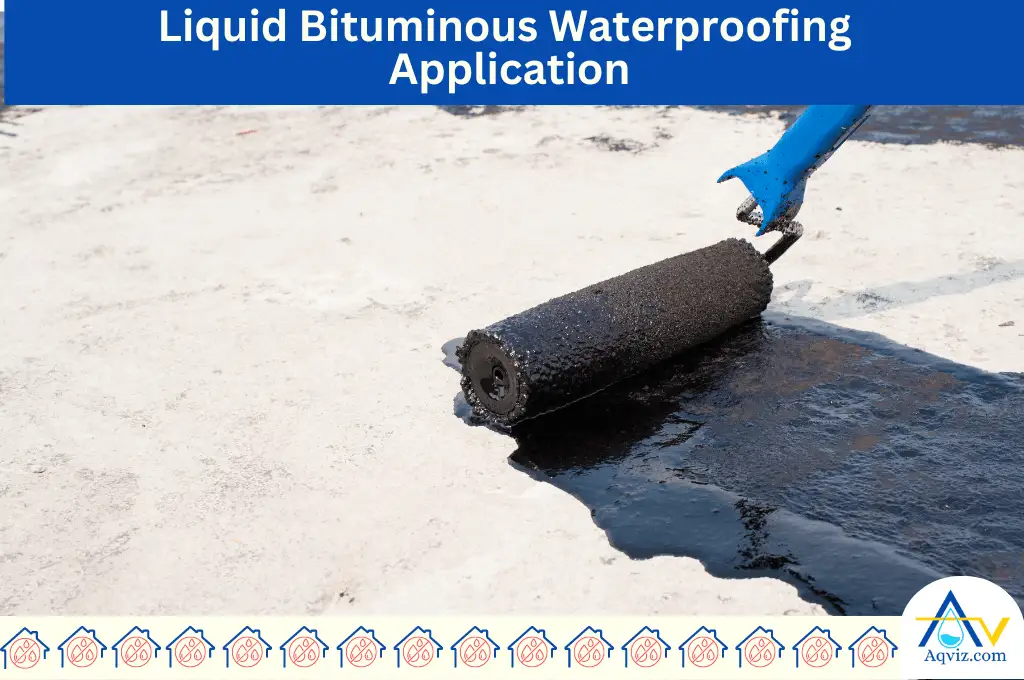
- Liquid Bituminous Waterproofing Membranes: Liquid bituminous waterproofing membranes are less viscous and semisolid liquids that can be applied on the waterproofing surface using a brush. Liquid membranes can be used on uneven surfaces, vertical surfaces, angled surfaces, and below-ground applications in construction structures.

What are the Features of Bituminous Waterproofing Membranes?
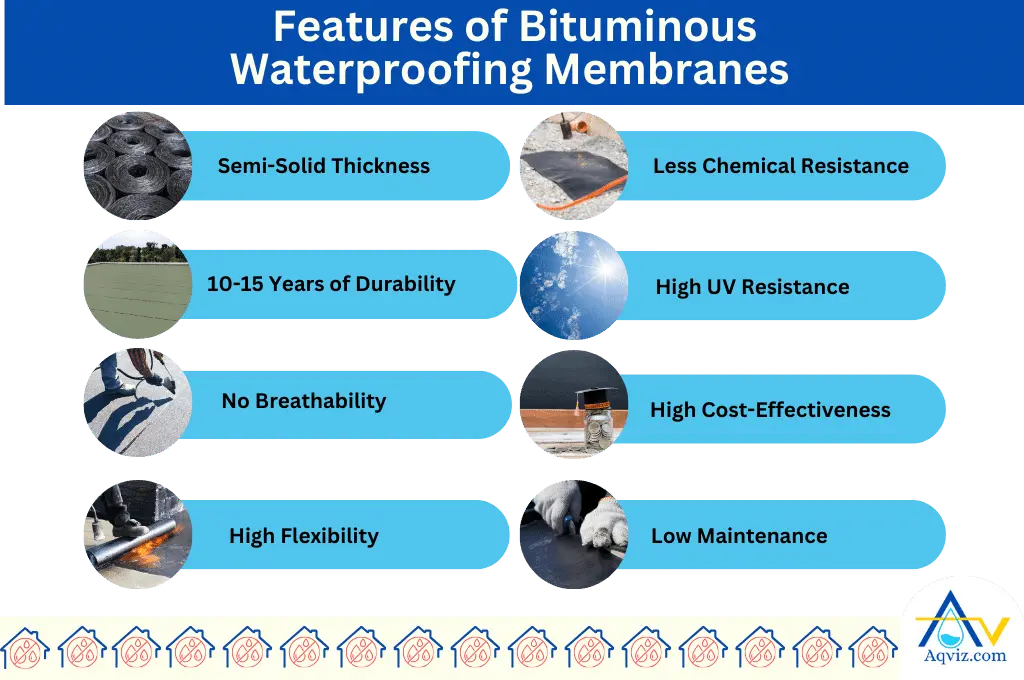
The features of bituminous waterproofing membranes are semi-solid thickness, 10-15 years of durability, no breathability, high flexibility, less chemical resistance, high UV resistance, high cost-effectiveness, and low maintenance. Each of these features has specific values and ranges. Before you use a bituminous waterproofing membrane, you should know these features.
Thickness of bituminous waterproofing membranes
The thickness of the bituminous waterproofing membranes varied with the types of membranes. There are 4 main types of bituminous waterproofing membranes with different thicknesses.
- Single-ply membrane: Thickness 1.5mm – 2.5mm
- APP modified membrane: Thickness 3mm – 5mm
- SBS modified membrane: Thickness 3mm – 5mm
- Self-adhesive membrane: Thickness 1.3mm – 3mm
Durability of a bituminous waterproofing membrane
The durability of bituminous waterproofing membrane is between 10 to 15 years. But it can be varied with the maintenance, environmental conditions, installation quality, types of membrane, and traffic generation
Breathability of bituminous waterproofing membrane
Bituminous waterproofing membranes are not breathable. These membranes are designed to create a water-tight barrier and prevent the passage of water, moisture, and air.
Flexibility of bituminous waterproofing membrane
Bituminous waterproofing membranes are highly flexible waterproofing materials. Both bituminous liquid membranes and sheet membranes are flexible. The membrane flexibility increases with the temperature. Hence, bituminous waterproofing membranes can be used on temperature fluctuation applications, movable, and vibrated structure waterproofings.
Chemical resistance of bituminous waterproofing membrane
Bituminous waterproofing membranes are considered chemical-resistant materials because bituminous waterproofing membranes do not react with alkynes, acids, water, or chemical additives.
UV resistance of bituminous waterproofing membrane
Bituminous waterproofing membranes are able to resist UV light. Hence bituminous waterproofing layer does not deteriorate with the UV light. Therefore, this membrane can be used for outdoor purposes.
Cost-effectiveness of bituminous waterproofing membrane
Bituminous waterproofing membrane is a cost-effective waterproofing membrane because it has a lower initial cost, lower installation cost, higher durability and lifespan, lower maintenance cost, a wide range of use, and can withstand any climate.
Maintenance capability of bituminous waterproofing membrane
Bituminous waterproofing membrane is easy to maintain compared to other types of waterproofing methods, and it can be repaired easily.
What are the Advantages of Bituminous Waterproofing Membranes?
Bituminous waterproofing membranes are mostly used for construction waterproofing because they have these important advantages.
- Effective waterproofing
- Higher flexibility
- Higher durability
- Wide range of usage
- Easy to install
- Higher compatibility
- Resistant to UV
- Resistant to Fire
- Cost-effective membrane
What are the Applications of Bituminous Waterproofing Membranes?
Bituminous waterproofing membranes should be applied on the dry, clean, free-of-dust, fuel, oil, and debris surface areas that do not exceed the service life temperature of 75.3 °C.
Liquid waterproofing membranes are used in lower water-effect areas, while sheet membranes are used in higher water-effect areas. Both of these bituminous liquids and sheet membranes can be used for the following usages.
Usage of Bituminous Waterproofing Membranes
- Foundation Waterproofing
- Basement waterproofing
- Exterior walls (retaining walls)
- Below-ground waterproofing
- Bathroom waterproofing
- Roof waterproofing
- Balcony and Terrace waterproofing
- Planter boxes and pond waterproofing
- Tunnel and subway waterproofing
- Bridge deck waterproofing
- Expansion joints waterproofing
- Pavement and roadways
- Subgrade and slab protections
Bituminous waterproofing is mostly used for concrete slab and roof waterproofing. It is used to cover a wide range of areas where the substrate is moving or exposed to sunlight.
How to Apply Bituminous Waterproofing Membranes?
Bituminous waterproofing membranes can be applied in separate ways according to their types. The two types of bituminous waterproofing membranes are liquid and sheet membranes. Each of these membranes should be applied as below.
How to Apply Sheet Bituminous Membrane?

10 Steps to apply bituminous waterproofing membranes.
- Prepare the surface by repairing and fixing cracks, holes, surface defects, and loose materials on the surface.
- Clean the surface and keep the surface dry, free of dust, debris or contaminants before applying the bituminous sheet waterproofing membranes.
- Roll out the sheet membrane on the surface and cut it to the required length.
- Start to install the sheet membrane at the lowest point or edge of the surface to allow water to flow away from the structure.
- Apply the recommended adhesive material with the sheet membrane among bitumen-based adhesive, cold adhesive, or hot asphalt.
- Place the sheet membrane properly without any wrinkles or bubbles on the surface.
- Maintain side lap and overlap distances as below.
- Side lap distance – 3”
- Overlap distance – 6”
- Seal the edges using a foot, roller or spectacular between two layers.
- When you use a roller, it should be close, not less than 3 feet, and it should not be more than 4 feet distance.
- Maintain the temperature – Do not use too much heat or too little heat, which can affect the adhesiveness of the waterproofing layer. If you use higher heat, heavy smoke can rise, and the temperature will not adhere to the other layers.
- Fix the non-adherent edges on the sheet using a gas torch
What is the temperature of the sheet bituminous waterproofing membrane?
The temperature of the sheet bituminous waterproofing membranes is between 54°C (130°F) – 65°C (150°F). A high-heated bituminous sheet can smoke during laying, and one heated below that level will not adhere to the other layers. Hence bituminous membrane should be heated properly as it can adhere to another layer.
How to Apply Liquid Bituminous Membrane?
- Prepare the surface by repairing and fixing cracks, holes, surface defects, and loose materials on the surface.
- Clean the surface and keep the surface dry, free of dust, debris or contaminants before applying the bituminous sheet waterproofing membranes.
- Mix the coating according to the manufacturer’s instruction guide or method statement of the product.
- Start applying the coating on the lowest point on the edge of the surface to allow the water to flow away from the structure.
- You can use a brush, roller, trowel or spray. The applied layer should be spread all over the surface.
- Let the coating dry as per the manufacturer’s guidelines.
- Check with water before further construction on the surface.
What is Modified Bituminous Sheet Waterproofing?
Modified bituminous sheet waterproofing is a waterproofing membrane with a bituminous sheet as a core section and reinforced with fiberglass, polyester, or a combination of both to provide strength and stability to the membrane. These sheets are highly effective at preventing water infiltration and provide a durable waterproofing barrier. Modified bitumens are more adhesive and have lower thermal sensitivity than pure bitumens. Hence, it can be used under minimum temperature than pure bitumens.
There are 3 main polymer modifications: Atactic Polypropylene (APP), Styrene-Butadiene-Styrene (SBS), Styrene Ethylene Butadiene Styrene (SEBS). Modified bituminous sheet waterproofing has a granules reflective coating or smooth finishes. The surface should be chosen according to the further construction and environmental effects.
What are the Best bituminous waterproofing Products?
Sika: Sika bituminous waterproofing products are available under the SikaShield® brand. These products are based on different temperatures and weather conditions, such as wind, snow and hail.
- SikaShield® P – Suitable for hot climates. It has excellent heat resistance and can be used on wide range of hardness.
- SikaShield® E – Suitable for cold climates. It has higher flexibility at low temperatures with excellent elastic recovery.
- SikaShield® HB – SikaShield® HB is a hybrid membrane. Its top layer is excellent heat resistance, while the bottom layer provides flexibility in cold conditions.
DOLPHIN Bituminous Waterproofing: DOLPHIN Bituminous Waterproofing is a high-performance, cold-applied single-component waterproofing coating. DOLPHIN Bituminous Waterproofing is available in various packaging sizes, including 5kg, 10kg, 25kg buckets, and 200L drums. It is suitable for waterproofing and protecting wet areas, kitchens, substructures, walls, floors, shaded or tiled roofs, polyurethane foam slabs, polyester built-up roofs, and for maintaining existing roofs, masonry, and concrete walls
MAPEI: MAPEI is a solvent-free, quick-drying, low-shrinkage, and highly flexible bitumen waterproofing emulsion. According to their usage, contains, and application method there are 6 products.
- PLASTIMUL 1K SUPER PLUS:
- PLASTIMUL 2K PLUS
- PLASTIMUL 2K REACTIVE
- PLASTIMUL 2K SUPER
- PLASTIMUL C
- PLASTIMUL HIGH FLEX PLUS
- PLASTIMUL PRIMER
Duram Durabit Bituminous waterproofing: Durabit Bituminous waterproofing coating is suitable for permanent immersion features in the water, box gutters, behind tiles, and for retaining walls. Available product sizes are 1L, 5L, and 20L. You can apply 2.5 m2 per liter as a prime coat on the surface.
How to Damage a Bituminous Waterproofing Membrane?
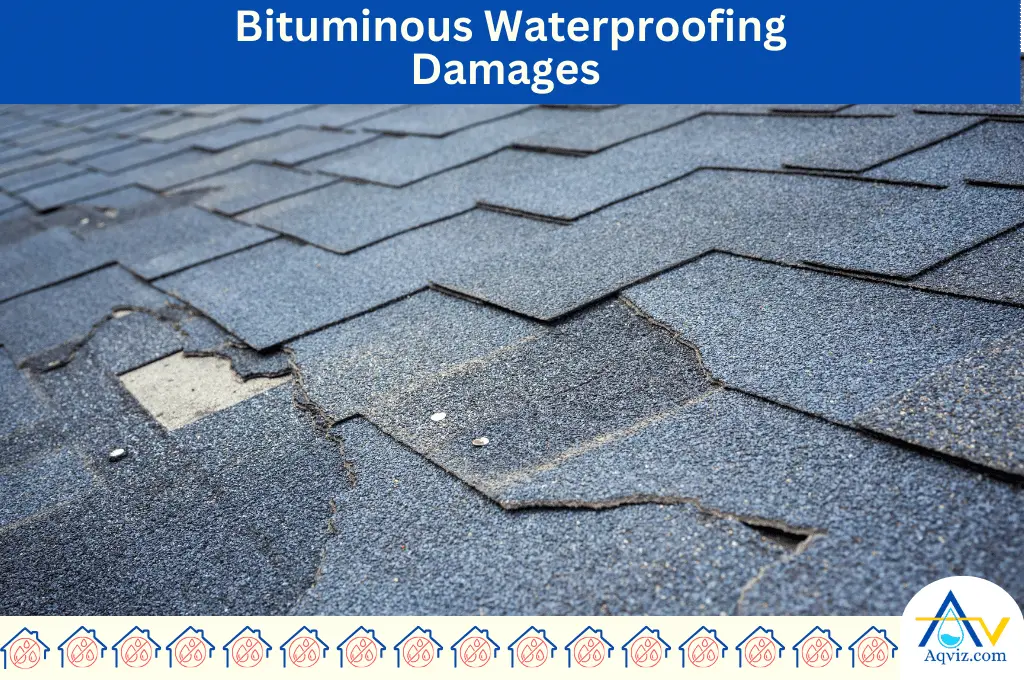
Bituminous waterproofing membrane can be damaged during laying, construction, and after construction periods. The 7 severe damage reasons for the bituminous waterproofing membrane are as follows.
- Applying excessive heat with a torch
- Apply excess pressure to the layer
- Improper installations
- Punching or cutting the layer during the construction
- Drive heavy equipment on the layer
- Open to harmful chemicals such as kerosene oil, etc
- Neglecting the maintenance
What Can I Use Optional Waterproof Membranes for Bituminous Waterproofing?
Bituminous waterproof membranes are sheet waterproofing membranes; hence, you can install sheet-type waterproof membranes such as PVC waterproofing, HDPE, and EPDM instead of the bituminous waterproofing membranes among these 10 waterproofing membranes.
Does PVC Waterproofing need a Gas Torch?
No, you do not need a gas torch for PVC waterproof installation. PVC waterproofing membranes are commonly applied using hot air welding methods rather than open flame techniques. Hot air welding involves the use of specialized equipment that blows hot air to melt the PVC membrane edges, creating a secure and watertight seal.
Is HDPE Waterproofing Suitable for Both Indoor and Outdoor Applications?
Yes, HDPE can be used for both indoor and outdoor waterproofing projects. HDPE provides an effective barrier against moisture and can be used in various settings, including basements, roofs, and foundations. HDPE waterproofing is durable and resistant to water, UV rays, extreme temperatures, chemicals, tears, and punctures. Hence, it can be used for both residential and commercial structures.