
Cementitious vs. Bituminous Waterproofing: What Are the Differences?

Cementitious waterproofing and bituminous waterproofing are two of the most used waterproofing membranes, and they are used to protect buildings from water and moisture penetration. In order to choose the right type of waterproofing membrane, you should know the differences between them before you apply.
So as waterproofing experts, Aqviz, we prepared a complete comparison guide by considering the cementitious vs bituminous waterproofing. We have included the main differences in material composition, water resistance, breathability, flexibility, chemical resistance, and UV resistance. As minor differences, we included adhesion, tear resistance, seam integrity, root penetration resistance, eco-friendliness, fire resistance, anti-slip resistance, toxicity, and self-expanding capability.
These are the material composition, performance, durability, and environmental resistance comparisons between cementitious and bituminous waterproofing.
- Application: Cementitious waterproofing can be applied as a liquid membrane, while bituminous waterproofing can be applied as liquid and sheet membranes using a gas torch.
- Cost: Cementitious waterproofing costs about $54-$75 per 1 m², while bituminous waterproofing costs about $4-$15 per 1 m², depending on membrane type and quality.
- Composition: Cementitious waterproofing is a cement-based coating, while bituminous waterproofing is derived from petroleum-based bitumen.
- Water resistance: Both methods offer strong water resistance, but the level of protection varies.
- Breathability: Cementitious waterproofing is highly breathable, while bituminous waterproofing has a lower breathability.
- Flexibility: Cementitious waterproofing is not flexible, while bituminous waterproofing is highly flexible.
- Chemical resistance: Cementitious waterproofing has a moderate chemical resistance, while bituminous waterproofing has a superior chemical resistance
- UV resistance: Cementitious waterproofing has a higher UV resistance, while bituminous waterproofing has poor UV resistance.
- Adhesion: Cementitious waterproofing has a higher adhesion, while bituminous waterproofing has a moderate adhesion that depends on surface preparation and primers.
- Tear resistance: Cementitious waterproofing has a low tear resistance, while bituminous waterproofing has a high tear resistance and remains flexible under stress.
- Seam integrity: Cementitious waterproofing has a seamless application with no joints, while bituminous waterproofing has joints that require sealing to maintain integrity.
- Eco-Friendliness: Cementitious waterproofing is eco-friendly and made from natural materials, while bituminous waterproofing is less eco-friendly because of its petroleum-based content.
- Root penetration: Cementitious waterproofing is not resistant to root penetration, while bituminous waterproofing is resistant to root penetration and used for green roofs.
- Fire resistant: Cementitious waterproofing is highly fire-resistant, while bituminous waterproofing is flammable unless modified with fire retardants.
- Antislip properties: Cementitious waterproofing has good anti-slip properties, while bituminous waterproofing has low anti-slip resistance because of its smooth surface.
- Toxicity: Cementitious waterproofing is non-toxic and safe for drinking water applications, while bituminous waterproofing contains volatile compounds and requires safety precautions.
- Self-expanding capability: Cementitious waterproofing does not expand and remains rigid, while bituminous waterproofing can expand and contract with temperature changes.
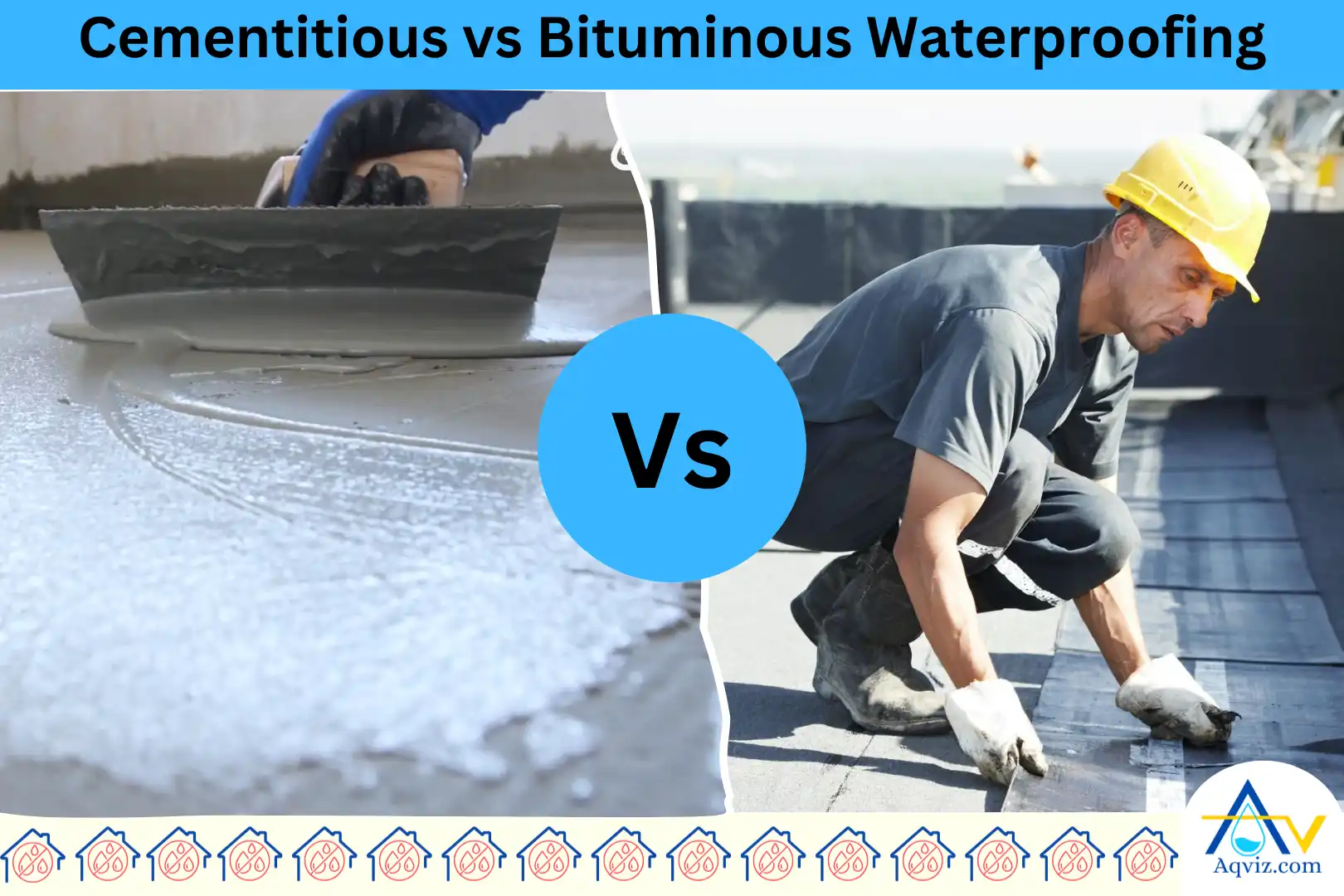
Application Difference Between Cementitious and Bituminous Waterproofing
Cementitious waterproofing can be applied as a liquid membrane, while bituminous waterproofing can be applied as liquid and sheet membranes using a gas torch.
Cementitious waterproofing can be applied as a liquid membrane using a brush, roller, or spray. When cementitious waterproofing is mixed with water or polymer additives, it forms a slurry that spreads easily over concrete, masonry, or cement plaster. Cementitious waterproofing achieves an applied thickness of 1.5-3.0 mm (0.06-0.12 in) in two coats and does not require heat, making application safe in confined and indoor areas.
Bituminous waterproofing can be applied as a liquid coating or as a sheet membrane. Liquid bituminous waterproofing is applied by brush, roller, or spray, while sheet bituminous membranes are installed using a gas torch to heat-weld overlaps. Torch-applied membranes typically have a thickness of 3.0-4.0 mm (0.12-0.16 in). This application method provides strong bonding but requires trained applicators, fire safety control, and dry surface conditions.
Cost Difference Between Cementitious and Bituminous Waterproofing
Cementitious waterproofing costs about $54-$75 per 1 m², while bituminous waterproofing costs about $4-$15 per 1 m², depending on membrane type and quality.
Cementitious waterproofing typically costs around $5-$7 per square foot (~$54-$75 per 1 m²) for the material when applied as a liquid or polymer-modified coating. This range reflects standard cementitious formulations used on concrete walls and slabs.
Bituminous waterproofing membranes generally range between $4 and $12 per 1 m² for the membrane material itself, with thicker torch-applied bitumen membranes tending toward the higher end of that range. Installation labor can add another $2-$5 per 1 m², depending on complexity.
Composition Difference Between Cementitious and Bituminous Waterproofing
Cementitious waterproofing is a cement-based coating, while bituminous waterproofing is derived from petroleum based bitumen.
Cementitious waterproofing is a cement-based coating that consists of mainly portland cement, kaolin, and minor additives such as marble dust or silica sand, lime, ground salt, alum stone, or calcium chloride. When it mixes with water, it forms a rigid and durable barrier against water. Hence, it can be applied to the concrete surface to stop water from leaking and seeping.
Bituminous waterproofing is a petroleum-based, asphalt-derived membrane. It consists of bitumen mixed with polymers and reinforced with fabrics or fiberglass to create a flexible and durable waterproof membrane. The petroleum-based nature of bituminous coatings gives them a highly effective waterproofing quality, making them a popular choice for roofs and underground structures.
Water Resistance Difference Between Cementitious and Bituminous Waterproofing
Cementitious and bituminous waterproofing have strong water resistance, but the level of protection varies.
Cementitious waterproofing is highly resistant to hydrostatic pressure. Hence, it can be used for water tanks, basements, and swimming pools. The cement-based composition allows it to bond permanently with concrete, ensuring long-term protection against water seepage.
On the other hand, bituminous waterproofing provides superior water repellency due to its non-porous, petroleum-based nature. It is excellent for flat roofs, foundations, and underground structures, where continuous exposure to moisture is expected. The key reason for its superior resistance is its hydrophobic (water-repelling) nature, which prevents water absorption and penetration.
Breathability Differences Between Cementitious and Bituminous Waterproofing
Cementitious waterproofing is highly breathable, while bituminous waterproofing has a lower breathability.
Cementitious waterproofing is highly breathable due to its higher porosity nature. It allows moisture vapors to escape from the substrate. This makes it suitable for concrete walls and basements. This leads to mold growth and structural deterioration on the concrete surface over time.
Bituminous waterproofing has lower breathability. It forms a completely sealed, non-permeable layer, preventing both water and vapor from passing through. This characteristic makes it effective for roofing and underground applications, but in enclosed spaces like basements, improper application can trap moisture, leading to condensation issues.
Flexibility Difference Between Cementitious and Bituminous Waterproofing
Cementitious waterproofing is not flexible, while bituminous waterproofing is highly flexible.
One of the major drawbacks of cementitious waterproofing is its rigidity. Once applied and cured, it forms a hard, inflexible layer on the concrete surface. If there is any small movement on the structure, it can be cracked easily.
Bituminous waterproofing is more flexible compared to cementitious waterproofing. Bituminous waterproofing can withstand structural movements and temperature changes without cracking it due to its flexibility. The bituminous membrane’s flexibility depends on the polymer content in it. It allows to stretch and contracting without losing adhesion. It helps to use bituminous waterproofing on roofs, bridges, and areas with thermal expansion.
Chemical Resistance Difference Between Cementitious and Bituminous Waterproofing
Cementitious waterproofing has a moderate chemical resistance, while bituminous waterproofing has a superior chemical resistance.
Cementitious waterproofing has moderate chemical resistance, making it suitable for water treatment plants, swimming pools, and sewage systems. It can withstand exposure to alkalinity, mild acids, and sulfates commonly found in concrete environments. However, it is vulnerable to strong acids and aggressive chemicals, which can break down the cementitious structure over time.
Bituminous waterproofing offers superior chemical resistance. Especially against salts, acids, and industrial pollutants. The hydrocarbon-based composition of bitumen makes it highly resistant to chemical corrosion, making it an excellent choice for industrial facilities, underground structures, and chemical storage areas.
UV Resistance Difference Between Cementitious and Bituminous Waterproofing
Cementitious waterproofing has a higher UV resistance, while bituminous waterproofing has a poor UV resistance.
Cementitious waterproofing is highly resistant to UV radiation due to its mineral-based composition. It does not degrade under direct sunlight and maintains its waterproofing properties without requiring an additional protective layer. This makes it suitable for exposed concrete structures, terraces, and facades where UV stability is crucial.
Bituminous waterproofing has poor UV resistance. When it is exposed to sunlight, it causes oxidation, brittleness, and surface cracking, reducing its lifespan over time. In order to improve UV protection, a protective layer like aluminum foil, gravel, or a UV-resistant coating is often applied over bituminous membranes. Without this protection, bituminous coatings deteriorate faster, leading to potential waterproofing failure.
Read our similar expert guide related to cementitious waterproofing
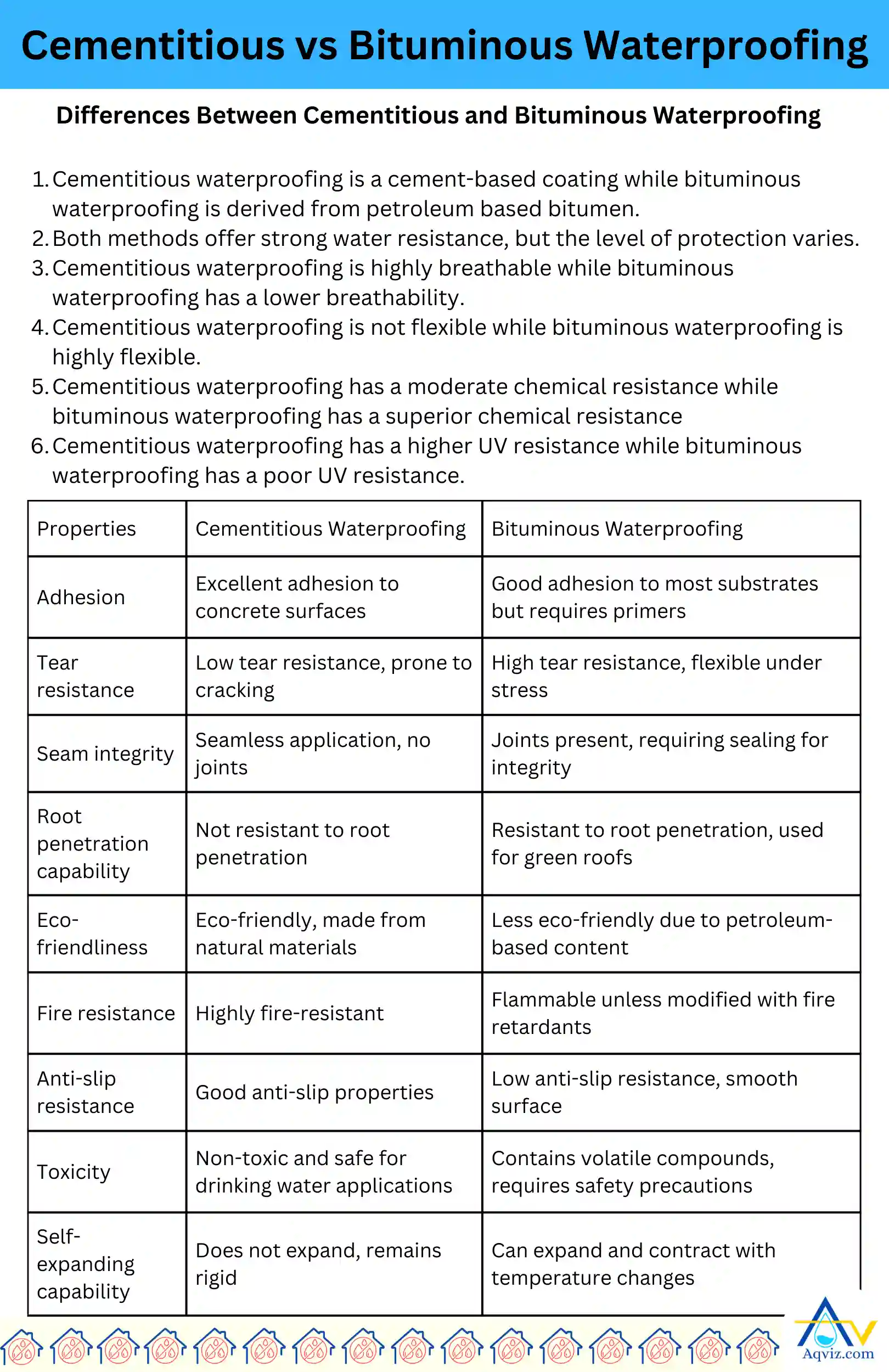
These are the mechanical strength, safety, environmental impact, and usability comparisons between cementitious and bituminous waterproofing.
| Properties | Cementitious Waterproofing | Bituminous Waterproofing |
| Adhesion | Excellent adhesion to concrete surfaces | Good adhesion to most substrates but requires primers |
| Tear resistance | Low tear resistance, prone to cracking | High tear resistance, flexible under stress |
| Seam integrity | Seamless application, no joints | Joints present, requiring sealing for integrity |
| Root penetration capability | Not resistant to root penetration | Resistant to root penetration, used for green roofs |
| Eco-friendliness | Eco-friendly, made from natural materials | Less eco-friendly due to petroleum-based content |
| Fire resistance | Highly fire-resistant | Flammable unless modified with fire retardants |
| Anti-slip resistance | Good anti-slip properties | Low anti-slip resistance, smooth surface |
| Toxicity | Non-toxic and safe for drinking water applications | Contains volatile compounds, requires safety precautions |
| Self-expanding capability | Does not expand, remains rigid | Can expand and contract with temperature changes |
Adhesion Between Cementitious and Bituminous Waterproofing
Cementitious waterproofing has a higher adhesion, while bituminous waterproofing has a moderate adhesion that depends on surface preparation and primers.
Cementitious waterproofing achieves strong adhesion 1.0-1.5 N/mm² (145-218 psi) because of its cement-based, hydraulic bonding mechanism. When applied on concrete, masonry, or cement plaster, it forms a chemical and mechanical bond with the substrate. This strong bonding prevents peeling, blistering, and delamination, even under continuous water pressure.
Bituminous waterproofing membrane relies mainly on mechanical adhesion, not chemical bonding. The adhesion strength of bitumen waterproofing membrane typically ranges between 0.3-0.6 N/mm² (44-87 psi), depending on surface roughness and primer quality. Bitumen membrane waterproofing requires a primer when it is installed on the surface. Over time, thermal movement and substrate vibration can weaken the bond, increasing the risk of edge lifting and membrane separation.
Tear Resistance Between Cementitious and Bituminous Waterproofing
Cementitious waterproofing has a low tear resistance, while bituminous waterproofing has a high tear resistance and remains flexible under stress.
Cementitious waterproofing has low tear resistance because of its rigid, mineral-based composition. Once cementitious waterproofing is cured, it behaves like a thin cement layer with limited elongation of 0.1-0.3%. When cementitious waterproofing is exposed to structural movement, thermal expansion, or shrinkage cracks wider than 0.3 mm (0.012 in), it is prone to cracking and surface fissures. These cracks can allow water penetration if movement continues.
Bituminous waterproofing has high tear resistance because of its elastomeric and thermoplastic properties. Modified bitumen membranes can achieve elongation values of 150-300%, allowing them to absorb stress without tearing. This flexibility helps the bitumen membrane bridge substrate cracks up to 3.0 mm (0.12 in) and resist rupture caused by vibration, settlement, or temperature fluctuation. Hence, it can be used for roofs, foundations, and expansion-prone structures.
Seam Integrity Between Cementitious and Bituminous Waterproofing
Cementitious waterproofing has a seamless application with no joints, while bituminous waterproofing has joints that require sealing to maintain integrity.
Cementitious waterproofing provides high seam integrity because of its monolithic, continuous application. When cementitious waterproofing is applied on concrete, masonry, or cement plaster, it forms a single, joint-free waterproofing layer. Since cementitious waterproofing has no overlaps or seams, it eliminates weak points that commonly cause leakage. This seamless nature improves watertight performance on water tanks, basements, lift pits, and retaining walls.
Bituminous waterproofing has joints because bituminous membranes are installed in sheets or rolls. These overlaps require proper heat welding, cold adhesive bonding, or sealing tapes to maintain seam integrity. If bituminous waterproofing joints are poorly sealed or exposed to thermal movement, joint failure can occur. Over time, joint separation can lead to water ingress, making seam detailing a critical factor in bituminous waterproofing performance.
Eco-Friendlyness Between Cementitious and Bituminous Waterproofing
Cementitious waterproofing is eco-friendly and made from natural materials, while bituminous waterproofing is less eco-friendly because of petroleum-based content.
Cementitious waterproofing is eco-friendly because cementitious waterproofing is manufactured using natural minerals such as cement, silica, and graded aggregates. Cementitious waterproofing contains low volatile organic compounds (VOC) levels of < 5 g/L (0.01 lb/gal) and does not release harmful fumes during application. Cementitious waterproofing is compatible with potable water structures, including water tanks and reservoirs, and supports sustainable construction practices.
Bituminous waterproofing is less eco-friendly because bituminous waterproofing is derived from crude oil and petrochemical refining. Bituminous waterproofing contains higher VOC levels of 50-250 g/L (0.11-0.55 lb/gal), especially in solvent-based systems. During production and installation, bituminous waterproofing can release hydrocarbon emissions and is difficult to recycle. These factors increase the environmental footprint compared to cementitious waterproofing systems.
Root Penetration Capability Between Cementitious and Bituminous Waterproofing
Cementitious waterproofing is not resistant to root penetration, while bituminous waterproofing is resistant to root penetration and used for green roofs.
Cementitious waterproofing is not resistant to root penetration because of its rigid, mineral-based structure. Once cementitious waterproofing is cured, it has no flexibility or self-healing ability to stop root tips. When roots exert point pressure greater than 0.5-1.0 N/mm² (73-145 psi), cementitious waterproofing can crack or fracture, allowing roots to penetrate through the coating. This limitation restricts cementitious waterproofing to non-vegetated structures such as basements, water tanks, and internal wet areas.
Bituminous waterproofing is resistant to root penetration due to its dense, elastomer-modified composition. Root-resistant bituminous membranes are often treated with anti-root additives or copper-based compounds to prevent biological attack. Modified bituminous waterproofing can withstand continuous root pressure while maintaining elongation of 150-300%, which prevents tearing and puncturing. Because of this property, bituminous waterproofing is widely used for green roofs, podium slabs, and landscaped terraces where vegetation is present.
Fire Resistance Between Cementitious and Bituminous Waterproofing
Cementitious waterproofing is highly fire-resistant, while bituminous waterproofing is flammable unless modified with fire retardants.
Cementitious waterproofing is highly fire-resistant because cementitious waterproofing is made from inorganic, mineral-based materials. Cementitious waterproofing does not ignite, melt, or release toxic fumes when exposed to fire. Cementitious waterproofing can withstand temperatures above 1,000°C (1,832°F) without structural failure, making cementitious waterproofing suitable for basements, tunnels, water tanks, and fire-rated concrete structures.
Bituminous waterproofing is flammable because bituminous waterproofing is derived from petroleum-based compounds. Standard bituminous waterproofing can soften at 70-120°C (158-248°F) and ignite when exposed to open flame. Fire-retardant–modified bituminous waterproofing improves resistance by reducing flame spread, but bituminous waterproofing still emits smoke and toxic gases under fire conditions. Because of this behavior, bituminous waterproofing requires protective layers or fire-rated systems in fire-sensitive areas.
Antislip Resistance Between Cementitious and Bituminous Waterproofing
Anti-slip resistance is the ability of a waterproofing surface to provide friction and reduce slip risk under wet or damp conditions.
Cementitious waterproofing has good anti-slip properties, while bituminous waterproofing has low anti-slip resistance because of its smooth surface.
Cementitious waterproofing has good anti-slip resistance because cementitious waterproofing forms a textured, mineral-based finish after curing. The micro-rough surface increases the coefficient of friction to approximately 0.6-0.8, even when wet. When cementitious waterproofing is applied on terraces, balconies, wet areas, or service walkways, it reduces slip hazards without requiring additional aggregates or coatings.
Bituminous waterproofing has low anti-slip resistance because bituminous waterproofing cures into a smooth and glossy surface. The coefficient of friction typically drops to 0.3-0.4 under wet conditions, increasing slip risk. For pedestrian areas, bituminous waterproofing requires an additional anti-slip layer such as sand broadcasting, mineral granules, or protective screed to improve surface safety.
Toxicity Between Cementitious and Bituminous Waterproofing
Cementitious waterproofing is non-toxic and safe for drinking water applications, while bituminous waterproofing contains volatile compounds and requires safety precautions.
Cementitious waterproofing is non-toxic because cementitious waterproofing is manufactured from inorganic, mineral-based raw materials. Cementitious waterproofing does not release harmful fumes and contains very low VOC levels of < 5 g/L (0.01 lb/gal). Because of this property, cementitious waterproofing is approved for potable water structures such as drinking water tanks, reservoirs, and water treatment facilities.
Bituminous waterproofing contains volatile compounds because bituminous waterproofing is derived from petroleum-based materials. During application and curing, bituminous waterproofing can release VOCs in the range of 50-250 g/L (0.11-0.55 lb/gal), especially in solvent-based systems. These emissions require the use of personal protective equipment, proper ventilation, and fire safety measures, particularly in enclosed or indoor environments.
Self Expanding Capability Between Cementitious and Bituminous Waterproofing
Cementitious waterproofing does not expand and remains rigid, while bituminous waterproofing can expand and contract with temperature changes.
Cementitious waterproofing does not expand because cementitious waterproofing hardens into a rigid, mineral-based layer after curing. Once cementitious waterproofing is set, thermal movement is limited to less than 0.01% per 10°C (50°F) change. When cementitious waterproofing is exposed to temperature fluctuation or structural movement, the rigid nature can lead to microcracking, especially at joints and corners.
Bituminous waterproofing can expand and contract because bituminous waterproofing has elastomeric and thermoplastic properties. Bituminous waterproofing can accommodate thermal movement of approximately 1-3%, depending on the formulation and modification. This flexibility allows bituminous waterproofing to remain intact during daily and seasonal temperature changes, making it suitable for roofs, exposed slabs, and structures subjected to thermal cycling.
What is Cementitious Waterproofing?
Cementitious waterproofing is a rigid, cement-based waterproofing system used to protect concrete structures from water penetration. It is composed of cement, sand, special additives such as marble dust or silica sand, lime, ground salt, alum stone, or calcium chloride. Polymer modifiers are also added to cementitious waterproofing to improve adhesion and flexibility to the substrate. Cementitious waterproofing can be applied as a liquid slurry or mortar to the substrate that bonds permanently with concrete surfaces.
There are more than 10 types of waterproofing membranes available for building waterproofing. If you need to know about all of them, read our expert guide about 10 Types of Waterproofing Membranes: Properties, Applications, Pros, and Cons
What are the Advantages of Cementitious Waterproofing?
- Easy to apply: Cementitious waterproofing does not require specialized equipment.
- Excellent adhesion: Cementitious waterproofing bonds permanently with concrete, preventing water seepage.
- Cementitious waterproofing is highly resistant to hydrostatic pressure
- Cementitious waterproofing is non-toxic and safe for potable water
- Cementitious waterproofing is UV-resistant
What are the Disadvantages of Cementitious Waterproofing?
- Rigid and brittle: Cementitious waterproofing is prone to cracking even in small movements
- Cementitious waterproofing has limited flexibility
- Cementitious waterproofing is not effective for dynamic surfaces
- Cementitious waterproofing has a Moderate chemical resistance
- Cementitious waterproofing requires multiple coats for higher protection
What is Bituminous Waterproofing?
Bituminous waterproofing membranes are water-dissolved, sticky, higher temperature sensitive, and have a higher viscosity and higher deformed at room temperature, black-colored, liquid, or semi-solid forms of asphalt that are derived from petroleum, used to prevent water leaking from basements, foundations, bathrooms, balconies, rooftops, slabs, and construction surfaces.
What are the Advantages of Bituminous Waterproofing?
- Bituminous waterproofing membranes are highly flexible
- Bituminous waterproofing is an excellent water resistance
- Bituminous waterproofing has strong chemical resistance
- Bituminous waterproofing adheres tightly to the substrate tightly
- Bituminous waterproofing is resistant to root penetrations
What are the Disadvantages of Bituminous Waterproofing?
- Poor UV resistance: Bituminous waterproofing requires protective layers like aluminum coating or gravel.
- Flammable: Some bituminous waterproofing requires heat protection due to fire risk
- Environmental concerns: Bituminous waterproofing is less eco-friendly
- Can soften under high temperatures: Bituminous waterproofing requires polymer modification for better stability
- Seam issues in sheet membranes: Improper bituminous sheet membrane installation can lead to leaks at seams and overlaps.