
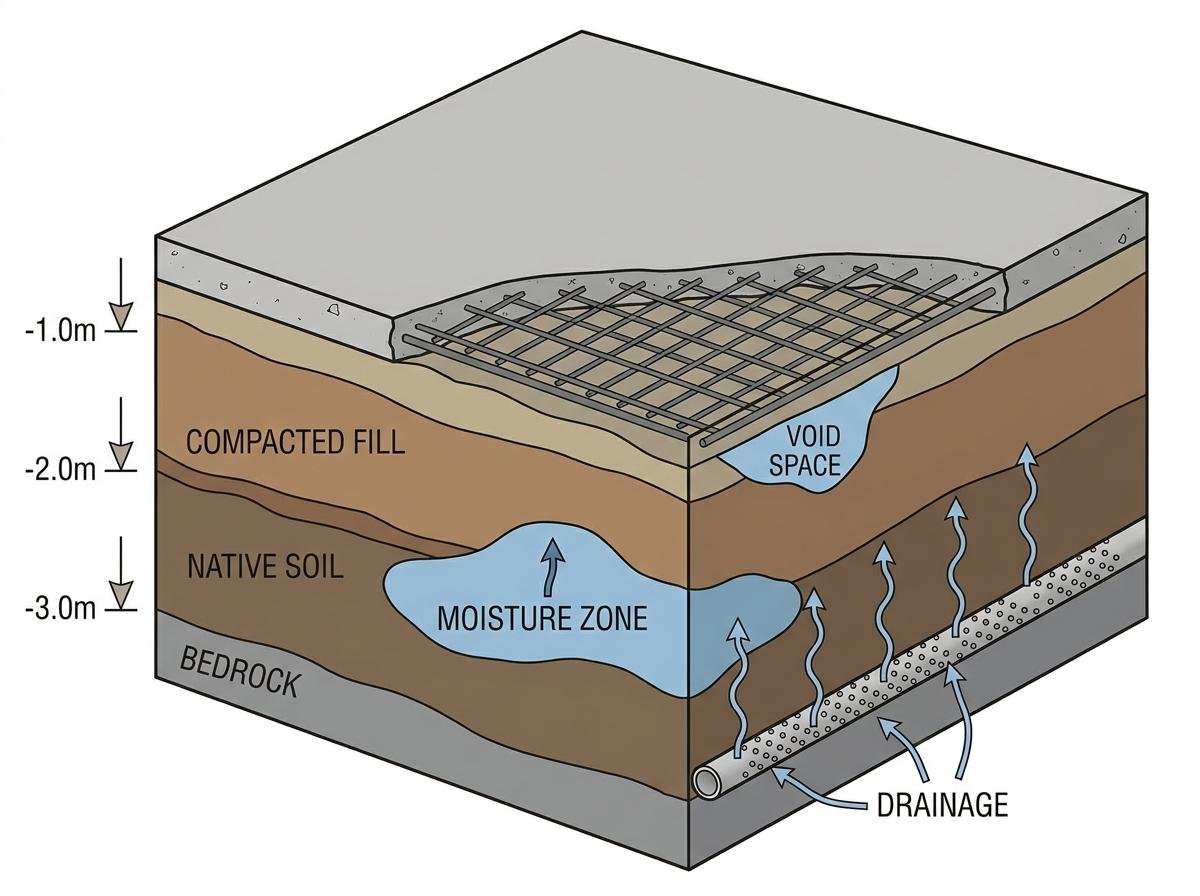

Water finds its way in. That’s the single truth every basement owner learns eventually. The question is whether you discover the path before you spend money on waterproofing or after.
Most waterproofing work happens blind. Contractors apply sealants, install drainage systems, and mount sump pumps without knowing what’s happening inside the concrete or beneath the slab. When that waterproofing fails six months later, the cause isn’t usually the product. It’s the condition the product was laid over. A hidden void. A crack that runs deep but looks shallow from the surface. Saturated soil behind a wall that looked dry.
Ground penetrating radar (GPR) changes this dynamic. It gives you a non-destructive way to inspect concrete and subsurface conditions before any work begins. For anyone planning basement waterproofing or foundation repairs, a GPR scan turns guesswork into measurement.
Why you should scan before you waterproof
Ground-penetrating radar reveals what lies beneath your foundation before waterproofing begins. Voids, cracks, moisture zones, and embedded utilities all show up clearly in GPR scans.
Applying a waterproofing membrane over compromised concrete is like painting over rotten wood. It might look good for a week, but the failure underneath doesn’t go away. GPR is the only non-destructive method that gives you a full picture of subsurface conditions without coring or excavation.
Professional GPR services bring trained specialists and the latest-generation equipment to assess concrete slabs, foundations, and subsurface conditions with precision. They provide the data homeowners and contractors need before committing to waterproofing work. A 2025 study published in CivilEng found that structured image-based GPR interpretation achieves about 90% detection accuracy for voids, delamination, and corrosion in concrete slabs. That’s up from 70-80% with traditional manual interpretation.
The difference between guessing and knowing is the difference between one waterproofing job and two. Without a scan, you’re rolling dice on a five-figure investment.
What GPR can detect beneath your foundation
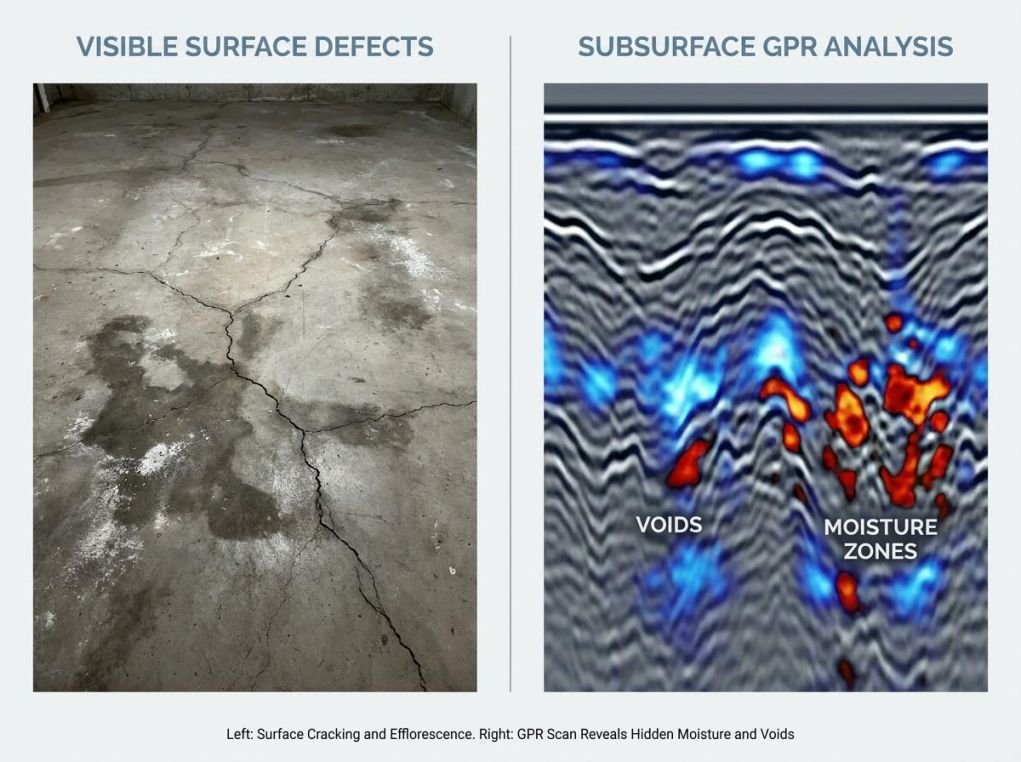
GPR detects moisture intrusion in concrete slabs by identifying dielectric contrast between dry concrete and water-saturated zones.
Ground penetrating radar sees through concrete and soil to identify several types of subsurface conditions that directly affect waterproofing success.
Subsurface voids and cavities are air pockets under slabs that can collapse under weight or channel water into your basement. Cracks and cold joints, internal fractures, and construction seams that aren’t visible from the surface act as highways for moisture over time. GPR differentiates between dry concrete and water-saturated zones, telling you exactly where a leak path starts.
The system also locates rebar, post-tension cables, and conduits embedded in concrete. That information is critical before you core, inject waterproofing materials, or cut into a slab. Hitting a live conduit or severing a post-tension cable turns a routine waterproofing job into an expensive repair.
North America holds the largest share of the global GPR market at 38.31%, according to a 2025 Fortune Business Insights report. The report values the global GPR market at USD 457.32 million in 2025 and projects it to reach USD 882.67 million by 2034 at a 7.58% CAGR. That growth reflects the construction industry’s increasing reliance on non-destructive testing for concrete evaluation.
For a broader overview of non-destructive testing techniques, the Inspectioneering Journal published a thorough review of NDT methods, including GPR, in early 2025.
How GPR saves money on waterproofing projects
Skipping the GPR scan to save a few hundred dollars is a false economy. Here’s why.
The biggest expense on any waterproofing job isn’t materials. It’s the discovery cost, finding what you didn’t know was there after the work is already underway. A void under the slab discovered after excavation means stopping work, reassessing the approach, and bringing in extra equipment. That kills timelines and inflates budgets.
GPR eliminates the guesswork. It pinpoints exactly where crack injection, void filling, or drainage work is needed. Instead of ripping up the entire slab to check, you target only the problem areas. The scan shows you where to focus and where you can leave well enough alone.
For homeowners comparing their interior and exterior foundation waterproofing options, having GPR data beforehand makes the decision clearer. If the scan shows significant moisture intrusion on the interior side of the foundation, exterior excavation is worth the investment. If the concrete is sound, interior solutions may be enough.
Adding a GPR scan before any basement work also helps you plan your basement floor drainage and water protection options with the right strategy from the start. You’re not guessing where the water is coming from, and you’re not designing a drainage system around symptoms you don’t fully understand.
GPR standards and best practices
Not all GPR scans deliver the same quality. Results depend on equipment quality, operator experience, and adherence to industry standards.
The American Concrete Institute’s ACI 228.2R and ASTM D6432 provide the framework for using GPR in concrete evaluation. These standards cover void detection, rebar location, member thickness measurement, and moisture assessment. A professional scan follows these protocols and includes grid-pattern data collection, depth calibration, and real-time interpretation by a trained technician.
When should you scan? Before any waterproofing work starts. Before coring into a slab for sump pump installation or drainage tie-ins. And before purchasing a property with known moisture issues. A pre-purchase GPR scan puts you in a stronger position: either the seller fixes what you find, or you adjust your offer accordingly.
Recent advances in GPR technology are making scans faster and more accurate. A 2025 study in Scientific Reports demonstrated that AI-enhanced GPR systems can detect defects in concrete structures in real time using attention-based deep learning. The technology, tested on UAV-mounted scanning systems, achieved high mean average precision for autonomous structural inspection.
The broader market supports this direction. Research and Markets projects the GPR for concrete market to grow steadily through 2030, driven by aging infrastructure inspection needs and expanding non-destructive testing requirements across residential and commercial sectors.
If you’re planning basement waterproofing solutions, a GPR scan should be on your checklist before you call the excavation crew. It’s a small investment that prevents big mistakes.
Conclusion
What you can’t see can still hurt your home. Ground penetrating radar makes the invisible visible, giving homeowners and contractors the data they need to make smart waterproofing decisions from day one.
Skipping the diagnostic step doesn’t save money. It just defers the cost. And deferred costs on foundation work have a way of adding up. A GPR scan before waterproofing isn’t an extra expense. It’s the most cost-effective decision you can make on any basement or foundation project.
