
Every building you walk into depends on thousands of metal components working together. Steel beams carry the load. Copper pipes deliver water. Fasteners and connectors hold everything in place.
HVAC systems rely on precision parts that must resist wear, corrosion, and repeated thermal stress. Most people never think about how those components are made strong enough for the job. The answer, in many cases, is induction heat treating.
This article breaks down what induction heat treating is, why it outperforms conventional methods, and how it directly affects the durability of metal parts used in modern buildings and infrastructure.
What Is Induction Heat Treating?
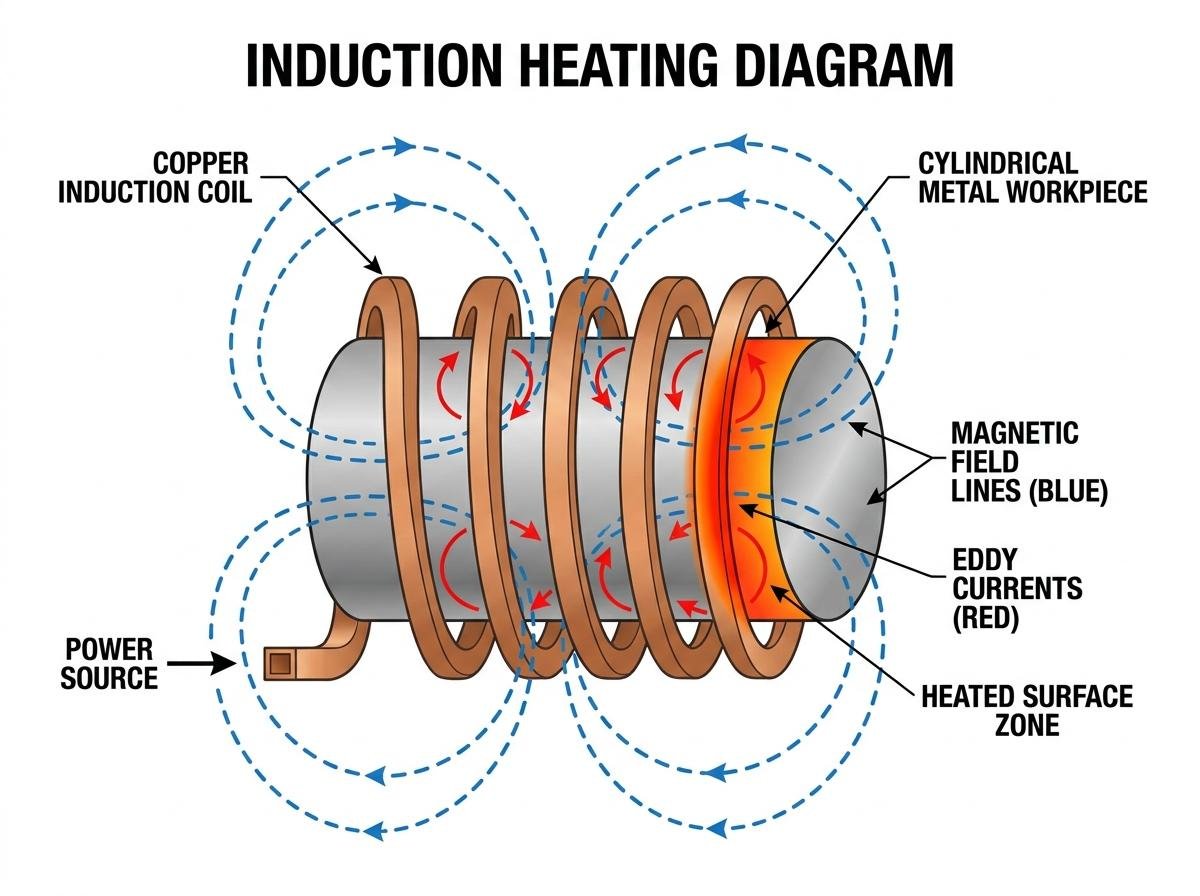
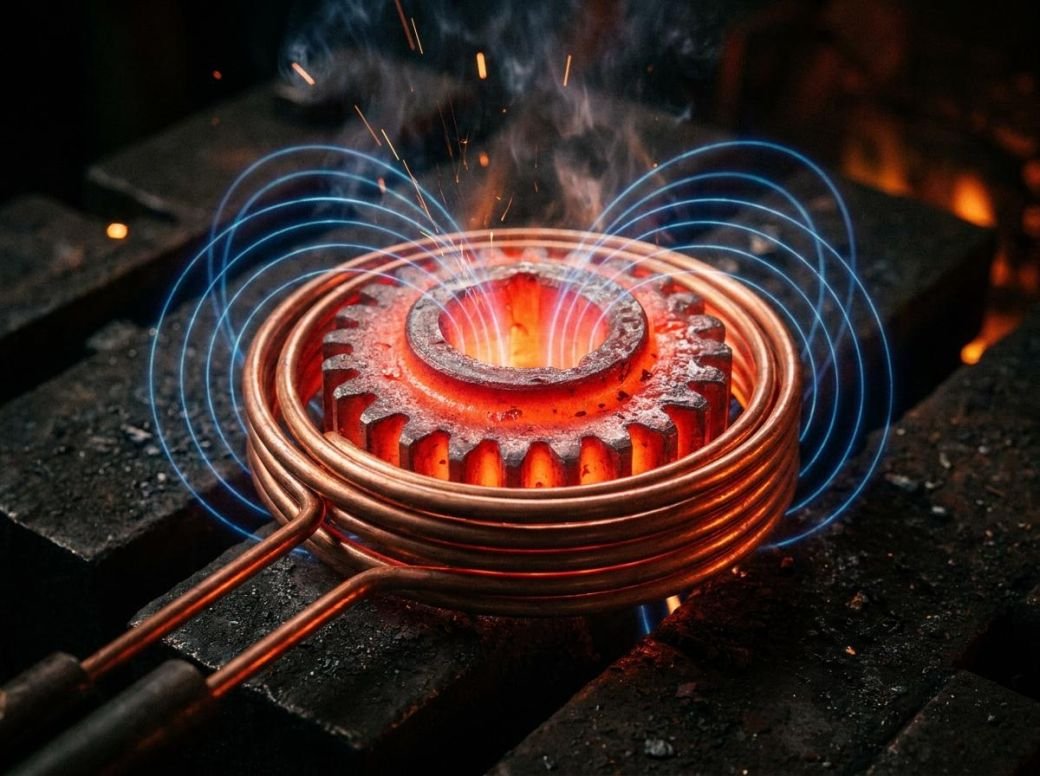
Induction heat treating is a contactless heating method that uses electromagnetic induction to heat metal parts quickly and with pinpoint accuracy. An alternating current passes through a copper coil, creating a rapidly changing magnetic field. When a metal workpiece is placed in that field, eddy currents form within it. Those currents generate heat through electrical resistance, bringing the surface to the exact temperature needed. The depth of heating depends on the current frequency – higher frequencies heat a thinner surface layer, while lower frequencies penetrate deeper.
The process follows a two-step cycle. First, rapid heating brings the metal surface above its transformation temperature (austenitization). Then a quenching step – usually water, oil, or polymer – cools it instantly. This creates a hard martensitic layer on the surface while the core of the part stays tough and ductile. That combination is what makes induction heat treating such a powerful tool for creating metal components that can withstand heavy use without becoming brittle.
Speed and precision are what set induction apart. A typical cycle takes seconds, not hours. The operator can dial in exact temperatures and hold times for each part. That level of control matters when you are hardening a single critical surface – like the bearing race on a motor shaft or the threads on a pipe fitting – without softening adjacent areas.
Key Benefits Over Conventional Heat Treatment
Traditional furnace heat treating works by heating an entire part in a gas-fired or electric oven for hours. Induction does the same work in seconds or minutes while using less energy. According to a February 2026 report from ABP Induction Systems published by Heat Treat Today, induction heating achieves practical energy efficiencies of up to 90%. That’s far better than conventional gas furnaces, which lose significant energy through convective and radiant heat transfer.
The same report notes that hybrid induction systems retrofitted onto existing gas furnaces can cut fossil energy consumption by up to 60%. The induction coil handles the rapid preheating phase, and the gas burner finishes the job. That kind of efficiency matters both for operating costs and for environmental compliance – especially as building codes push contractors toward lower-carbon supply chains.
Another major advantage is selective heating. Induction treats only the areas that need hardening – a gear tooth, a bearing surface, a pipe thread – while leaving the rest of the part unchanged. That means less distortion, fewer rejected parts, and better dimensional accuracy. The compressive residual stresses left on the surface also improve fatigue life, so parts last longer before they crack or wear out.
The energy and material savings add up across a whole construction project. Fewer rejects mean less scrap. Better wear resistance means fewer replacements. When you multiply those factors across thousands of components in a single building, the cost difference between induction-treated parts and conventionally treated ones becomes significant.
Induction Heat Treating in Construction and Building Maintenance
The connection between induction heat treating and building durability is straightforward. Hardened steel components resist wear, corrosion, and mechanical stress better than untreated ones. That translates into longer service life for plumbing fittings, HVAC components, structural connectors, and fasteners.
Recent research supports this. A March 2026 study published in De Gruyter’s Materials Testing journal looked at martensitic stainless steel (440B) treated with induction thermal cycling. The researchers found that the induction process produced finer, more uniform microstructures with reduced wear loss and improved intergranular corrosion resistance compared to conventional furnace treatment. For building owners and maintenance professionals, that means fewer pipe replacements, less fastener corrosion, and lower long-term repair costs.
The benefits extend beyond raw materials. Every hardware component in a building envelope experiences temperature fluctuations, moisture, and mechanical loads. That includes the brackets, connectors, and fittings that hold mechanical systems together in walls and crawl spaces. Parts made with induction hardening simply hold up longer under those conditions.
Think about a typical commercial building. It has hundreds of threaded fasteners holding ductwork in place, dozens of motor shafts driving pumps and fans, and miles of pipe fittings carrying water and refrigerant. Every one of those components experiences cyclic stress and environmental exposure. When they are made with induction-hardened surfaces, the maintenance interval stretches. That is not a theoretical benefit – it is measurable in reduced service calls and deferred replacement costs.
Market Trends and the Push for Energy Efficiency
The induction heat treating market reflects growing demand for stronger, more sustainable metal processing. WiseGuyReports estimates the global induction heat treating services market was valued at roughly $2.23 billion in 2025, with projections reaching $3.5 billion by 2035 at a compound annual growth rate of 4.6%. That growth is driven largely by the construction, automotive, and heavy equipment sectors, which need higher-performance components.
On the technology side, a University of Florida project, backed by $11 million in Department of Energy funding, is developing a superconducting magnet combined with induction technology that could cut steel heat-treatment time by up to 80%. That kind of breakthrough would turn 8-hour furnace cycles into minute-scale processes, reshaping how metal components are made for the construction industry.
For contractors and property owners, these trends connect back to everyday buying decisions. When manufacturers adopt more efficient heat-treating processes, the savings can affect the price of the equipment you install. Knowing your new furnace costs and replacement options helps you plan for upgrades that take advantage of better-engineered components. The same logic applies to pumps, compressors, and any mechanical equipment with hardened internal parts.
Looking Ahead
Induction heat treating is evolving beyond its traditional industrial base. Manufacturers are integrating AI-assisted temperature control and real-time monitoring systems that adjust heating parameters on the fly. The result is even tighter process control and fewer quality defects. At the same time, the technology is expanding into new sectors – defense, shipbuilding, and renewable energy infrastructure all rely on the material properties that only induction can deliver efficiently at scale.
These advances matter for construction and property maintenance because they change the economics of quality. As induction equipment becomes cheaper and more widely available, the cost premium for induction-treated parts shrinks. More manufacturers will adopt the process, which means more building components will come with better surface hardness and longer service life as standard features rather than upgrades.
As these advances reach the construction supply chain, they’ll affect even routine building systems. Your next high-efficiency furnace venting installation will likely include hardware made with better materials and more consistent heat treatment than what was available five years ago. That means fewer service calls and longer replacement cycles for the components you rely on.
Conclusion
Stronger metal components mean longer-lasting buildings. Induction heat treating delivers that strength faster, more efficiently, and more precisely than conventional furnace methods. The energy savings, reduced waste, and superior metallurgical properties make it a clear upgrade for any application where durability matters.
Understanding the process behind the parts you specify, install, or maintain helps you make better decisions about materials and quality. In a world where building standards keep rising and sustainability requirements grow stricter, the way metal components are treated matters more than ever.