
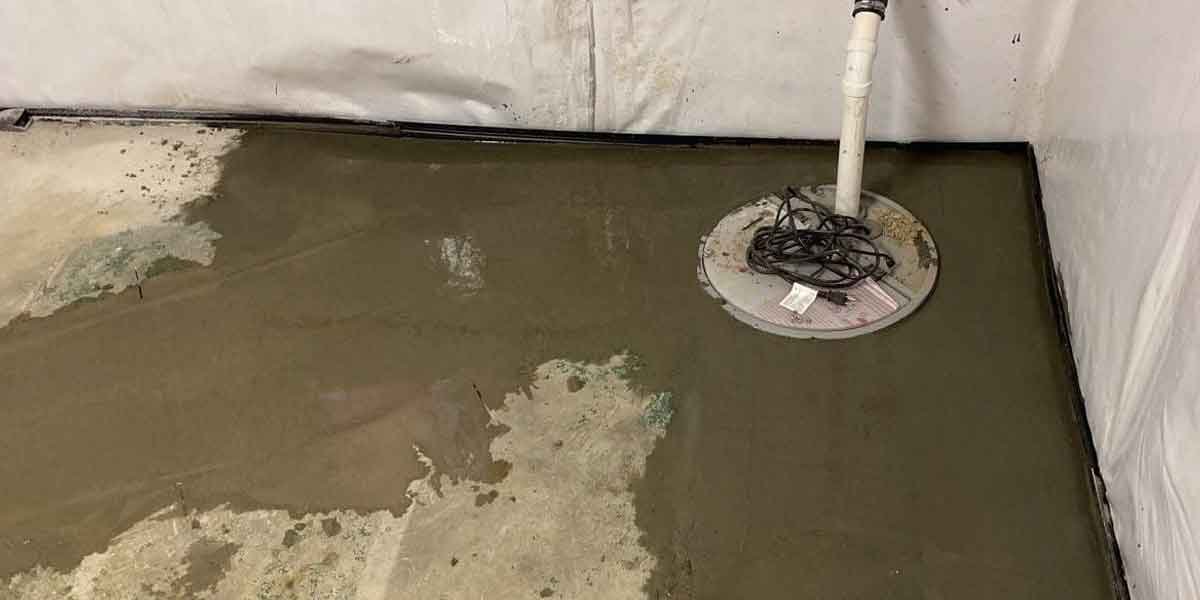

Water with no visible leak arrives as vapor or creeps through concrete. So why is there water in my basement but no leak? Four mechanisms move water in without ever forming a drip: condensation on cold surfaces, capillary wicking through the slab and footings, groundwater pushed up by hydrostatic pressure, and a short list of appliances that spill quietly.
Drainage systems get sold before anyone measures humidity. That order is what makes a wet basement expensive.
A moisture meter, a square of plastic film, and 24 hours settle most of these cases. Each source leaves its own trace: where the wet patch sits, what it looks like, and which weeks of the year it turns up.
Why Is There Water in My Basement But No Leak?
A wet basement with nothing dripping is a moisture problem first and a plumbing problem second: water is arriving as vapor, wicking through concrete, or rising under pressure, so it never gathers into a stream you can trace back to a fitting.
A wet basement, in the plain sense, means moisture is present without standing water, a cold and slightly tacky floor, cardboard boxes that soften along the bottom edge, and a smell a visitor notices before you do.
Roughly one in 60 insured homes files a property claim for water damage or freezing, according to the Insurance Information Institute’s homeowner loss data for 2019 through 2023. That category trails wind and hail in claim frequency.
What the missing drip rules out is a pressurized supply line spraying or a drain pouring. Everything else still applies, including water that has been arriving for months.
Condensation Is the Usual Culprit in Summer
Condensation is water vapor turning back into liquid on any surface colder than the air’s dew point.
Air at 85°F and 70 percent relative humidity has a dew point near 74°F, which puts every surface below 74°F in the condensation zone: the slab, a steel column, a cold-water pipe, an uninsulated air-conditioning duct. Basement concrete stays cool well into summer because the soil around it lags behind the air temperature.
The signature is where the water is not. An exposed floor feels damp while the floor under a rubber mat or a stack of storage bins stays dry, because the moisture condensed out of the air and landed there. The same film of water collects on the underside of metal shelving and on the first rung of a ladder.
The EPA sets the target for indoor air below 60 percent relative humidity, ideally between 30 and 50 percent. Its mold guidance points at condensation in cold corners and on walls behind furniture as a common starting point for growth (EPA, A Brief Guide to Mold, Moisture and Your Home).
The seasonal tell needs no tools. Water that peaks in July and is gone by January is air condensing, not a leak.
A dehumidifier that only runs when someone remembers to empty it, and a basement door left open to a muggy upstairs, both make it worse.
Capillary Action Pulls Water Up Through the Floor
Capillary action is water climbing through narrow pores against gravity, and concrete is full of pores. They form a continuous path from wet soil through the footing and up into the slab and the bottom courses of the wall.
This turns up as a band, not a puddle. The damp strip sits along the joint where the wall meets the floor, climbs a few inches up the concrete, and the slab beside it darkens and stays dark.
White powder on that band is the most useful clue in the basement. Efflorescence is the mineral salt left behind when water evaporates out of concrete, so a deposit is physical proof that water has been moving through the wall. A drop of white vinegar separates it from mold in seconds: the salt dissolves, while mold resists and smears on a cotton swab.
The layer that stops this is unglamorous. Section R506.2.3 of the International Residential Code calls for a 6-mil polyethylene vapor retarder, lapped at least 6 inches, between the slab and the gravel base course, and the gravel is the part that breaks the capillary path (code text for IRC Section R506.2.3, as adopted in Oklahoma). A slab poured without either layer has no such break.
Waterproof paint is the wrong first move on a wicking wall. A film on the inside traps water in the concrete, and the coating blisters and peels within a couple of seasons.
Water That Appears After a Storm Is Pushed, Not Wicked
Hydrostatic pressure is the force saturated soil exerts against a foundation. Full ground raises the water table, and the water moves through the path of least resistance: the floor-wall joint, a shrinkage crack in the slab, or the sump pit.
Timing separates this from wicking. Wicking is seasonal and slow, and it pays no attention to whether it rained this week. Hydrostatic water arrives hours after a storm, during snowmelt, or after a neighbor’s irrigation has run long enough to soak the shared grade.
The shape of the wet area points the same way. A ring of damp concrete around the sump pit, or a wet patch in the middle of a slab with dry concrete between it and the walls, means water is coming up from below.
Start at the pit. A pump that runs with a pit that never fills is the first thing to check. So are a check valve stuck open, a discharge line crushed under mulch or frozen at the outlet, and a float jammed by gravel. Each of them leaves a wet floor with no visible leak anywhere.
When the Source Sits Indoors: Appliances That Leak Quietly
A handful of household failures wet a basement floor without an obvious drip. They share one signature: the water appears in the same spot each time and spreads over weeks.
Air-conditioning condensate tops the list. The pan under an air handler rusts through, the small condensate pump stops, or the drain line clogs with biofilm, and the water lands within a couple of steps of the unit. An air conditioner pulls a surprising volume of water out of summer air, and every drop leaves through that line.
The temperature-and-pressure valve on a water heater weeps when the tank overheats or pressure spikes, and its discharge pipe points straight at the floor. The evidence is a small puddle that has already dried by the time anyone looks.
Washing machine supply hoses fail from the inside, most often near the fitting where the hose bends behind the machine, and they sit under household line pressure the whole time. Water appears at the base of the machine first.
Ventilation adds its own load. A dryer duct that has pulled apart inside a wall cavity, a vent flap jammed shut by lint, or a bathroom fan that terminates in the joist bay rather than outdoors all dump humid air into the same space.
One source leaves no puddle at all. A supply line running beneath the slab can leak for months into the concrete without pooling on top of it, which reads as a damp patch that no amount of mopping fixes.
Once the source is shut off, the drying window is short. The EPA puts it at 24 to 48 hours to dry a water-damaged area before mold growth becomes likely.
The 24-Hour Test That Splits Vapor From Liquid
A square of plastic film taped over a damp patch and left for a day answers the first question: is the water in the air, or is it in the concrete? The method even has a designation, ASTM D4263, and the reading depends on which side of the film the moisture collects.
Cut a piece about a foot square, tape all four edges flat against the floor or the wall, leave it for 24 hours, then lift one corner and look at both faces of the plastic.
- Beads on the room side of the film mean the air is the source. That points at condensation.
- A dark, damp patch on the concrete side, or concrete that is still wet where the film was sealed down, means water is moving through the concrete from the soil.
The film says which family the problem belongs to; a meter says how bad it is. Digital hygrometers run $10 to $50 at hardware stores, per the EPA’s guide, and the number to watch is 60 percent, the humidity level above which the EPA expects mold to take hold (EPA).
Set the meter about waist high, away from the dehumidifier and away from the door, then read it in the morning and again at the end of the hottest part of the day. A single reading taken after a shower tells you nothing.
Keep the dates beside the readings. A problem that follows rain, one that follows mugginess, and one that never goes away need three different repairs, and the log does that sorting for you.
The last basement I walked through, I spent an hour on the plumbing before taping film to the floor. The film came back beaded on the room side and every pipe in the place was dry. That hour would have been better spent in the other order.
Read the two results together. Above 60 percent with beads on the film is condensation; below 50 percent with the concrete side soaked is wicking or hydrostatic pressure. Both at once is common in an old basement, and it means two repairs, not one.
What to Fix First
Fix the source the tests point at, and dry the space inside the first 48 hours, because every later repair costs more once mold has a foothold.
Start with air movement and a dehumidifier, whatever the cause. Capacity is rated in pints per 24 hours, ENERGY STAR’s sizing guidance says to err on the large side, and a certified unit uses about 20 percent less energy than a similarly sized conventional one.
If the film points at condensation, hold the basement between 30 and 50 percent, insulate the cold surfaces that sweat (ductwork, cold-water lines, the rim where the wall meets the mudsill), and shut the basement door when the upstairs air is muggy.
If it points at wicking or hydrostatic pressure, the money goes outside first: extend the downspouts, re-grade the soil so it falls away from the wall, clear the window wells, and keep the sump discharge well clear of the foundation. Interior drainage and vapor barriers come after that, and they are the expensive tier.
Do not coat or paint the wall while it is still wicking. The film fails, and the next bill includes scraping it off.
Call a professional when water rises across the whole floor during storms, when the pump cannot keep up, when a block wall shows a widening horizontal crack or is bowing inward, or when the water smells like sewage.
If the meter reads 45 percent and the film comes back wet on the concrete side, no dehumidifier will fix it. That is a drainage problem, and it is the one case where the money goes under the floor.
Frequently Asked Questions
Why is there water in my basement but no leak after heavy rain?
Rain saturates the soil, raises the water table, and pushes water through the floor-wall joint or a slab crack. Check the sump pit first, then the discharge line and the check valve. A pump that keeps running, or a pit that stays full, points to the drainage side of the problem instead of the plumbing.
How can I tell if water is coming up through the basement floor?
White salt powder along the floor-wall joint, a damp patch ringed by dry concrete, and moisture on the concrete side of a taped film all point to water rising through the slab. Condensation leaves the opposite pattern: a damp surface where the floor is exposed and a dry strip under mats and boxes.
How do I know if there is mold in my basement?
A musty smell that returns after cleaning, dark staining in a cold corner or behind furniture, and a soft or stained bottom edge on stored cardboard are the usual signs. Mold does not dissolve in white vinegar and smears when wiped, which tells it apart from efflorescence. The EPA puts the do-it-yourself line at a moldy area smaller than roughly a 3-by-3-foot patch; beyond that it points to professional remediation.
How do I get rid of the moisture for good?
Hold the basement between 30 and 50 percent relative humidity with a dehumidifier, then close off the route the water takes to get in. Sealing the surface without removing the source traps water inside the concrete and usually fails within two seasons.