
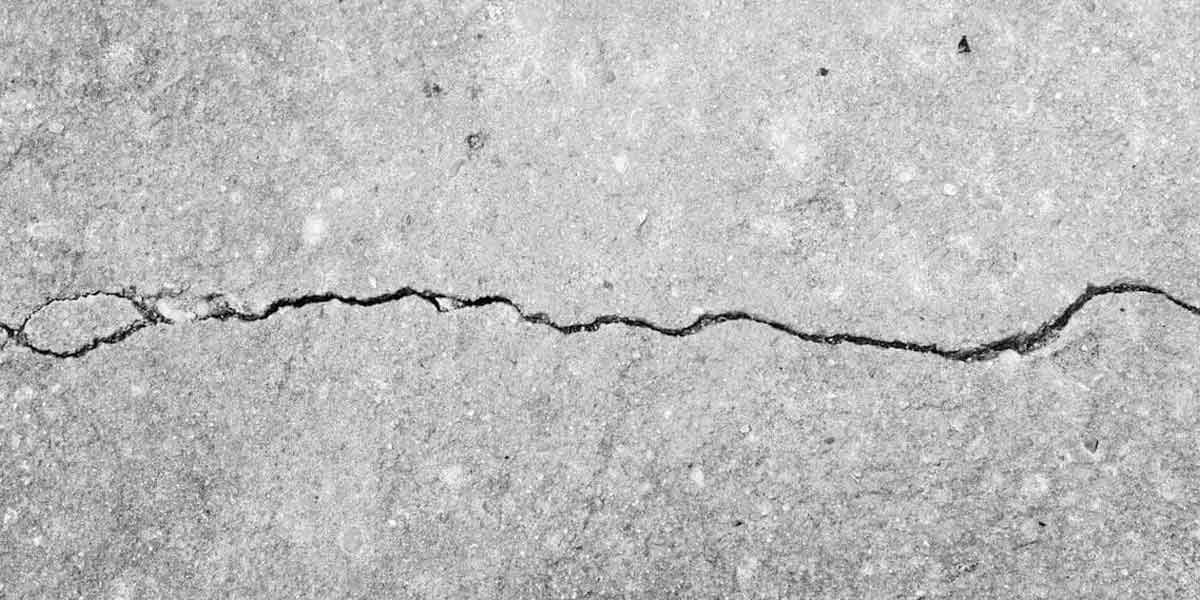

A dry interior slab can carry cracks up to 0.016 in. wide. Acceptable cracks in concrete slab construction are a range instead of a number, and the top of that range belongs to dry, protected slabs.
That ceiling drops once water or salt enters the picture. A slab on grade in contact with the subgrade falls to 0.012 in., a garage slab that sees road salt falls to 0.007 in., and a slab meant to hold water falls to 0.004 in. The same crack width that passes in one of those settings fails in another.
Acceptable cracks in concrete slab work are settled by exposure and use, not by one field number.
The Five Width Limits That Decide Acceptance
ACI 224R-01, Table 4.1 lists reasonable crack widths for reinforced concrete under service loads: 0.016 in. in dry air or under a protective membrane, 0.012 in. in humid air or soil contact, 0.007 in. under deicing chemicals, 0.006 in. under seawater, and 0.004 in. for water-retaining structures.
ACI restates the same five values in its own technical answer on acceptable cracking, and the pattern is easy to hold onto. Dry slabs tolerate the widest openings, wet and salt-exposed slabs the narrowest.
A footnote under the table carries more weight than the values in it. It warns that a portion of the cracks in a structure will exceed these numbers, and that over time a larger share can. ACI 318-19, Commentary R24.3.1, adds a reason: visible cracks form under service loads, and their widths scatter widely, moved by shrinkage and other effects that keep working with age.
Slabs on ground answer to a second metric, and this one is not about width at all. Section 3.2.5.3 of ACI 302.1R-04 states that random visible cracks might reasonably be expected in 0 to 3% of the panels formed by saw cuts, construction joints, or a combination of the two. ASCC Position Statement #29, published in ACI’s Concrete International, repeats that figure and suggests using the 3% mark as a cap on a project crack repair allowance.
The width table tells a designer what a detail can tolerate; the 0 to 3% figure tells an owner how much random cracking counts as normal across a panel layout.
How Exposure Lowers the Ceiling
A crack of 0.016 in. that raises no concern in a heated basement is more than double the reasonable width for a slab exposed to deicing chemicals, where ACI 224R-01 sets 0.007 in.
Exposure changes the answer before anyone measures anything. Cars in cold states carry salt indoors on their tires, and a garage slab spends every winter under chloride-laden meltwater. Chloride reaches the reinforcement, the steel corrodes and expands, and the concrete above it spalls. That mechanism is why the salt-exposure row of the table is the tightest of the ordinary cases.
A slab that has to hold water is held to a quarter of the dry-air limit. Below that line the crack has stopped being a surface defect and has become a leak path, and the fix moves from filler to injection or a membrane.
Direction and movement sit alongside exposure. Random cracking in a slab on ground traces back to drying shrinkage or thermal contraction, which ASCC names as the two causes behind the complaint it addresses. A crack that has held its width for a year reads differently from one that has gained width since spring, and that distinction needs two dates, not one careful look.
Measuring and Tracking a Slab Crack
A crack gauge card or a pocket microscope reads width to 0.001 in., taken across a clean, straight section of the crack where both edges are intact.
Two habits decide whether the reading means anything. Measure where the edge is sound, because a chipped or worn lip adds width that belongs to the surface, not to the opening. Then write the number beside the date, with the location and the visible length of the crack, so the next reading has something to argue with.
Reading the Change Between Two Dates
A single measurement is a snapshot; two measurements a year apart are evidence. A crack that holds its width through a heating season and a wet season behaves as dormant. One that gains width, or a slab that develops a step from one side of the crack to the other, points to something moving below.
Depth and cause take more than a gauge card. Core samples sent for petrographic testing can be analyzed for freeze-thaw resistance, alkali-silica reactivity, or delayed ettringite formation, and a nondestructive method such as ultrasonic pulse velocity gives a read on how deep the crack goes. The technique is documented for bridge decks and pier caps, and the same logic applies to any slab whose crack keeps opening.
When a Slab Crack Stops Being Acceptable
Repair is warranted when the crack spalls at its edges under hard-wheeled traffic, when the two sides have faulted into a step, or when the opening is wide enough to affect how the surface performs.
That list comes from ASCC Position Statement #29, and it is shorter than most owners expect to hear after they find a crack in a floor they just paid for. Appearance is not on it.
A step across the crack is the clearest of the three signals, because it means the two sides no longer share load the way the panel was detailed to carry it. Spalling at the edges is the second, since a lifted lip under a forklift or a car tire loses its edge the first winter.
What Injection Fixes, and What It Does Not
Epoxy injection is the structural repair. Epoxy bonds to concrete more strongly than concrete pulls itself apart, so injecting a crack 0.002 in. wide or wider can bring the original tensile capacity back. The resin has to suit the opening: cracks under 0.01 in., and any injection work done below 60 F (15 C), call for a lower-viscosity epoxy in the 150 to 225 cps range, while 300 to 600 cps covers most cracks that can be sealed on all sides.
Wide openings change the tooling. At 1/8 in. (3 mm) or more, surface-mounted ports are not enough, and the ports go into the crack itself or into holes drilled to meet it, spaced at least the measured depth of the crack apart. Typical injection pressures run 50 to 100 psi, with a temporary epoxy paste sealing the face of the crack until the resin sets.
Shallow cracks on a horizontal surface are a different job. A gravity-fed epoxy or a low-molecular-weight methacrylate will penetrate a surface crack as narrow as 0.002 in. without being pressurized, which suits a garage or basement slab where the crack matters for appearance and moisture before it matters structurally.
Two conditions rule pressure injection out. If corroding reinforcement opened the crack, sealing the surface leaves the cause in place. If the slab is still moving, the repair will fail beside the crack that was filled.
A dormant, dry crack does not always need resin at all. Filling is enough for many indoor cracks, and matching the filler to the crack is where that choice gets made.
Why Repair Can Make the Slab Look Worse
Repair products do not hide a crack, and ASCC warns they can accentuate it. When appearance is the only complaint, the trade group’s own advice is to leave the slab as it is. Cutting out and replacing cracked panels is often economic waste, and the replacement concrete rarely matches the color of the panels around it.
What should be in writing is a crack repair allowance. ASCC suggests a project allowance priced per lineal foot of cracking for the random cracks that cannot be pinned on any one party, capped by the 3% panel figure from ACI 302.1R-04.
That language exists because the usual explanations for a random crack, concrete placed at too high a slump or joints sawed too late, are conjecture until someone verifies them against the batch tickets and the sawing log.
Questions Owners Ask About Acceptable Cracks in Concrete Slab
Is it normal to have cracks in your slab?
Yes, and acceptable cracks in concrete slab floors are common enough that ACI 302.1R-15 and ACI 360R-10 both state it is unrealistic to expect crack-free, curl-free floors even with the best design and construction.
How do you seal a crack in a concrete slab?
Epoxy injection bonds a crack 0.002 in. wide or wider back to its original tensile capacity, and hairline cracks under 0.01 in. take a lower-viscosity resin. Openings of 1/8 in. or more are injected through ports set into the crack.
Is thicker concrete less likely to crack?
Thickness shifts where the joints fall, not whether the slab cracks. ASCC lists cracking potential as a product of reinforcement, joint spacing, and concrete properties taken together, and ACI 302.1R-15 still expects cracks in a slab that was built well.
What causes cracks in walls?
Concrete walls take horizontal pressure from backfill and frost, so their cracks are read against different limits than a slab on grade, where drying shrinkage and thermal contraction do the work.