
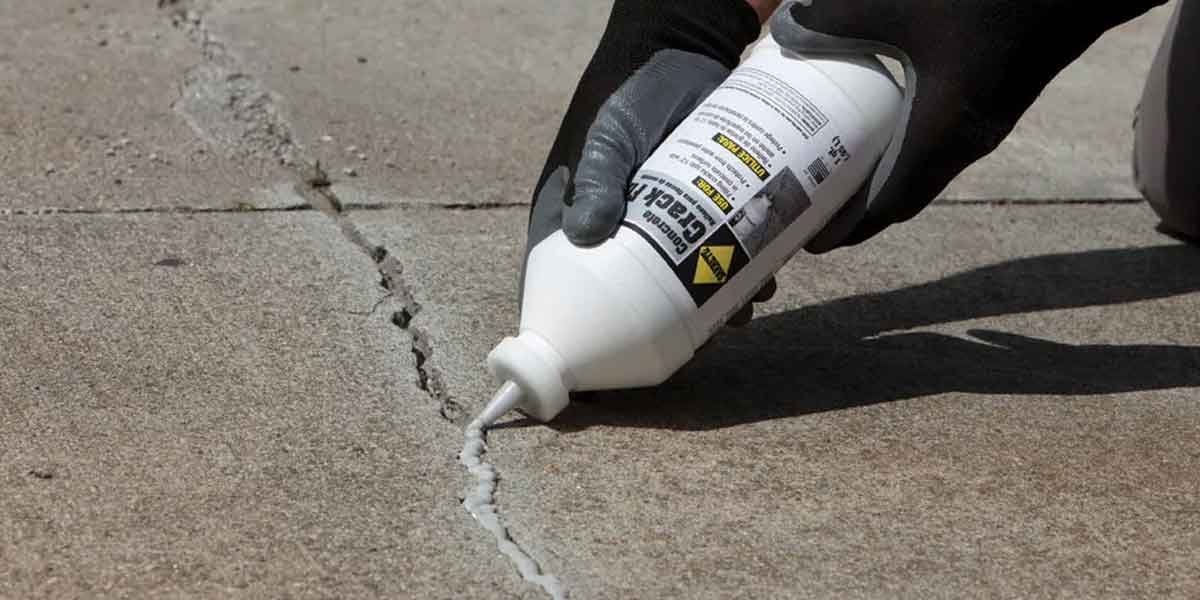

Rigid filler for dead cracks, flexible sealant for live ones. That single judgment decides most concrete crack repair calls.
The question product labels skip is whether the crack has stopped moving.
A shrinkage hairline that has held the same width through a season will take a cement-based filler and stay shut. A crack that reopens every spring will chew through that same filler in one winter.
The behaviour of the crack decides the material, not the other way around.
Is the crack still moving?
A crack is still moving if it reopens, widens, or leaves one face standing higher than the other, and no filler holds a moving crack. One that has kept its width through a heating season is stable enough to patch.
Rigid compounds set hard and brittle.
When the two sides shift even a millimetre, the patch shears along the bond line and lifts out of the crack in one piece.
Flexible sealants stretch with the concrete and hold on joints that open and close with temperature.
They cost more per tube. They never disappear against a trowelled slab.
That is the trade.
Signs that mean stop and look closer
Four patterns deserve an engineer or a foundation contractor before any filler goes in.
- A crack wider than 1/4 inch that reads the same on the inside and the outside of a wall
- Stair-step cracking through block or brick
- A long vertical crack in a wall that is bowing inward
- One face of the crack offset from the other, or a width that has grown since last year
DRYLOK’s own guidance puts the professional-inspection line at 1/4 inch for cracks visible from both faces of a building, and names stair-step cracking in masonry as the pattern that points to a weakened wall.
The pencil-line test
Draw a pencil line straight across the crack at a right angle and write the date beside it. Cheap, and it answers the movement question in one season.
Photograph the same spot once a month from the same angle. If the pencil mark breaks, or its two halves step out of line with each other, the crack is working. If the mark sits unbroken through a winter and a summer, the crack has quit.
In a basement the same crack reads as a dark line with a chalky edge, hairline where it meets the wall and wider near the sump. Dust settles into it. By late summer the line looks darker than it did in spring.
Ask a room of experienced builders which product belongs in a floor crack and the answers contradict each other. A thread on Green Building Advisor, opened in February 2022 by a homeowner with cracks and chips in a basement slab, is a fair sample.
“Seems to me cracks in a concrete floor are almost 100% cosmetic and an indication the base under the concrete was settled slightly. It seems to me the base is likely to settle more over time making any repair temporary at best.”
— walta100, Green Building Advisor forum, February 2022
He adds that cement-based products will not stay put in cracks under 1/8 inch and points to epoxy instead.
“First, clean with water and wire brush. Then a simple wash with Portland in a bit of water slurry. Then, 1 part Portland cement and 2 parts sand to patch all. Feather with a sponge.”
— PAUL KUENN, Green Building Advisor forum, February 2022
Same thread, opposite advice: a rigid cement mix, chosen deliberately, because a mix like that can be re-done whenever the slab settles again.
Both men are describing their own floor accurately. The pencil line is what tells you which floor you are standing on.
Which filler fits which crack
Concrete crack repair products divide by what the crack does and where it sits, not by brand. A dead interior hairline takes a vinyl patching compound, a working joint takes a self-levelling polyurethane sealant, and the space left by a chipped or chiselled edge takes a cement mortar with a bonding agent.
- Dead hairline in an interior slab. Vinyl patching compound trowelled in from a cartridge, or a masonry crack filler built for a caulking gun. Vinyl compound needs no bonding agent; cement mortar does.
- Working joint, driveway or garage apron. Self-levelling polyurethane sealant, the family Sikaflex Construction Sealant belongs to, or QUIKRETE Polyurethane Concrete Crack Sealant. Deep cracks need something behind the sealant to stop it running away.
- Chiselled opening or spalled edge. A polymer-modified structural repair mortar, pushed in and tamped so air pockets cannot sit under the skin.
- Water weeping through a wall crack. Hydraulic cement sets against running water. The water still has to be dealt with, or the crack returns as a damp line.
- Crack narrower than 1/8 inch. Cement-based fillers will not stay in a slot that tight; a low-viscosity epoxy will.
Concrete crack repair on a slab, step by step
Six steps cover the whole job, and the order matters more than the product. Open the crack into an undercut V, clean out the grit, prime the sides, back the deep ones, fill in lifts, and tool it while it is still plastic.
- Undercut the crack with a chisel and a small sledgehammer so the base of the opening is wider than its top. A patch keyed into an undercut cannot back out.
- Wire-brush out the loose grit, then flush the crack with water or blow it clean with compressed air. Dust left in the slot blocks the bond.
- Prime the sides with a thin slurry of neat Portland cement or a latex bonding agent. Vinyl patching compound skips this step.
- Back a deep crack to within 1/4 inch of the top. Oakum, backer rod, or fine sand all work. The point is to stop the filler running down the crack.
- Fill and tamp. Press the compound in with a trowel, tamp to drive out air pockets, then trowel it flush.
- Above 1/4 inch, work in layers. QUIKRETE’s instruction for its Concrete Crack Seal is multiple applications with 24 hours between them.
Finish before the material takes a skin. QUIKRETE Concrete Repair skins over in about 20 to 40 minutes and sets fully in about an hour, which is the window you have to tool the patch level with the surrounding slab.
That window also sets the size of the job you can take on in one go.
Wall cracks and why the patch comes back
Wall cracks fail for a reason a floor crack does not have: water arrives under pressure and the crack is the path it takes. Plugging the crack without managing that water buys a few months, then the damp line returns along the same line.
Concrete crack repair on a basement wall is a water problem first. Drains, grading, and a concrete waterproofing sealer on the wall face decide how much water ever reaches the crack, and a sealer applied over a live crack will bridge it for one season at most.
Steel inside the wall is the second problem. Once a crack gives chloride ions and carbon dioxide a path in, the reinforcement corrodes, the iron oxide that forms takes up more space than the steel it replaced, and the expansion pushes the crack wider. The mechanism is standard in any account of concrete degradation.
Outdoors the weather does the same work faster. Water sits in an open crack, freezes, expands, and widens the opening a little each cycle.
An unfilled crack in a driveway or walk never improves on its own.
Settlement is the slowest of the three and the one that decides whether a patch is permanent. A slab that keeps settling will keep working its cracks open, and the patch becomes a maintenance item rather than a repair.
Watch the crack for a season before spending anything on it. Movement decides whether the patch holds, and the pencil line you drew last spring already knows the answer.
FAQ
What does Coca-Cola do for concrete?
The cola trick is a cleaning trick. Mild acid lifts rust stains and light surface grime from the top layer of a slab; it does not fill an opening, bond two faces together, or carry load.
Can Quikrete fill cracks in concrete?
QUIKRETE sells both a crack sealant and a repair mortar, and the label decides which crack each one suits. The polyurethane crack sealant goes into joints and working cracks, the repair mortar goes into chiselled openings, and above 1/4 inch the sealant is applied in multiple passes 24 hours apart.
What is a good crack filler for cement walls?
A masonry crack filler or hydraulic cement suits a leaking wall crack, and a polyurethane sealant suits one that opens and closes with the season. Sealing is only half the job while water is collecting on the far side of the wall.
Should you fix hairline cracks in concrete?
A shrinkage hairline in a dry interior slab can be left alone; it is cosmetic and it has stopped moving. Seal it if it sits outdoors, if it is a path water uses into a basement, or if a floor covering is going over the top.
How much does concrete crack repair cost?
The tube and the bag of mortar are the cheap part. Cost sits in preparation and in the diagnosis: a hairline sealed over with a cartridge is a small job, while a chiselled and layered repair, or a crack a contractor has to assess for movement, is priced by the labour around it. No two quotes on the same crack land in the same place.