
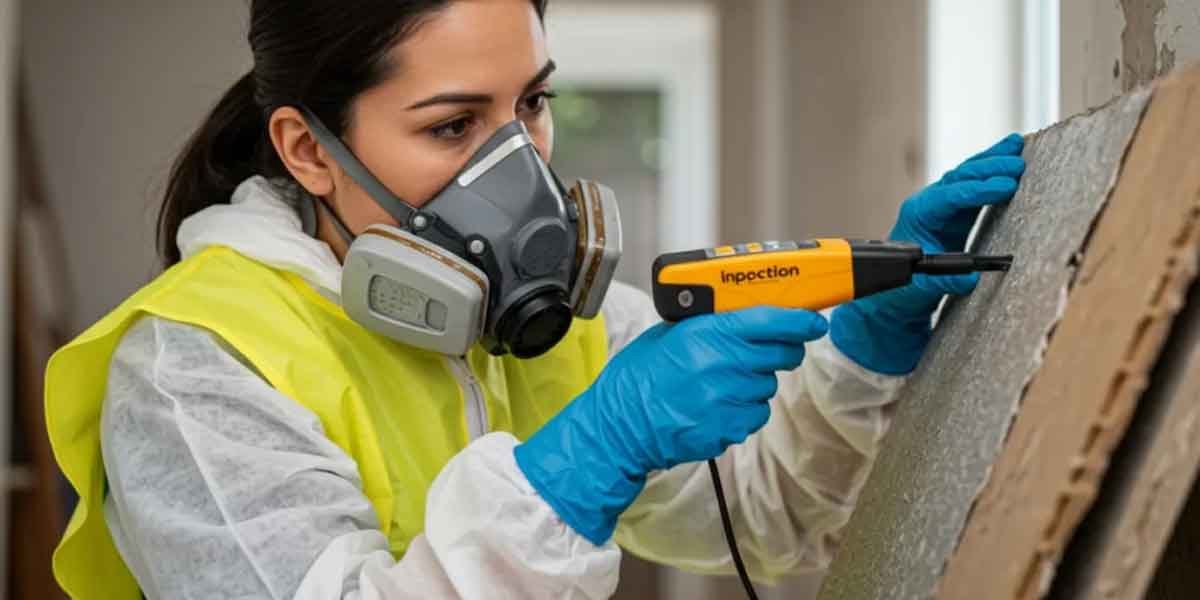

A typical asbestos testing cost for a single US home runs $250 to $750, with most homeowners landing near $500.
That figure gets repeated everywhere and explained almost nowhere. Fixr’s cost guide puts the national average at $500 for an inspection plus a physical sample test, with a low end of $120 for a dust sample and a high end around $1,200 when air testing is involved, says Oak Trust Management company. The spread is not noise. It tracks sample count, travel and how quickly you want the lab report.
Compare bids on sample count and turnaround. A price with no sample number attached tells you nothing about what the report will cover.
Asbestos testing cost: what the invoice is built from
An asbestos invoice is a trip charge plus a per-sample fee plus lab work, not a flat rate for a house. A Healthy Home, a Colorado asbestos consulting firm, publishes its rate card: $165 per visit, $37 per sample, and $115 when a demolition permit is needed.
Run the arithmetic. One visit with five samples comes to $165 + (5 x $37) = $350. Eight samples on the same visit reaches $461. A second visit, which happens when a permit office wants results before the next inspection, adds another $165 before any lab work enters the total.
Lab fees and the summary report sit inside that per-sample figure at this firm, and results come back the next day at the standard price. Not every market works that way. Where samples are mailed to an out-of-state lab, you pay in shipping time, and rush handling carries a surcharge.
The 3-5-7 rule sets the sample count
Federal minimums are three samples for a homogeneous area of 1,000 square feet or less, five for areas between 1,000 and 5,000 square feet, and seven above 5,000 square feet. That is the 3-5-7 rule, written into AHERA at 40 CFR 763.86(a) for friable surfacing material.
A homogeneous area is material that looks the same, installed at one time: same color, same texture. Count them separately, because they are priced separately. A textured ceiling in a hallway, the same texture over a living room, and a taped drywall seam in a basement become three line items once an inspector treats them as three areas.
Surfacing material is not the only category. Thermal system insulation takes at least three samples per homogeneous area, with a patched section under six linear or square feet sampled once. Friable miscellaneous material, floor tile and mastic included, is sampled enough to settle the question, which in practice means two or three per area.
Samples are never composited. Each one is analyzed by polarized light microscopy, and a single result above 1% asbestos classifies the whole homogeneous area as asbestos-containing material. Averaging results is not acceptable, which is exactly what matters on patchy materials where three samples come back at 0%, 2% and 15%.
The EPA’s nine-sample scheme is the alternative worth knowing about. Its 1985 sampling guidance, the Pink Book, divides a homogeneous area into nine subareas and takes one sample from the center of each, which raises the odds of catching patchy asbestos above what 3-5-7 delivers. An inspector asking for nine samples on a 900-square-foot ceiling is not padding the bill.
Why two quotes differ by hundreds
Three testing methods carry three price bands, and the method decides where an asbestos testing cost lands: dust sample testing at $120 to $180, a physical sample test at $250 to $750, and air testing at $300 to $1,200, all from Fixr’s guide.
Method is the first fork in the road. Dust sampling means collecting settled dust and mailing it off, which is cheap and narrow, since it reports what settled on surfaces and says nothing about the wall cavity. A physical sample test is what most renovation projects need. Air testing uses a pump and a filter over a set period and costs the most, usually after abatement to confirm the work.
Method choice alone explains much of the gap between published local figures. Homeyou lists Houston testing at a typical range of $147 to $2,961 while also describing the average as under $300. JJ&S Environmental in Los Angeles quotes $300 to $800 for most residential work. Both numbers can be true in the same month.
Two add-ons push the total after the method is settled. Point counting, where a lab quantifies the percentage of asbestos in a positive sample instead of simply reporting it, is a paid upgrade that abatement contractors ask for. Rush turnaround is the other, and a next-day result that is standard at one local lab is a surcharge at the next.
When the law decides for you
The federal trigger for a full survey before renovation is 260 linear feet on pipes, 160 square feet on other building components, or 35 cubic feet off components, under the asbestos NESHAP at 40 CFR 61.145. Cross one of those in a calendar year and the project carries notification and work-practice duties.
Notification reaches the state or local air agency at least 10 working days before work starts, and it has to be updated if the amount of affected material changes by 20% or more. For unscheduled renovation work the three thresholds are cumulative across the calendar year, a detail that catches contractors running several small jobs in one building.
The EPA does not require this of owners of detached houses or residential buildings with four or fewer dwelling units, which is why a homeowner planning a kitchen remodel files no federal paperwork. Testing before a renovation still makes sense, because a county or city permit office can require an asbestos survey before it issues a demolition or remodel permit.
What the test fee does not buy
A positive result starts a second and much larger bill, because the test fee covers sampling and analysis only. Removal runs $400 to $500 per hour according to Fixr, and repairs after removal can push a project past $10,000. Testing, abatement and the post-abatement clearance inspection are three separate contracts.
Keep those contracts separate on purpose. The EPA tells property owners not to use one firm to assess a property and then remove the material, because a company that finds asbestos and profits from the cleanup carries an incentive no contract language fixes. Some test-only firms advertise exactly that independence as their selling point.
Insurance is the part homeowners get wrong most often. Standard HO-3 policies treat asbestos as a pollutant, and the pollutants exclusion along with the ordinance-or-law exclusion reaches the cost of testing for, monitoring or responding to pollutants. Courts have not settled the question cleanly. In Martinez Auto Parts v. Western Heritage Insurance (W.D. Wash. 2020), a judge refused to rule that asbestos abatement was categorically excluded. The exception that does work is a covered peril: fire, wind or another insured event damages material that turns out to contain asbestos, and the abatement folds into that claim. A planned renovation is not a covered peril.
When a positive sample forces demolition, the repair bill follows the same logic as any rebuild after damage. Basement mold remediation costs break down the same way, with the testing establishing what is present and the removal scope setting the invoice.
Turnaround, and the do-it-yourself question
Turnaround runs from same-day to two to three weeks depending on the lab. Same-day and next-day results come from labs that run polarized light microscopy in house, and some fold that speed into the standard price. Samples shipped out and batched are the slow end, with rush surcharges on anything inside a week.
Do-it-yourself sampling is legal in most states and still a poor idea for anything friable. Kits exist, and a dust sample you collect and mail in is the cheapest option on the market at $120 to $180. The risk sits in the sampling rather than the lab. Breaking a piece off a popcorn ceiling or a damaged pipe wrap releases the fibers you are trying to measure, and one sample from one spot misses patchy material.
Some states add their own layer. Colorado registers asbestos consulting firms and certifies individual building inspectors, and the registration number plus the inspector’s certification dates belong on the quote. Ask for those in writing, along with the name of the lab that will run the analysis.
Five bids for the same job will disagree, because the inspectors counted different areas and picked different methods. Ask each one for the sample list, the analysis method, the lab name and the turnaround before you weigh a single asbestos testing cost figure.
What makes a low bid comparable is the written sample count, the named lab and the inspector’s certification, because state rules and policy forms vary enough that no national average settles your case.
Asbestos testing cost FAQ
Can I test asbestos myself?
You can collect a sample and mail it to an accredited lab, and it is legal in most states. The EPA recommends a trained inspector for friable material, because sampling disturbs the fibers and a single sample from a single spot commonly misses patchy asbestos.
How much does it cost to test one asbestos sample?
A Healthy Home in Colorado advertises $37 per sample on top of a $165 trip charge, with lab fees and the summary report included. The final bill depends on how many samples the inspector takes, not on that per-sample rate.
Does homeowners insurance cover asbestos testing?
Rarely for a planned renovation. HO-3 policies carry pollutants and ordinance-or-law exclusions that reach the cost of testing for pollutants, and asbestos is treated as a pollutant. Coverage appears when a covered loss such as a fire or windstorm damages material that then tests positive.
What is the 3-5-7 rule for asbestos sampling?
It is the AHERA minimum sample count for each homogeneous area of friable surfacing material: three samples up to 1,000 square feet, five between 1,000 and 5,000 square feet, and seven above 5,000. Every homogeneous area gets counted on its own.