
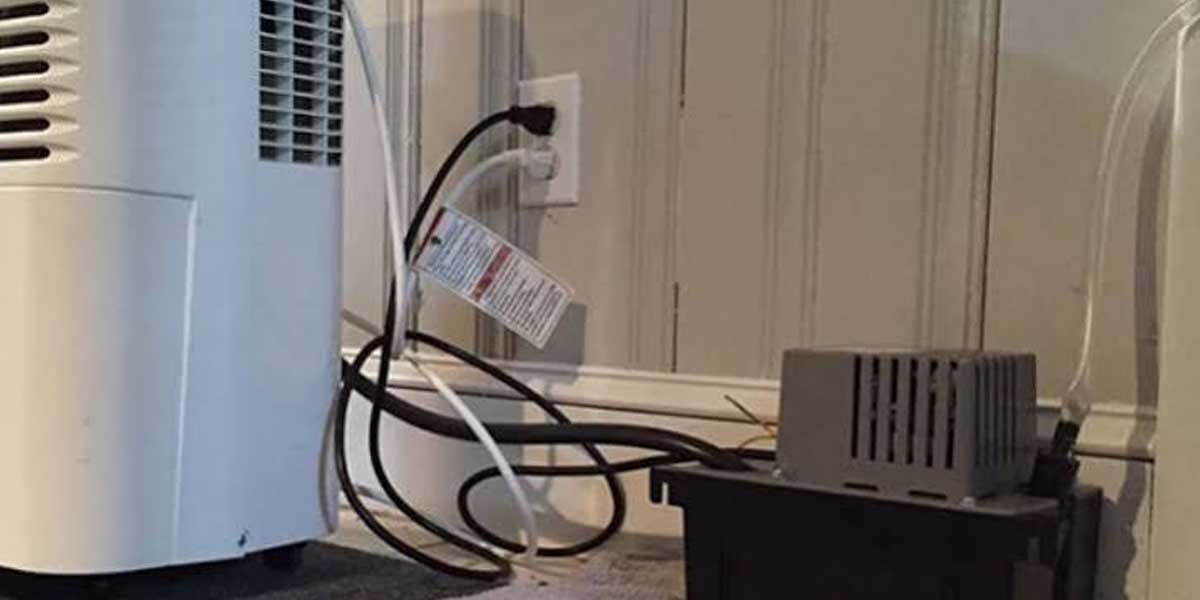

A basement dehumidifier drain to sump pump connection lets the unit empty itself into the same pit that already collects groundwater, so you stop hauling a bucket up the stairs. The catch is elevation. The dehumidifier has to sit above the water level in the pit, or a small condensate pump has to lift the water the last few feet.
Most people set this up once and forget it, which is exactly why it fails quietly six months later. A hose that sags, a pit that is not the one you think it is, and a discharge line that freezes are the three things that turn a clean install into a wet floor.
What follows is the setup, the fittings that fit, the pitfalls worth knowing before you cut a hose, and what to do when the basement has no pit at all.
Routing a Dehumidifier Drain Into the Sump Pump
The cleanest setup runs a hose from the dehumidifier’s drain outlet down into the sump pit, letting gravity carry the condensate to the same place the pump already empties. It works as long as the outlet stays above the pit’s high-water line. Reach for a condensate pump only when the unit sits too low.
The water itself is harmless here. A dehumidifier pulls moisture out of the air and condenses it, so what drips into the pit is distilled-grade water, the same thing a central air conditioner sends down its drain.
- Park the dehumidifier on a level surface near the pit, on a block or a small stand if the floor is uneven.
- Check the outlet height against the pit. The outlet must sit above the point where the pump kicks on, with a little room to spare.
- Thread or clamp the drain hose onto the outlet. Hand-tight on a garden thread, a hose clamp on a barbed fitting.
- Run the hose downhill the whole way. No dips, no loops, no place where water can sit.
- Direct the end over the pit, not into standing water, so it cannot siphon back.
- Pour a quart of water through the setup and watch it leave before you walk away.
Done this way, a basement dehumidifier drain to sump pump needs no further thought. The water leaves as fast as the machine makes it, and the bucket stays a backup you never touch.
Gravity Setup
A gravity drain needs one thing: the dehumidifier outlet higher than the water it drains into. If the outlet sits even a few inches above the pit’s trigger level, water falls on its own with nothing to wear out, plug in, or fail.
Elevate the unit on a concrete block or a sturdy shelf to buy that height. It does not take much. A working drop of a foot or two clears the pit rim easily and keeps the hose out of the way of your feet.
The failure mode is the sag. A hose that dips below its outlet holds water, and held water is a bowl for dust, biofilm, and the musty smell that follows.
Pumped Setup
A condensate pump is a small reservoir with a float and a motor that pushes water uphill when gravity is not available. It solves the low-unit problem and the long-run problem at once, and most models lift water several feet of vertical head without strain.
Buy a pump rated for the lift you need and check that number before installation, because a pump asked to climb too far runs long, heats up, and quits early. Route the pump’s discharge into the pit, and give it a check valve so water does not slide back when it cycles off.
You can also skip the add-on entirely. Some dehumidifiers ship with the pump already inside, which removes a fitting, a cord, and a failure point from the project.
Can You Drain a Dehumidifier Into a Sump Pump
Yes, with one condition: the pit must collect groundwater, not sewage. A sump pump moves clear water out of the foundation, and dehumidifier condensate is just as clean, so the two share a pit without trouble. A sewage ejector pit is a different system entirely.
That distinction matters more than it sounds. A stormwater sump pit sits low in the basement and handles seepage and rising groundwater. A sewage ejector pit handles the waste from a basement bathroom, and it is sealed and vented for a reason.
Homeowners sometimes confuse the two because both are round basins set into a concrete floor. Look at the lid. A sealed, bolted, gasketed lid with a vent pipe means sewage. An open or loosely covered basin means groundwater.
The mistake is quiet and expensive. A homeowner sees a covered pit, assumes every pit is the same, and connects a clear-water drain to the one system in the house built to handle waste.
Matching the Hose, Fittings, and Slope
Most units ship with a threaded outlet sized to a standard garden hose, usually 5/8 inch, and that hose is all you need for a gravity run. Match the fitting to the outlet first, then keep the whole line on a steady downward slope so nothing pools along the way.
A dehumidifier removes water by cooling air below its dew point, which is why the outlet, the coils, and the drip tray are all designed to shed water continuously rather than hold it.
| Drain part | Common size or type | What to watch |
|---|---|---|
| Outlet on the unit | Threaded spigot, often 5/8 inch (garden-hose thread) | Some units need an adapter included in the box |
| Hose | Standard garden hose or clear vinyl tubing | Keep an even fall; avoid low spots that trap water |
| Fittings | Barbed adapter, hose clamp, or PVC elbow | Clamp every joint; PVC glue sets in seconds |
| Slope | Roughly 1/8 to 1/4 inch of fall per foot | Flat runs and uphill runs both stall the flow |
Clear tubing shows you the water moving, which makes clogs easy to spot, but it also traps light and grows biofilm faster than an opaque hose. A garden hose hides the flow and lasts longer in the dark.
If you glue a PVC run, dry-fit the whole path before you open the can. The glue grabs in seconds, and a joint you set crooked stays crooked.
When the Drain Stops Working
A drain that quits is almost always one of four things: a clog, an air lock, a frozen discharge line, or water backing up from the pit. Each leaves a different signature, and each has a fix that takes minutes.
Start at the source and work downstream. The outlet clogs where the water is slowest, the hose sags where it dips, and the discharge freezes where it meets cold air.
Why does this matter? Because the cheapest fix is the one you catch early, before the water finds the floor instead of the pit.
| What you see | Likely cause | The fix |
|---|---|---|
| Water pools in the tray, hose stays dry | Clog at the outlet or a kink in the line | Clear the spigot, straighten the hose, flush with warm water |
| Water gurgles and drains slowly | Air lock, or a low spot holding water | Re-route so the hose falls the entire way |
| Water on the floor near the outdoor end in winter | Frozen discharge line | Thaw the line, then add fall or run it indoors |
| Pit water rises into the hose instead of falling | Backflow, or a hose end sitting in water | Lift the hose end above the pit’s trigger level, add a check valve |
| Dehumidifier shuts off while the room is damp | Full tray, float switch tripped | Clear the drain so the unit keeps running |
A frozen line does not announce itself. The dehumidifier keeps running, the bucket stays empty because the water is going somewhere, and the first sign of trouble is a wet patch where the hose finally splits.
When a Sump Pump Is the Wrong Target
Not every basement has a sump pit, and not every pit sits where a dehumidifier can reach it. A floor drain, a utility sink, a condensate pump to a laundry tub, or a dry well outside can all take the water instead.
If the pit itself is still the question, a french drain and a sump pump solve different problems, and only one of them gives you a basin to drain into. Sorting that out first saves a rerouted hose later.
The best option is whichever one is downhill from your unit. If the floor already slopes to a drain, use it. If a sink is close, a hose and a short drop do the job.
A floor drain accepts condensate the same way it accepts a spill, provided it is not clogged and does not back up in heavy rain. A utility sink takes the water and sends it to the same sanitary line as the rest of the house.
When nothing indoors is downhill, a condensate pump empties the unit into a sink or a laundry tub across the room. It is the same device that solves a low pit, pointed at a different destination.
If the dehumidifier serves a crawl space, the answer can differ again, because drying that space and keeping the basement dry are related jobs with different targets. A crawl space often needs its own drainage path rather than a share of the basement pit.
The wrong fix is never free. Money spent on a repair that cannot work is money spent twice, once on the wrong part and again on the right one.
Keeping the Line Clear Through the Year
A gravity drain needs very little upkeep, but the few chores that matter are seasonal. Flush the line before the humid season, protect outdoor discharge from freezing, and test the flow after any long shutdown.
Run warm water through the hose at the start of spring, when the dehumidifier is about to work hardest. The rinse clears the film that builds up over a dry winter and lets you see the flow before you rely on it.
Watch the slope once a year. A hose that was fine in October can sag by July as the floor settles or someone kicks it, and a new low spot is a new clog waiting to form.
If the setup sends water outside, winter is the enemy. Disconnect the outdoor run before the first hard freeze, or switch to an indoor destination for the cold months so the line cannot ice shut.
If the pit runs long or cycles hard, it may be undersized for the water it sees, and what a sump pump installation costs is worth knowing before it fails on a wet night.
Minutes, not hours. That is the whole maintenance schedule for a drain that was routed right the first time.
Frequently Asked Questions
How do I drain a dehumidifier into a sump pump?
Run a hose from the dehumidifier’s drain outlet downhill into the sump pit, keeping the outlet above the pit’s high-water line so gravity carries the condensate. If the unit sits below that line, add a condensate pump to lift the water the last few feet.
Can you drain a dehumidifier into a sump pump?
Yes, as long as the pit is a groundwater sump pit and not a sewage ejector basin. Dehumidifier condensate is clean water, and it shares a clear-water sump pit without any problem.
How high above the sump pump does the dehumidifier need to be?
High enough that the drain outlet sits above the pit’s trigger water level, which usually means one or two feet above the pit rim. Any steady drop lets gravity work, and without it you need a pump.
Do I need a condensate pump if the dehumidifier sits lower than the pit?
Yes. Gravity cannot push water uphill, so a unit below the pit’s water line needs a small condensate pump to raise the condensate into the pit. Check the pump’s vertical lift rating against the height you need.
Why does my dehumidifier drain line keep clogging?
Clogs form where the water is slowest, usually at a low spot in the hose or inside the unit’s outlet spigot. A flat or sagging run holds water that collects dust and biofilm, so the real fix is a hose that falls the whole way.
Is it normal for the sump pit to smell when the dehumidifier drains into it?
A musty pit smell comes from standing water and debris already in the basin, not from the clean condensate adding to it. Keep the sump pit clean and covered, and the dehumidifier’s water will not change the odor.
What if my basement has no sump pump?
Use a floor drain, a utility sink, or a condensate pump that empties into a laundry tub or sink across the room. A dry well or the home’s HVAC condensate line can also take the water when they are reachable.
Does a dry basement still need a dehumidifier?
Often yes, because humidity rises without visible water. Warm outside air that cools indoors releases moisture, so a basement can climb past a safe level even when no drop of water ever enters it.
The Point of the Whole Setup
A dehumidifier that drains itself into the right pit stops being a chore and starts being infrastructure. The bucket never fills, the space stays dry, and the machine runs where you are not watching.
Almost every failure comes back to three habits: matching the pit to the water, giving gravity a clear fall, and keeping the line from freezing or sagging. Get those right and a basement dehumidifier drain to sump pump stays on the job for years.