

Most wet basements are a drainage problem, not a wall problem. That single distinction decides which basement waterproofing solutions will actually work, and which will leave you mopping the same corner again next spring.
Water arrives one of four ways: from below, from the sides, from above, or from the air. Below means hydrostatic pressure pushing through a saturated slab or the joint where the wall meets the floor.
Sides means a high water table or heavy clay soil that holds water against the wall. Above means gutters, downspouts, or grading that sends roof water downhill into the foundation.
From the air means condensation, which is a humidity problem rather than a leak. Each path has a matching fix, and the fixes are not interchangeable.
What follows is a plain look at the basement waterproofing solutions that hold up, what each costs, and how to tell which one your basement is asking for.
Why Basements Get Wet
Water reaches a basement through four routes: hydrostatic pressure from saturated soil, seepage at cracks and the cove joint, surface water from failed grading or clogged gutters, and condensation from humid air. Diagnosing the route is what separates a fix that lasts a decade from one that fails within a season.
Hydrostatic pressure is the weight of groundwater pushing against the foundation from outside. When the soil around a house stays saturated, that pressure finds the weakest points: hairline cracks, the cove joint, and tie-rod holes left from the original pour.
Soil type makes this worse. Clay holds water instead of draining it, so a heavy rain can keep the water table pressed against the wall for days.
Surface water is the most fixable cause and the most often ignored. A downspout that dumps beside the foundation, or soil that slopes toward the house, delivers roof water straight to the wall.
Condensation looks like a leak but is not one. Cool basement walls and pipes pull moisture out of warm, humid summer air, and that water collects on the floor.
One sign is easy to miss. Efflorescence, the chalky white bloom that forms on block walls, is mineral salt left behind as water evaporates, and it marks where moisture has been moving through the masonry.
The U.S. Environmental Protection Agency frames mold control as moisture control. Damp surfaces can support mold growth within a day or two, so finding the water source matters more than any cleaner.
Interior Drainage Systems: The Backbone Fix
An interior drainage system is a perimeter network of perforated pipe set in washed stone beneath the slab, along the inside of the footing, that captures water before it rises through the floor. It is the most common permanent fix for hydrostatic water, because it removes the water instead of trying to hold the wall dry.
Contractors call the pipe drain tile, though little of it is actually tile anymore. Modern systems use rigid PVC or flexible perforated pipe wrapped in filter fabric to keep silt out.
What an Interior Drainage System Includes
A full system has four parts: the perforated pipe along the footing, washed stone around and above the pipe, a sump pit that collects the water, and a discharge line that carries it away from the house. A filter fabric sleeve keeps the stone from clogging with soil over time.
Water enters the pipe through the perforations, flows by gravity to the lowest point, and drops into the sump pit. From there a pump takes over.
Drain Tile, Footing Drain, and French Drain
These terms get used loosely, and the difference matters. A footing drain sits at the base of the foundation and manages groundwater, while a French drain is a shallow trench of gravel and pipe that handles surface and shallow subsurface water.
An interior system is essentially a footing drain built inside the basement. Because it needs no excavation, it can be installed year-round and works in a finished basement.
Sump Pumps and Backup Power
A sump pump is a device that lifts collected water from a pit and pushes it through a discharge pipe to a point above and away from the foundation. It is the engine of any interior system, and it is also the part most likely to fail exactly when it is needed most.
Most homes use a submersible pump, which sits inside the pit and runs quieter and cooler than the older pedestal style. Pit size matters: a pit that is too small makes the pump cycle too often, which shortens its life.
Power is the real weak point. The storms that trigger basement flooding are the same storms that knock out electricity, so a pump with no backup can leave a working system idle at the worst moment.
The pump did its job for nine years. It failed the one night the power went out.
A battery backup pump runs on a charged battery when the power fails, giving several hours of protection for the most common outages. A water-powered backup uses municipal water pressure instead of electricity, which lasts longer but needs a dependable supply and sends that water down the drain.
Discharge details cause quiet failures too. If the outlet pipe slopes back toward the house, or ends where it can freeze, water returns to the pit or backs up in winter.
Vapor Barriers, Encapsulation, and Humidity Control
A basement vapor barrier is a heavy plastic sheet laid over the floor, and sometimes up the walls, to block moisture that would otherwise evaporate into the room. It controls humidity and radon well, but on its own it does not stop a pressurized water problem.
Barrier thickness is the main choice. A 6-mil sheet is a light-duty floor cover, while a 20-mil sheet is far more puncture-resistant and is the usual choice under a finished floor.
Encapsulation is the full version: a sealed barrier over the floor, up the walls, and often across the rim joists, sealed at every seam and penetration. A floor-only barrier over a wet slab can trap water underneath and make the real problem harder to see.
Where water is not pressurized, a barrier plus ventilation keeps a basement usable. Where water is actively rising, the barrier is a supplement to drainage rather than a replacement.
Do You Need a Dehumidifier?
A basement dehumidifier treats humid air, which is why it helps with condensation and the faint musty smell that hangs in damp rooms, but it will not stop a leak. Size it to the space, set it near 50 percent relative humidity, and use a continuous drain so you are not emptying a bucket twice a day.
Energy Star guidance on sealing air leaks and adding insulation points in the same direction. A drier, better-sealed shell is easier to keep comfortable and cheaper to condition.
The same logic applies to the crawl space, where the choice between insulation and encapsulation comes down to whether the problem is heat loss or moisture.
Exterior Waterproofing and Site Drainage
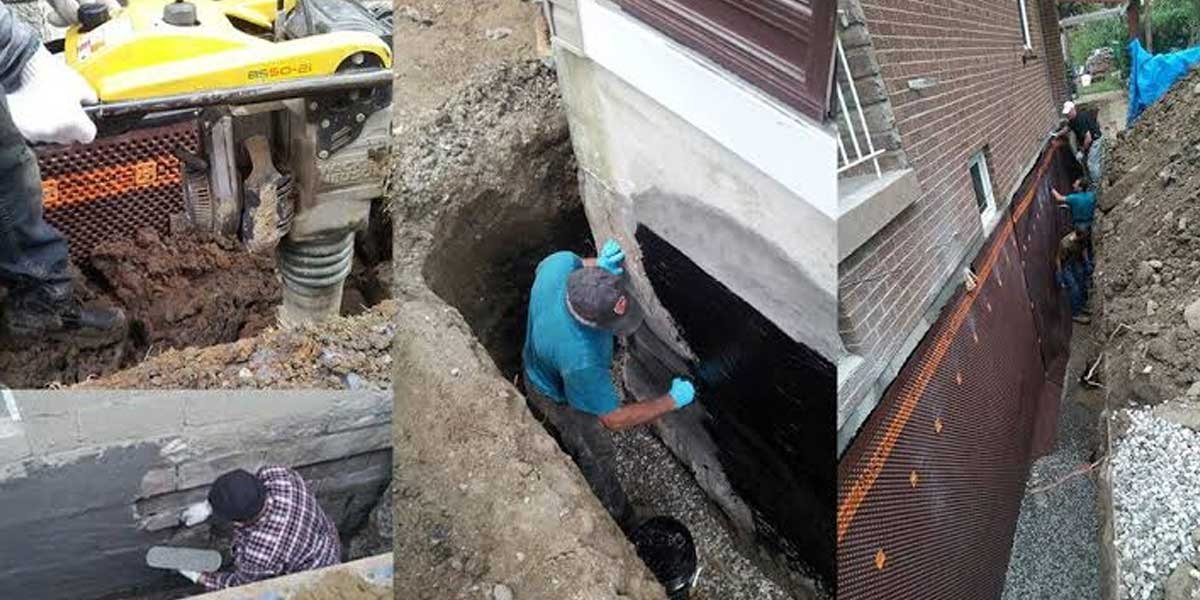
Exterior waterproofing means excavating down to the footing, coating the wall with a waterproof membrane, adding a drainage board, and installing a footing drain at the base. It addresses water from the outside, where it starts, but the excavation makes it the most expensive and disruptive option.
For a home with finished landscaping, a deck, or a driveway against the wall, exterior work can be impractical no matter the budget. That is why many contractors recommend interior drainage for existing homes and reserve exterior membranes for new construction or severe cases.
Site drainage is the low-cost half of exterior work and the first thing to check. Clean the gutters, extend downspouts several feet from the foundation, and regrade so the soil slopes away from the house.
Where standing water collects in the yard, a French drain for standing water can move surface water away before it ever reaches the foundation.
Interior vs. Exterior: The Trade-Off
Neither approach is automatically better. Each fits a different situation.
| Factor | Interior drainage | Exterior waterproofing |
|---|---|---|
| Typical cost | Lower to mid range | Higher, excavation-driven |
| Disruption | Minimal, done from inside | Major, yard and hardscape removed |
| Lifespan | 20-30+ years with pump upkeep | 20-30 years |
| Best for | Existing homes, finished basements | New builds, severe seepage |
| What it fixes | Water already inside the wall | Water before it reaches the wall |
Crack Injection, Sealants, and Coatings: What They Can and Can’t Do
Basement crack injection fills a single crack from the inside with epoxy or polyurethane resin, sealing it at the source. It is the right fix for an isolated leaking crack and the wrong fix for water coming through many cracks or the floor, which signals a drainage problem.
Epoxy is rigid and suits dry, stable cracks that are not moving. Polyurethane stays flexible and foams on contact with water, which makes it the pick for active leaks.
A crack that leaks only during heavy rain is usually water finding a path, not structural failure. A crack that keeps widening is a different matter and needs a foundation assessment rather than a tube of sealant.
Not always. The crack repair can be complete and the basement can still stay damp, because a sealed crack does nothing about pressure building behind the wall.
Surface sealers and masonry paint are the weakest option. They can look like a fix for a season, but water pressure behind the wall tends to push them off, and a coating over a wet wall can trap moisture and accelerate spalling.
The cheapest repair and the most expensive one sometimes chase the same puddle. The difference is whether the water was ever given somewhere else to go.
Hydraulic cement can plug a gushing hole long enough to work nearby, but it is a pause button rather than a repair.
Matching the Solution to the Problem: A Diagnostic Table
Start with what you actually see, because the symptom points to the cause and the cause points to the fix. This table routes the most common basement complaints to the solution that usually resolves them.
It depends on the route. Two basements with the same puddle can need two different systems.
| What you notice | Likely cause | First step |
|---|---|---|
| Wet floor along the walls, worst after rain | Hydrostatic pressure at the footing | Interior drainage plus sump |
| Water at a single crack | Isolated crack, active or dormant | Crack injection |
| Damp and musty, no standing water | Condensation or high humidity | Dehumidifier plus vapor barrier |
| Water only at the wall-floor joint | Cove joint seepage | Interior drainage |
| Wet only near a downspout | Surface water and grading | Gutters, extensions, regrade |
| Puddle rising from the floor center | High water table | Sump with backup power |
Home inspectors tend to see the same handful of failures, and surface grading shows up more often than any crack. Sound familiar?
What Basement Waterproofing Solutions Cost
Costs vary widely by region, foundation type, and access, so treat these as typical U.S. ranges rather than quotes. The pattern is consistent: fixing water from the outside costs the most, and the cheapest fixes only work when they match the actual cause.
| Method | Typical range | Notes |
|---|---|---|
| Interior drainage system plus sump | $3,000 – $10,000 | One-time, minimal disruption |
| Sump pump (primary) | $600 – $1,800 | Backup adds $400 – $1,200 |
| Vapor barrier (floor) | $1,000 – $3,000 | Full encapsulation: $4,000 – $12,000 |
| Exterior membrane and footing drain | $8,000 – $30,000+ | Excavation drives the cost |
| Crack injection | $300 – $800 per crack | Priced per crack, not per wall |
| Masonry sealer or paint | $100 – $500 DIY; $1,500 – $4,000 pro | Short-lived, weakest option |
| Dehumidifier | $200 – $2,000 | Unit cost plus running power |
Choosing among basement waterproofing solutions comes down to two numbers: how much linear footage of drainage is needed, and how hard the site is to access. An unfinished basement with open walls is a different job from a finished one.
Watch for a quote that sells a system without a diagnosis first. A lifetime warranty on a fix that never addressed the water’s route is a warranty on the wrong problem.
Frequently Asked Questions
How do I know if my basement leak is serious?
A leak is serious when it keeps coming back, when it covers more than a small area, or when it shows up right after heavy rain. That pattern points to groundwater rather than a one-time spill, and mold can start on a damp surface within a day or two.
Can you waterproof a basement from the inside?
Yes, and for most existing homes interior drainage is the practical choice. It captures water at the footing and pumps it out, so it handles hydrostatic pressure without excavation, though it will not stop water vapor the way a full exterior membrane can.
How long does basement waterproofing last?
A well-built interior drainage system typically lasts 20 to 30 years with the sump pump replaced as needed. Exterior membranes last about as long but cost far more to repair later, and the pump is the part that wears out first.
Does a dehumidifier fix a wet basement?
No. A dehumidifier removes moisture from the air, which helps with condensation and odors, but it cannot stop water that enters through the wall or floor. Use it alongside drainage, not instead of it.
Is crack injection a permanent fix?
Crack injection is permanent for that crack when the crack was the whole problem. If water keeps finding new paths, the repair is buying time until the underlying drainage is addressed.
How much do basement waterproofing solutions cost?
Typical U.S. costs run from a few hundred dollars for a single crack injection to $3,000 – $10,000 for an interior drainage system, and $8,000 or more for exterior work. The range is wide because scope, access, and region all change the job.
Can I waterproof a basement myself?
You can handle the low-cost steps yourself: cleaning gutters, extending downspouts, regrading soil, and running a dehumidifier. Structural work involving drainage, sump pumps, or excavation is best left to a contractor who can diagnose the cause and warranty the result.
The Right Fix Is the One That Matches the Water
Basement waterproofing solutions are not ranked from cheap to best. They are matched to how water arrives, and getting the route right is what keeps the space dry for decades.
Get the route wrong and the most expensive excavation on the block still leaves a damp corner every spring.