
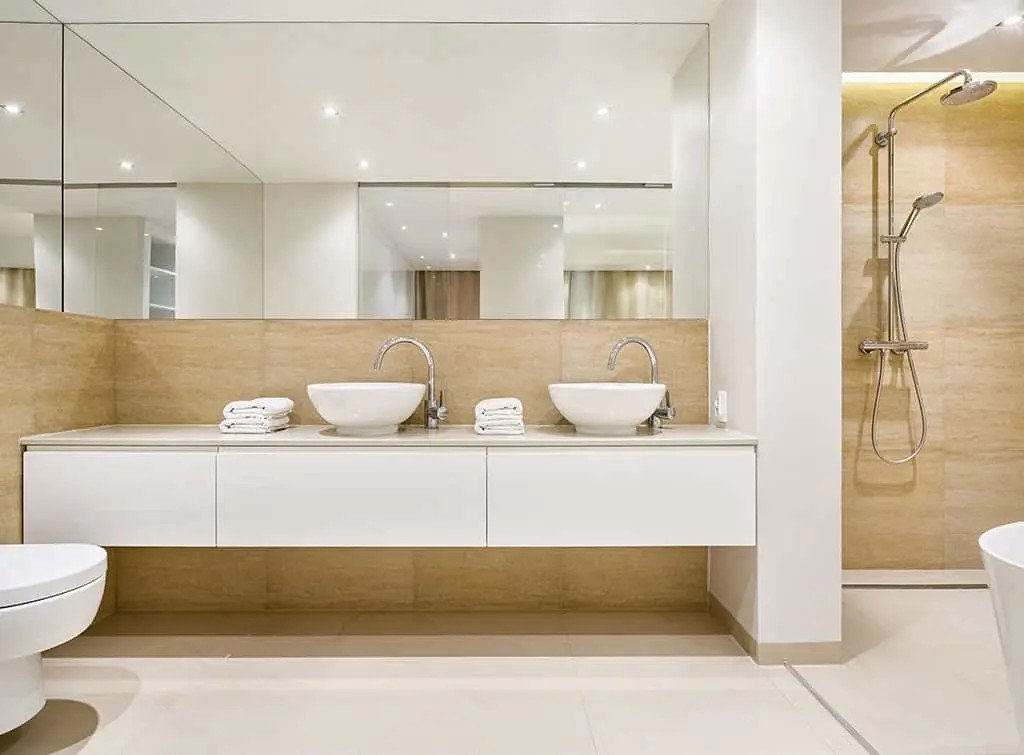

According to McCourt Real Estate & Property Management, this bathroom lighting cost guide covers what you will pay in 2026 for every fixture type. Bathroom lighting costs between $200 and $2,500 per fixture installed, depending on whether you are replacing an existing fixture or running new wiring for a new location. Replacing a vanity light with a like-for-like fixture costs $150 to $500 including the fixture and labor. Adding a new recessed light where no fixture existed costs \$300 to \$800. A full bathroom lighting upgrade with multiple fixtures, new circuits, and dimmer switches costs $1,500 to $4,000.
Bathroom lighting is subject to code requirements that other rooms are not — fixtures near water must be damp-rated or wet-rated depending on their proximity to the shower or tub. The cost difference between a standard fixture and a damp-rated fixture is small — $20 to $50 per fixture. The cost of installing a standard fixture that corrodes and fails within two years is the cost of replacing it with the damp-rated fixture you should have installed the first time.
Bathroom Lighting Costs by Fixture Type
| Fixture Type | Fixture Cost | Installed Cost (Replacement) | Installed Cost (New Location) |
| Vanity bar (2-4 lights) | $50 – $300 | $150 – $500 | $300 – $800 |
| Vanity sconce (single) | $40 – $200 | $120 – $400 | $250 – $600 |
| Recessed can (4- or 6-inch) | $20 – $80 | $150 – $350 | $300 – $800 |
| Flush-mount ceiling | $40 – $200 | $150 – $400 | $300 – $700 |
| Pendant light | $60 – $300 | $200 – $500 | $350 – $800 |
| Shower light (wet-rated recessed) | $40 – $200 | $200 – $450 | $400 – $900 |
| Exhaust fan with integrated light | $100 – $400 | $300 – $800 | $500 – $1,200 |
A replacement — swapping an existing fixture for a new one in the same location using the same electrical box — costs the least because no new wiring is needed. The electrician removes the old fixture, connects the new one to the existing wires, mounts it, and leaves. The entire job takes 30 to 60 minutes per fixture and costs $100 to $300 in labor per fixture, plus the fixture cost.
A new location — adding a light where no fixture existed, costs significantly more because the electrician must run new cable from the switch or from an existing circuit, cut a hole in the ceiling or wall for the fixture box, and patch and paint around the new opening. The labor is two to three times longer, and the additional materials, cable, box, connectors, add $20 to $50 per fixture. The total installed cost for a new-location recessed light is $300 to $800, compared to $150 to $350 for a replacement in an existing location.
Wiring and Circuit Requirements for Bathrooms
The National Electrical Code requires at least one ceiling-mounted or wall-mounted light fixture in every bathroom, controlled by a wall switch. A second circuit, a dedicated 20-amp circuit, is required for the bathroom receptacle outlets. The lighting can share a circuit with other rooms. The outlets cannot.
Adding a new circuit for bathroom lighting, rarely necessary unless the bathroom is being added to a house that previously had none, costs $350 to $700 for a standard 15-amp lighting circuit. The cost covers the breaker, the cable run from the panel to the bathroom, the switch, and the labor. If the panel is in the basement and the bathroom is on the second floor, the cost is at the high end because the cable must be fished through two floors of finished walls.
The U.S. Department of Energy recommends LED lighting for all bathroom fixtures due to the combination of energy efficiency, long lifespan, 15,000 to 50,000 hours, and the availability of color-temperature options that range from warm white at 2,700K for a soft, flattering light to cool daylight at 5,000K for task lighting at the mirror. LEDs cost more upfront than incandescent bulbs, $5 to $15 per bulb versus $1 to $2, but use 75% to 80% less energy and last 15 to 25 times longer. An LED bulb in a bathroom that is used two hours per day will last 20 to 68 years before it needs replacement.
Damp-Rated vs. Wet-Rated, the Code Distinction That Costs Money
Bathroom light fixtures must be rated for the zone they are installed in. Fixtures directly above a shower or bathtub must be wet-rated, designed to withstand direct water spray. Fixtures within 3 feet of the shower or tub but not directly above it must be damp-rated, designed for high-humidity environments where condensation is likely. Fixtures more than 3 feet from the water source can use standard dry-location ratings.
A wet-rated recessed shower light costs $40 to $200 for the fixture, $20 to $50 more than a standard recessed can, and the installation labor is identical. The cost difference is entirely in the fixture rating. Installing a standard fixture in a wet-rated zone saves $30 and creates a shock hazard and a corrosion failure that will require replacing the fixture within two years. The electrical inspector will flag an incorrectly rated fixture during the final inspection and require it to be replaced. The cost of doing it right the first time is lower than the cost of doing it twice.
Dimmers, Timers, and Smart Controls
A dimmer switch for bathroom vanity lights costs $15 to $50 for the switch and $50 to $100 for installation, $65 to $150 total. Dimming the vanity lights to 50% in the morning reduces the shock of bright light before coffee and extends LED bulb life by reducing heat buildup. A timer switch for the exhaust fan costs $20 to $60 for the switch and $50 to $100 for installation. A humidity-sensing switch that automatically turns the fan on when moisture levels rise costs $40 to $100 for the switch and $50 to $100 for installation, $90 to $200 total, and prevents the most common bathroom ventilation failure: the fan that never gets turned on because someone forgot.
Smart lighting controls, app-controlled dimmers, motion sensors, voice-activated switches, cost $50 to $200 for the device and require a neutral wire in the switch box, which older homes may not have. Running a neutral wire to a switch box that lacks one costs $150 to $400 per switch location. Confirm the switch box has a neutral before you buy a smart switch. The packaging does not mention this requirement prominently. The electrician will mention it when they open the box and discover it is missing.
Frequently Asked Questions
How much does bathroom lighting cost to install?
Replacing an existing bathroom light fixture costs $150 to $500 per fixture installed. Adding a new fixture in a new location costs $300 to $900. A full bathroom lighting upgrade with multiple fixtures, new switches, and dimmers costs $1,500 to $4,000. The cost depends on the number of fixtures, whether new wiring is needed, and the fixture quality.
What type of lighting is best for a bathroom?
LED lighting at 2,700K to 3,000K color temperature is best for most bathrooms. Vanity lights at eye level on either side of the mirror eliminate shadows on the face, the most common bathroom lighting complaint. A ceiling-mounted fixture provides ambient light. A recessed shower light with a wet rating provides safe illumination in the shower. A combination of ambient, task, and accent lighting creates a bathroom that works for both morning routines and evening relaxation.
Do I need a permit to install bathroom lighting?
Replacing an existing fixture in the same location does not require a permit in most jurisdictions. Adding a new fixture, running new wiring, or installing a new circuit does require a permit. The electrical inspector will verify that the fixture ratings are appropriate for the location, damp-rated near the shower, wet-rated over it, and that the circuit is not overloaded.
Can I install bathroom lighting myself?
Replacing an existing fixture in the same location, disconnect two or three wires, connect the new fixture, is within the capability of a careful DIYer who turns off the circuit breaker and verifies the power is off before touching any wires. Running new wiring, adding a switch, or installing a new circuit requires knowledge of electrical code and should be done by a licensed electrician. The risk of improper wiring near water is electrocution, not just a non-functioning light.
How many lights does a bathroom need?
A small bathroom, powder room or half bath, needs one ceiling or wall fixture. A full bathroom needs a ceiling fixture for ambient light, vanity lighting on either side of or above the mirror for task lighting, and a wet-rated recessed light in the shower. A large master bathroom may also benefit from accent lighting, a pendant over a freestanding tub or recessed lights in a water closet. The minimum is one fixture that provides adequate, shadow-free light at the mirror. Most bathrooms are under-lit, not over-lit.
How much does a bathroom exhaust fan with a light cost?
An exhaust fan with an integrated light costs $100 to $400 for the unit and $300 to $1,200 installed. The installation cost varies widely because it depends on whether the fan is replacing an existing unit, $300 to $500, or being installed where no fan existed, requiring a new vent duct through the roof or exterior wall, $800 to $1,200. The vent duct is the expensive part. Running a 4-inch duct through an attic to a roof vent costs more than the fan itself.
What Good Bathroom Lighting Costs
A vanity light on either side of the mirror, two sconces or a 3-light bar, plus a ceiling fixture for ambient light, a wet-rated recessed shower light, and dimmer switches on the vanity and ceiling lights costs $800 to $2,000 installed as replacements in existing locations. Add $300 to $800 per fixture that requires new wiring. The total for a well-lit bathroom with LED fixtures and dimmers is $1,000 to $3,000.
Bathroom lighting is the most used lighting in the house, more hours per day than any room except the kitchen, and the most frequently installed wrong. Shadows on the face at the mirror, a single ceiling fixture that leaves the shower dark, a fan that never runs because the switch is outside the bathroom and nobody remembers to flip it. Each of these mistakes costs $150 to $500 to fix after the fact. Each costs nothing to avoid by planning the lighting layout before the drywall goes up or before the electrician arrives for the upgrade. The lights will be on every morning for the next twenty years. Spend the extra $300 to make them right. Ever tried to put on makeup or shave in a bathroom lit only by a single ceiling fixture directly above your head? The shadows under your eyes are lying to you. The lighting is the problem, not your face.